


Most tutoring centers don't have a growth problem. They have a synchronization problem.
Marketing runs on its own calendar. Hiring runs on a different one. The schedule fills up or empties out based on whatever happened six weeks ago, and nobody can quite trace the cause. You spend on Google Ads in January, the leads show up in February, but you only have two open slots on Tuesday afternoons, so half of them wait, go cold, or enroll somewhere else. Then March is dead, so you panic-spend again, and now you've got more demand than tutors.
That whiplash isn't bad luck. It's what happens when the three systems that should be talking to each other — demand generation, lead conversion, and delivery capacity — operate as separate islands.
The fix isn't "do more marketing" or "hire ahead." It's building a channel-to-capacity model: a single operating logic where each marketing channel has known conversion behavior and timing, where leads get scored and routed consistently, and where hiring and slot decisions are triggered by demand signals instead of gut feel. This is the backbone of predictable channel to capacity tutoring growth, and once it's in place, most of the quarterly chaos quietly disappears.
Why channels and capacity drift apart
The core issue is simple but easy to miss. Marketing produces leads over time. Capacity exists as a fixed grid — specific tutors, specific subjects, specific time blocks. These two things have completely different shapes, and nobody owns the translation between them.
A typical example: a center runs a referral push and a Facebook campaign at the same time. Referrals convert slowly but at a high rate and skew toward high-commitment families. Facebook leads come in fast, convert at maybe a third of that rate, and cluster around whatever offer you dangled. If you treat both as "a lead," your front desk gets buried responding to tire-kickers while the warm referral sits in an inbox for two days.
Meanwhile, the schedule has its own reality. You might have tons of open capacity for elementary reading and almost none for high school chemistry. A campaign that drives chemistry demand into a full grid produces frustrated parents and a waitlist you're not managing well. A campaign that drives reading demand into an empty grid is money well spent.
What comes up repeatedly across different centers is that the people running marketing often have zero visibility into which slots are open by subject and time. So they optimize for lead volume, which is the wrong target. The right target is enrollments that fit available capacity. Those aren't the same number, and the gap between them is where your ad budget leaks.
The three layers that have to connect
Think of the model as three layers stacked on top of each other. Each one feeds the next, and a break in any layer silently degrades the whole thing.
Never miss another tutoring session.
Tutoryly helps you schedule, confirm, and manage every tutoring session efficiently.
- Unified session scheduling
- Automated student notifications
- Tutor calendar & availability management
No credit card required
Layer 1 — Channel map with per-channel SLAs. Every channel you use gets documented with its real behavior: typical lead volume, conversion rate to enrollment, time-to-enroll, and cost per enrollment. Then each channel gets a response SLA based on how perishable its leads are.
Layer 2 — Lead scoring. A consistent set of rules that tells your team which leads are hot, warm, or cold, so response effort and sequencing match the actual probability of enrollment.
Layer 3 — Capacity triggers. Rules that watch utilization by subject and time block, then fire off hiring or slot-opening actions before you hit the wall, plus budget actions that throttle channels up or down based on where you have room.
Layers 1 and 2 are about getting the right families to say yes. Layer 3 is about making sure you can actually serve them. When centers get this wrong, it's almost always because they built one layer reasonably well and ignored the other two entirely.
Building the channel map (and realistic SLAs)
Start by pulling the last 6–12 months of leads and tagging each by source. You're looking for four numbers per channel, and don't be surprised if they're uglier than expected:
-
Lead volume (monthly average)
-
Enrollment conversion rate
-
Time-to-enroll (days from first contact to first paid session)
-
Cost per enrollment (spend ÷ enrollments, including staff time where you can estimate it)
A rough but realistic map for a single-location center might look something like this:
| Channel | Monthly leads | Conv. to enroll | Time-to-enroll | Cost per enrollment | Response SLA |
|---|---|---|---|---|---|
| Parent referrals | 8–12 | ~45% | 5–9 days | very low | Same day |
| Google Search ads | 25–40 | ~12% | 3–6 days | $90–$140 | Within 1 hour |
| Organic / website | 10–18 | ~22% | 7–14 days | low | Within 2 hours |
| Facebook/Instagram | 30–60 | ~6% | 1–4 days | $120–$200 | Within 30 min |
| School partnerships | 4–8 | ~38% | 10–21 days | low | Within 1 day |
The SLAs aren't arbitrary. Paid-social leads decay fast — if you don't reach them inside the first half hour, conversion often drops by half or more. Referrals and school partnerships are patient; the family already trusts whoever vouched for you, so a thoughtful same-day response beats a rushed instant one.
One pattern worth naming: centers consistently underinvest in channels with the best cost-per-enrollment because those channels are quiet. Referrals don't show up as a line item on an ad dashboard, so they get ignored in planning. If your referral channel converts at 45% and costs almost nothing, it deserves a deliberate SLA and a real system behind it — not just a vague hope that happy parents mention you to their friends. And if you haven't tightened up how organic traffic turns into trials, your website channel is probably underperforming too; the SEO & website content kit for converting organic traffic into trials covers how to lift that specific number.
Centers consistently underinvest in channels with the best cost-per-enrollment because those channels are quiet — give referrals and organic channels a deliberate SLA and system.
If you haven't tightened up how organic traffic turns into trials, your website channel is probably underperforming too; the SEO & website content kit for converting organic traffic into trials covers how to lift that specific number.
Lead scoring: stop treating every inquiry the same
This is where most front desks go wrong. They work leads in the order they arrive, which means a low-intent form fill gets the same energy as a parent who's clearly ready to enroll this week.
A simple scoring model doesn't need to be complicated. Assign points across a few dimensions and let the total decide the response track.
Scoring inputs:
-
Channel base score — referral or school partnership starts higher than cold paid social
-
Subject fit vs. capacity — a lead for a subject with open slots scores higher than one for a fully-booked subject
-
Stated urgency — "test is in three weeks" vs. "just looking around"
-
Grade/program match — fits a program you actually run well
-
Contact completeness — phone number given vs. email only
Then bucket the total:
-
Hot — call immediately, offer a specific assessment slot, assume they'll enroll.
-
Warm — personal response within SLA, nurture sequence, two concrete next steps.
-
Cold — automated follow-up, light touch, no front-desk time until they re-engage.
Scoring protects your capacity as much as your staff time. If you route a hot lead toward a subject that's already full, you've created a problem — you've emotionally committed a family to a slot that doesn't exist. Good scoring rules check capacity inside the scoring step, so a lead for a jammed subject either routes to the waitlist flow or triggers a capacity decision instead of a false promise. How you handle that overflow matters quite a bit; a structured approach like the one in this tutoring waitlist strategy to prevent revenue loss keeps those families warm instead of letting them quietly shop elsewhere.
Scoring protects your capacity as much as your staff time.
Capacity triggers: tying demand to hiring and slot rules
This is the layer almost nobody builds, and it's the one that actually makes growth predictable.
A capacity trigger is a pre-agreed rule that converts a utilization number into an action. No meeting, no debate — the number crosses a line and the action fires.
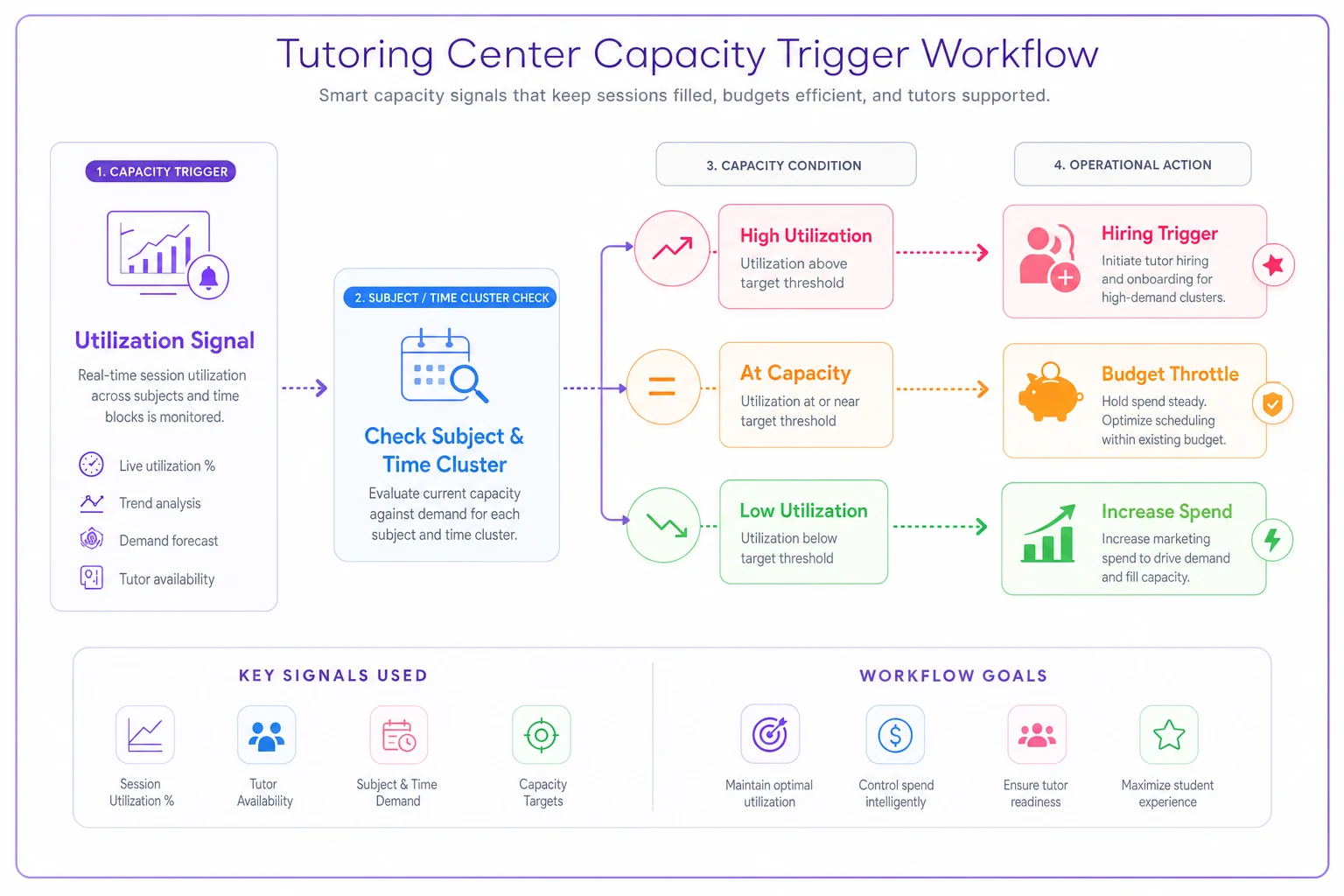
The diagram shows how utilization signals map to hiring, throttles, or spend increases.
The two most useful triggers:
Hiring trigger. When utilization in a subject/time cluster crosses a threshold and your channel map projects continued demand, you start recruiting. The key is projecting forward. If high school math is running at 85% utilization and your channel map shows March historically drives another wave of math leads, you don't wait until you're at 100% and turning families away. Hiring and ramping a tutor takes weeks, so the trigger has to fire while you still have slack.
Slot/budget throttle. When a subject hits capacity, you reduce spend on channels driving that subject and shift it toward subjects with open grid space. This is the move that stops you from paying for leads you can't serve. A lot of centers never do this because ad spend and schedule management live in two different heads.
A simple trigger table:
| Signal | Threshold | Action |
|---|---|---|
| Subject utilization rising | > 80% for 2 weeks | Start recruiting for that subject |
| Subject at capacity | ≥ 95% | Throttle paid channels driving it; route new leads to waitlist flow |
| Subject utilization low | < 55% | Increase spend / run targeted offer for that subject |
| New tutor onboarded | ramp complete | Reopen channels, raise lead targets |
The non-obvious part: triggers should be tied to clusters, not your center overall. A center at 70% total utilization sounds healthy, but if that's 95% elementary reading and 40% high school science, the average hides two separate problems. Triggers work on the clusters where the actual bottleneck lives.
The 90-day operating cadence
A map and a set of rules are useless if nobody runs them on a rhythm. The cadence is what turns this from a document into an operating system.
Monthly — forecast and budget review.
-
Update the channel map with last month's real conversion and cost numbers.
-
Re-forecast leads by channel for the next 90 days using seasonal patterns.
-
Set the next month's budget by target enrollments per cluster, not total lead volume.
This forecasting step connects directly to your finances. If you haven't built the financial side of this, a tutoring center cashflow forecast with P&L scenarios and hire/marketing triggers is the natural companion — the channel model feeds enrollment projections, and the cashflow model tells you what you can actually afford to spend to get there.
Every two weeks — capacity and SLA check.
-
Pull utilization by cluster; check any triggers that fired.
-
Review SLA adherence by channel (are paid-social leads actually getting the 30-minute response?).
-
Reconcile scoring
did hot leads convert at the rate the model predicted?
Weekly — operational run.
-
Front desk works leads by score, not arrival order.
-
Open or close specific slots based on the week's bookings.
-
Flag any subject drifting toward a trigger threshold.
The whole thing is a decision table at heart. Demand signals come in, the rules say what to do, actions go out. The staffing decision table in particular is where centers stop over- and under-hiring: this utilization in this cluster, holding this forecast, equals this hiring action. Written down once, applied every two weeks.
A real scenario
A two-location center was spending somewhere between $3k and $4k a month across Google and Facebook and feeling like it wasn't working. Leads came in fine, but enrollments felt stuck and the owner kept hearing "we had someone interested but the schedule was full."
When they actually mapped it out, the problem was obvious in hindsight. Nearly 60% of ad spend was pushing a reading and English message, but their reading slots were already running near capacity. Meanwhile their math and science grid had roughly 35–40% open capacity with almost no demand pointed at it.
They did three things: rebalanced spend toward the open clusters, added per-channel SLAs (paid-social leads went from "answered within a day or so" to under 30 minutes), and set a hiring trigger on reading so they stopped silently losing those families to competitors. Over about a quarter, enrollments climbed noticeably without increasing total ad spend. They were just spending against capacity they could actually fill. The "schedule's full, sorry" conversations dropped off.
Nothing exotic — they just stopped letting marketing and capacity operate blind to each other.
When this makes sense — and when it doesn't
Worth building if:
-
You run more than one acquisition channel and can't say which one produces enrollments that actually stick.
-
You've had months where demand and capacity were badly mismatched in either direction.
-
You're planning to add tutors or a location and want hiring driven by signals, not panic.
Probably overkill if:
-
You're a solo tutor fully booked by word of mouth. You don't need a channel map to tell you to stop advertising.
-
Your demand is entirely referral-based and steady. Build a light version — just the capacity triggers — and skip the rest for now.
Who should not start here:
If your underlying data is a mess — leads untagged, utilization unknown, conversion a guess — fix that first. A channel-to-capacity model runs on numbers. Feed it garbage and it'll confidently point you in the wrong direction. Start by getting clean source-tagging on every lead and honest utilization by cluster. A month of decent data beats a year of assumptions.
Where software quietly helps
You can run a basic version of this in spreadsheets, and plenty of centers do for a while. It starts breaking down when the layers need to talk to each other in real time — when a lead's score should depend on current utilization, when a trigger should fire the moment a cluster crosses a threshold, when SLA timers need to start ticking the second a lead arrives.
That's the point where an operational platform with built-in automation earns its place. Having leads auto-tagged by channel, scored against live capacity, routed by SLA, and tied to utilization triggers means the cadence runs itself between your review meetings instead of depending on someone remembering to check a spreadsheet. The value isn't the automation for its own sake — it's that the three layers stay synchronized without a human manually holding them together.
The real shift
The centers that grow predictably aren't the ones spending the most or hiring the fastest. They're the ones where a marketing decision and a staffing decision are essentially the same decision, made against the same picture of demand and capacity.
Get the channel map honest, score leads against real capacity, let triggers handle the hiring and budget moves, and run it on a steady 90-day loop. The quarterly whiplash — the panic spend, the empty Tuesdays, the full schedules you can't actually serve — stops being your normal. Growth becomes something you can see coming, which is the whole point.
Once the enrollment engine is steady, the next lever is keeping those families longer. Tightening the loop between delivery and renewal is where parent progress reports that reduce churn do a lot of the work. But that's only worth focusing on once the front of the funnel and your capacity are actually talking to each other.
Ready to streamline your tutoring operations?
Join 500+ tutors and centers using Tutoryly to save time, improve scheduling accuracy, and enhance student experiences.