



Most tutoring centers never run a real experiment. They change something — a new warm-up routine, a spaced-repetition homework schedule, a different first-session structure — and then they feel like it worked. Enrollment held steady, a couple of parents said nice things, so the change gets locked in. Six months later nobody can say whether it did anything at all, or whether it quietly cost them retention.
The excuse is almost always the same: "We're too small to run experiments. That's for big companies with thousands of users." That belief is wrong, and it's expensive. You don't need thousands of students to learn something real. You need a clean design, a metric that matters, and enough discipline not to contaminate your own test. Small centers can absolutely measure tutoring impact — they just have to accept that they'll be detecting bigger effects, not tiny ones, and they have to structure the test so the signal isn't drowned out by noise.
This is a walkthrough of how the whole measurement system fits together: what to test, how to assign students without a data science team, how big your sample actually needs to be, and — the part everyone skips — how to translate a pedagogy result into retention and lifetime value so you can decide whether it's worth keeping.
Why gut-feel evaluation quietly breaks
The core problem isn't that owners are lazy. It's that tutoring outcomes are genuinely confounded. A student improves and you have no idea if it was your new method, the fact that they were also getting help at school, the parent finally enforcing homework time, or just natural maturation over a semester. When you evaluate by vibes, three things tend to happen:
-
You attribute improvement to whatever you changed most recently. Recency bias. The new method gets credit that belonged to a motivated cohort of families who happened to enroll that spring.
-
You keep changes that feel good to tutors but don't move outcomes. Tutors love new materials. "Feels smoother" is not the same as "students retain more."
-
You kill things too early. A method that needed four weeks to show up in assessments gets scrapped after two because one loud parent complained.
At small scale this is survivable for a while, because you know every family personally. But the moment you add a second location or a second shift of tutors, that personal knowledge disappears. You can't eyeball 90 students the way you eyeballed 30. The lack of a real measurement habit becomes a coordination failure — nobody agrees on what's working, so every tutor drifts toward their own favorite approach and your "curriculum" becomes fiction.
Pick a change worth measuring
Before any design talk, be honest about what's actually testable. A lot of pedagogy changes are too diffuse to measure with a small sample. "We're going to be more encouraging" is not a test. "We're adding a 5-minute retrieval quiz at the start of every session, using last session's material" is a test, because it's a discrete, repeatable intervention with a plausible mechanism.
Never miss another tutoring session.
Tutoryly helps you schedule, confirm, and manage every tutoring session efficiently.
- Unified session scheduling
- Automated student notifications
- Tutor calendar & availability management
No credit card required
Good candidates for a minimal-data experiment share three traits:
-
Discrete — you can point to exactly what's different.
-
Consistently deliverable — every tutor can do it the same way, or your "treatment" isn't really one thing.
-
Tied to something you already track — assessment scores, homework completion, session attendance, renewal.
That last point matters more than people think. If you're not already capturing outcomes cleanly, your experiment inherits garbage data. Centers that have already connected sessions to measurable outcomes — the kind of setup described in a tutoring progress-tracking system that ties sessions to outcomes — have a real head start, because the measurement pipe already exists. You're just splitting students into groups and reading a number you were already collecting.
Two designs that work at small scale
You have two realistic options. Pick based on how your center actually operates, not on which sounds more scientific.
A/B (parallel) design
Split incoming or existing students into two groups. Group A gets the new method, Group B keeps the current one. Compare outcomes over a fixed window. Cleaner in theory, harder logistically — you're running two different practices at once and tutors have to keep them straight.
Quasi-random / staggered rollout
Instead of splitting simultaneously, you roll the change out in phases. Cohort 1 gets the new method in September, Cohort 2 stays on the old method and switches in November. You compare the September–November window across the two groups, then everyone converges. This is often more practical for tiny centers because you're not asking a single tutor to teach two ways in the same afternoon. It also tends to feel fairer to families — everyone eventually gets the "new thing."
| Factor | A/B (parallel) | Staggered rollout |
|---|---|---|
| Cleanliness of comparison | Higher | Slightly lower (time effects sneak in) |
| Logistical load on tutors | Higher | Lower |
| Works with <30 students | Tight but possible | Better |
| Risk of contamination | Higher (groups interact) | Lower |
| How fast you get an answer | Faster | Slower |
| Fairness optics with parents | Harder to explain | Easier |
One assignment trap most centers fall into: letting tutors or the schedule decide who goes in which group. If your best tutor "happens" to take the treatment group, or motivated families self-select into the new method, your result is worthless. Assign by something arbitrary and unrelated to ability — last digit of enrollment ID, alternate intake order, a coin flip logged in a sheet. It doesn't have to be perfectly random. It has to be unrelated to who the student is.
The sample-size question, answered honestly
With 20–40 students, you can only reliably detect large effects. And that's fine — you're not publishing a paper, you're deciding whether to keep a change.
-
To detect a large effect (roughly a 0.8 standard-deviation difference), you need about 20–26 students per group.
-
To detect a medium effect (~0.5 SD), you need closer to 60+ per group — usually out of reach for a single small center.
-
To detect a small effect, forget it. You'd need hundreds. Small effects are invisible at your scale, so don't design around them.
What this means in practice: design your intervention to be strong. A tiny tweak to homework phrasing won't produce a large effect and you'll never see it in your data. A structural change — a completely different session format, a real spaced-repetition system, mandatory retrieval practice — has a shot at producing an effect big enough that even 25 students per group can reveal it.
If you genuinely can't hit around 20 per group, you have two moves. First, run the test longer and use multiple measurement points per student — a pre/post plus mid-point gives you more information per head. Second, pool across locations or terms: run the same protocol in two centers and combine, or run it two terms in a row.
Don't fake power you don't have. A test with 8 students per group that shows "improvement" is telling you almost nothing, and acting on it confidently is worse than not testing at all.
A worked example: retrieval quizzes vs. standard review
A center running roughly 50 active middle-school math students wants to know if starting each session with a short retrieval quiz beats their standard "let's review last week" chat.
-
Setup
-
- 48 students, assigned by alternating intake order → 24 treatment, 24 control.
-
- Metric
change in unit assessment scores over 8 weeks (they already run standardized unit checks, so no new tooling needed).
-
- Guardrail metric
attendance and renewal, so they can catch if the quizzes annoy kids into dropping.
Result after 8 weeks:
-
Control group average improvement
about +9 points.
-
Treatment group average improvement
about +15 points.
The spread within each group was wide — some kids barely moved — but the gap between group averages held up as a genuinely large effect given the variation they saw. Six points on a unit test sounds modest. The question that actually matters for the business: what is that worth?
Translating effect size into retention and LTV
This is the step that turns a pedagogy result into a decision. A score bump only matters to your center if it changes behavior — specifically, whether families stay.
You need one link from your own data: how does outcome improvement relate to renewal? Most centers can estimate this even roughly. Say you look back at last year and find that students who showed strong assessment gains renewed at around 80%, while students with flat or weak gains renewed closer to 60%.
-
The retrieval-quiz group is more likely to land in the "strong gains" bucket.
-
Strong-gains students renew roughly 20 percentage points higher.
-
Each retained family is worth their remaining lifetime value.
A rough LTV calculation:
-
Average monthly revenue per student
~$320.
-
Average additional tenure from a renewal
~6 months.
-
So one retained family ≈ $1,900 in additional LTV.
If the new method shifts even 4 extra students per 24 from the low-renewal bucket to the high-renewal bucket, that's somewhere around $7,000–$8,000 in retained value from that one cohort — against a near-zero cost, since the intervention is just a change in session structure.
That's the whole point of measuring tutoring impact properly. "Scores went up 6 points" doesn't move an owner. "This change is worth several thousand dollars per cohort in retained revenue and costs nothing to run" ends the debate.
A few honest caveats on this math: the renewal-to-outcome link is correlational, not proof — use it as a directional estimate, not gospel. Don't chain three shaky assumptions and present the final number as precise. Round hard. "Somewhere in the mid-thousands per cohort" is more defensible than a false $7,642. And re-check the renewal link yearly, because it drifts.
A repeatable process you can actually run
Here's the sequence, start to finish, for a single experiment:
-
Write the hypothesis in one sentence. "Starting each session with a retrieval quiz will improve unit-assessment gains vs. standard review."
-
Pick one primary metric and one guardrail metric. Primary = the thing you hope improves. Guardrail = the thing that must NOT get worse (usually attendance or renewal).
-
Decide the design — A/B or staggered — based on tutor load.
-
Assign students by something arbitrary and log the assignment before the test starts. Freeze the groups.
-
Set the window and the sample. Aim for ~20+ per group; if you can't, extend time or pool.
-
Standardize delivery. Give tutors a one-page script so the "treatment" is genuinely the same thing everywhere. Inconsistent delivery is the number one killer of small experiments.
-
Don't peek and pivot. Resist changing the method mid-test because early numbers look good or bad. Let the window finish.
-
Read the result and translate it into retention and LTV using your own renewal-by-outcome link.
-
Decide
adopt, drop, or re-test.
Write down the decision and why.
That last step is worth pausing on. Deciding your decision rule before you see data stops you from rationalizing whatever outcome you were emotionally rooting for.
Here's a quick visual of the workflow if it helps: hypothesis → design → assignment → standardized delivery → measurement window → analysis → translate to retention/LTV → decision.
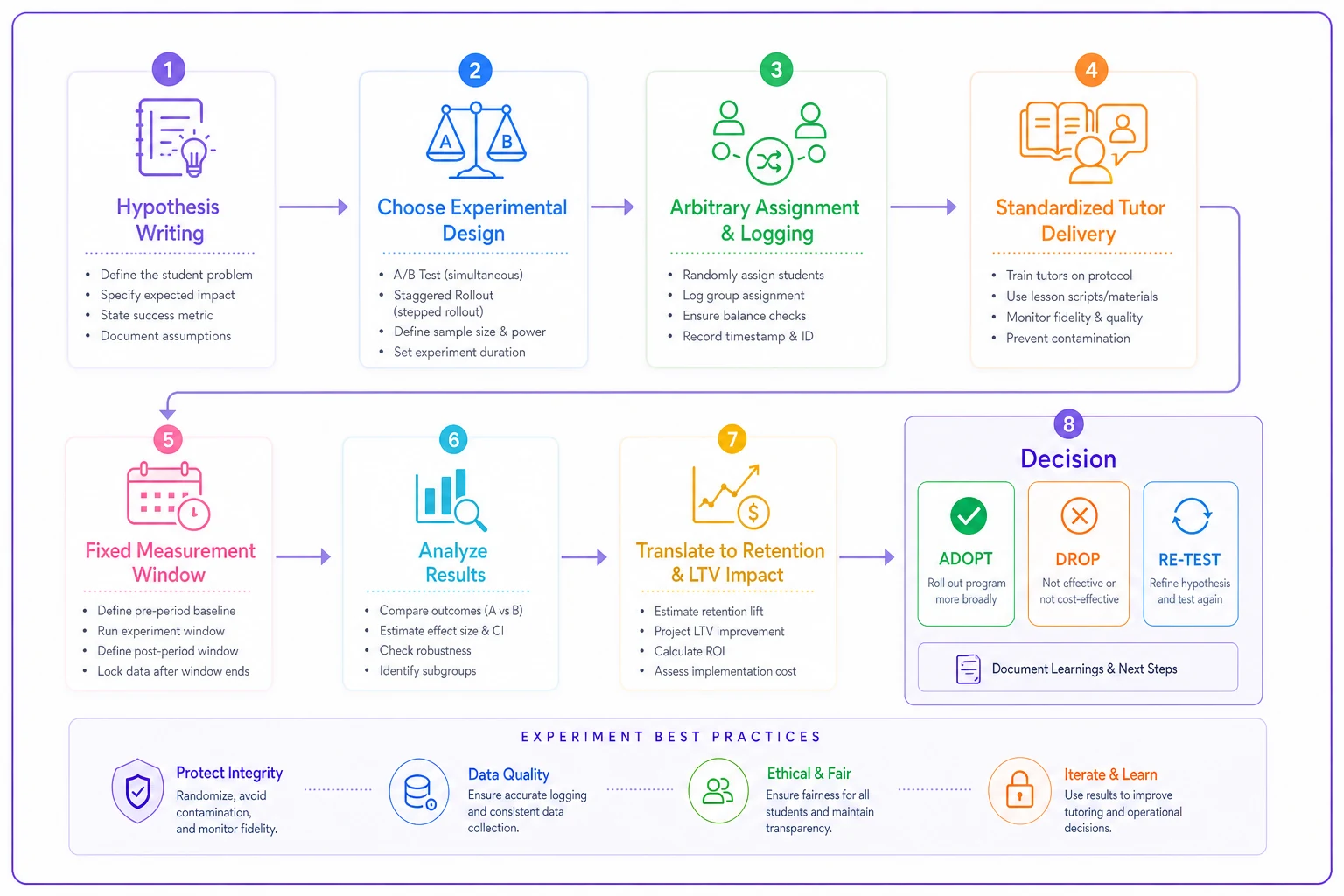
Treat the graphic as a checklist you can pin to the wall before a test.
Give tutors a one-page script for the treatment so delivery variance doesn't drown out any real effect.
Don't let execution slip. Small experiments fail most often because the treatment isn't actually implemented consistently.
A pre-launch checklist
Before you start any experiment, confirm all of these. If you can't check one off, your result will be suspect.
-
The intervention is discrete and one thing, not a bundle of five changes.
-
Assignment is unrelated to student ability or family motivation.
-
Groups are frozen and logged before day one.
-
The primary metric is already being collected cleanly.
-
There's a guardrail metric so a "win" on scores can't secretly cost you retention.
-
Every tutor has the same one-page delivery script.
-
The measurement window is fixed in advance, not "we'll see."
-
You've written down what result would make you adopt vs. drop.
If you can't check one off, your result will be suspect.
When this makes sense — and when it doesn't
When it's worth running an experiment:
-
The change is structural and affects a lot of sessions (high leverage).
-
You have at least ~20 students you can put in each group.
-
The outcome is something you already measure.
-
The decision has real stakes — you'd roll it across the whole center if it works.
When it's a bad idea:
-
The change is cosmetic. Testing tiny tweaks with a small sample wastes a term and teaches you nothing.
-
You can't standardize delivery across tutors. Then you're not testing a method, you're testing tutor personality, and the result won't transfer.
-
You'd adopt the change regardless of the outcome. If your mind is made up, skip the theater and just implement it.
Who should NOT do this yet: brand-new centers with a dozen students and no clean outcome tracking. Your first job isn't experimentation — it's getting a reliable measurement pipeline in place. Build the habit of connecting sessions to outcomes and running a consistent quality-assurance loop with rubrics and coaching cadence first. Experiments sit on top of that foundation. Without it, you're testing changes against data you can't trust.
A real scenario
A two-tutor center running roughly 35 active students wanted to know whether a restructured homework model — short daily spaced practice instead of one big weekly packet — actually helped, or just created more grading.
They ran it staggered: one tutor's caseload switched first, the other switched six weeks later, giving them a comparison window. The metric was homework-linked concept retention on their existing biweekly checks, with attendance as the guardrail.
Over the window, the spaced-practice group's retention checks came in noticeably stronger — the kind of gap that held up even with only around 17 students on each side, because the effect was large. Attendance didn't budge, so no hidden cost. When they mapped it against their renewal history, students in that stronger-retention band had been renewing meaningfully more often the prior year. Their rough estimate landed in the low-to-mid thousands of dollars of retained value across the affected families — enough to justify rolling daily spaced practice into the standard model for everyone, and enough to justify building it into how they turn assessment results into the week's plan, along the lines of turning assessment data into weekly lesson plans with a decision tree and fillable templates.
None of this required more than a shared spreadsheet, a frozen group assignment, and the discipline to not touch the method for eight weeks. That's the part worth remembering.
The bigger system this plugs into
An experiment is only useful if the result actually changes how your center operates. That's where small centers most often fail — they run one clever test, get an answer, and then let it evaporate because there's no mechanism to fold the finding back into daily practice.
The centers that get compounding value treat measurement as a loop, not an event: outcomes are tracked consistently, changes get tested against those outcomes, winning changes get written into the standard delivery script, and the next question gets queued up. Over a couple of years, that habit is the difference between a center whose "method" is really just tradition and one that can point to actual evidence for why it teaches the way it does — and price accordingly, because it can prove impact.
You don't need to be big to do this. You need to accept that you'll only see large effects, design changes strong enough to produce them, protect your groups from contamination, and always finish by asking the only question the business cares about: what is this worth in families who stay?
Ready to streamline your tutoring operations?
Join 500+ tutors and centers using Tutoryly to save time, improve scheduling accuracy, and enhance student experiences.