



Most tutors spend 30-45 minutes every week turning assessment scores into actual lesson plans. Not because they don't understand the content, but because translating a math score of 62% into three specific 50-minute sessions requires dozens of micro-decisions that compound into analysis paralysis.
Track the breakdown and it gets ugly fast: pull the assessment report, identify weak areas, determine skill priorities, find appropriate materials, structure the sessions, estimate pacing, create practice sets, plan review segments. Multiply that across 15-20 students and you're burning 10+ hours weekly on planning alone.
What makes this particularly frustrating is that assessment data usually points to predictable skill gaps. A student scoring 65% on algebraic expressions will almost always need the same foundational sequence: simplifying expressions first, then distributive property, then combining like terms. Yet tutors rebuild this wheel every single week because there's no systematic way to convert scores into session structures.
The assessment-to-lesson bottleneck that kills tutoring operations
Monday morning, tutors receive assessment reports. By Wednesday, they need three fully planned sessions ready. In between, chaos.
Sarah runs a math tutoring center with 8 tutors handling roughly 140 students weekly. Her tutors consistently report spending Sunday nights scrambling to create lesson plans. Not because they're procrastinating—they literally can't start planning until they've manually processed each student's assessment data, cross-referenced it with available materials, and made judgment calls about pacing.
The real killer is what happens when a student switches tutors, which happens around 15% of the time monthly. The new tutor basically starts from scratch. They see that previous sessions covered quadratic equations but have no idea why that skill was prioritized over factoring, or what the three-session progression was supposed to achieve. There's no standardized way to document the assessment-to-lesson logic.
This creates a vicious cycle. Experienced tutors protect their time by keeping planning minimal and storing everything in their heads. New tutors overcompensate by creating elaborate plans that don't scale. Neither approach builds organizational knowledge that improves over time.
Building your operational decision tree: assessment ranges to skill targets
The solution isn't better assessment tools or fancier templates. It's a decision tree that removes excess thinking from the equation.
Never miss another tutoring session.
Tutoryly helps you schedule, confirm, and manage every tutoring session efficiently.
- Unified session scheduling
- Automated student notifications
- Tutor calendar & availability management
No credit card required
Math Example Decision Tree:
Assessment Score 40-55%:
-
Primary deficit
Number sense and basic operations
-
3-session sequence
(1) Place value and estimation, (2) Multi-digit operations with checking, (3) Word problems with operation selection
Assessment Score 56-70%:
-
Primary deficit
Pre-algebra foundations
-
3-session sequence
(1) Order of operations and expressions, (2) Single-variable equations, (3) Translating word problems to equations
Assessment Score 71-85%:
-
Primary deficit
Algebraic reasoning
-
3-session sequence
(1) Multi-step equations and inequalities, (2) Systems of equations introduction, (3) Function basics and graphing
Here's a quick workflow visualization.
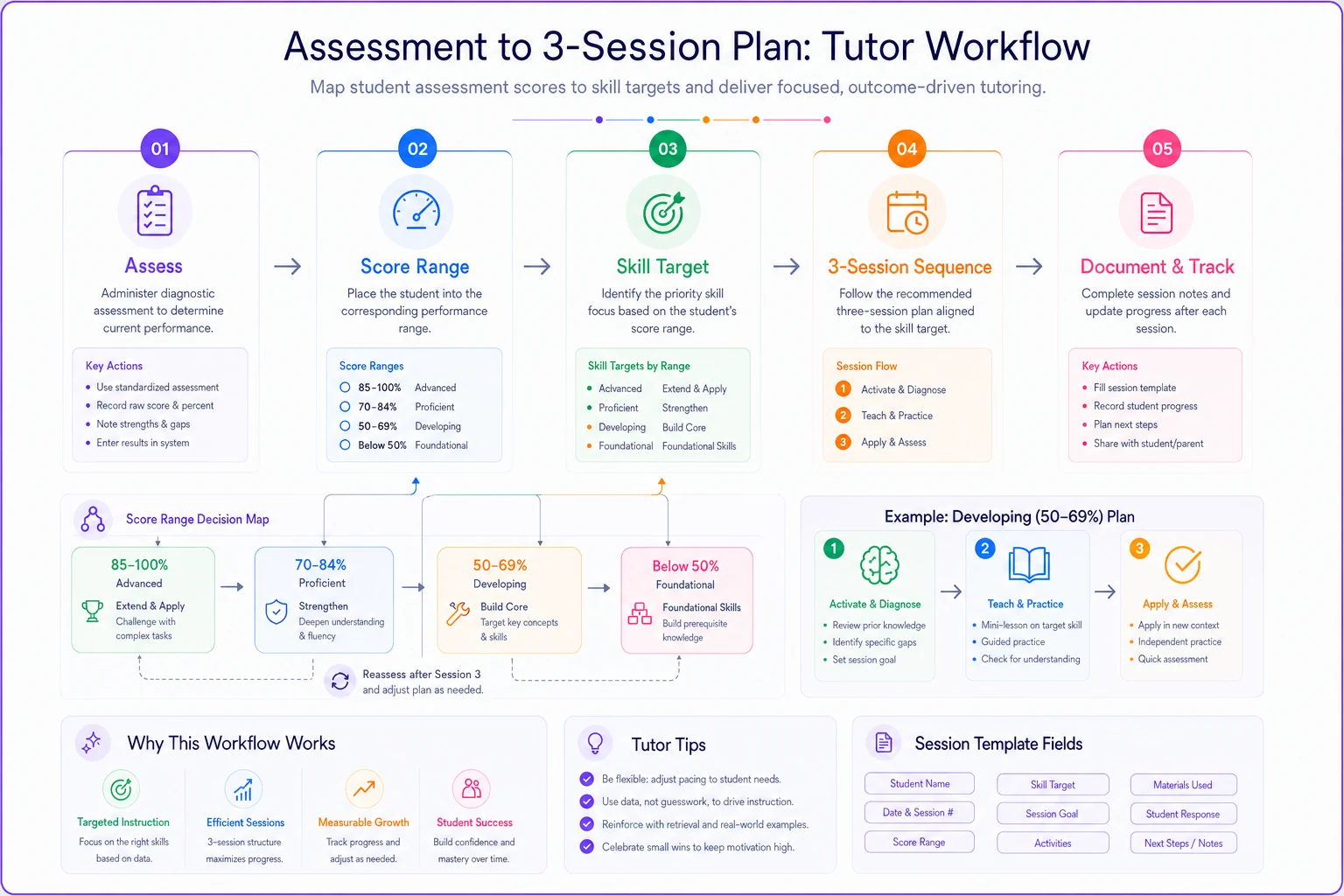
The real value comes when you make these pathways specific to your actual student population. Track which skill sequences move scores over 8-12 weeks, then encode those patterns into your tree.
The 3-session microcycle structure that actually works
Most tutoring centers think in single sessions or full semesters. The operational sweet spot is three sessions—long enough to build momentum, short enough to adjust based on results.
Session 1: Diagnostic teaching
-
10 minutes
Targeted skill assessment (not another test, just 3-5 problems)
-
25 minutes
Direct instruction on core concept
-
10 minutes
Guided practice with immediate correction
-
5 minutes
Independent problem and homework assignment
Keep the Session 1 diagnostic to 3-5 targeted items so you can immediately align instruction without extra testing.
Session 2: Productive struggle
-
5 minutes
Homework review and error patterns
-
15 minutes
Slightly harder variation of Session 1 skill
-
25 minutes
Mixed practice combining new and review
-
5 minutes
Student explains concept back (teaching test)
Session 3: Transfer and assessment
-
10 minutes
Application to word problems or multi-step scenarios
-
20 minutes
Independent work with tutor observation
-
15 minutes
Next-level skill preview
-
5 minutes
Microcycle assessment and next cycle planning
This structure works because it follows cognitive load principles without requiring tutors to be learning scientists. Session 1 introduces, Session 2 consolidates, Session 3 extends. Rinse and repeat.
Fillable templates that eliminate planning paralysis
Templates only work when they enforce good decisions rather than creating more decisions. Here's what actually speeds up planning:
Assessment Processing Template:
Student: Date: _ Assessment Score: __ Score Range: [ ] 40-55 [ ] 56-70 [ ] 71-85 [ ] 86-100
Automatic Skill Target (from decision tree): _
Session 1 Focus: _
-
Main skill
[Pre-filled from decision tree]
-
Materials needed
[Pre-selected packet/page numbers]
-
Success criteria
Student can complete 3 of 5 problems independently
Session 2 Focus: _
-
Build on
[Auto-populated from Session 1]
-
Mix with
[Previous unit skill for interleaving]
-
Success criteria
Student can explain why method works
Session 3 Focus: _
-
Application context
[Word problems/real scenarios]
-
Assessment items
[3 problems from bank]
-
Next cycle recommendation
[ ] Repeat [ ] Advance [ ] Lateral move
Weekly Planning Dashboard:
| Student | Assessment Score | Skill Target | Session 1 Date | Session 2 Date | Session 3 Date | Materials Packet |
|---|---|---|---|---|---|---|
| [Name] | [Auto-pull] | [Auto-assign] | [Schedule] | [Schedule] | [Schedule] | [Auto-link] |
The key is pre-filling as much as possible based on the assessment score. Tutors should only be making decisions when the standard path won't work—not rebuilding the entire decision chain every single time.
Converting paper systems to operational software
The templates above work fine in Google Sheets for 5-10 students. Beyond that, the manual copying and lookup time starts eating into the efficiency gains.
This is where AI-assisted operational software becomes genuinely useful—not for fancy algorithms, but for automatically populating templates based on assessment scores. When a student's assessment comes in at 68%, the system immediately suggests the 56-70% skill sequence, schedules three sessions, and links to the appropriate material sets. No digging through folders, no rebuilding logic from scratch.
More importantly, it tracks which three-session sequences actually improve scores. If students starting at 65% who follow the standard sequence average 8-point gains, while those on a modified sequence average 12-point gains, that pattern gets flagged for review. Over time, your decision tree gets smarter based on actual outcomes rather than assumptions.
The coordination benefit compounds when multiple tutors work with the same student. Tutor A completes Session 1 on Monday, Tutor B picks up Session 2 on Wednesday—they're working from the same playbook with clear handoff notes generated automatically from the template structure. No text messages, no "what did you cover last time?"
Adjustments for different subjects and grade levels
The three-session microcycle structure stays constant. The decision tree logic is what changes, based on how skills actually build in a given subject.
Reading Comprehension Decision Tree:
Assessment Score 40-55%:
-
Focus
Literal comprehension and vocabulary
-
Sequence
(1) Main idea identification, (2) Context clues for vocabulary, (3) Sequencing and summarization
Assessment Score 56-70%:
-
Focus
Inferential reasoning
-
Sequence
(1) Making predictions and inferences, (2) Author's purpose and perspective, (3) Comparing texts
Science Decision Tree:
Assessment Score 40-55%:
-
Focus
Scientific method and basic concepts
-
Sequence
(1) Variables and hypothesis formation, (2) Data collection and charts, (3) Drawing conclusions
Assessment Score 56-70%:
-
Focus
Application and analysis
-
Sequence
(1) Experimental design, (2) Data interpretation and error analysis, (3) Connecting concepts across units
The subject-specific trees should reflect how skills actually build in that domain. Math is hierarchical—multiplication before algebra. Reading is more spiral—inference revisited at increasing complexity levels. Build your trees accordingly.
Tracking microcycle effectiveness
A decision tree only stays useful if it reflects what actually works. Track three metrics for every microcycle:
-
Skill score change (pre-test in Session 1 vs. assessment in Session 3)
-
Completion rate (did the student attend all three sessions?)
-
Tutor time spent planning (should drop from 45 minutes to somewhere around 8-12 minutes)
After 50-100 microcycles, patterns start emerging. Maybe students in the 56-70% range consistently need four sessions for equation-solving instead of three. Maybe Session 2 works better with 30 minutes of practice instead of 25. These aren't failures—they're refinements that make your decision tree more accurate.
Some tutoring centers track the wrong metrics entirely. They measure semester-over-semester grade improvements or standardized test scores, which matter for marketing but don't help you optimize weekly operations. Microcycle metrics give you fast feedback loops that actually improve what happens in the room.
Handling edge cases without destroying the system
About 20% of students won't fit neatly into your decision tree. Learning differences, motivation issues, unusual skill gaps—these require adjustment. The mistake is abandoning the system entirely for these cases.
Instead, document the deviation and the reasoning. When a student scored 72% but has processing speed issues, you use the 56-70% sequence with extended time. When a student scored 58% but only struggles with word problems, you skip to Session 2 of the 56-70% sequence. When a student scored 83% but lacks confidence, you add confidence-building activities to the 71-85% sequence.
These adjustments become new branches over time. What starts as an edge case for one student often applies to several others once you identify the pattern.
The operational impact: time, consistency, and scalability
The impact hits in three waves.
First, planning time drops significantly. Tutors spending 30-45 minutes per student now spend closer to 8-12 minutes, mostly on material prep rather than decision-making.
Second, consistency across tutors improves. New tutors can deliver effective sessions immediately by following the decision tree, while experienced tutors spend less energy on planning and more on actual instruction.
Third, the business becomes scalable in a way it wasn't before. Adding new tutors no longer means accepting a quality dip while they figure things out. Adding new students doesn't create linear increases in planning time.
One tutoring center implemented this system across 12 tutors and roughly 180 students. Planning time per student dropped from an average of 38 minutes to 11 minutes weekly. Parent complaints about inconsistency between tutors dropped by around 60% in the first two months.
Making the system stick: implementation rules
Most operational systems fail because they require too much behavior change too quickly. The implementation sequence that actually works looks something like this:
-
Week 1-2 Create decision trees for your two most common assessment score ranges. Test with 5-10 students only.
-
Week 3-4 Refine based on feedback and extend to all score ranges for one subject.
-
Week 5-6 Roll out templates to all tutors, paper-based for now.
-
Week 7-8 Add a second subject and begin tracking microcycle metrics.
-
Week 9-12 Evaluate data and refine decision trees based on actual outcomes.
The gradual rollout prevents resistance and allows refinement before full implementation. Tutors need to see it saving them time before they'll fully commit to it.
Beyond individual planning: center-wide optimization
Once individual tutors operate efficiently, the next leverage point is center-wide resource allocation. The decision tree data reveals patterns—which skill sequences get requested most often, which materials get used repeatedly, which sessions could be grouped for efficiency.
If 15 students all need the Session 1 introduction to algebraic expressions, why not run a small group session? If the 56-70% math sequence runs 40 times monthly, why not pre-print material packets?
The decision tree becomes more than a planning tool—it becomes operational intelligence that drives purchasing, scheduling, and staffing decisions. You stop reacting to individual student needs and start anticipating patterns.
That's what separates tutoring businesses that scale from those that stay stuck in the owner-operator model. When planning becomes predictable and efficient, tutors can focus on actual teaching and relationship building—the stuff that drives retention and referrals.
The assessment-to-lesson-plan problem isn't really about education theory or pedagogy. It's an operational workflow problem that needs an operational solution. The decision tree and template system outlined here isn't perfect, but it's infinitely better than the ad-hoc planning that burns out tutors and creates inconsistent student experiences.
Start with one subject, one grade level, and five students. Build your tree based on what actually works, not what should work in theory. Within 12 weeks, you'll have a planning system that handles 80% of cases automatically, giving tutors their Sunday nights back while actually improving session quality. The more systematic you make the routine stuff, the more energy you have for the genuinely complex cases that need real human judgment.
Ready to streamline your tutoring operations?
Join 500+ tutors and centers using Tutoryly to save time, improve scheduling accuracy, and enhance student experiences.