



Most tutoring centers don't fail because the owner picked bad KPIs. They fail because nobody looks at the numbers on a predictable schedule, and when someone does, there's no clear decision that comes out of it. The dashboard exists. It just sits there. Utilization slips from the high 70s down into the 60s over a few weeks and nobody catches it until payroll feels tight — because the "review" was a Slack message that said "numbers look ok?" and got a thumbs-up.
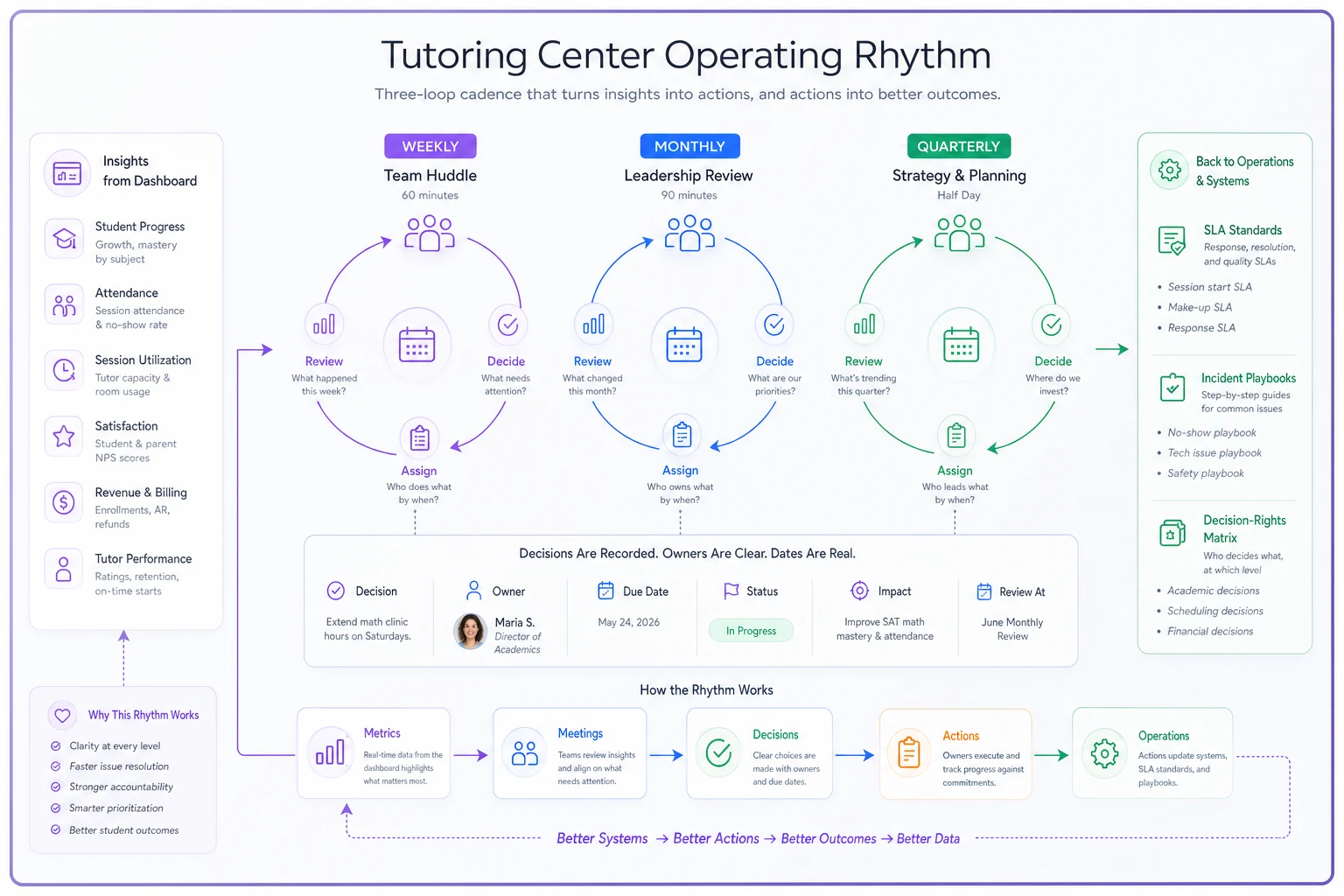
A leadership operating cadence fixes that gap. It's the machinery that turns your KPIs into meetings, your meetings into decisions, and your decisions into someone's actual to-do list with a name and a date attached. Get it right and the same three or four numbers you already track start driving the business instead of describing it after the fact.
This is a systems piece, not a list of meeting tips. The point is how the weekly, monthly, and quarterly rhythms connect — and where each layer breaks when the center grows past one location or one manager who "just knows everything."
Why cadence breaks down (and it's rarely the KPIs)
There's a pattern you see over and over. A center owner reads that utilization, trial conversion, and QA are the big three. They build a dashboard. For about six weeks, the dashboard is the star of every conversation. Then a busy September hits, a lead tutor quits, and the review meetings quietly stop happening. Six months later the numbers are worse and nobody can point to when it went sideways.
-
No fixed rhythm. Reviews happen "when there's time," which means they happen when there's a problem — always too late.
-
No decision rights. People look at a bad number and don't know whether they're allowed to fix it, so they escalate everything or nothing.
-
No owner per metric. Utilization is "everyone's job," which means it's nobody's.
The cadence is what forces the discipline. Different problems live at different altitudes, and each altitude needs its own meeting. Trying to solve a staffing-model problem in a Monday standup is how you get 90-minute standups that resolve nothing. Trying to catch a same-day scheduling gap in a quarterly review is how you bleed revenue for eleven weeks before anyone reacts.
The three altitudes: what each meeting is actually for
Think of it as three loops running at different speeds, each catching a different class of problem.
Never miss another tutoring session.
Tutoryly helps you schedule, confirm, and manage every tutoring session efficiently.
- Unified session scheduling
- Automated student notifications
- Tutor calendar & availability management
No credit card required
| Cadence | Time horizon | Core question | Primary KPIs | Owner |
|---|---|---|---|---|
| Weekly (30 min) | Next 7 days | "What's on fire or about to be?" | Utilization, no-shows, trial sessions booked, open incidents | Center manager |
| Monthly (60–75 min) | Last 30 / next 30 | "Are our conversion and quality trends healthy?" | Trial conversion %, QA rubric scores, churn, tutor capacity | Center manager + owner |
| Quarterly (half day) | 90 days + | "Is the model working and where do we invest?" | LTV, margin, retention cohorts, staffing plan, pricing | Owner |
The mistake is collapsing these. A single-location center with four tutors can sometimes fold monthly into a longer weekly — that's fine early on. But the second you add a location or a second manager, you need all three separated, because coordination problems appear that a solo operator never sees. Two managers running two different weekly rhythms with two different definitions of "trial conversion" will produce numbers you can't compare, and then your quarterly is just an argument about whose spreadsheet is right.
If your intake, scheduling, delivery, and billing aren't already mapped into one repeatable flow, the cadence will surface that fast — because half the meeting will be spent reconciling data instead of making decisions. Fixing the underlying tutoring operations workflow is a prerequisite, not an afterthought.
The weekly meeting: catch the leaks
The weekly is a leak-detection meeting. Thirty minutes, same day and time, camera on if remote, and it does not become a status update. Status goes in a doc beforehand. The meeting is only for exceptions and decisions.
Weekly agenda (30 min):
-
Utilization snapshot (5 min). Booked hours vs. available tutor hours for the coming week. Anything below your floor — say 75% — gets flagged with a name attached to fixing it.
-
No-shows and same-day gaps (5 min). Who's exposed, what got rebooked, what didn't.
-
Trials this week (5 min). How many booked, how many happened, how many converted. Each unconverted trial from last week gets a one-line reason.
-
Open incidents (10 min). Anything from the escalation playbook that's still live — a parent complaint, a tutor mismatch, a billing dispute.
-
Decisions and owners (5 min). Everything that came up gets a name and a date, or it doesn't count as decided.
The insight most owners miss: the weekly's job is to protect the coming week, not autopsy the last one. If you spend 25 minutes explaining why last week's utilization was low, you've already lost this week too. Look back only long enough to fix forward.
A common failure is the "everything's fine" weekly. If nothing ever gets flagged, your floors are set too low or people are hiding problems. Healthy weeklies surface two or three real issues every single time.
The monthly meeting: read the trends
Weekly catches leaks. Monthly catches drift — the slow slide you can't feel week to week. Trial conversion dropping from 62% to 55% over eight weeks is invisible in any single weekly. Across a month, it's obvious.
Monthly agenda (60–75 min):
-
Conversion review. Trial-to-paid by tutor and by lead source. Which tutors convert trials and which don't. This one number quietly reveals more about your center than almost anything else.
-
QA scores. Rubric averages, session observations completed vs. planned, coaching follow-ups from last month — did they actually happen?
-
Churn and retention. Who cancelled, stated reasons, and whether the pattern points at scheduling, tutor fit, or results.
-
Capacity look-ahead. Are you heading toward a wall where demand outruns tutor hours? This ties directly to your hiring triggers.
-
Carry-forward. Every decision from last month — closed, or explain why not.
One pattern worth naming: centers obsessively track conversion but never break it down by tutor. When you do, you almost always find one or two people converting 15–20 points above everyone else. That's not luck. That's a repeatable behavior you can teach — and it's invisible until the monthly forces the breakdown.
Capacity is the metric that quietly connects the monthly to the quarterly. When your look-ahead shows utilization consistently pushing past 85% with a waitlist forming, that's your signal to trigger a hire — and the mechanics of when and who belong in a proper staffing and capacity-trigger framework rather than a gut call in the meeting.
Role-level SLAs: the connective tissue
Meetings decide things. SLAs make sure the things happen between meetings. Without them, every decision waits until the next meeting to check if it got done, which turns your cadence into a nagging loop.
-
New lead → first contact within 4 business hours (owner: front desk / intake)
-
Trial booked → tutor assigned + prep sent within 24 hours (owner: center manager)
-
Session observation → coaching feedback delivered within 3 days (owner: lead tutor)
-
Parent complaint logged → first response same day (owner: center manager)
-
Failed payment → first outreach within 1 business day (owner: billing)
-
Tutor cancels → substitute confirmed within 2 hours for next-day sessions (owner: scheduler)
Track SLA compliance as a simple weekly line item so repeated breaches surface as process or capacity problems rather than discipline issues.
The failure mode at scale is SLA drift — everyone technically knows the standard but nobody measures compliance. Add one line to your weekly: "Any SLA breaches this week?" If the same SLA breaks three weeks running, it's not a discipline problem, it's a capacity or process problem, and it graduates to the monthly.
Decision rights: who's allowed to do what
This is the part almost every center skips, and it's the reason meetings get clogged. When people don't know what they can decide alone, they bring everything to you. A simple decision-rights matrix — even a rough RACI — clears the fog.
| Decision | Front desk | Tutor | Lead tutor | Center manager | Owner |
|---|---|---|---|---|---|
| Reschedule a session | R | C | — | A | — |
| Waive a late-cancel fee (≤1x) | R | — | C | A | I |
| Approve a package discount | — | — | — | R | A |
| Reassign student to new tutor | I | C | R | A | I |
| Fire / formally discipline a tutor | — | — | C | R | A |
| Change pricing | — | — | — | C | A/R |
| Approve a refund > $200 | — | — | — | R | A |
R = Responsible, A = Accountable, C = Consulted, I = Informed.
Most centers give too little authority at the front line and too much at the top. If your center manager can't waive a single late fee without asking you, you've made yourself the bottleneck for the most common friction point in the business. Push routine, low-dollar decisions down. Reserve the top for money and people.
One caveat on the money row — anything touching student records, refunds, or family data needs to line up with your privacy and record-keeping standards, so the person "responsible" isn't quietly creating an audit exposure through sloppy data handling. Decision rights and data governance have to agree with each other.
Escalation playbooks: run-sheets for the predictable disasters
The incidents that hurt tutoring centers are mostly the same five or six, over and over. Write the run-sheet once and stop improvising at 6pm when a parent is upset. Each playbook needs: trigger, first responder, SLA, steps, and who gets informed.
Example run-sheet — Tutor no-shows for a session:
-
Trigger Tutor is 10 minutes late with no message.
-
First responder Front desk / scheduler.
-
Immediate (0–15 min) Call tutor. Simultaneously text on-call substitute. Keep student/parent updated — don't let them sit in silence.
-
If no cover (15–30 min) Offer make-up credit + reschedule; manager approves any goodwill credit per decision matrix.
-
Same day Log incident, note billing adjustment, flag tutor for follow-up.
-
Inform Center manager same day; owner only if it's a repeat or a key family.
The incidents worth writing run-sheets for:
-
Tutor no-show or same-day cancellation
-
Parent complaint about a tutor or results
-
Student–tutor mismatch surfacing mid-package
-
Failed or disputed payment
-
Safeguarding / behavior concern (this one always escalates to owner immediately)
-
Data or privacy incident
Centers that handle incidents well aren't calmer people — they're better-prepared people. The stress of an incident comes almost entirely from deciding what to do in the moment. Pre-decide it, and a tutor no-show becomes a 90-second procedure instead of a scramble that eats the whole afternoon.
A real scenario: two locations, one cadence fix
A center with two locations — around 40 active students each, six tutors between them — kept missing its numbers without knowing why. Each manager ran things their own way. One reviewed utilization loosely on Fridays; the other didn't track it at all until month-end. Trial conversion sat somewhere in the mid-50s but nobody could say exactly, because the two locations logged trials differently.
They put in the three-loop cadence: a shared 30-minute weekly at each location using the same agenda, a joint monthly for both managers plus the owner, and a quarterly. They added the decision-rights matrix so managers stopped funneling every fee waiver to the owner, and they wrote run-sheets for the four most common incidents.
Nothing dramatic happened in week one. But over roughly two quarters, utilization stabilized in the low 80s at both sites instead of swinging between the 60s and 80s. Trial conversion, now measured the same way, came in around 63% — and more importantly, they could finally see that one location's lead tutor converted far better and actually copy what she did. Owner time in the weeds dropped noticeably, because the matrix meant fewer "hey, can I..." interruptions.
The win wasn't a new metric. It was the same metrics, finally on a rhythm, with names attached to the problems.
When this cadence makes sense — and when it doesn't
When it makes sense: You have more than one person making operational decisions, more than one location, or you've hit the point where you can't personally see every trial and every session. That's when the informal "I just know" system stops scaling and the cadence earns its keep.
When it's overkill: A solo tutor or a two-person operation running 20 sessions a week doesn't need three separated loops and a RACI matrix. You'll spend more time in meetings than tutoring. Run a single weekly review with yourself, track three core numbers, and skip the ceremony until you add people.
Who should NOT do this yet: If your data is a mess — trials logged inconsistently, utilization calculated three different ways, billing living in someone's head — building a cadence on top of that just formalizes the confusion. Fix the underlying operations flow first, get your numbers trustworthy, then layer the meetings on. A clean dashboard with a rough cadence beats a beautiful cadence reviewing garbage data every time.
Where tooling actually helps
None of this requires software to start. A shared doc and a recurring calendar invite will get a small center a long way. But the cadence gets fragile at scale in one specific spot: keeping the dashboard current and the SLAs measured without someone hand-assembling numbers before every meeting.
That's the honest case for operational software with some automation built in — not to run your meetings, but to make sure utilization, conversion, and SLA-breach data are ready when you sit down, and that incident logs and decisions have somewhere to live besides memory. When the prep is automatic, the cadence survives busy seasons and staff turnover. When prep depends on one person manually pulling reports, the cadence dies the first week that person is slammed.
The tool's job is boring and important: keep the inputs trustworthy so the meeting can be about decisions.
Pulling it together
A leadership operating cadence isn't about more meetings — most centers already meet plenty. It's about giving each of your core numbers a home: a rhythm that reviews it, an owner who's accountable for it, a decision-right that says who can act on it, and a run-sheet for when it goes wrong. Weekly protects the coming week. Monthly catches the drift. Quarterly steers the model.
Start smaller than you think. Pick three KPIs, run one disciplined weekly for a month, and only add the monthly and quarterly loops once the weekly is actually producing decisions with names on them. The centers that grow cleanly aren't the ones with the fanciest dashboards — they're the ones where looking at a bad number reliably turns into someone doing something about it by a specific date.
Start smaller than you think. Pick three KPIs, run one disciplined weekly for a month, and only add the monthly and quarterly loops once the weekly is actually producing decisions with names on them. The centers that grow cleanly aren't the ones with the fanciest dashboards — they're the ones where looking at a bad number reliably turns into someone doing something about it by a specific date.
Ready to streamline your tutoring operations?
Join 500+ tutors and centers using Tutoryly to save time, improve scheduling accuracy, and enhance student experiences.