



Most tutoring centers don't fail because of bad tutoring. They fail because the handoffs between stages leak. A parent inquires on Monday, gets assessed on Thursday, waits nine days for a schedule, and by then they've already booked somewhere else. The tutoring was never the problem. The path from "interested" to "invoiced" was.
Every stage of your operation is really just a handoff to the next one. Intake feeds scheduling. Scheduling feeds delivery. Delivery feeds billing. Billing feeds reporting. And reporting should feed back into intake so you actually know what's working. When any of those handoffs is manual, undocumented, or living in someone's head, the chain slows down — and you usually don't notice until a family churns or a payment disappears.
This isn't about fixing one broken piece. It's about seeing the whole machine, understanding where the friction actually lives, and building a single repeatable workflow with clear owners, triggers, and SOPs.
The five-stage spine every tutoring center runs on
Whether you're a solo tutor with 12 students or a center with 30 tutors and 400 families, you're running the same five-stage operation. At small scale you can hold it together with memory and sticky notes. At scale, those same gaps quietly cost you thousands.
| Stage | What it produces | Owner (small) | Owner (scaled) | Most common leak |
|---|---|---|---|---|
| Intake | A qualified, assessed lead with a defined need | Owner | Front-desk / intake coordinator | Response lag, missing info |
| Scheduling | A confirmed recurring slot with the right tutor | Owner | Scheduler / ops lead | Tutor-fit guesswork, double-booking |
| Delivery | A completed session + notes | Tutor | Tutor + lead tutor | Missing notes, no continuity |
| Billing | An accurate, paid invoice | Owner | Billing / admin | Untracked cancellations, failed payments |
| Reporting | Progress + operational visibility | Owner | Ops lead | Data trapped in silos |
The trap most owners fall into: they optimize one stage really well. Beautiful intake form, slick progress reports — and assume the rest will keep up. But a system moves at the speed of its slowest handoff, not its best department.
Stage 1 → 2: Where intake hands off to scheduling
This is the joint that leaks the most revenue, and almost nobody measures it.
Never miss another tutoring session.
Tutoryly helps you schedule, confirm, and manage every tutoring session efficiently.
- Unified session scheduling
- Automated student notifications
- Tutor calendar & availability management
No credit card required
A typical scenario: a parent fills out an inquiry form at 8pm. It lands in an inbox. Someone sees it the next morning, replies to book an assessment, waits for a response, runs the assessment, then separately tries to figure out which tutor and time slot fits. By the time an offer goes out, four to six days have passed. In tutoring, response speed is basically a conversion multiplier — centers that reply within a couple of hours convert noticeably better than the ones that get back to families the next day.
What a clean handoff actually looks like:
Intake should capture everything scheduling needs the first time — grade level, subject, availability windows, learning needs, scheduling constraints. When the assessment ends, the output shouldn't be a PDF sitting in a folder. It should be a structured record that tells the scheduler immediately: this student needs a Tuesday/Thursday algebra tutor, intermediate level, afternoons.
-
If assessment complete and availability captured → route to scheduler with a 24-hour booking SLA
-
If no tutor match exists within availability → route to waitlist workflow, not a dead inbox
-
If parent hasn't responded to an offer within 48 hours → trigger a follow-up
That middle one matters more than most people think. A student with no match shouldn't just vanish — they should enter a tracked queue with a real follow-up owner.
Stage 2 → 3: Scheduling into delivery
Once a student is booked, the next handoff is to the tutor. This is where continuity dies.
It shows up constantly at growing centers: a student has a great first month, their regular tutor gets sick, a sub covers the session with zero context, and the parent quietly starts questioning whether they're paying for consistency. One weak session after a scheduling disruption can undo months of goodwill.
-
What was covered last session (structured, not an essay)
-
What's planned this session
-
Current focus areas / struggles
-
Any parent notes or flags
This is the difference between a center that absorbs a tutor absence without a family noticing, and one where every disruption is a retention risk. Delivery isn't just "the tutoring happens" — it's "the tutoring happens and the record updates so whoever runs the next session starts warm."
Your scheduling system and your notes system need to be the same system, or at minimum talk to each other. If a tutor has to open a calendar, then a separate notes doc, then a separate messaging app just to run one session, they'll skip steps. Every extra place they have to look is a place the process breaks.
Stage 3 → 4: Delivery into billing
A quiet money-loser: sessions get delivered but billing doesn't reflect reality.
Cancellations that should have been charged aren't. Make-up sessions get delivered free because nobody tracked the original credit. A package of 10 sessions gets stretched to 12 because nobody's counting. Across a full roster, these small leaks add up — a center doing a few hundred sessions a month can easily lose the equivalent of several full-paying students a year to untracked delivery-to-billing mismatches.
The fix is making session completion the billing trigger, not a separate manual reconciliation step. When a session is marked complete (or flagged as a late cancel, or a no-show), that status should feed directly into billing logic:
-
Session completed → decrement package / add to invoice
-
Late cancel → apply cancellation policy automatically
-
No-show → flag per policy
-
Package hits low balance → trigger renewal conversation
Tie session completion timestamps directly to billing so reconciliation is automatic.
When these steps are manual, someone forgets. When completion status is the trigger, the math stays honest without anyone babysitting it.
Stage 4 → 5: Billing into reporting (and reporting back into intake)
The last handoff closes the loop, and it's the one small centers skip entirely because they're too busy running the first four stages.
Reporting isn't just parent progress reports. It's operational visibility: which tutors retain students, which subjects are overbooked, where students drop off, how long intake actually takes, what your real utilization looks like. Without it, you're making staffing and marketing decisions on gut feel.
A pattern that comes up at scale: an owner feels like Tuesdays are packed and Fridays are dead, so they hire based on that — and it turns out they were wrong, because the busy days were just the days they happened to be in the building. Real reporting replaces that with the actual shape of demand.
And the loop only closes when reporting feeds back into intake. If your data shows you keep turning away Thursday-afternoon chemistry students, that's not just a reporting insight — that's a hiring instruction. The system should tell you what to sell next.
What breaks as you scale — a rough timeline
The failure points shift depending on where you are.
Solo / under ~20 students: Everything runs on memory and it mostly works. The thing that bites you is billing accuracy — cancellations and package tracking slip because you're the tutor and the admin. Fix billing triggers first.
Small center / ~20–75 students, a few tutors: Intake-to-scheduling lag starts costing conversions, and continuity breaks when tutors cover for each other. This is where the intake→scheduling handoff and notes-on-the-slot need to become real, documented steps — not favors people do when they remember.
Growing center / ~75–200 students: No single person can hold the state of the business anymore. Reporting becomes non-optional, and the manual handoffs that worked at 40 students actively lose money at 150. Utilization and tutor-retention data need to drive hiring decisions.
Multi-tutor / 200+ students: Every ungoverned handoff is now a systemic leak. The centers that survive here have turned all five stages into one connected workflow where completing one stage automatically starts the next.
A real scenario: the reconciliation gap
A center running roughly 330 sessions a month came in convinced their problem was marketing — not growing despite steady inquiries.
The actual problem was three broken handoffs stacked on top of each other. Intake took four to five days to convert to a booked slot, losing maybe a third of qualified leads. Sub-covered sessions had no context, so disrupted students churned faster. And billing was reconciled by hand once a month, so late cancels and stretched packages leaked somewhere in the range of $600–$900 monthly.
None were dramatic on their own. Together they were quietly capping the business.
The changes weren't fancy. Intake started routing assessment results straight to a scheduler with a 24-hour booking SLA. Session notes got attached to the scheduled slot so any tutor could cover. And session completion became the billing trigger, so cancellations applied policy automatically.
Within about a quarter, intake-to-booking dropped from several days to under 24 hours, the billing leak mostly closed, and families stopped churning after tutor disruptions. Same marketing. Same tutors. The growth came from plugging the joints.
Building the single workflow: an implementation checklist
Fix the joints in order of how much they leak. Start here:
-
Map your current handoffs. For each of the five stages, write down exactly how information moves to the next stage and who carries it. Circle every step that depends on memory.
-
Define one owner per stage. Not "whoever's free" — a named role, even if it's you wearing four hats.
-
Set an intake→scheduling SLA. 24 hours from assessment to booking offer. Add a follow-up trigger for non-responders.
-
Attach session context to the slot, not the tutor. Standardize a short notes format any tutor can read in 60 seconds.
-
Make session completion your billing trigger. Completed, late-cancel, and no-show statuses should each drive a billing action automatically.
-
Add a low-balance renewal trigger. Don't wait for a package to hit zero before starting the renewal conversation.
-
Build one operational dashboard. Utilization, intake speed, tutor retention. Review it weekly and let it inform hiring and intake decisions.
Here's roughly how those steps flow in sequence:
Inquiry received → Assessment scheduled → Assessment completed ↓ Structured record created → Tutor matched → Slot offered (within 24hrs) ↓ Session confirmed → Notes attached to slot → Session delivered ↓ Completion status logged → Billing action triggered → Package balance updated ↓ Reporting updated → Operational decisions informed → Intake adjusted
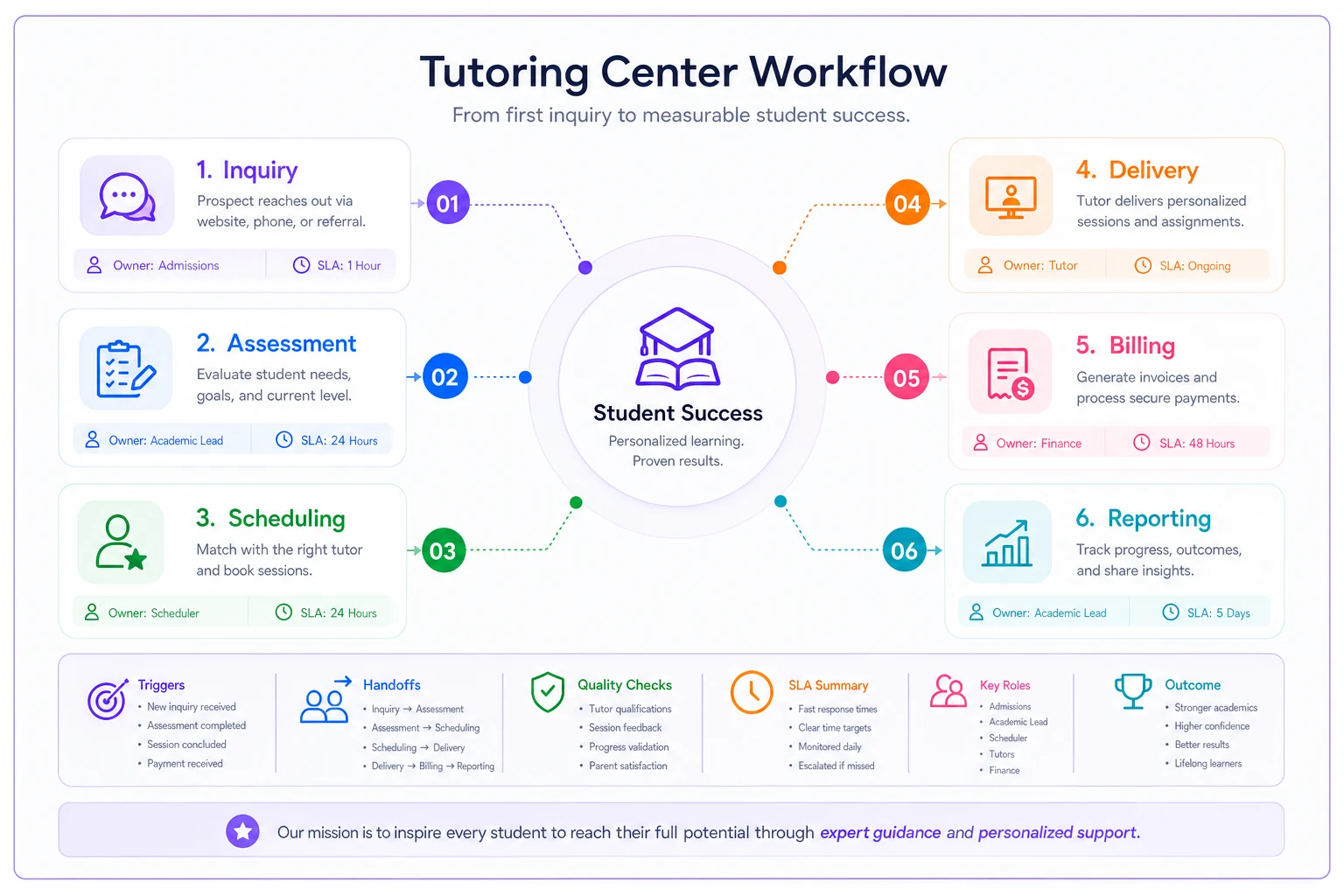
This isn't a technology diagram — it's just the order things need to happen for the handoffs to stop leaking.
Where software fits — and where it doesn't
You can run this whole system on spreadsheets and calendars at small scale. Honestly, you should start there — so you actually understand your own workflow before automating it. Automating a broken process just makes it break faster.
But there's a real ceiling. Once you're past 75–100 students, the manual handoffs between intake, scheduling, delivery, and billing consume more admin time than they're worth, and the memory-based steps start failing under load. That's where an AI-powered operational platform earns its keep — not by replacing your judgment, but by carrying information between stages automatically. Completing a session actually triggers the billing update. A stalled intake actually surfaces instead of dying in an inbox.
When it makes sense: you're past the point where one person can hold the whole operation in their head, and manual reconciliation is eating real hours.
When it's premature: you're a solo tutor with 15 students and no defined process yet. Get the workflow right on paper first. Software can't fix a system you haven't designed.
Stop thinking of intake, scheduling, delivery, billing, and reporting as separate jobs. They're one continuous workflow, and your business runs exactly as well as its weakest handoff. Map the joints, assign an owner to each stage, set triggers where information currently depends on memory, and fix the leakiest handoff first. The centers that grow smoothly aren't the ones with the best tutors — they're the ones where finishing one stage cleanly starts the next, every time, without anyone having to remember to make it happen.
Ready to streamline your tutoring operations?
Join 500+ tutors and centers using Tutoryly to save time, improve scheduling accuracy, and enhance student experiences.