



Growing a tutoring business feels deceptively simple at first. You get more students, you hire more tutors, you make more money. But that's not how it works.
Your business hits invisible walls at specific student counts. Not revenue walls or marketing walls—operational walls that completely change how your business needs to function. Miss these transitions and you end up with a business that's technically growing but operationally falling apart.
The tutoring businesses that scale successfully understand something: growth isn't linear, it's staged. Each stage requires fundamentally different operational structures, and the triggers for moving between stages are surprisingly precise.
Why tutoring businesses break at predictable points
Most tutoring businesses follow a predictable pattern of operational breakdown. It's not about the founder's skills or tutoring quality—it's about hitting capacity points where the existing operational structure simply can't handle the load.
What happens when you go from 3 students to 15? At 3 students, you're tracking everything mentally. Student progress, parent communication, scheduling, payments—it all fits in your head. But at 15 students, that mental tracking system fails. You start forgetting parent emails. You double-book sessions. You lose track of who's paid and who hasn't.
The breakdown accelerates when you add your first tutor. Now you're managing someone else's schedule, their student relationships, their payment structure. The complexity doesn't just double—it compounds. Every new element multiplies against every existing element, creating exponential operational complexity.
So many tutoring businesses get stuck around 20-30 students. They've outgrown the founder-does-everything model but haven't built the systems for the next stage. They're in operational purgatory.
Stage 0-3 students: Foundation mode
At this stage, you're not really running a business—you're freelance tutoring with ambition. But the decisions you make here determine whether you'll successfully scale or get trapped later.
Never miss another tutoring session.
Tutoryly helps you schedule, confirm, and manage every tutoring session efficiently.
- Unified session scheduling
- Automated student notifications
- Tutor calendar & availability management
No credit card required
Your operational focus should be documentation, even when it feels unnecessary. Every parent interaction, every curriculum adjustment, every scheduling preference—document it all. Not because you need it now, but because at 15 students, trying to recreate this information becomes impossible.
The billing structure you choose here matters more than you think. Hourly billing feels natural but creates massive administrative overhead later. Package-based billing (monthly or semester packages) reduces future operational load by roughly 70%. One decision now saves hundreds of hours later.
Start with package-based billing early; it reduces future operational load.
Quality control is simple at this stage—you're doing everything yourself. But start recording what "good tutoring" means in your business. What's your session structure? How do you handle struggling students? How do you communicate progress to parents? These informal standards become your training foundation when you hire.
Critical trigger for moving to the next stage: when you're consistently booked for 15+ hours per week for at least a month. Not occasionally hitting 15 hours—consistently maintaining it. This indicates real demand, not just a temporary spike.
Stage 4-15 students: Systems emergence
This is where real operational challenges begin. You can't track everything mentally anymore, but you probably can't afford sophisticated systems yet. It's an awkward middle ground that breaks many tutoring businesses.
The first hire usually happens around 8-10 students, typically when you're tutoring 25-30 hours weekly and physically can't take more students. But hiring without systems is like pouring water into a bucket with holes.
Before making that first hire, you need three documented systems:
Your onboarding sequence for new students needs to be completely standardized. Initial assessment format, parent communication templates, scheduling process, payment setup—every step documented. This isn't bureaucracy; it's survival. When you're managing 12 students and training a new tutor simultaneously, you won't remember your "standard" process unless it's written down.
Session planning and curriculum structure must be transferable. Most tutors create custom plans for each student in their head. That doesn't scale. You need a framework that any competent tutor can follow while still allowing customization. Think templates and guidelines, not rigid scripts.
Progress tracking and parent communication needs a consistent format. Parents don't care who sends the update—they care that updates arrive consistently with useful information. Create templates for session summaries, monthly progress reports, and concern escalations.
The scheduling complexity at this stage often surprises people. With one tutor, you're managing maybe 30-40 time slots per week. With two tutors, it's not 60-80 slots—it's also coordinating availability, matching tutor expertise to student needs, handling substitutions, managing cancellations across multiple calendars. The complexity multiplies.
Around 12-15 students, you'll notice something: you're spending more time on operations than tutoring. Scheduling, billing, parent communication, tutor management—it consumes 15-20 hours weekly. This is your trigger for the next stage.
Stage 15+ students: True scale operations
Beyond 15 students, you're running an actual operation, not just a tutoring practice with help. The operational requirements change completely.
The role transitions here catch most people off guard. You're no longer a tutor who manages—you're a manager who occasionally tutors. Some founders fight this transition and their businesses stagnate. The ones who embrace it build real companies.
At around 20 students, you need someone handling pure administrative work. Not another tutor who "also does admin"—someone whose primary job is operations. They handle scheduling, billing, initial parent inquiries, basic progress tracking. This role typically requires 15-20 hours weekly at first, scaling to full-time around 35-40 students.
Quality control becomes your biggest challenge at scale. When you were tutoring everyone yourself, quality was automatic. With 3-4 tutors, quality varies dramatically. You need systematic observation and feedback loops.
What actually works: recorded session reviews (with permission), standardized student progress metrics, parent satisfaction surveys every 6-8 weeks, and monthly tutor performance discussions. Not yearly reviews—monthly. Small corrections monthly prevent major quality drops.
The billing and scheduling complexity at this stage demands actual systems. Spreadsheets break down completely around 25-30 students. You're tracking hundreds of sessions monthly, multiple payment methods, package balances, makeup sessions, teacher substitutions. Manual tracking becomes a full-time job.
This is where operational software becomes non-negotiable. Not because it's trendy, but because the human hours required for manual tracking exceed the software cost by a factor of 10. A decent tutoring management platform runs $100-300 monthly. The alternative is 40+ hours of administrative work that could be spent on growth.
Hidden complexity multipliers nobody talks about
The real operational complexity in scaling comes from interaction effects. It's not just more students—it's more students times more tutors times more parents times more scheduling options times more curriculum variations.
Consider makeup sessions. With 3 students, makeups are easy—you find another slot that week. With 30 students and 4 tutors, makeups become a complex optimization problem. Which tutor is qualified for this student? When are they available? Does it conflict with other students? Can we group makeups? The complexity isn't linear—it's exponential.
Parent communication scales poorly without systems. One parent email takes 5 minutes. Seems fine. But 30 parents with weekly updates plus ad-hoc questions equals 10-15 hours weekly just on email. Add phone calls and texts, and communication becomes a full-time job.
Tutor reliability creates cascade failures at scale. When your only tutor calls in sick with 3 students, you cancel three sessions. Annoying but manageable. When one of four tutors calls in sick with 35 total students, you're not just canceling their 8-9 students—you're trying to redistribute them to other tutors, managing parent expectations, rescheduling makeups, adjusting billing. One absence creates 20-30 operational tasks.
Building systems that actually scale
The mistake most tutoring businesses make is building systems for their current size, not their next stage. By the time you need the system, it's too late to build it calmly.
Start with communication templates while you have 5 students, not when you have 20 and you're drowning in parent emails. Create your tutor training program when you have one tutor, not when you're trying to onboard three simultaneously.
The session note system deserves special attention. Most tutors write narrative notes: "Johnny did great today, we worked on fractions." This doesn't scale. You need structured notes that capture: topics covered, proficiency demonstrated, homework assigned, parent action items, next session plan. Structured notes take the same time to write but become searchable, trackable, and transferable between tutors.
Package management complexity surprises everyone. When you sell 10-session packages, you're tracking: sessions remaining, expiration dates, makeup credits, unused balances, renewal timing. Multiply by 30 students with staggered start dates, and you've got a full-time accounting job. Build the tracking system before you need it.
The SOPs that actually matter
Not all processes need documentation. Focus on the ones that directly impact quality and efficiency.
The new student onboarding SOP is critical. From first parent contact through the fourth session, every step should be defined. Who does the assessment? How are results communicated? Who assigns the tutor? How is scheduling confirmed? Who sends the welcome packet? This process runs 30-50 times per year—optimization here has massive compound effects.
Session handoff procedures between tutors prevent quality drops. When a student switches tutors (temporarily or permanently), information transfer determines success. Create a standard handoff format: learning style notes, successful techniques, challenge areas, parent communication style, curriculum progress. Without this, every tutor switch means starting from scratch.
The billing dispute resolution process seems minor until you need it. Parents question charges, packages get confused, makeups get lost. Having a clear process (check records, verify with tutor, respond within 24 hours with documentation) prevents small issues from becoming relationship-ending problems.
Technology decisions that scale (or don't)
The tools you choose at 5 students determine your operational ceiling at 50 students. Choose wrong and you'll hit a wall that requires complete system rebuilds.
Google Calendar works until about 10 students. Beyond that, the lack of student profiles, package tracking, and automated reminders creates more work than it saves. You need something built for service businesses, not just calendar sharing.
Payment processing through Venmo or Zelle seems convenient but becomes an accounting nightmare at scale. You can't track packages, can't automate renewals, can't generate reports. Payment automation through proper platforms reduces billing time by roughly 85% while eliminating most payment delays.
The communication platform decision matters. Email doesn't scale—parents expect text-like response times. But pure texting becomes unmanageable. You need something that centralizes communication while maintaining personal touch. This usually means a platform that manages email, text, and app messaging in one place, with template responses and communication history.
Most importantly, these systems need to talk to each other. When a parent books a session, it should automatically: update the calendar, notify the tutor, adjust the package balance, and trigger reminder messages. Manual updates between disconnected systems become impossible around 20-25 students.
Real scaling scenario: From side hustle to 40 students
Sarah starts tutoring 3 neighbor kids in math. $60/hour, meeting in homes, scheduling via text. Revenue around $720/month. Everything fits in her head.
| Stage | Students | Revenue | Weekly Admin Hours | Key Changes |
|---|---|---|---|---|
| Start | 3 | $720 | 2 | Mental tracking only |
| Month 6 | 8 | $1,900 | 5 | Google Calendar, packages |
| Month 12 | 14 | $3,200 | 15+ | First tutor, chaos |
| Month 18 | 22 | $5,800 | 8 | Systems implemented |
| Month 24 | 38 | $11,000 | 10 | Full operations team |
Month 6: Word spreads, she's got 8 students. Still managing via text but starting to double-book. Switches to Google Calendar and starts charging monthly packages. Revenue around $1,900/month but spending 5 hours weekly on admin.
Month 12: 14 students, hired first tutor. Chaos. Training takes longer than expected, parents confused about who's tutoring their kids, billing errors monthly. Revenue $3,200 but profit margins dropping due to inefficiency.
Month 18: Implemented proper systems. Standardized onboarding, structured session notes, automated billing. 22 students with 2 tutors. Admin assistant 20 hours/week. Revenue around $5,800/month, operations running smoothly.
Month 24: 38 students, 4 tutors, full-time admin coordinator. Considering second location. Revenue roughly $11,000/month. Spending only 10 hours weekly on business operations, rest on growth and strategy.
The difference between month 12 and month 24 wasn't marketing or tutoring quality—it was operational systems.
When growth isn't the answer
Not every tutoring business should scale beyond certain points. The operational complexity at 50+ students fundamentally changes the business model.
If you love tutoring, staying at 10-12 students with one assistant might be optimal. You maintain teaching involvement while earning $8,000-10,000 monthly with manageable complexity.
The 20-30 student range is actually the most challenging. Too big for solo operation, too small for full management infrastructure. Many businesses should either stay smaller or push through to 40+ students quickly.
Beyond 50 students, you're running an education company, not a tutoring business. Different skills, different challenges, different rewards. Some founders thrive here; others discover they preferred the smaller operation.
Automation and AI in modern tutoring operations
The operational complexity described above is exactly why AI-powered platforms are transforming tutoring businesses. Not replacing tutors—handling the exponential complexity that breaks most growing operations.
Modern platforms use AI automation to handle the multiplication effects. When a tutor calls in sick, AI agents can instantly identify qualified substitutes, check availability, notify parents, adjust billing, and schedule makeups. What took 2 hours of frantic phone calls becomes a 30-second automated process.
The communication burden that consumes 15+ hours weekly? AI-assisted responses handle routine questions while maintaining personal tone. Progress reports that took 30 minutes per student now generate in seconds from session notes, with tutors reviewing and personalizing before sending.
These aren't futuristic concepts—they're operational realities in well-run tutoring businesses today. The businesses scaling successfully aren't just working harder; they're building intelligent operational systems that handle complexity automatically.
Making the stage transitions successfully
The key to scaling a tutoring business isn't gradual growth—it's recognizing and executing stage transitions effectively. Each stage requires different operational structures, and success depends on implementing these structures before you desperately need them.
-
Consistent 15+ hour weeks signals readiness for systems
-
Operational time exceeding tutoring time demands role transition
-
Quality variations between tutors requires management infrastructure
-
Communication becoming unmanageable needs automated solutions
These aren't problems to solve with more effort—they're signals to restructure operations.
Build systems for your next stage while you're comfortable in your current stage. The calm period at 8 students is when you build systems for 15. The stability at 20 is when you prepare for 40.
Here's a quick visual of the transition workflow.
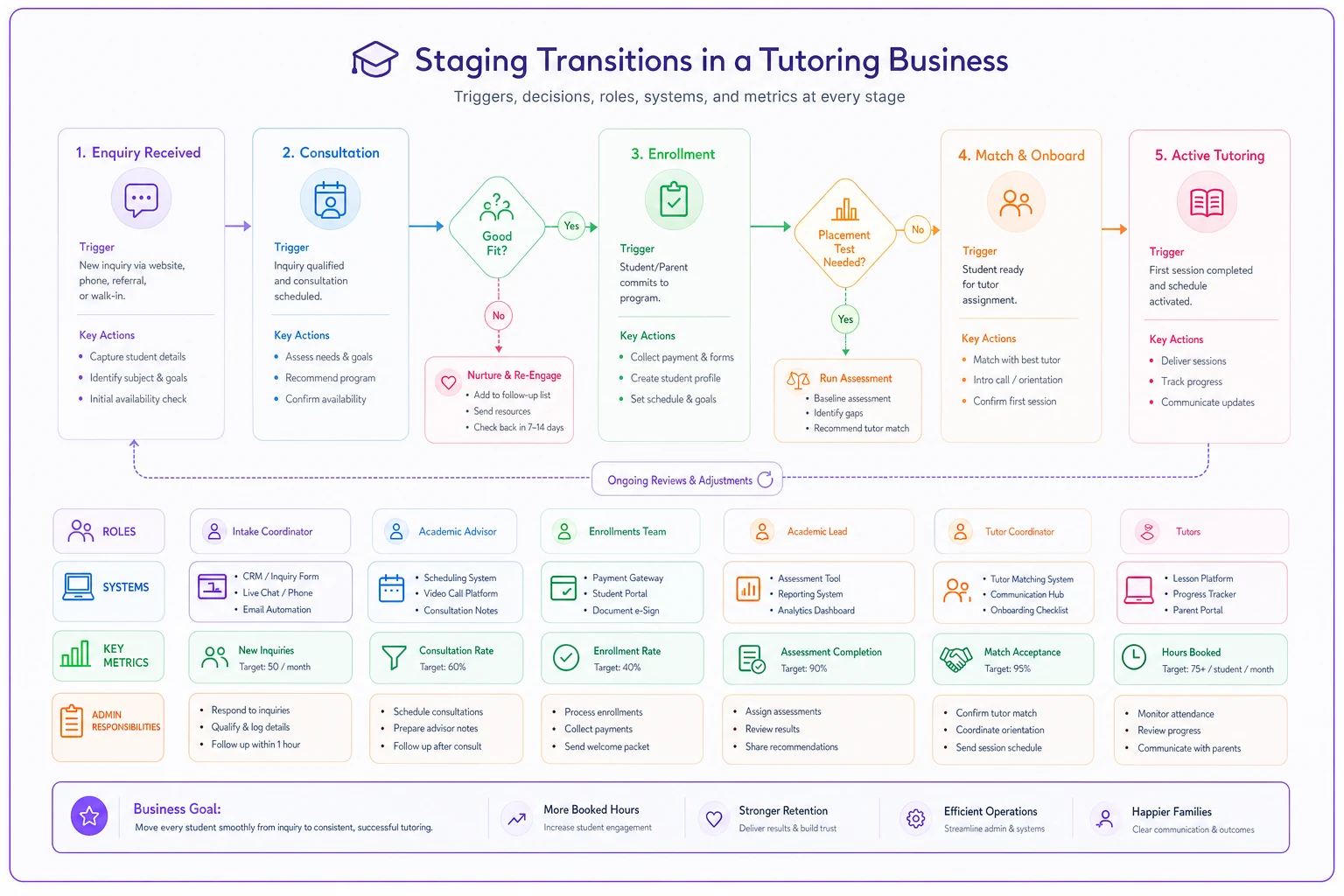
Accept that scaling changes your role. You'll transition from tutor to manager to executive. Each transition feels uncomfortable. The businesses that scale successfully are run by founders who embrace these role changes rather than resisting them.
The path from 3 students to 40 isn't just about getting more clients. It's about building operational systems that can handle exponential complexity while maintaining the educational quality that created demand in the first place. Get the operations right, and growth becomes the easy part.
Ready to streamline your tutoring operations?
Join 500+ tutors and centers using Tutoryly to save time, improve scheduling accuracy, and enhance student experiences.