



The strange thing about running multiple tutoring locations is that nothing technically changes. Same brand, same curriculum, same pricing sheet. And yet within a few months, your second and third sites start behaving like completely separate businesses — their own habits, their own shortcuts, their own quiet ways of doing things "differently but it works for us."
That drift is the real enemy in multi-location tutoring. Not competition, not marketing, not even hiring. It's the slow divergence between how each site actually runs versus how you think it runs. By the time you notice, you're not managing one business with three locations — you're managing three loosely related operations that happen to share a logo.
This article is about building the governance layer that keeps that from happening: who decides what centrally versus locally, how often you audit, what guardrails protect quality without micromanaging good tutors, and the SOP templates that map to the specific ways tutoring operations tend to break.
Why standardization quietly falls apart at the second location
When you have one center, you are the SOP. Every decision routes through you or someone sitting fifteen feet away. Intake gets done a certain way because you're watching. Lesson notes get filled in because you'll notice if they aren't. Quality holds together through proximity, not process.
Open a second site forty minutes away and that proximity disappears overnight. The site lead starts making reasonable local calls — a slightly different intake conversation, a looser cancellation grace period because "these families are different," a homegrown way of tracking progress on a whiteboard instead of your system. None of those decisions are wrong on their own. The problem is nobody wrote them down, nobody approved them, and now you have two versions of "the truth."
-
Intake and assessment, because each lead interprets the process through their own judgment
-
Attendance and cancellation enforcement, because the person on-site feels the social pressure of a family standing right in front of them
-
Progress documentation, because it's the easiest thing to skip when you're busy
By the time you're at three or four sites, these small forks have compounded into genuinely different customer experiences. A family who moves their kid from your east-side location to your north location notices. That's a governance failure, not a staffing one.
The central vs. local split: the decision that shapes everything else
The core question in multi-location governance is deceptively simple: what gets decided at HQ, and what gets decided at the site? Get this wrong in either direction and you pay for it.
Never miss another tutoring session.
Tutoryly helps you schedule, confirm, and manage every tutoring session efficiently.
- Unified session scheduling
- Automated student notifications
- Tutor calendar & availability management
No credit card required
Over-centralize, and your site leads become order-takers who can't respond to real situations. They wait on approvals, families feel the friction, and your best local managers leave because they have no real authority. Over-localize, and you get the divergence problem — every site quietly inventing its own operating reality.
Think of it this way: centralize the things that define your brand and protect your risk. Localize the things that require judgment about specific people and specific days.
| Decision area | Owned centrally (HQ) | Owned locally (site lead) |
|---|---|---|
| Curriculum & progression gates | Standard, versioned, non-negotiable | Pacing within the standard |
| Pricing & packages | Set centrally, no local discounts | Enrollment conversations |
| Tutor hiring criteria & pay bands | Defined centrally | Interview scheduling, final pick within band |
| Assessment tools & scoring rubric | Standardized | Administering & interpreting for a student |
| Cancellation/no-show policy | Policy & thresholds set centrally | Case-by-case grace within defined limits |
| Lesson notes format & required fields | Mandatory template | Content of the notes |
| Scheduling & tutor-student matching rules | Rules defined centrally | Actual matches within rules |
| Marketing & brand | Centralized | Local community events (pre-approved) |
| Refunds & billing disputes | Escalation rules & caps | Small resolutions under a set dollar limit |
Notice the pattern in that last column. Local leads don't get "no authority" — they get bounded authority. A site lead can waive a cancellation fee, but only inside a rule that defines how often and up to what dollar value. That boundary is what makes delegation safe. This connects directly to how you scale staffing and set stage-based SOPs as capacity grows — the right split actually shifts depending on which stage each site is at.
A useful test when you're unsure where something belongs: If two site leads made opposite calls on this, would a customer notice or would our risk change? If yes, centralize it. If it's just about reading the room with one family on one afternoon, let the local lead own it.
Fidelity guardrails: keeping quality without hovering
"Fidelity" here means how closely each site actually delivers what you designed. Most owners treat it as either total freedom or total control. Neither works. What works is a small set of guardrails — the handful of things that must be true everywhere, no exceptions — surrounded by a wide zone of genuine local flexibility. Guardrails should be few and boring. If you list twenty, nobody remembers any.
Pick the five to eight that, if violated, genuinely damage student outcomes or your legal and financial exposure.
-
Every student has a completed assessment on file before session three. No exceptions, regardless of how "obvious" the placement seemed.
-
Lesson notes are completed within 24 hours of every session, using the required fields — because this is what makes tutor handoffs and substitute coverage survivable.
-
No pricing or package offered that isn't on the central sheet. Local discounting is the fastest way to erode margin across a chain.
-
Progression gates are honored — a student doesn't advance a level without meeting the defined criteria, no matter how much a parent pushes.
-
Student data handling follows one privacy standard across all sites, not a local interpretation.
-
Tutor-student matches follow the central matching rules, not whoever's free that hour.
Everything outside those guardrails should be genuinely flexible. How a tutor explains fractions, how a lead runs their morning huddle, which local coffee shop hosts the parent info night — leave it alone. Tight guardrails earn you the right to loosen everything else. When leads see that the rules are few and the reasons are obvious, they stop treating governance as a fight.
The quality-assurance loop is what tells you whether your guardrails are actually holding — a guardrail with no measurement is just a wish written on a wall.
Audit cadence: catching drift before it becomes damage
Guardrails only work if someone checks them. Most owners audit the wrong way — a big surprise inspection twice a year that generates panic, a cleanup rush, and no lasting change. That's theater, not governance.
Better multi-site operators run a layered cadence: quick, frequent, lightweight checks on the things that matter most, plus a slower deep review that looks at patterns.
Governance and SOP workflow across sites
This workflow maps the layered checks from site-level self-review up to full fidelity audits.
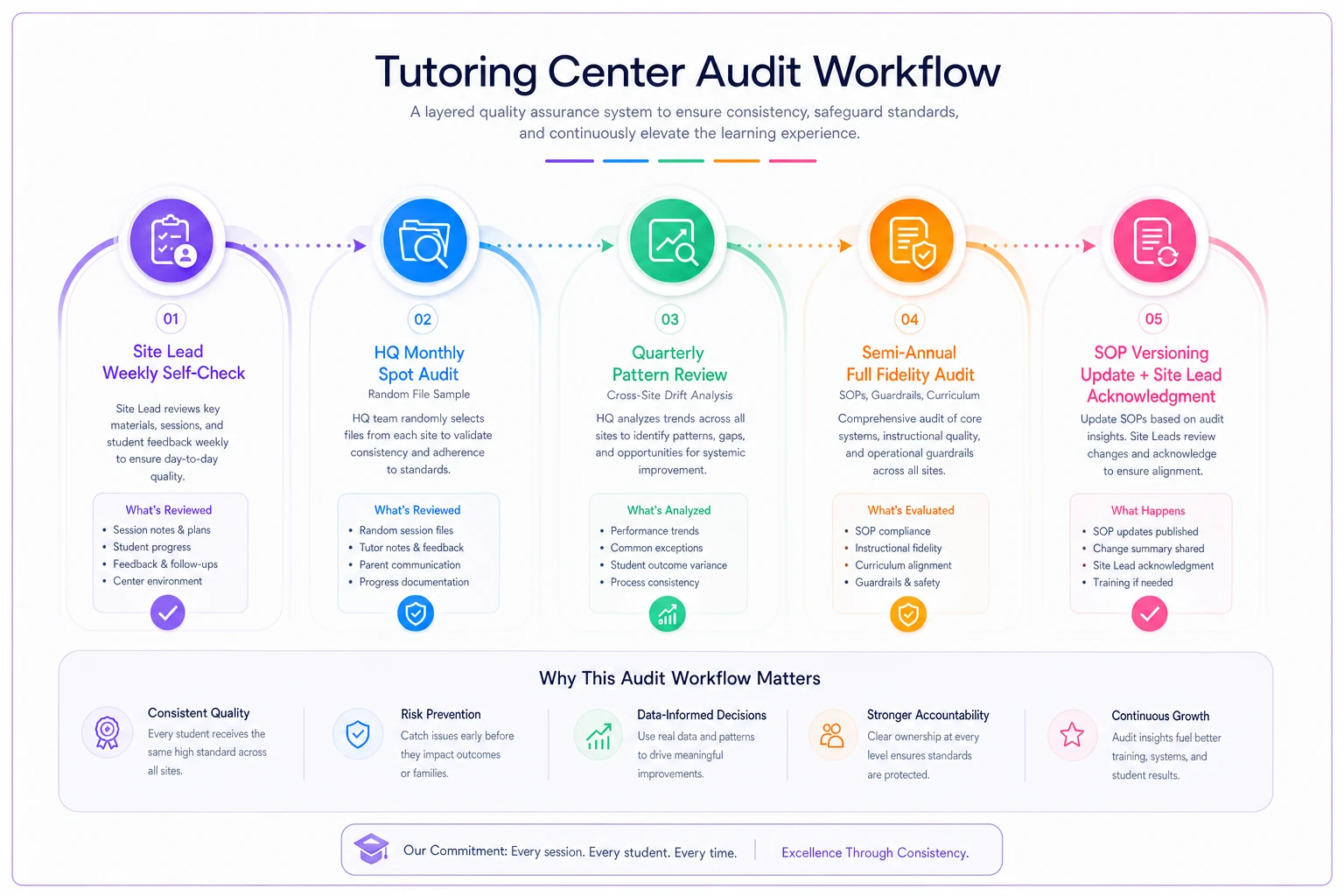
A practical audit cadence
-
Weekly (self-check by site lead, ~15 min) Lead pulls a short list — were all lesson notes completed on time? Any student past session three without an assessment? Any off-sheet pricing? Self-reported, low-friction, mostly about keeping the site honest with itself.
-
Monthly (cross-site or HQ spot-check, ~30–45 min) Someone who is not the site lead reviews a random sample — pull 8–10 student files and check that documentation, matching, and progression records actually match reality. Random sampling matters more than volume; people can't game what they can't predict.
-
Quarterly (deep review, half a day) Step back from individual files and look at operational patterns. Is one site's no-show rate drifting up? Are progression gates being honored consistently, or is one location advancing kids faster to keep parents happy? This is where you catch slow forks before they harden.
-
Twice yearly (full fidelity audit) The complete walk-through — every guardrail, every SOP, plus a look at whether the SOPs themselves still make sense. Sometimes the site "broke the rule" because the rule was wrong. That's a finding, not a crime.
The single most common audit mistake is checking whether paperwork exists rather than whether it's true. A lesson note field can be filled in with "good session, made progress" a hundred times and pass every existence check while telling you nothing. Audit for signal, not for boxes ticked.
One more thing worth naming: audits fail when they're only ever punitive. If HQ only shows up to catch mistakes, sites learn to hide problems until the inspection passes. The centers that maintain quality treat the monthly spot-check as coaching input — the goal is to fix the drift, not assign blame.
SOP templates built around how tutoring actually breaks
Generic SOP libraries fail because they're organized around org-chart categories ("Operations," "HR," "Finance") instead of around the moments where things actually go wrong. A multi-site SOP set should be built around failure modes — the specific, recurring ways tutoring operations fall apart. When something breaks, a lead should be able to grab the exact SOP for that situation without guessing.
-
A tutor calls out same-day — who covers, how the family is notified, how billing is handled, and how continuity is protected through notes.
-
A new student's intake is incomplete — what can and can't proceed, and by when the gap must close.
-
A parent disputes progress or pushes for early advancement — the script, the escalation path, and the non-negotiable line on progression gates.
-
A student's attendance drops below threshold — the local response, the reminder tiers, and when it escalates.
-
A billing or refund dispute exceeds the local dollar cap — the escalation to HQ.
-
A tutor-student mismatch surfaces — the reassignment rules and how it's communicated without drama.
-
A site's numbers drift (no-shows up, utilization down) — the trigger and the response plan.
Each template should follow the same skeleton so leads across sites internalize the pattern: Trigger → Immediate action → Who owns it → Communication script → Documentation required → Escalation threshold.
The value of templating this way is that it removes improvisation from the moments that most need consistency. When a tutor calls out at 7am, you do not want the north-side lead inventing a policy on the fly while the east-side lead does something completely different. Same trigger, same response, everywhere.
SOPs should also be versioned, just like curriculum. Every template needs a version number and a "last reviewed" date. When you update the cancellation SOP, you need to know instantly whether all four sites are running the current version or whether one is still operating on last year's rules. Version drift in SOPs is just as damaging as version drift in curriculum — same divergence problem, different costume.
A roll-out cadence for owners adding a new location
Most quality collapses happen not during steady-state operations but during the roll-out of a new site, when a lead is hired, handed the keys, and expected to absorb the whole system by osmosis. A staged roll-out prevents that.
-
Weeks 1–2 — Shadow at an existing site. The new lead runs nothing yet. They watch guardrails in action at a healthy location. Fidelity gets transferred person-to-person here, not through a PDF.
-
Weeks 3–4 — Guardrails and SOP walkthrough. Go through each failure-mode SOP with real examples from the mother site. The new lead should be able to say what happens in each of the seven failure scenarios above before the site opens.
-
Weeks 5–6 — Supervised launch. New site opens, but HQ or the mentor lead is on-site or on-call daily. Weekly self-checks start immediately, even at low volume — habits form when the site is small, not later.
-
Months 2–3 — Monthly spot-checks begin. The new site enters the normal audit cadence, but you look at it more closely than mature sites. Expect to find drift here; the goal is to catch it while it's still one file, not fifty.
-
Month 4+ — Full cadence. The site is treated like any other location, on the standard weekly/monthly/quarterly rhythm.
The mistake to avoid is launching a new site cold and promising yourself you'll standardize it later. You won't. Whatever habits form in the first sixty days become that site's permanent operating culture. Standardization is cheap to install and expensive to retrofit.
A real scenario: three locations, one drifting site
A tutoring operator running three centers — roughly 180 active students across all three — noticed that renewals at one location were quietly running about 10–12% below the other two. Same curriculum, same pricing, similar demographics. On paper, identical businesses.
When they finally ran a proper file audit instead of trusting the existence checks, the pattern showed up fast. At the underperforming site, lesson notes were being completed maybe 60% of the time and mostly with filler content. Assessments were regularly skipped past session three "because we knew the kid already." And the site lead had been quietly extending cancellation grace to almost every family — which looked fine short-term but had trained families to treat sessions as optional.
None of it was malicious. The lead was well-liked, busy, and had drifted into local shortcuts that felt reasonable in the moment. Nobody had checked the actual truth of the operation in over a year.
The fix wasn't dramatic. They installed the layered audit cadence, tightened five guardrails to non-negotiables, and put the failure-mode SOPs in place with version numbers. Within a quarter, documentation compliance climbed back toward the other locations, cancellation behavior tightened up, and renewals recovered most of the gap — not overnight, but steadily. The revenue leaking out through drift, a few thousand dollars a month once you accounted for churn, mostly came back. The real win was that the site stopped being a mystery.
When tight governance is the wrong move
Not every operation needs this. If you have a single location, most of this is overkill — proximity is doing the job, and adding heavy audit cadences to a ten-tutor shop just creates paperwork nobody reads. Build the guardrails and SOP skeletons now if you plan to expand, but don't run a four-site governance model on a one-site business.
It's also the wrong move if your "locations" are genuinely different products — say, one site does exam prep and another does early-literacy for a totally different market. Forcing identical SOPs on genuinely different operations creates friction without benefit. Standardize what's actually shared; let the rest diverge on purpose, with documentation explaining why.
And if your bottleneck right now is cash flow rather than consistency, fix that first. Governance protects a working model — it doesn't rescue a broken one. Getting your cashflow forecast and hire/marketing triggers right often matters more than perfect SOPs when you're still deciding whether the second location should even open yet.
Where the software layer quietly helps
None of this requires software to design — you can build the central/local split, the guardrails, the audit cadence, and the SOP templates on paper. But keeping them alive across sites is where most operators lose steam, because manually chasing whether every location completed its weekly self-check, filed notes on time, and honored progression gates is its own full-time job.
This is the practical case for running multi-location tutoring operations on an AI-assisted operational platform rather than a stack of spreadsheets and group chats. When lesson-note completion, assessment deadlines, cancellation patterns, and progression records all live in one system, the audit cadence largely runs itself — the platform flags the student who hit session three without an assessment, surfaces the site whose no-show rate is drifting, and shows you at a glance which locations are running the current SOP version. The governance still comes from you. The software just removes the manual chasing that makes owners quietly abandon their own systems by month three.
The takeaway for owners scaling past one site
Multi-location tutoring lives or dies on whether "the way we do things" survives distance. It won't survive on trust and good intentions — proximity was doing more work than you realized, and the moment it's gone, drift begins. What replaces it is a deliberate split between central and local authority, a small set of guardrails that actually matter, an audit rhythm that checks truth instead of paperwork, and SOPs built around the specific moments tutoring breaks.
Install it early, keep the guardrails few and obvious, audit as coaching rather than punishment, and version everything. Do that, and your fourth location should feel a lot like your first — which, when you're building a chain, is the whole point.
Ready to streamline your tutoring operations?
Join 500+ tutors and centers using Tutoryly to save time, improve scheduling accuracy, and enhance student experiences.