



Your best calculus tutor just texted—their kid has the flu and they can't make tonight's 6pm session with the Johnson twins. It's 3:47pm.
This scenario plays out at tutoring centers every single week. Not because tutors get sick (that's unavoidable), but because most centers handle substitutions like they're defusing a bomb while blindfolded. Frantic texts to available tutors, panicked parent calls, lost session notes, confused billing adjustments. By the time you find coverage, you've burned 90 minutes on something that should've taken 15.
The chaos from poor substitute workflows costs more than just time. Centers routinely lose 12-18% of scheduled revenue to cancellation confusion—sessions that could've been covered but weren't, parents who got frustrated and paused services, make-good credits that didn't need to happen.
The notification cascade that actually works
Most tutoring centers treat cancellation notifications like a game of telephone. The tutor texts the owner, who messages the coordinator, who emails parents. Information degrades at every handoff.
A functioning substitute workflow starts with a single notification point that triggers everything else. When Marcus cancels his Thursday SAT prep sessions, that notification needs to simultaneously:
-
Flag all affected sessions in your scheduling system
-
Alert your substitute pool with session details
-
Queue parent notifications (but not send them yet)
-
Document the cancellation reason for pattern tracking
The mistake centers make is rushing to notify parents before securing coverage. Parents don't need to know about the problem—they need to know about the solution. Hold those parent messages until you've either confirmed a substitute or determined you need to reschedule.
Your notification hierarchy should follow this priority order:
-
Internal team gets cancellation alert
-
Substitute pool receives availability request
-
Match confirmation triggers parent notification
-
Billing system logs any adjustments
Notice what's missing? Manual coordination calls. Every notification should be templated, automated, or both. The moment you're typing custom messages for routine cancellations, you're already behind.
Auto-matching rules that preserve session quality
This is where substitute systems usually fail: throwing any available tutor into any open slot. That's how you end up with your Spanish tutor covering AP Chemistry because "they were free."
Never miss another tutoring session.
Tutoryly helps you schedule, confirm, and manage every tutoring session efficiently.
- Unified session scheduling
- Automated student notifications
- Tutor calendar & availability management
No credit card required
Effective substitute matching requires structured priority rules. Not suggestions—actual operational rules that determine who covers what.
Start with your match matrix:
Primary match criteria:
-
Subject expertise (exact match required)
-
Grade level experience (within 2 levels acceptable)
-
Learning style compatibility (from intake notes)
-
Schedule availability
Secondary considerations:
-
Previous substitute success with that student
-
Parent preference notes
-
Session continuity (has subbed for this student before)
-
Geographic proximity for in-person sessions
The key is making these matches automatically rather than manually reviewing each one. Build your substitute pool with pre-tagged expertise areas. When cancellations hit, your system identifies the top 3 matches and sends availability requests in priority order.
When your regular algebra tutor cancels, the system checks:
-
Who has "Algebra I" or "Algebra II" tagged
-
Who has worked with 9th-10th graders
-
Who's available Tuesday 4-6pm
-
Who's substituted for this student before
First tutor to confirm gets the session. No back-and-forth, no coordinator playing matchmaker.
Session notes handoff protocol
This is where substitute coverage either maintains continuity or completely falls apart. Without proper session notes, your substitute walks in blind, wastes 20 minutes figuring out where the student is, and delivers a mediocre review session instead of advancing actual progress.
Session notes handoffs need more than just "worked on Chapter 7." Your substitute needs:
Immediate context:
-
Last session's specific topics covered
-
Current assignment or test prep focus
-
Problem areas identified
-
Pacing notes (ahead/behind/on track)
Student success factors:
-
Learning style preferences
-
Motivation triggers
-
Common confusion points
-
What explanations have actually worked
Session plan trajectory:
-
What was planned for this session
-
Upcoming test/assignment dates
-
Overall goal for this unit or month
Centers lose substitute effectiveness when these notes live in the regular tutor's head or scattered across email threads. Every tutor should be updating a centralized session record that any substitute can access immediately.
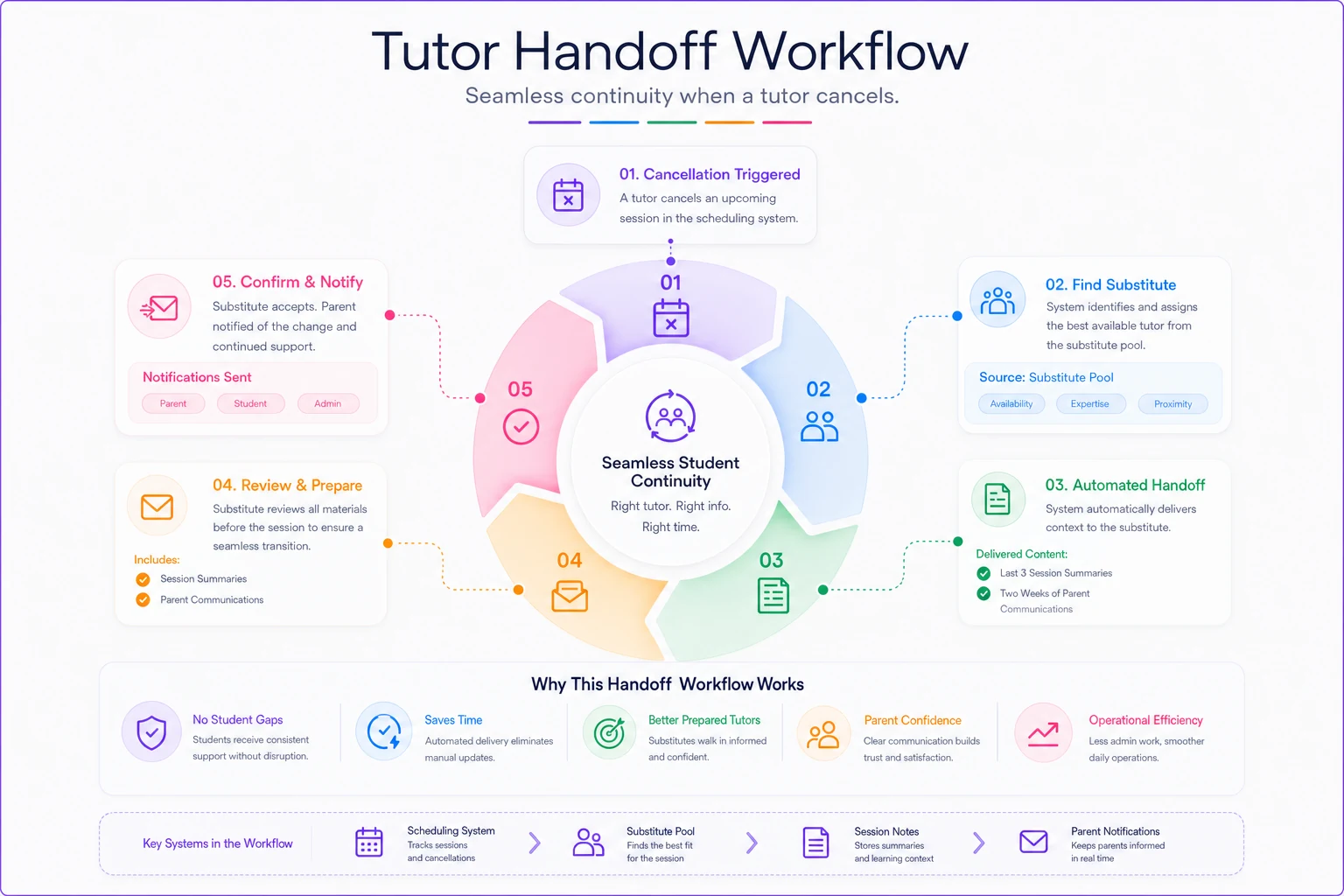
The handoff works like this: when a cancellation triggers, the system automatically sends the substitute the last 3 session summaries plus any parent communication from the past two weeks. The substitute reviews these before the session, not during it.
Here's a simple visual of that handoff workflow.
Some centers resist this level of documentation because it feels like overhead. But you're either spending 5 minutes documenting after each session, or you're spending 45 minutes in crisis mode trying to reconstruct student history when substitutions hit. The math isn't complicated.
Parent messaging that builds confidence, not concern
Most centers get this backwards—they lead with the problem instead of the solution.
Bad parent message: "Hi Sarah, unfortunately Tom can't make tonight's session due to illness. We're working on finding a substitute. Will update soon!"
This creates anxiety. Parents immediately start wondering if the session will happen, whether the substitute will be qualified, whether they should cancel other plans.
Better message: "Hi Sarah, tonight's 6pm session will be covered by Jennifer, one of our senior math tutors. She's reviewed Alex's recent progress notes and will continue with the geometry unit. Tom will be back next week."
You're announcing the solution, not the problem. Parents don't actually care that Tom is sick—they care that their kid's session happens with qualified coverage.
Message templates should vary based on timing:
More than 4 hours notice: "Tomorrow's 4pm session will be with [Substitute Name], who specializes in [Subject]. They've reviewed [Student]'s recent work and will continue with [Current Topic]."
2-4 hours notice: "Quick update: [Substitute Name] will cover today's [Time] session. Same focus on [Topic], just a different tutor. [Regular Tutor] returns [Date]."
Less than 2 hours notice: "Today's [Time] session is confirmed with substitute tutor [Name]. If you'd prefer to reschedule instead, just reply 'RESCHEDULE' and we'll prioritize you for this week."
Always include the substitute's qualification that matters most for that subject. Parents covering SAT prep want to know scores. Parents covering elementary reading want experience level. Match your credibility point to their actual concern.
Billing adjustments without margin bleeding
Panic credits and make-goods that weren't necessary are expensive. Centers bleed margin when they reflexively offer credits for any substitution, even successful ones.
Your billing rules need clear triggers:
| Rule | When it applies |
|---|---|
| Full session rate applies when: | Substitute delivers the scheduled session Session meets minimum time (typically 90% of scheduled) Parent doesn't request cancellation before session |
| Partial credit (25%) when: | Session happens but runs short due to late substitute arrival Substitute covers different material than planned Technical issues affect virtual session quality |
| Full credit only when: | No substitute available and session cancelled Parent explicitly refuses the substitute option Substitute no-shows without coverage |
Make these rules automatic, not discretionary. When your coordinator decides credits on the fly, they'll almost always over-credit to avoid confrontation. Build the rules into your billing system so credits process based on actual outcomes.
Track your substitution metrics monthly:
-
Percentage of cancelled sessions successfully covered
-
Average time to confirm a substitute
-
Credit rate for substituted sessions
-
Parent satisfaction scores for substitute sessions
If you're crediting more than 15% of substituted sessions, either your substitutes aren't qualified or your expectations aren't clearly set. Usually it's the latter.
Priority rules and escalation paths
Not all cancellations are equal. Your AP test prep student three weeks before exams needs different handling than a casual elementary reading student in October. Without priority rules, you treat every cancellation like a crisis—which means nothing actually gets priority treatment.
Priority Level 1 (Immediate coverage required):
-
Test prep within 2 weeks of exam
-
Students on academic probation
-
New students in first month
-
Previously rescheduled sessions
Priority Level 2 (Same-day coverage preferred):
-
Regular weekly students
-
Students with upcoming assignments
-
Package sessions expiring soon
Priority Level 3 (Can reschedule if needed):
-
Maintenance/review sessions
-
Students ahead of pace
-
Flexible scheduling families
Your substitute pool gets different notifications based on priority level. Level 1 cancellations might trigger immediate calls to your best substitutes, while Level 3 sends standard availability requests.
The escalation path:
-
First 30 minutes
Check auto-matched substitutes
-
30-60 minutes
Expand to secondary substitute pool
-
60-90 minutes
Offer reschedule options to parent
-
After 90 minutes
Provide credit and priority reschedule
This prevents the panic spiral where you're calling every tutor in your database for a non-urgent session while actually urgent coverage goes unhandled.
Revenue preservation through systematic coverage
The real cost of poor substitute workflows isn't the individual session—it's the compound effect on lifetime value. Families that experience multiple coverage failures don't just pause services; they leave. Your substitute system directly impacts retention.
Centers with structured substitute workflows typically preserve 85-90% of cancelled session revenue. Those running ad-hoc coverage lose closer to 40%. The difference is systematic operations versus scrambled ones.
A functioning substitute workflow moves several key metrics:
-
Coverage rate (percentage of cancellations successfully covered)
-
Time to confirmation (how quickly you secure substitutes)
-
Session quality scores (parent ratings of substitute sessions)
-
Retention through disruption (families staying through tutor changes)
The biggest revenue risk is the cascade effect. When one botched substitution makes parents nervous, they start cancelling preemptively "just in case." Soon you're losing sessions that never needed substitution at all.
Building your substitute bench strength
Your substitute pool needs to be more than "whoever's available." Strong centers maintain a bench that's 30-40% the size of their regular tutor roster. That sounds like overkill until flu season hits and you have four tutors out simultaneously.
Your waitlist strategy actually feeds your substitute pool well. Tutors waiting for regular assignments can earn immediate income through substitute coverage while building relationships with families.
Classify your substitutes into tiers:
-
Tier 1
Full coverage substitutes
- Can cover any session in their subject area - Proven track record with families - Available with 2+ hours notice -
Tier 2
Specialized substitutes
- Excel in specific topics or grade levels - Need more notice (4+ hours) - May require session notes review -
Tier 3
Emergency coverage
- Basic subject competence - Available on very short notice - Best for review or practice sessions
Pay structures should reflect these tiers. Tier 1 substitutes might earn 90% of session rate, Tier 3 closer to 70%. This incentivizes tutors to maintain availability and improve their substitute performance over time.
The workflow automation advantage
Manual substitute coordination is like solving a puzzle while someone keeps changing the pieces. By the time you've texted three tutors, the first one's availability has already changed. You're always working with outdated information.
AI-powered operational software turns this into a systematic workflow instead. When a cancellation comes in, the platform identifies qualified substitutes based on your matching rules, sends availability requests in priority order, and confirms coverage without manual back-and-forth. Session notes transfer automatically. Parents get professional notifications at the right moment. Billing adjusts based on actual outcomes.
What normally takes 60-90 minutes of frantic coordination compresses into a short automated workflow. Your team stops fighting fires and can actually focus on running the business. It also surfaces patterns humans miss in the scramble—like which substitutes have the best parent satisfaction scores for specific subject areas, or which families need extra communication during coverage changes.
Making substitutions seamless, not stressful
The difference between chaos and coverage isn't tutor availability—it's operational structure. Every tutoring center faces cancellations. The ones that handle it well have turned an inevitable disruption into a minor operational adjustment.
Your substitute workflow becomes effective when it runs without you. When cancellations trigger systematic responses instead of scrambled reactions. When parents see professional coverage instead of panicked apologies. When billing reflects actual outcomes rather than emotional make-goods.
Each smooth substitution builds parent confidence. Each preserved session maintains revenue. Each successful coverage strengthens your reputation as a reliable education partner—not just a tutoring matchmaker hoping nothing goes wrong.
Stop treating substitutions like emergencies. Build the workflow once, refine it based on real patterns, and let it run.
That 3:47pm cancellation text becomes a brief notification, not a 90-minute crisis.
Ready to streamline your tutoring operations?
Join 500+ tutors and centers using Tutoryly to save time, improve scheduling accuracy, and enhance student experiences.