



Three months ago, I watched a math tutor spend 25 minutes trying to figure out where her student left off in algebra because the previous tutor's notes said "worked on equations." That's it. Just "worked on equations." No specifics about which type, what confused the student, or what approach finally clicked.
The student's parent sat there watching this waste of their $85/hour session time. They switched tutoring centers two weeks later.
This happens constantly in tutoring operations. A tutor gets sick, takes vacation, or picks up a new client, and suddenly you're scrambling because nobody documented sessions properly. Your substitute walks in blind, the student feels like they're starting over, and parents wonder why they're paying premium rates for disjointed instruction.
When tutors can't build on previous work, students plateau. Parents notice the lack of progress reports. Your best tutors burn out from constantly re-diagnosing issues that should have been documented weeks ago.
Why tutors resist proper note-taking (and why required fields fix it)
Most tutors treat session notes like optional homework. They'll spend an hour crafting the perfect lesson, then scribble three words about what happened. Not because they're lazy – they genuinely think their memory or teaching style is enough.
After a session ends, the tutor finishes at 5:00 PM, has another student at 5:30, and thinks "I'll remember this." By the next morning, the details blur together with their other twelve students. Was it Sarah who struggled with fractions or Sam? Did the breakthrough happen using the pizza method or the number line?
Even well-meaning tutors who want to document properly don't know what information actually matters for continuity. They'll write paragraphs about the student's mood but forget to mention they switched from Saxon Math Book 2 to Book 3.
The solution isn't asking tutors to write better notes – it's requiring specific fields they can't skip.
The mandatory template that eliminates handoff chaos
Core Session Documentation (All Fields Required)
Never miss another tutoring session.
Tutoryly helps you schedule, confirm, and manage every tutoring session efficiently.
- Unified session scheduling
- Automated student notifications
- Tutor calendar & availability management
No credit card required
Session Basics
-
Date/Time
[Auto-populated]
-
Student
[Dropdown from roster]
-
Subject/Level
[Pre-set options]
-
Materials Used
[Specific book/chapter/page or resource]
Academic Progress
-
Topic Covered
[Specific skill, not general subject]
-
Starting Point
[Where we began today]
-
Ending Point
[Where we stopped]
-
Mastery Level
[Introduced/Practicing/Proficient/Advanced]
Student Response
-
What Clicked
[Specific method or explanation that worked]
-
What Didn't
[Concepts still causing confusion]
-
Energy/Focus Today
[High/Medium/Low with brief reason]
Next Session Must-Do
-
Start With
[Exact topic or problem set]
-
Avoid
[Methods or approaches that don't work for this student]
-
Bring
[Specific materials needed]
Parent Communication
-
Homework Assigned
[Specific pages/problems]
-
Key Win to Share
[One specific achievement]
-
Concern to Monitor
[If any]
The enforcement mechanism needs teeth. Required fields alone won't work. You need a submission lock – tutors literally cannot clock out or submit their timesheet until all fields are complete. No field can accept generic inputs like "N/A" or "same as last time."
One center went further: incomplete notes meant the session didn't count toward their monthly bonus. Documentation compliance jumped from 30% to 95% in two weeks.
Real examples across different subjects and age groups
Elementary Math (Grade 3)
Topic Covered: Two-digit multiplication using area model
Starting Point: Review 14 x 6 from Tuesday
Ending Point: Completed 23 x 15 independently
What Clicked: Drawing the box method with colored sections
What Didn't: Still rushing mental math, making careless errors
Next Session Start: Three-digit by one-digit (try 234 x 6)
Avoid: Traditional stacking method (frustrates him)
High School Chemistry (Grade 11)
Topic Covered: Balancing chemical equations - combustion reactions
Starting Point: CH4 + O2 practice problems from homework
Ending Point: Successfully balanced 5 combustion equations solo
What Clicked: The "element inventory" chart method
What Didn't: Identifying reaction types before balancing
Next Session Start: Quiz prep - mixed reaction types
Bring: Periodic table and reaction type reference sheet
SAT Prep (Junior Year)
Topic Covered: Reading comprehension - inference questions
Starting Point: Practice test 3, passages 2-3 review
Ending Point: New strategy for evidence-based questions
What Clicked: Underlining before reading questions
What Didn't: Time management (spent 15 min on one passage)
Next Session Start: Timed passage practice - 13 min each
Parent Note: Score improved from 650 to 680 on practice section
Special Needs Support (Age 8, Dyslexia)
Topic Covered: Phonics - distinguishing b/d/p/q
Starting Point: Worksheet from OG Level 1, Lesson 12
Ending Point: 80% accuracy with tactile letters
What Clicked: "Thumbs up" trick for b vs d
What Didn't: Writing without lined paper support
Next Session Start: Same letters in simple words (bed, dip, quit)
Bring: Sandpaper letters and highlighted lined paper
Avoid: Cursive practice (OT recommended waiting)
Notice how each example gives a substitute everything they need to continue the student's progression.
The policy framework that ensures adoption
Submission Requirements
-
Notes must be completed within 30 minutes of session end
-
All fields must contain specific, actionable information
-
Generic responses trigger automatic rejection
-
Late submissions require manager approval
Access Permissions
| Role | Access Level |
|---|---|
| Assigned Tutors | Full note history (read/write) |
| Parents | "Parent Communication" fields only |
| Substitutes | Read-only access 24 hours before coverage |
| Students | No access to internal progress notes |
Quality Standards
-
Can a substitute run the next session from this alone?
-
Would a parent understand their child's progress?
-
Could you create a progress report from accumulated notes?
-
Does it protect student privacy while being useful?
Consequences and Incentives
First incomplete note: Verbal reminder, template retraining
Second incomplete note: Written warning, shadow observation
Third incomplete note: Removed from substitute list
Perfect monthly notes: Priority scheduling, 5% session bonus
Building this into your operational workflow
The biggest implementation mistake is rolling this out to everyone simultaneously. Start with your lead tutors for two weeks. They'll find the friction points and help you adjust fields before training others.
During rollout, assign one person to review notes daily. Not for spelling or grammar – just checking that fields contain usable information. This reviewer should be someone who could theoretically substitute teach from these notes.
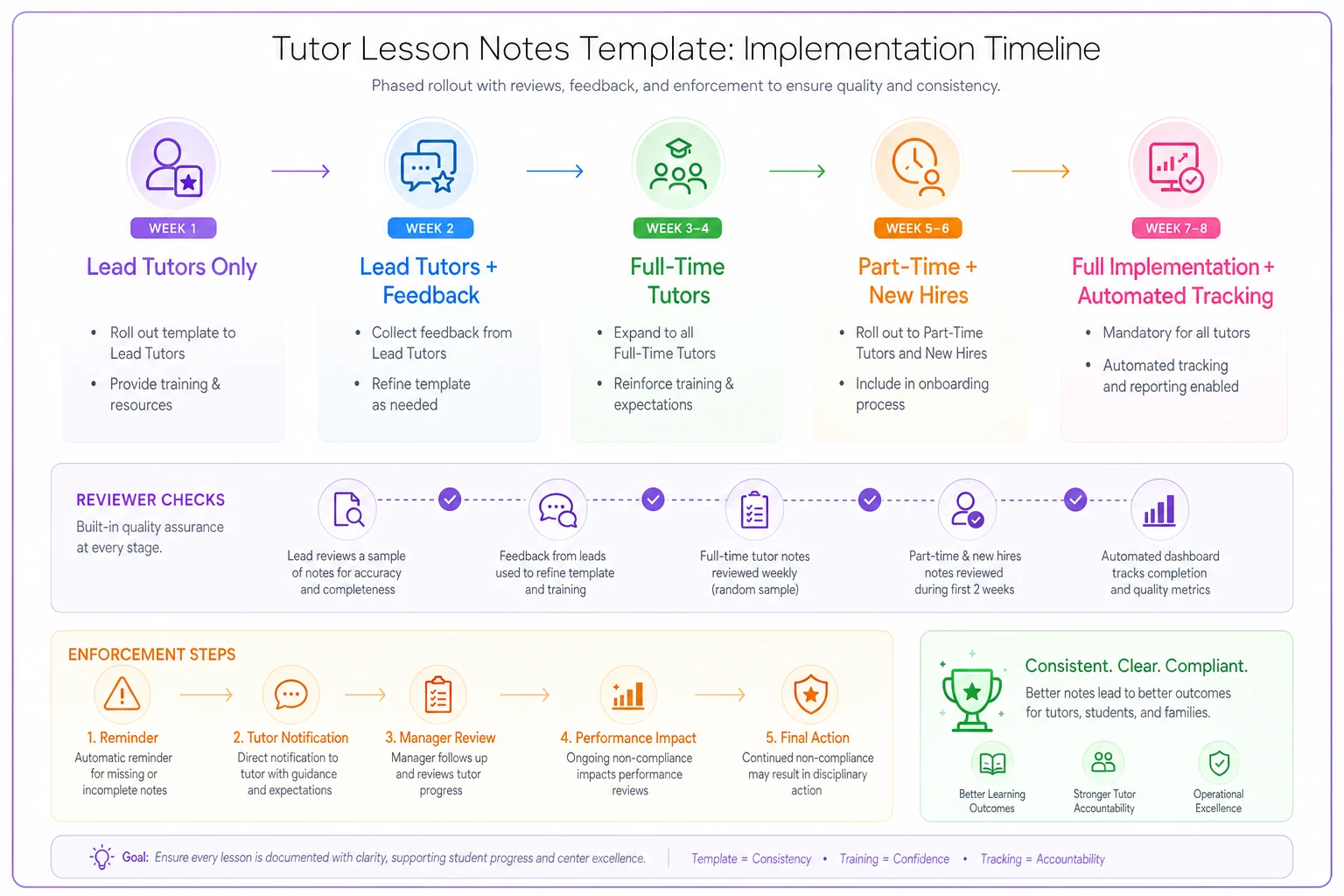
A simple timeline visualization helps show the staged rollout and reviewer checks.
A medium-sized center with 25 tutors typically sees these patterns:
-
Days 1-7
Lots of resistance and incomplete submissions
-
Days 8-14
Notes get longer but not necessarily better
-
Days 15-21
Tutors find their rhythm, quality improves
-
Day 22+
System becomes automatic, complaints stop
The resistance is temporary. The operational benefits last.
When substitute coverage actually works smoothly
The real test comes during flu season or holiday breaks. A properly documented student file means your substitute can walk in, scan the last five session notes, and continue exactly where the regular tutor left off.
Picture this scenario: Sarah usually tutors Michael in pre-calculus every Tuesday. She gets food poisoning Monday night. Instead of canceling (losing $125 in revenue) or sending someone blind, you pull Michael's notes:
Last session: "Struggled with related rates, especially cone problems. The 'draw and label' method finally worked. Assign problems 15-18 from Section 4.6, skip anything with implicit differentiation (haven't covered yet). Energy was low - mentioned basketball tryout stress."
Your substitute knows exactly what to review, what to assign, and even why Michael might seem distracted. The session continues seamlessly. Michael's mom never even knows Sarah was sick until the following week.
The documentation gaps that matter most
Even with templates, tutors miss critical information that makes handoffs fail:
Learning style indicators: A student might be a visual learner, but if nobody documents that written explanations don't work, every substitute starts with the wrong approach.
Behavioral triggers: One student shuts down when corrected directly. Another needs frequent breaks. These details make or break substitute sessions.
Parent communication preferences: Some parents want detailed weekly reports. Others only want contact about problems. Substitutes need this context.
Academic modifications: If a student has an IEP or 504 plan with specific accommodations, generic notes won't capture the required adjustments.
These gaps compound over time. Miss them once, and the substitute has a rough session. Miss them consistently, and parents start questioning your professionalism.
Making your template work with scheduling systems
Most tutoring management software treats notes as an afterthought – a text box at the bottom of the booking screen. That's backwards. Your note system should drive scheduling decisions.
When notes show a student struggling with focus after 4 PM, don't schedule substitutes during that time. When patterns emerge about materials or methods, your system should flag mismatched substitute assignments.
This is where AI-powered operational software makes a real difference. Instead of manually reviewing notes for patterns, automated systems can track mastery progression, flag concerning trends, and even suggest optimal substitute matches based on documented teaching styles. The best platforms integrate notes directly with:
-
Substitute matching algorithms
-
Progress report generation
-
Parent communication triggers
-
Resource preparation reminders
-
Learning pattern analysis
Some centers try building this with spreadsheets and Google Forms. Works for about ten students. Beyond that, you need proper operational software that enforces compliance while reducing the documentation burden through smart fields and auto-population.
The monthly audit that keeps quality high
Even perfect templates drift over time. Tutors find shortcuts. New hires bring bad habits. Running a monthly note audit catches decay before it affects operations.
Pull five random students each month. Read their last ten session notes. Ask yourself:
-
Could you teach their next session from these notes?
-
Do you understand their learning progression?
-
Are patterns and struggles clearly documented?
-
Would parents feel informed reading the communication sections?
Share audit results with your team, highlighting excellent examples and common gaps. This isn't about catching people doing wrong – it's about maintaining standards that protect session continuity.
Track these metrics monthly:
-
Percentage of complete notes submitted on time
-
Average detail level (scored 1-5)
-
Substitute session success rate
-
Parent complaints about continuity
-
Time spent on session prep
When all five metrics improve simultaneously, your documentation system is working.
The bottom line on tutor documentation
Every tutoring center thinks their note-taking problem is unique. It's not. The same pattern repeats everywhere: well-meaning tutors who don't document properly, substitutes who can't maintain continuity, and parents who lose faith in your program's organization.
A mandatory tutor lesson notes template with required fields solves this. Not through better writing or longer notes, but through structured documentation that captures what actually matters for handoffs.
The centers that implement this properly see immediate changes. Substitutes stop calling with questions. Parents stop complaining about repeated lessons. Tutors stop wasting session time on re-diagnosis. The operational drag of poor documentation disappears.
Most importantly, students maintain momentum even when their regular tutor isn't available. That consistency separates professional tutoring operations from glorified homework help.
The template and policies outlined here aren't theoretical. They're pulled from real implementations across dozens of centers. The specific fields, enforcement mechanisms, and rollout timeline come from what actually works in practice, not what sounds good in a management book.
Your documentation system is either supporting continuity or destroying it. There's no middle ground. Pick which outcome you want and build your requirements accordingly.
Your documentation system is either supporting continuity or destroying it. There's no middle ground. Pick which outcome you want and build your requirements accordingly.
Ready to streamline your tutoring operations?
Join 500+ tutors and centers using Tutoryly to save time, improve scheduling accuracy, and enhance student experiences.