

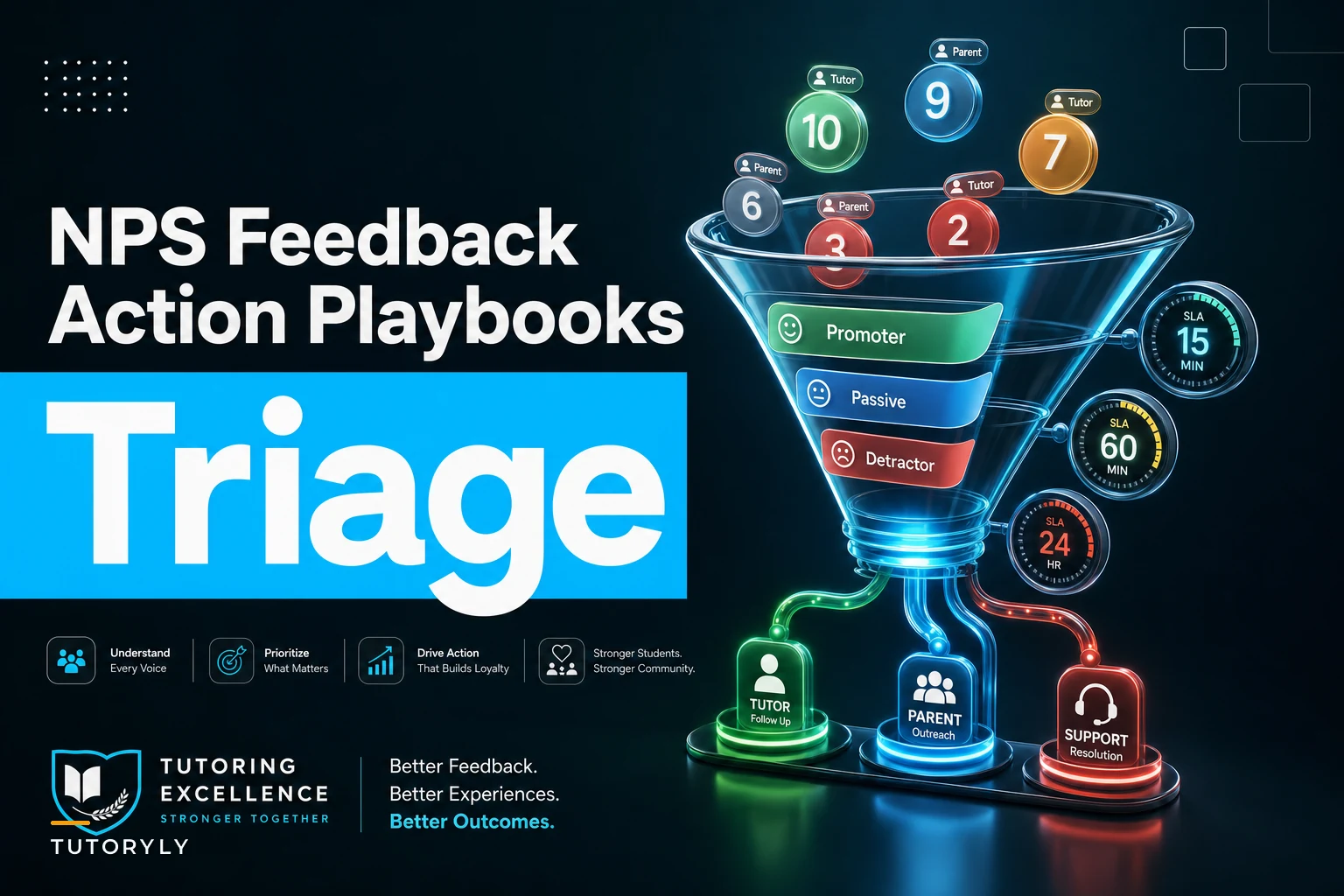

Most tutoring centers collect some form of feedback. Fewer do anything useful with it. The score comes in, someone glances at it, maybe a low one gets a "hey we should call that parent" comment in Slack, and then nothing. Three weeks later the family quietly stops booking sessions and you find out through a canceled autopay.
The gap isn't measuring satisfaction. It's the machinery that connects a parent's answer to an actual human doing something about it before the family walks. That machinery is what most centers never build, and it's where a tutoring automated NPS program stops being a vanity metric and starts protecting revenue.
This post is narrow on purpose. It's about the plumbing between "parent answered a survey" and "the right person fixed the problem, on time." Nothing about progress report design or QA rubrics beyond how they hook into feedback.
The failure most centers don't see coming
Tutoring feedback is different from, say, a restaurant survey. The person answering — the parent — usually isn't in the room. They're forming an opinion secondhand, from what their kid says in the car and whether the last progress note made sense. So a 6/10 from a parent might mean the tutor is genuinely underperforming, or it might mean their 9-year-old had a bad afternoon and complained about "boring worksheets."
That ambiguity is exactly why raw scores lead centers astray. A number alone can't tell you whether to coach a tutor, apologize to a family, or ignore the noise entirely.
The typical breakdown looks like this. A center sends a long survey once a quarter. Response rate sits around 12–18%. The responses that come in skew heavily toward very happy or very angry parents, so the average score is close to useless. And because there's no short comment attached, nobody knows why anyone scored the way they did. The center ends up with a directional feeling — "parents seem happy-ish" — and zero actionable signal.
Why "low-friction plus a tiny bit of qualitative" beats the long survey
The single biggest lever on feedback quality is friction. Every extra question cuts response rate, and the parents who bail on question 7 are disproportionately the busy, distracted, on-the-fence families — the exact ones whose churn risk you most want to see.
Never miss another tutoring session.
Tutoryly helps you schedule, confirm, and manage every tutoring session efficiently.
- Unified session scheduling
- Automated student notifications
- Tutor calendar & availability management
No credit card required
-
One score question. "How likely are you to recommend us to another family?" 0–10. That's your NPS anchor.
-
One optional open text. "What's the main reason for your score?" Never required. Never more than one box.
Two fields. Send it after a session or at a monthly cadence, not quarterly. Centers that trim to this format tend to see response rates land somewhere in the 40–55% range — roughly triple the long-survey numbers — and the comments are shorter but far more useful because parents aren't exhausted by the time they reach them.
The short comment does heavier lifting than it looks. A 7 with "sessions are great, scheduling has been a headache" is a completely different problem than a 7 with "not sure it's helping with the math grade." Same score, two totally different playbooks. The score tells you how urgent. The snippet tells you what to do.
Turning answers into routing: the triage layer
Once you've got a score and a snippet, the question becomes: who sees this, how fast, and what do they do? This is where a tutoring automated NPS program earns its keep — not by collecting responses, but by sorting them the moment they land.
The idea is to triage on two dimensions simultaneously: the numeric score and the sentiment of the comment. Score alone is too blunt. A 9 with a comment like "tutor's great but I've had trouble reaching the office twice" is a hidden operational leak that a pure score threshold would sail right past.
| Score | Comment sentiment | Category | Routing | Response window |
|---|---|---|---|---|
| 0–6 | Any | Detractor | Owner or center manager, recovery playbook | Same day |
| 7–8 | Negative or specific complaint | At-risk passive | Center manager review | 48 hours |
| 7–8 | Neutral / positive | Stable passive | Batch review weekly | No SLA |
| 9–10 | Complaint buried in praise | Hidden issue | Ops/manager, quiet fix | 3–4 days |
| 9–10 | Positive | Promoter | Referral ask + note in tutor's file | Weekly |
The two rows people skip are the "hidden issue" and the "at-risk passive." Detractors are obvious and get attention. It's the 7s and the buried complaints inside 9s that quietly erode retention because nobody flags them.
A lightweight automation that reads the snippet and tags it scheduling, tutor fit, progress, communication, or billing is enough to route correctly.
A quick diagram of the triage-to-routing workflow.
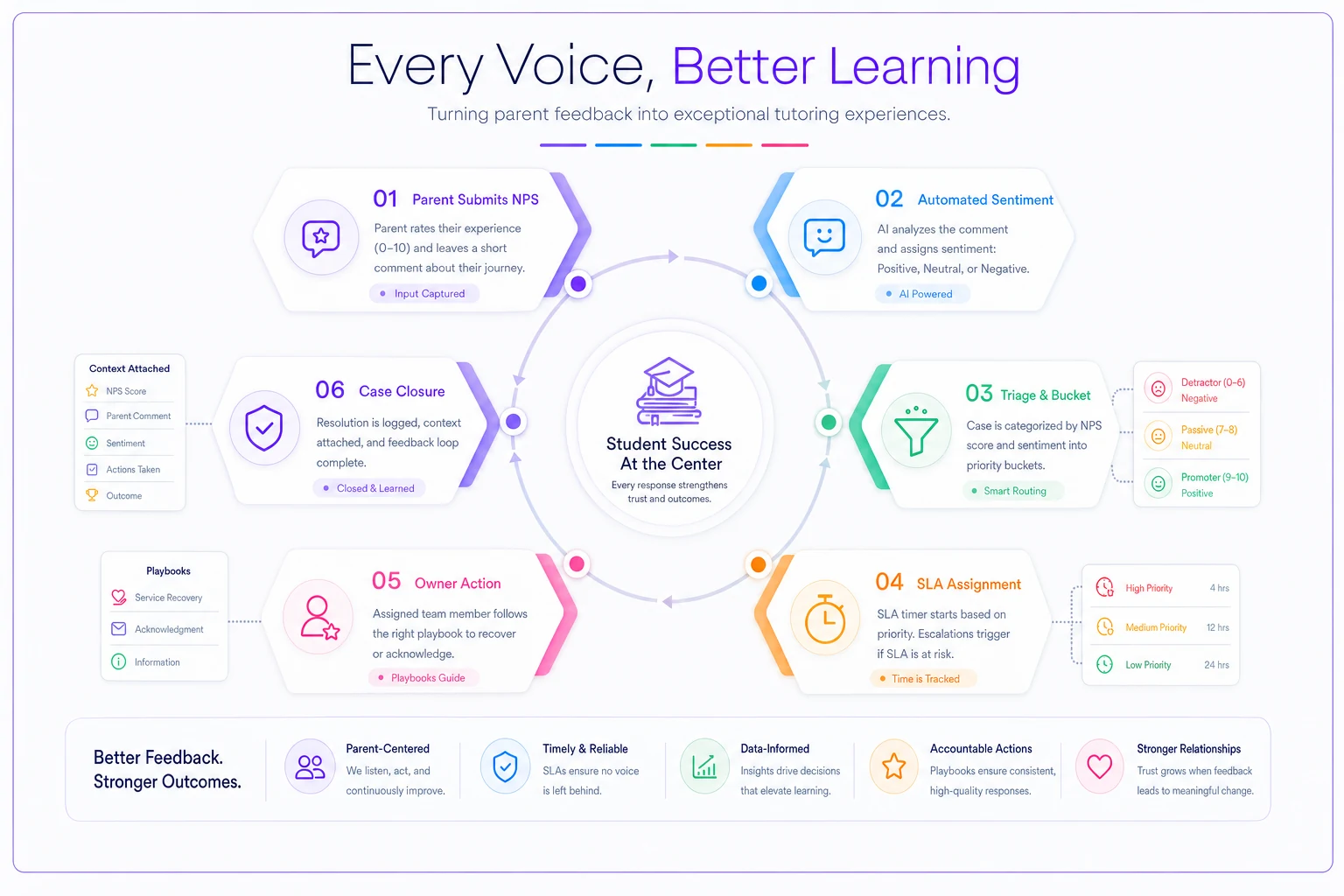
For sentiment tagging, you don't need anything exotic. A lightweight automation that reads the snippet and tags it scheduling, tutor fit, progress, communication, or billing is enough to route correctly. The point isn't perfect classification. It's making sure a negative 7 never sits in the same undifferentiated pile as a happy 9.
SLA routing: attaching a clock to every response
A category with no deadline is a category that gets ignored during a busy week. The whole reason to automate this is that manual triage collapses exactly when you're slammed — which is also when frustrated parents are most likely to have just submitted something.
Each category gets an owner and a clock. When a response lands, it auto-assigns to a person and starts a timer. If the detractor case isn't acknowledged within the same day, it escalates — a reminder to the manager, then to the owner. This is the difference between "we saw a bad score last Tuesday" and "we called that mom two hours after she submitted."
A workflow that runs cleanly looks like this:
-
Parent submits score + snippet.
-
System tags sentiment and category from the comment.
-
Response is bucketed using the triage table and assigned to the right owner.
-
An SLA timer starts based on the bucket.
-
Owner opens the case and sees the score, the snippet, and the family's recent history in one place.
-
Owner runs the matching recovery or acknowledgment playbook.
-
Case is closed with a note; if the SLA lapses, it escalates automatically.
The part that quietly matters most is step 5. If the person handling a detractor has to hunt through three systems for session history, attendance, and the last progress note, the SLA is dead on arrival. Feedback triage only works when context travels with the case.
This connects directly into the broader quality system. If you've built out rubrics and coaching cadence — the sort of thing covered in the tutoring quality-assurance loop — then a routed detractor tagged "tutor fit" shouldn't just trigger a parent call. It should also drop a flag into that tutor's QA record.
Recovery playbooks: what the owner actually does
Routing gets the case to the right desk on time. The playbook decides what happens next. Without one, you get the improvisation problem: every manager handles a detractor differently, some over-apologize and comp sessions they didn't need to, others go quiet and hope it blows over.
-
Detractor, tagged "progress" Owner reviews the last few lesson notes and the student's assessment trajectory before calling. The conversation leads with data, not apology. If progress genuinely stalled, the fix is a plan adjustment, not a discount. Your parent progress report cadence does heavy lifting here — if reports were already landing consistently, this call becomes a five-minute reassurance instead of a rescue.
-
Detractor, tagged "tutor fit" Routes to two places at once — a parent conversation about options, and the tutor's coaching file. Not as punishment. A single mismatch comment isn't a performance problem. But if the same tutor collects three "fit" flags in a term, that's worth acting on.
-
Passive (7–8), tagged "scheduling" or "communication": These almost never need the owner. They need an operational fix — a reminder-tier adjustment, a callback, a clearer confirmation flow. Fix the mechanism, then a short "we made this easier" note to the family.
-
Promoter with a buried complaint Quiet fix, no drama, and a light referral ask after the small issue is resolved — never before.
Keep playbooks short and tied to the comment category:
Tying feedback to recertification and coaching
This is the piece that separates a feedback program from a coaching system, and it's where most centers stop short.
Individual comments are noise. Patterns are signal. When a tutor's feedback is aggregated over a term, you start seeing whether score trends are drifting, which categories keep showing up, and whether coaching from last quarter actually moved anything.
A sensible structure: tutors carry a rolling feedback profile. Persistent low scores or a cluster of the same complaint category feed into their recertification review — where you decide whether they keep certain student types, need targeted coaching, or need a shadowing period. The coaching topic isn't guesswork; it's whatever the aggregated snippets keep pointing at. If four families independently mention "hard to follow" for one tutor, the coaching plan writes itself.
The guardrail matters. Never recertify or discipline on a single score. Parent feedback is noisy and secondhand. Use it as a pattern input alongside QA observations, not as a standalone verdict. A tutor with three strong QA reviews and one angry parent whose kid had a rough week is not a problem tutor.
A real scenario
A mid-sized center — around 180 active students, six tutors — was running a quarterly 10-question survey. Response rate hovered around 15%, and the results were basically decorative. They'd lose maybe 8–10 families a quarter, and in exit conversations the reasons were things they could have caught weeks earlier: "felt like sessions weren't going anywhere," "office was hard to reach."
They switched to a monthly two-field survey with automated triage. Response rate climbed into the mid-40s. More importantly, detractors now got a same-day call instead of a maybe-someday one. Over the following two terms, they caught a scheduling-communication issue that was quietly irritating about a dozen families, and they identified a tutor-fit pattern that a targeted coaching cycle resolved.
Churn didn't collapse overnight — it moved from that 8–10 range down to around 4–6 a quarter. Modest on paper. But at their price point, saving three or four families a quarter was worth well into five figures annually, for what amounted to a two-question survey and some routing rules.
When this is worth building — and when it isn't
Worth it if: you're past roughly 60–80 active students, you have more than one or two tutors, and you can't personally know how every family feels anymore. That's the point where feedback has to be systematized because your gut coverage runs out.
Not worth it if: you're a solo tutor with 20 students. You already know how everyone feels. Building triage rules and SLAs for 20 families is process for the sake of process — a monthly text asking "everything going okay?" outperforms any system at that scale.
Be careful if: you're tempted to over-engineer the sentiment tagging or add more survey questions "while you're at it." Both instincts kill the program. The short survey and simple triage are the whole point. The moment it gets heavy, response rates fall and managers stop trusting the queue.
Where this actually breaks down in practice
The technology is the easy part. What sinks these programs is human: managers who let the detractor queue pile up, playbooks that drift into "just comp them a session" for everything, and tutors who feel surveilled rather than supported.
Get those three right — a real SLA with escalation, playbooks that fix causes instead of buying silence, and feedback framed as coaching fuel rather than a scoreboard — and a two-question survey becomes one of the cheapest retention tools you own. The score was never the point. The routing was.
Get those three right — a real SLA with escalation, playbooks that fix causes instead of buying silence, and feedback framed as coaching fuel rather than a scoreboard — and a two-question survey becomes one of the cheapest retention tools you own. The score was never the point. The routing was.
Ready to streamline your tutoring operations?
Join 500+ tutors and centers using Tutoryly to save time, improve scheduling accuracy, and enhance student experiences.