


There's a specific kind of tension that shows up once you move from pay-per-session to a subscription model. You've promised a family four sessions a month at a flat rate. They use two. Then one month they use zero, but they still expect all four "banked" for later. Meanwhile your tutor got paid for holding those slots, and you're carrying the cost of unused capacity while someone on your waitlist would happily take that time.
That's the enforcement problem. And most centers handle it one of two broken ways: either they enforce nothing and slowly bleed utilization, or they slam down a rigid "use-it-or-lose-it" rule that generates angry emails and a churned account by month three.
The better answer is a tiered system — where enforcement escalates only as far as it needs to, and where families always see a fair warning before anything actually costs them. This post is specifically about how to build those tiers, what to say at each level, and which numbers should trigger a move from one tier to the next.
Why flat enforcement fails on subscriptions specifically
On a subscription, the family isn't paying per session — they're paying for access. That reframes their psychology entirely. A missed session doesn't feel like wasted money the way a skipped pay-as-you-go session does. It feels like "I already paid, so it's fine, I'll catch up later."
That's the trap. The parent's mental accounting says the money is already spent, so a skipped Tuesday is emotionally free. Your accounting says the opposite: that skipped Tuesday is a paid tutor slot producing zero learning outcome and zero goodwill.
A typical scenario looks like this. A family on a 4-session plan at around $60 effective per session attends roughly 2.5 times a month during the busy spring stretch. You're delivering about 62% utilization but billing 100%. On paper things look fine. In reality you've got a family who feels like they're overpaying, a renewal conversation that's going to be awkward, and a tutor coasting on a lighter-than-expected schedule. When that family finally does the math at renewal, they downgrade or leave — and you never saw it coming because revenue looked healthy the whole time.
Flat enforcement fixes the margin problem but creates a goodwill problem that's often worse. The families who trip your rules first are usually the ones with legitimate chaos — a sick kid, a work schedule change, a sports season that materialized overnight. Punishing them hard in month one is how you lose the accounts you actually wanted to keep.
The three enforcement tiers, compared
The core idea: escalate pressure gradually, and make each tier do a specific job. Tier 1 is about awareness. Tier 2 protects capacity without taking anything away. Tier 3 protects your business when a pattern becomes structural.
Never miss another tutoring session.
Tutoryly helps you schedule, confirm, and manage every tutoring session efficiently.
- Unified session scheduling
- Automated student notifications
- Tutor calendar & availability management
No credit card required
| Tier | What it does | When it triggers | Family cost | Goal |
|---|---|---|---|---|
| 1. Reminder tiers | Nudges before and after missed sessions | Every booking; escalates after 1 miss | None | Awareness + easy rescheduling |
| 2. Soft-credit caps | Limits how many unused sessions can roll forward | Utilization drops below a set threshold | Low (caps rollover, doesn't delete) | Protect capacity, keep goodwill |
| 3. Booking restrictions | Limits future booking until usage recovers or plan is right-sized | Repeated low utilization over 2–3 cycles | Higher (friction on booking) | Protect margin, force a plan conversation |
The mistake most centers make is jumping straight to Tier 3 because that's the tier that "solves" the money problem. But Tier 3 without Tiers 1 and 2 in front of it reads as punitive and arbitrary. The family never got a graceful off-ramp, so the restriction feels like a trap.
Tier 1: Reminder tiers that actually change behavior
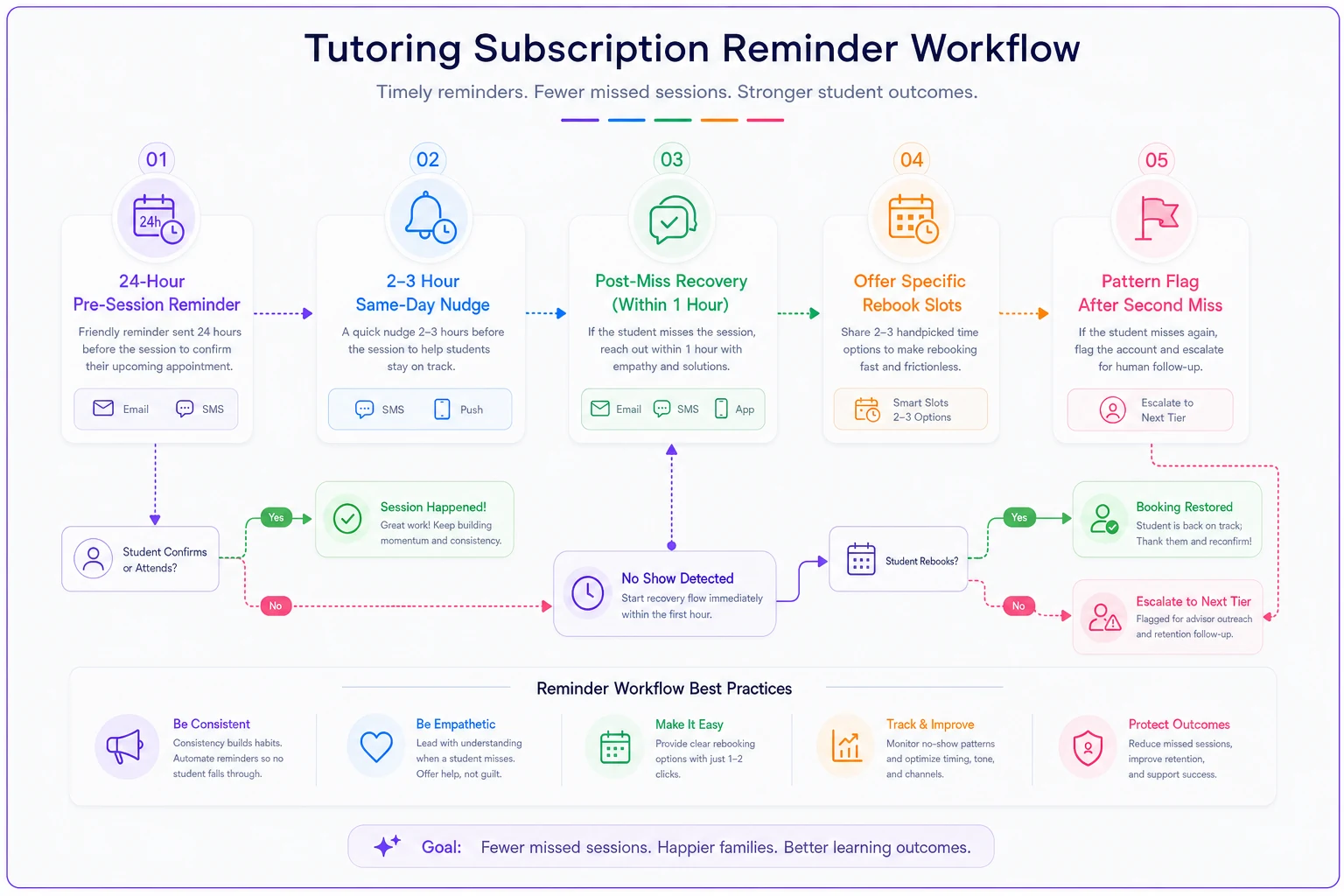
Reminders are the cheapest lever you have, and most centers under-use them by treating a "reminder" as a single event. It's not one message — it's a sequence that changes tone based on what the family does or doesn't do.
-
Standard pre-session reminder — 24 hours out. Neutral, logistical. "Emma's session with Mr. Lee is tomorrow at 4:00."
-
Same-day soft nudge — 2–3 hours out if no confirmation. "Just confirming Emma's 4:00 today — reply C to confirm or R to reschedule."
-
Post-miss recovery — within an hour of a missed session. This is the important one. "We missed Emma today. You have until Friday to rebook this session at no cost — here are open slots."
-
Pattern flag — after a second miss in a billing cycle. Warmer, but names the pattern. "We've had two sessions come up empty this month — want to shift Emma's regular time to something that fits better?"
The post-miss recovery message is where utilization is actually saved or lost. If the only reminder fires before the session, a missed slot just evaporates. The message that offers a specific, easy rebook within a short window is what pulls attendance back. Vague "let us know if you'd like to reschedule" language does almost nothing — you have to hand them open times.
A reminder sequence workflow looks like this.
If you're already running structured no-show messaging, this ties directly into the same logic covered in a tutoring cancellation policy that reduces no-shows without alienating families — the enforcement tiers here sit on top of that policy layer.
Tier 2: Soft-credit caps, and why "soft" is the whole point
Soft-credit caps are the most underrated tier because they solve the rollover problem without ever deleting a family's value.
A hard cap says: "Sessions expire at month end. Use them or lose them." A soft cap says: "You can roll forward up to 2 unused sessions. Beyond that, additional unused sessions don't stack — but nothing you've already banked disappears."
-
Rollover cap of 1–2 sessions on a 4-session monthly plan
-
A 30–45 day expiry window on rolled credits (long enough to feel fair, short enough to protect capacity)
-
Automatic notice at 1 credit remaining before cap — "You have 3 banked sessions and your rollover cap is 2. Book one this week so nothing goes unused."
That distinction matters more than most people expect. Nobody is losing money they think they own. They're just told the ceiling on rollover is 2 sessions, which is a reasonable-sounding limit almost no one argues with.
Families almost never complain about soft caps when the notice arrives before they hit the ceiling. They complain when they discover the cap only after they've already lost something. The entire goodwill outcome hinges on the timing of the warning, not the strictness of the rule.
Warn families before they hit the cap; they rarely complain when warned early.
When soft-credit caps make sense: any subscription where families genuinely intend to use sessions but life gets in the way. That's most tutoring families.
When they're a bad idea: if your plans are essentially "buy in bulk, use whenever" packages sold explicitly as flexible. In that case a rollover cap contradicts the promise, and you'll create friction where none needs to exist.
Tier 3: Booking restrictions — the tier to use sparingly
Booking restrictions are the nuclear option and should be treated that way. This tier limits a family's ability to book future sessions until their utilization recovers or they move to a plan that matches their actual usage.
The point of Tier 3 isn't punishment. It's to force a conversation that should have happened already. When a family is chronically at 40–50% utilization across two or three cycles, the plan is wrong. They're paying for four sessions and living a two-session life. A restriction that says "let's pause new bookings and right-size your plan" is often doing them a financial favor — it just comes with friction attached.
-
Triggered only after 2–3 consecutive cycles below your utilization floor
-
Never a hard lock — instead, "book only up to your rolling average" until usage recovers
-
Always paired with a plan-change offer (downgrade to a 2-session plan, pause, or convert to pay-per-use)
The mistake to avoid: applying restrictions based on a single bad month. One rough cycle is noise. A three-cycle pattern is signal. Enforcing on noise is exactly how you alienate a family that had one hard stretch and was about to bounce back.
When you do restrict, the freed capacity should go somewhere productive. If you keep a proper waitlist, this is where it pays off — the slot you reclaim from an under-utilizing family fills immediately from families actively waiting. The mechanics of that handoff are worth setting up in advance using a proper tutoring waitlist strategy with priority rules and automation flows.
The KPI triggers that move a family between tiers
The whole system falls apart if you're eyeballing who's under-using. You need defined numbers that automatically escalate a family from one tier to the next. A workable trigger set:
-
Utilization rate = sessions attended ÷ sessions included in plan, measured per billing cycle - Above ~85%: no action, Tier 1 reminders only - 65–85%: healthy but worth watching; Tier 1 stays active - Below ~65% for one cycle: soft-credit cap notice (Tier 2 engages) - Below ~60% for 2–3 cycles: booking restriction review (Tier 3 consideration)
-
Rollover balance approaching cap
triggers the "book this week" notice
-
Consecutive misses ≥ 2 in a cycle
triggers the pattern-flag message
-
Renewal proximity + low utilization
a family under 65% within 30 days of renewal should get a plan-fit conversation before the renewal charge, not after
Utilization is a leading indicator of churn, and almost nobody tracks it as one. A family at 55% utilization looks financially fine — they're paying in full. But the gap between what they pay and what they use is exactly the resentment that surfaces at renewal. Catch the drop two cycles early and you can right-size the plan and keep them. Catch it at the cancellation email and you've already lost.
A real scenario: mid-size center, spring slump
A center running around 90 active subscription students noticed spring utilization sliding as sports seasons ramped up. Average utilization across the membership drifted from roughly 82% down to around 68% over two months. Revenue looked stable so nothing flagged internally — but three families quietly canceled at renewal, each citing "we weren't using it enough."
They put in a tiered system the following term. Reminder sequences with same-day nudges and post-miss rebook offers. A soft-credit cap of 2 sessions with a 45-day window and a pre-cap warning. And a utilization report flagging anyone under 65% for two consecutive cycles.
The result wasn't dramatic in a headline-number way, but it was real. Overall utilization climbed back into the high 70s. More importantly, plan-fit conversations moved ahead of renewals instead of after them — a handful of families downgraded from 4-session to 2-session plans rather than canceling outright. Downgraded revenue beats churned revenue every time. The center kept those relationships, and several of those families upgraded again once the sports season ended.
Who should NOT build the full three-tier stack
Not every center needs all three tiers. If you're running a smaller operation — say 20–30 students — and you personally know every family, a formal Tier 3 restriction system is overkill. You can handle right-sizing conversations directly and warmly without any of the automated friction.
Skip or delay booking restrictions if:
-
Your utilization across the base is consistently above 80%
-
Your plans are explicitly sold as flexible-use bulk packages
-
You don't yet have clean per-family utilization data — don't enforce anything you can't measure fairly
For most centers past roughly 40 students, though, the reminder and soft-cap layers are worth building regardless. Those two tiers carry almost all the goodwill benefit and most of the utilization protection, without ever needing the friction of Tier 3.
Pulling it together
Tiered enforcement works because it separates two problems people usually mash together: the awareness problem (families forget or drift) and the structural problem (the plan doesn't fit their life). Reminders and soft caps solve the first one cheaply and without damaging goodwill. Booking restrictions solve the second — but only when the pattern is real and only after the family has had every reasonable chance to correct course on their own.
Track utilization as the number that drives all of it. Set your thresholds, warn early, and always give families an off-ramp before you give them a wall. Do that and you protect your margins without becoming the center every parent complains about at pickup — which, across a few years of renewals, is worth far more than any single reclaimed session.
Tiered enforcement works because it separates two problems people usually mash together: the awareness problem (families forget or drift) and the structural problem (the plan doesn't fit their life). Reminders and soft caps solve the first one cheaply and without damaging goodwill. Booking restrictions solve the second — but only when the pattern is real and only after the family has had every reasonable chance to correct course on their own.
Track utilization as the number that drives all of it. Set your thresholds, warn early, and always give families an off-ramp before you give them a wall. Do that and you protect your margins without becoming the center every parent complains about at pickup — which, across a few years of renewals, is worth far more than any single reclaimed session.
Ready to streamline your tutoring operations?
Join 500+ tutors and centers using Tutoryly to save time, improve scheduling accuracy, and enhance student experiences.