



Your tutoring cancellation policy sits at the intersection of revenue protection and family relationships. Get it wrong and you're either bleeding money from empty slots or watching families leave because your terms feel impossible to work with.
The gap between soft and strict policies isn't really about being nice versus being firm. It's about understanding how families actually operate and building something that works with their reality while still protecting your business.
Most tutoring businesses default to one extreme. They either copy-paste a 24-hour cancellation policy from somewhere online, or they run on vague "just let us know" guidelines that leave everyone guessing. Neither works, because neither actually accounts for what it's like to run a session-based business with real families.
Why Standard Cancellation Windows Create More Problems Than They Solve
The typical 24-hour policy looks clean on paper. Family cancels with less than 24 hours? They get charged. Simple.
Except families don't operate on clean 24-hour cycles. A kid wakes up sick at 6 AM for a 4 PM session—that's 10 hours notice. Technically a violation, but charging them feels wrong. A parent gets called into an emergency work meeting 90 minutes before their child's session. Another technical violation, another uncomfortable call to make.
Every time you have to decide whether to enforce, you're creating friction. Staff spends time debating exceptions. Parents feel uncertain. The policy that was supposed to protect revenue becomes its own administrative headache.
The opposite problem—no clear policy at all—creates a different kind of chaos. When families know they can cancel anytime without consequence, your schedule turns into Swiss cheese. Tutors show up for empty slots. Families who wanted those times couldn't get them. Revenue disappears without any accountability attached.
Soft vs Strict Policies: Understanding the Real Trade-offs
A soft tutoring cancellation policy prioritizes flexibility and relationship preservation. These typically feature shorter notice requirements (4–8 hours), multiple free cancellations per term, broad exception categories, verbal notification, and liberal make-up session offers.
Never miss another tutoring session.
Tutoryly helps you schedule, confirm, and manage every tutoring session efficiently.
- Unified session scheduling
- Automated student notifications
- Tutor calendar & availability management
No credit card required
The numbers on soft policies tell a clear story. Centers running these see cancellation rates between 15–25% of scheduled sessions. If you're running 200 sessions per week, you're losing 30–50 slots regularly. At $60 per session, that's potentially $1,800–$3,000 in weekly revenue volatility-not counting the tutor hours you're still paying for.
What soft policies do well is keep families happy in the moment. Parents appreciate flexibility. They stay longer because they don't feel trapped. Retention looks decent even as utilization rates quietly suffer.
Strict policies flip that equation. They typically require 24–48 hours notice, offer limited or no free cancellations, narrow exception criteria, written notification, and rare credits or refunds.
Centers running strict policies see cancellation rates drop to 5–10%. Same 200 sessions now only lose 10–20 slots. Revenue is more predictable. Tutors know their schedules will hold.
The hidden cost shows up in acquisition and retention. Families shopping around often eliminate strict-policy centers immediately. Those who do join might leave after their first charged cancellation, even if the terms were explained clearly upfront.
The Lead Time Sweet Spot That Families Can Actually Meet
After tracking cancellation patterns across different centers, a clear pattern emerges around 12 hours as the most practical notice requirement. Long enough to potentially fill the slot or reassign the tutor, but short enough that families can realistically meet it.
Here's why 12 hours holds up operationally:
Morning sessions (8 AM – noon): Families know by the previous evening if tomorrow morning won't work. Kids who are getting sick show symptoms by bedtime. Parents know their next-day work schedule.
Afternoon sessions (noon – 5 PM): A 12-hour window means families need to decide by midnight or early morning. Still reasonable for illness or schedule changes that emerge overnight.
Evening sessions (5 PM – 8 PM): Requires morning notification. Parents can assess their day and make the call before leaving for work.
The 24-hour requirement sounds more professional, but it consistently creates enforcement headaches. A child developing symptoms at 10 PM for tomorrow's 3 PM session leaves parents in an impossible position. They can't predict if the kid will feel better by morning, but waiting means violating the policy.
48-hour policies might as well not exist. Families genuinely can't predict that far ahead for the legitimate reasons they cancel. You end up making so many exceptions the policy loses any meaning.
Exact Policy Wording That Removes Ambiguity
Vague language creates operational nightmares. "Reasonable notice" means something different to every family. "Except in emergencies" opens endless debates. The policy language itself needs to do the work.
Standard Cancellation Terms
"Sessions must be cancelled at least 12 hours before the scheduled start time to avoid charges. Cancellations can be submitted via text, email, or through your parent portal.
You receive 2 courtesy cancellations per semester (Sept–Jan, Feb–June) that can be used with less than 12 hours notice without charge. After using both courtesy cancellations, sessions cancelled with less than 12 hours notice will be charged at full rate.
Documented illness (with doctor's note) or school-mandated conflicts (with school communication) are exempt from the 12-hour requirement and do not count toward your courtesy cancellation allowance."
For Group Sessions
"Group session cancellations require 24 hours notice due to minimum enrollment requirements. If a group session drops below 3 students due to late cancellations, remaining families will be offered the option to proceed with a semi-private session at no additional charge, reschedule to another group slot that week, or receive a credit for future use.
Group session courtesy cancellations are limited to 1 per semester."
The specificity eliminates gray areas. Families know exactly what happens. Staff doesn't need to interpret or negotiate on the fly.
Message Templates That Maintain Relationships During Enforcement
The moment of enforcement determines whether a family stays or leaves. Harsh automated messages push families out. Apologetic, inconsistent enforcement undermines the whole policy.
First Late Cancellation (Using Courtesy)
"Hi [Parent Name],
We've received your cancellation for today's 4 PM session. Since this is less than 12 hours notice, we'll apply one of your courtesy cancellations for this semester. You have 1 courtesy cancellation remaining through January.
[Tutor Name] has been notified. If you'd like to schedule a make-up session, please check available slots in your portal or reply to this message.
Thanks for letting us know,
[Your Name]"
Late Cancellation (Courtesy Already Used)
"Hi [Parent Name],
We've received your cancellation for tomorrow's session at 3 PM. Since this is less than 12 hours notice and your courtesy cancellations for this semester have been used, this session will be charged as scheduled.
We understand unexpected situations come up. If this is due to illness or a school conflict, please send documentation and we can review the charge.
Your next scheduled session remains on [date] at [time].
Best,
[Your Name]"
Policy Exception Granted
"Hi [Parent Name],
Thank you for sending the doctor's note for [Student Name]'s illness. We've waived the cancellation charge for yesterday's missed session as per our illness exception policy.
We hope [Student Name] feels better soon. Their next session is scheduled for [date]. Please let us know if you need to adjust the schedule while they recover.
Take care,
[Your Name]"
Slot-Credit vs Refund Handling: The Operational Reality
The choice between credits and refunds shapes both cash flow and family behavior. Most centers default to credits without really thinking through the implications.
Credits keep cash in your business and keep families engaged. A family with $180 in session credits is psychologically committed to using them. They're also more likely to book additional sessions once those credits are gone, even though it's technically their own money they're spending.
Credits do create accounting complexity though. You're carrying liability on your books. Families accumulate credits they forget about, then want to use them all at once during your busiest periods. Some states require you to honor credits indefinitely or treat them like gift cards with specific regulations—worth checking before you set any policy.
Refunds feel cleaner operationally but hurt cash flow and retention. Once money goes back, the psychological commitment drops. They might not rebook. You're also processing reversals, absorbing processing fees, and managing timing.
The middle ground that tends to work best is session banking with expiration.
Cancelled sessions convert to "banked sessions" valid for 60 days. Families can use these for make-up sessions, additional test prep sessions, sibling sessions, or credit toward next month's package.
After 60 days, unused banked sessions convert to account credits at 50% value, valid for 6 months. This creates urgency to use them while preventing indefinite liability on your end.
Here's a quick comparison of how these three approaches shake out in practice:
| Approach | Cash Flow Impact | Retention Effect | Admin Complexity |
|---|---|---|---|
| Full refund | High negative | Low – families disengage | Low |
| Indefinite credit | Neutral short-term | Medium – liability builds | High |
| Session banking (60-day) | Positive | High – creates urgency | Medium |
This creates urgency to use them while preventing indefinite liability on your end.
Automation Rules That Eliminate Manual Tracking
Manual cancellation tracking kills operational efficiency. Staff spends hours trying to remember who cancelled when, which courtesy cancellations were used, and which exceptions were approved. Mistakes lead to disputed charges and damaged relationships.
The right operational software handles the entire flow automatically. Here's how a well-configured system typically works end-to-end:
Cancellation comes in → System timestamps and calculates hours to session → Late flag triggers → Courtesy balance checked → Exception path or charge path → Parent notification sent → Billing updated
Here's a visual of the automation workflow.
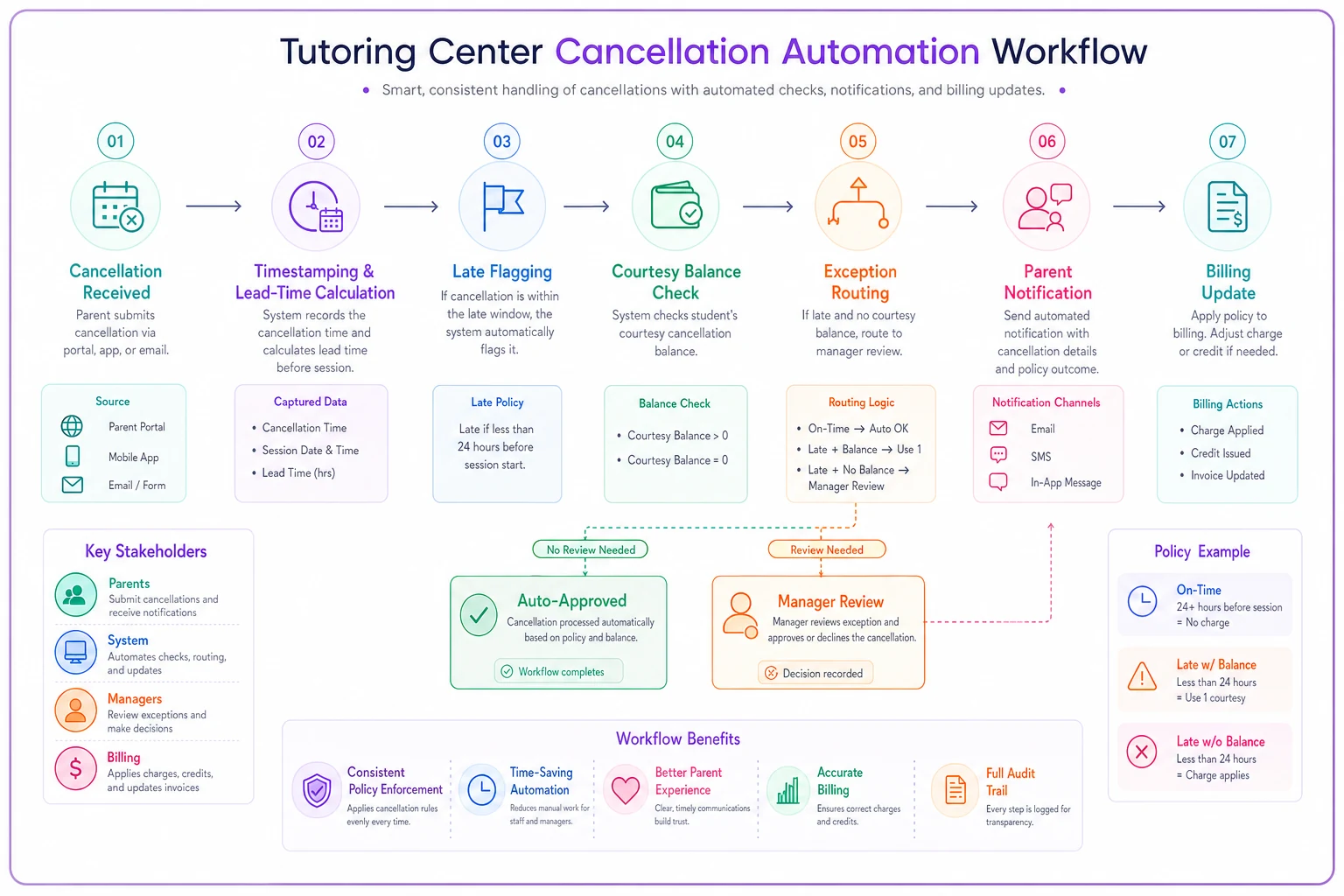
Breaking that down into the specific automation layers:
Cancellation Window Tracking
-
System timestamps all cancellation requests
-
Automatically calculates hours between cancellation and session time
-
Flags late cancellations for policy application
-
Routes exception requests to managers
Courtesy Cancellation Management
-
Tracks usage by semester automatically
-
Sends alerts when families use their first courtesy
-
Notifies when all courtesies are exhausted
-
Resets counters at semester boundaries
Exception Processing
-
Creates exception request tickets for documentation
-
Sets 48-hour response timers for staff
-
Automatically applies approved exceptions
-
Maintains exception history for pattern tracking
Billing Integration
-
Charges applied for late cancellations without remaining courtesies
-
Credits automatically applied for approved exceptions
-
Banked session balances tracked and displayed in the parent portal
-
Expiration warnings sent at 45 and 55 days
When AI-assisted platforms handle this systematically, policies get enforced consistently without staff making individual judgment calls on every cancellation. Families experience predictable, fair treatment. Revenue stops being a guessing game.
Real-World Testing: From 40% to 8% No-Shows
A tutoring center in suburban Denver was dealing with cascading cancellations. Their "just let us know" approach meant Mondays would start with 5–10 cancellation texts for the day. Tutors showed up for empty slots. Families on the waitlist couldn't get sessions.
They implemented a structured 12-hour policy with 2 courtesy cancellations per semester. The key wasn't just writing the policy—it was building the operational system around it.
First month: Cancellation rate dropped from around 40% to roughly 22%. Families started taking sessions more seriously just from having a clear, documented policy.
Second month: After enforcement began and courtesy cancellations started being used, the rate fell to about 15%. Automatic tracking meant no awkward conversations and no inconsistent enforcement.
Third month: Settled around 8–10%. Mostly legitimate illnesses and documented exceptions. Revenue stabilized. Tutors knew their schedules would hold.
What surprised them: families didn't leave because of the stricter policy. Enrollment actually went up because wait-listed families could finally get consistent slots. The center went from barely breaking even to generating predictable margins.
Exception Patterns That Reveal Policy Weaknesses
Your exception requests tell you exactly where your policy breaks down. Track what families ask exceptions for and you'll see the gaps clearly.
"Traffic was terrible" (multiple times): Your location might require longer buffers. Consider 15-minute grace periods or geographic-based adjustments.
"School schedule changed": Build in semester-start flexibility. Many schools adjust schedules in the first two weeks. Consider suspended enforcement during those periods.
"Sibling was sick": Your family-based policies might need work. If one child's illness shouldn't affect another's session, make that explicit. If it should, build it into the policy directly.
"Didn't know about the policy": Your onboarding has gaps. Policies need to be acknowledged during enrollment, not buried on your website.
The exceptions you keep granting consistently should probably just become part of your standard policy. The ones you always deny need better upfront communication.
Building Buffer Zones That Protect Revenue Without Rigidity
Smart policies build in release valves that prevent relationship damage while protecting core revenue. These acknowledge that life happens while keeping operations viable.
Graduated Consequences
-
First late cancellation
Courtesy used, friendly reminder sent
-
Second
Courtesy used, policy review email sent
-
Third
Charged, but with make-up session option at 50% discount
-
Fourth and beyond
Full charge, no make-up discount
Seasonal Adjustments
December: Extend courtesy cancellations by 1 due to holiday chaos. Flu season (Jan–Feb): Illness exceptions don't require doctor's notes. Testing periods: 24-hour requirement drops to 12 hours.
Family-Based Flexibility
Families with multiple enrolled children get 1 extra courtesy cancellation. Long-term families (12+ months enrolled) earn 1 additional courtesy per year. Families who refer others receive courtesy cancellation bonuses.
Auto-track courtesy usage so additional courtesies for multi-child families apply without manual edits.
Loyalty gets rewarded while the policy still protects against abuse.
When Strict Policies Actually Make Sense
Strict 24–48 hour policies with minimal exceptions do make sense in specific contexts—just not everywhere.
High-demand specialized tutoring: When you have waitlists for every slot and specialized tutors who can't be easily reassigned, strict policies protect everyone's access to the service.
Test prep boot camps: Intensive programs with fixed curricula need consistent attendance. Missing sessions disrupts the whole program flow, not just one student.
Premium pricing tiers: Families paying $150+ per session often expect and respect stricter policies. The value exchange is clear enough that it doesn't feel punitive.
Group programs: When other families depend on minimum enrollment to make a session happen, individual flexibility creates real problems for the group.
The key is matching policy strictness to your service model and market position. A neighborhood homework help center needs more flexibility than an elite test prep company. Applying the same policy to both doesn't make sense.
The Hidden Cost of Policy Friction
Every enforcement decision creates a micro-drain on operational energy. Staff debates whether to grant an exception. Managers review disputes. Parents feel uncertain about future cancellations.
-
2–3 hours weekly of management time reviewing exceptions
-
Increased customer service load from policy questions
-
Slower enrollment as families hesitate over ambiguous terms
-
Staff burnout from dealing with upset parents repeatedly
Well-designed policies with automated enforcement reduce these hidden costs significantly. When enforcement is automatic and predictable, the friction mostly disappears. Staff can focus on actual teaching support instead of policy negotiations.
Moving Forward: Implementation Timeline
Don't flip from soft to strict overnight. Gradual implementation prevents family revolt while building new operational habits.
Week 1–2: Communication
Email all families about upcoming policy updates. Explain the why—fairness, tutor scheduling, slot availability for wait-listed families. Highlight the benefits: courtesy cancellations, clear expectations, less ambiguity.
Week 3–4: Soft Launch
New policy applies to new enrollments only. Existing families get 30-day notice. Track cancellations to establish a baseline.
Week 5–8: Transition Period
Policy is active but exceptions granted more liberally. Focus on education over enforcement. Automation systems tested and refined.
Week 9+: Full Implementation
Consistent enforcement begins. Exception patterns tracked. Monthly reviews for policy adjustments.
This staged approach lets families adjust while you refine operations. By week 12 or so, the new normal is established without major disruption.
The Bottom Line on Cancellation Policies
Your tutoring cancellation policy isn't just about protecting revenue—it's about creating predictable operations that actually serve families better. Chaotic schedules hurt everyone, including the families you're trying to be flexible for.
The sweet spot for most tutoring businesses: 12-hour notice requirements, 2 courtesy cancellations per semester, automated tracking, and clear exception criteria. That combination balances flexibility with accountability while keeping operations manageable.
The centers that thrive don't have the strictest or softest policies. They have the clearest ones, backed by systems that enforce them consistently without burning staff energy on individual decisions every day. When families know exactly what to expect and staff doesn't have to negotiate every cancellation, everyone can focus on what actually matters—helping students make progress.
Getting from chaotic cancellations to a predictable schedule doesn't require being harsh with families. It requires being clear about expectations and systematic about enforcement. Get those two things right and your cancellation rate drops while relationships actually improve.
Your tutoring cancellation policy isn't just about protecting revenue—it's about creating predictable operations that actually serve families better. Chaotic schedules hurt everyone, including the families you're trying to be flexible for.
The sweet spot for most tutoring businesses: 12-hour notice requirements, 2 courtesy cancellations per semester, automated tracking, and clear exception criteria. That combination balances flexibility with accountability while keeping operations manageable.
The centers that thrive don't have the strictest or softest policies. They have the clearest ones, backed by systems that enforce them consistently without burning staff energy on individual decisions every day. When families know exactly what to expect and staff doesn't have to negotiate every cancellation, everyone can focus on what actually matters—helping students make progress.
Getting from chaotic cancellations to a predictable schedule doesn't require being harsh with families. It requires being clear about expectations and systematic about enforcement. Get those two things right and your cancellation rate drops while relationships actually improve.
Ready to streamline your tutoring operations?
Join 500+ tutors and centers using Tutoryly to save time, improve scheduling accuracy, and enhance student experiences.