

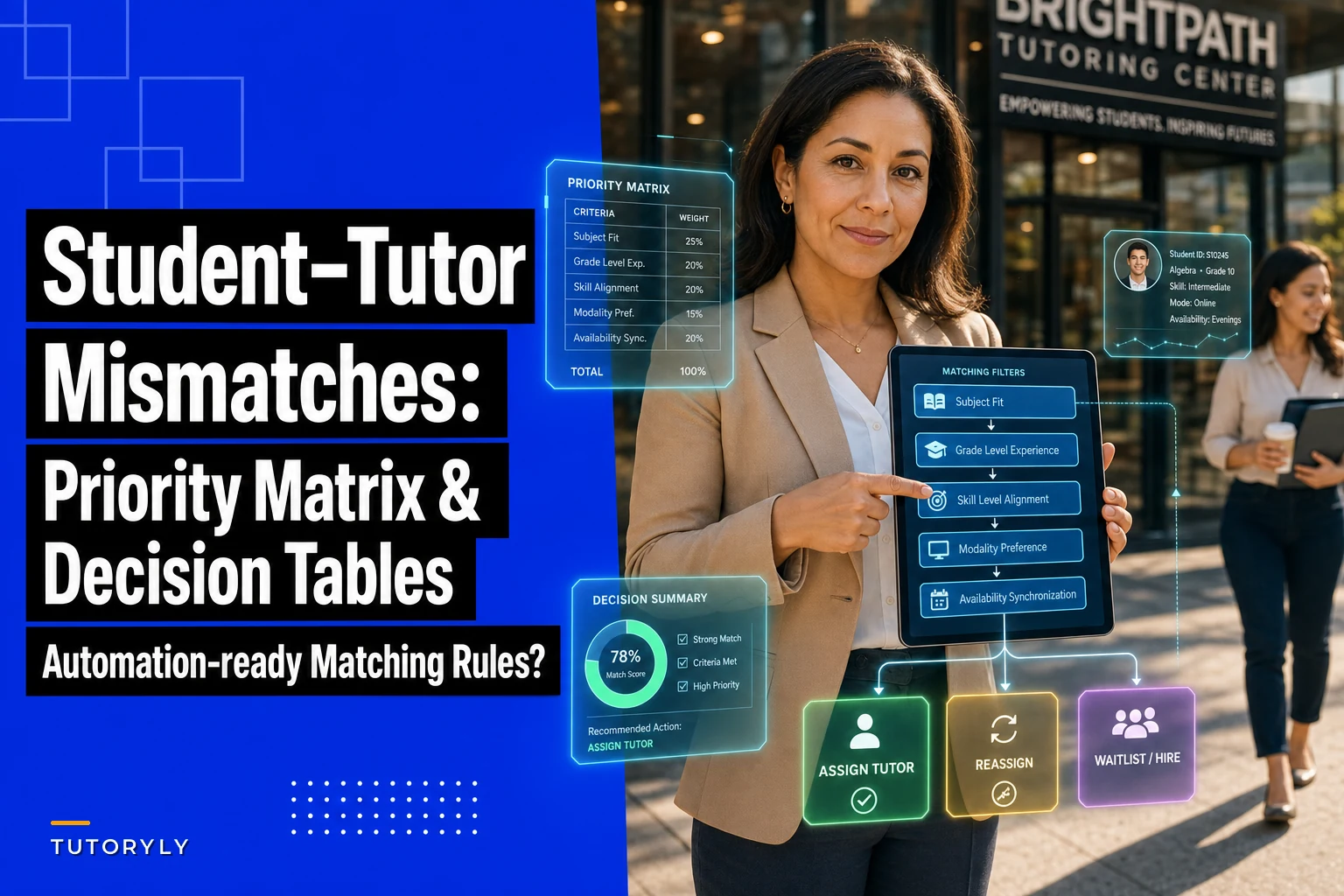

Wrong tutor assignments tank tutoring businesses faster than pricing issues or bad marketing ever could. You get a parent calling Thursday night about their kid's calculus test Monday morning, you quickly assign whoever's available, and two weeks later that family churns because the tutor kept teaching derivatives when the student needed help with basic algebra.
The mismatch problem runs deeper than most tutoring centers realize. It's not just about subject expertise—though that's where most centers stop thinking. A tutor who crushes AP Physics might completely fail with a struggling 9th grader who needs foundational math help. Or you match based on availability alone and end up with a monotone lecturer paired with a hyperactive 7th grader who needs constant engagement.
Why traditional scheduling creates expensive mismatches
Most tutoring operations match students using whatever feels easiest at the moment. Parent calls needing help with chemistry? Check who teaches chemistry. Tuesday at 4pm works? Done. That reactive approach creates a cascade of operational problems that compound over months.
The real cost shows up in your metrics about six to eight weeks later. Students start missing sessions. Parents request different tutors. Your admin team spends hours reshuffling schedules. Tutors get frustrated teaching outside their comfort zone. The family that signed up for three months quietly cancels after one.
What makes this particularly frustrating is that you probably have the right tutor on staff—they're just matched with the wrong student. Your engaging, high-energy SAT tutor is struggling with a quiet middle schooler while your patient, methodical math specialist is trying to keep a test-anxious junior focused on rapid-fire ACT problems.
The process breaks down because most centers treat matching as a one-dimensional problem. They check subject area and stop there. Or they rely on whoever answers the scheduling emails to make gut-feel calls. The coordinator thinks, "Sarah's good with kids," without considering that being good with elementary students doesn't automatically translate to connecting with seniors prepping for college.
Building a priority matrix that actually works
A functional student tutor matching rules system needs five core dimensions evaluated in a specific order. Miss any of them and you're essentially guessing.
Never miss another tutoring session.
Tutoryly helps you schedule, confirm, and manage every tutoring session efficiently.
- Unified session scheduling
- Automated student notifications
- Tutor calendar & availability management
No credit card required
Subject fit comes first but goes beyond just matching "math with math." You need three levels of granularity:
-
Core subject area (Math, English, Science)
-
Specific topic expertise (Algebra 2, Essay Writing, Organic Chemistry)
-
Grade-appropriate experience (Elementary vs Middle vs High School vs Test Prep)
Skill level alignment determines whether learning actually happens. This isn't about the tutor's credentials—it's about their teaching range. A tutor comfortable with remedial through honors students has different capacity than someone who only works with advanced placement. You want to match:
-
Student's current performance level
-
Student's target performance level
-
Tutor's effective teaching range
-
Complexity tolerance on both sides
Teaching modality preference affects engagement more than most centers track. Students have strong preferences that predict retention:
-
Visual learners with whiteboard-heavy tutors
-
Kinesthetic learners with hands-on problem solvers
-
Discussion-based learners with Socratic method tutors
-
Worksheet grinders with structured drill tutors
Availability synchronization needs buffer zones, not just matching time slots. Real availability includes:
-
Primary session windows
-
Makeup session flexibility
-
Pre-test cramming availability
-
Summer schedule compatibility
Language and communication style creates the rapport that keeps families paying. This includes:
-
Primary language fluency
-
Communication formality level
-
Parent interaction comfort
-
Technology platform familiarity
The decision flow works like this: start at Priority 1. If multiple tutors qualify, move to Priority 2. Keep filtering until you have your match. If you hit a level with zero matches, that's your cue to either waitlist the student or hire specifically for that gap.
The decision table that removes guesswork
Here's the exact decision matrix that works across multiple tutoring operations:
| Priority Level | Dimension | Weight | Mismatch Impact | Recovery Options |
|---|---|---|---|---|
| 1 (Mandatory) | Core Subject Match | 40% | Session fails immediately | Must reassign |
| 2 (Critical) | Grade Level Experience | 25% | Poor retention after 2-3 sessions | Tutor coaching possible |
| 3 (Important) | Skill Level Alignment | 20% | Slow progress, family frustration | Supplementary resources help |
| 4 (Valuable) | Modality Preference | 10% | Lower engagement, more cancellations | Tutor adaptation training |
| 5 (Beneficial) | Schedule Flexibility | 5% | Logistics friction | Admin coordination |
This weighted system means you never sacrifice a core requirement for a nice-to-have. A perfect schedule match doesn't matter if the tutor can't actually teach the subject. A friendly personality doesn't compensate for grade-level mismatch.
The decision flow works like this: start at Priority 1. If multiple tutors qualify, move to Priority 2. Keep filtering until you have your match. If you hit a level with zero matches, that's your cue to either waitlist the student or hire specifically for that gap.
Automation rules you can implement tomorrow
Manual matching breaks somewhere around 40–50 active students. Beyond that, you need systematic rules that remove human decision fatigue. These rules translate directly into any scheduling system that supports basic if-then logic.
Rule Set 1: Subject Hierarchy Matching
IF studentneed = "Algebra 2" THEN assigntutor WHERE tutorsubjects CONTAINS "Algebra 2" ELSE IF studentneed = "Algebra 2" AND noexactmatch THEN assigntutor WHERE tutorsubjects CONTAINS "Algebra 1" AND tutor_subjects CONTAINS "Precalculus"
Rule Set 2: Grade Level Boundaries
IF studentgrade <= 5 THEN assigntutor WHERE tutorexperience INCLUDES "Elementary" DO NOT assigntutor WHERE tutorexperience = "High School Only" IF studentgrade >= 11 AND studentneed CONTAINS "Test Prep" THEN prioritizetutor WHERE tutor_credentials INCLUDES "Test Prep Specialist"
Rule Set 3: Skill Level Matching
IF studentassessmentscore < 60% THEN assigntutor WHERE tutorspecialty INCLUDES "Remedial" OR tutorspecialty INCLUDES "Foundation Building" IF studentassessmentscore > 85% THEN assigntutor WHERE tutorspecialty INCLUDES "Advanced" OR tutorspecialty INCLUDES "Enrichment"
Rule Set 4: Availability Optimization
IF studentpreferredtime = "Weekday Afternoon" AND multipletutorsavailable THEN prioritizetutor WITH mostavailability IN studenttimezone IF studentschedule = "Irregular" THEN assigntutor WHERE tutorflexibility_score >= 8
Test these rules on a small new-student cohort before rolling them out to your entire active roster so you can catch edge cases quickly.
These rules stack and interact. A student needing remedial Algebra 2 on Tuesday afternoons triggers multiple filters that narrow your tutor pool systematically, not randomly.
Here's a simple visual of how the automation filters stack and lead to a final assignment or a waitlist/hire decision.
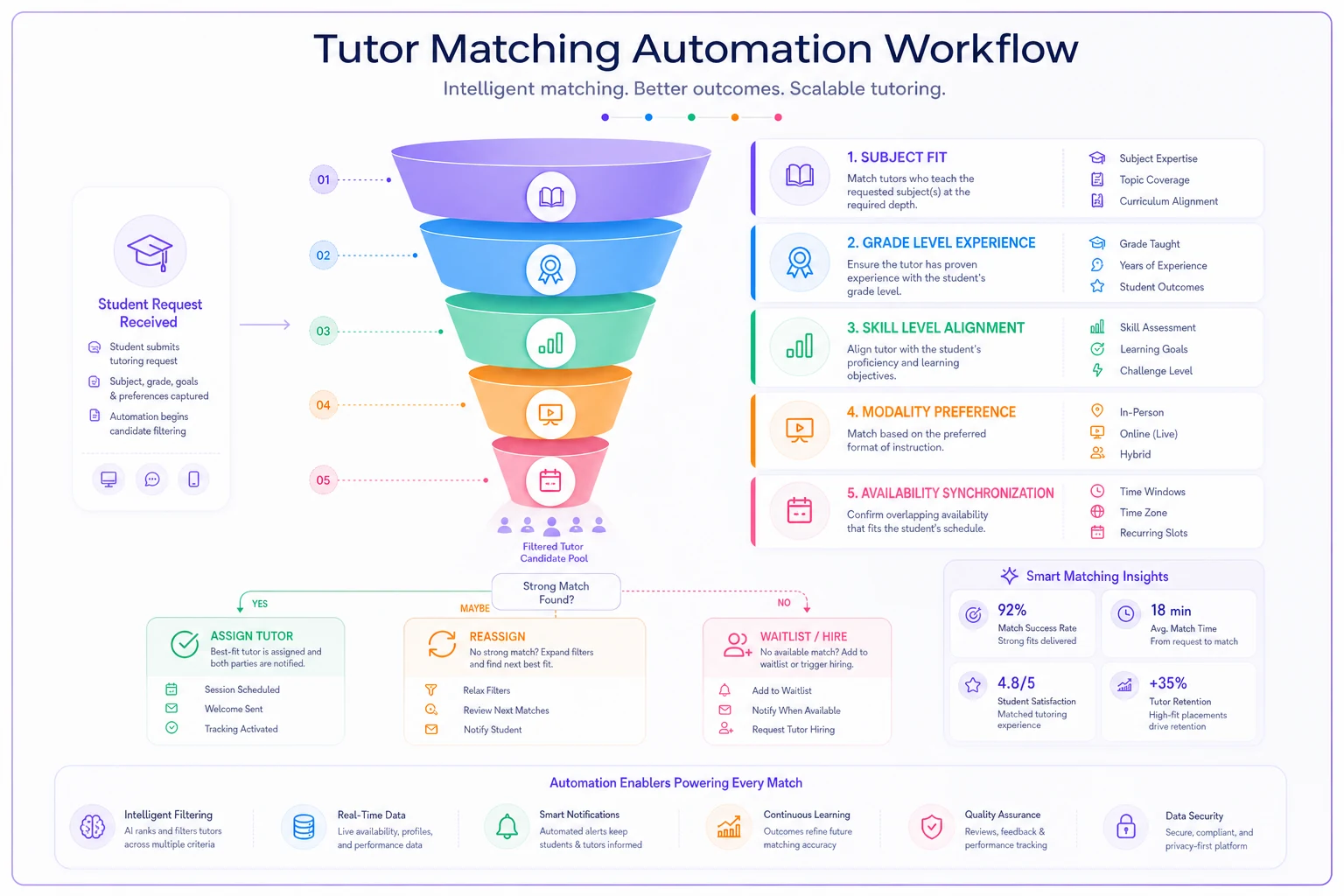
The graphic shows the filter sequence and where the system should stop and escalate if no match exists.
Real-world implementation: one center's 8-week turnaround
A Northern Virginia tutoring center with roughly 120 active students implemented this matrix system after hitting a 31% monthly cancellation rate. They were bleeding around $14,000 monthly from preventable churn.
Weeks 1–2: They audited existing matches and found 40% of students were paired based solely on schedule availability. No consideration for teaching style, skill level, or even specific subject expertise beyond broad categories.
Weeks 3–4: They built their priority matrix and retroactively scored all existing matches. Found that 28 students were significantly mismatched on at least two dimensions. Started gradually transitioning the worst cases to better-aligned tutors.
Weeks 5–6: Implemented the automation rules in their scheduling system. New students were now automatically matched using the five-dimension framework. Admin time on scheduling dropped from about 12 hours weekly to 3.
Weeks 7–8: Results became measurable. Cancellation rate dropped to 14%. Session attendance improved from 78% to 89%. And referral rates climbed—families were actually satisfied enough to recommend others.
By month three, their cancellation rate had stabilized at 8%. The same student volume now generated roughly $11,000 more monthly just from retention improvement. They hadn't added a single new student through marketing. They just stopped losing the ones they had.
Common matching mistakes that seem logical but fail
The "Best Tutor" Trap. Assigning your star tutor to every difficult case overloads them and underutilizes your specialists. Your AP Chemistry expert shouldn't be teaching basic science to middle schoolers just because they're "really good."
The Availability Override. "Just this once" exceptions for schedule mismatches cascade into permanent problems. That Thursday evening slot that "could work sometimes" becomes a weekly cancellation headache.
The Parent Preference Problem. Parents often request characteristics that don't correlate with learning outcomes. Matching learning style and actual expertise matters more for progress than almost anything a parent thinks they want upfront.
The Certification Obsession. Credentials matter less than teaching range. A state-certified teacher might be terrible in one-on-one settings while a college student tutor excels at individual instruction.
The Friendship Factor. Matching based on personality without considering academic alignment creates fun sessions that don't improve grades. Students like their tutor, but parents cancel when report cards don't move.
Measuring match quality beyond retention
Retention tells you about problems after they've already cost you money. Better metrics catch mismatches while they're still fixable.
Session completion rate by tutor-student pair shows engagement. Below 80% means something's wrong—either scheduling, teaching style, or content alignment.
Homework completion between sessions indicates whether the tutor's style resonates. Students do homework for tutors they connect with. They skip it for tutors they merely tolerate.
Parent communication frequency reveals satisfaction. Happy matches generate fewer emails. Constant parent questions mean the match isn't working even if the student keeps showing up.
Assessment score improvement velocity catches skill level mismatches. Properly matched pairs show consistent monthly improvement. Mismatched pairs plateau or improve erratically.
Referral generation by family is the clearest signal of all. Families with well-matched tutors actively refer others. Mismatched families might stay but never recommend.
Track these monthly by cohort. Patterns show up before they become expensive churn events.
Turning matching rules into competitive advantage
Most tutoring businesses treat matching as an administrative task. When you make it an operational priority instead, several things compound in your favor.
Trust builds faster because parents see immediate progress. They stop shopping around. Your cancellation rate drops below industry average. Tutors stay longer because they're teaching within their expertise zones. Referrals climb because families actually have something worth recommending.
The unit economics shift noticeably. Lower churn means higher lifetime value per student. Better matches mean less admin time reshuffling schedules. Happy tutors require less recruiting spend. All from fixing the one process most centers ignore.
This systematic approach to student tutor matching rules also scales. Whether you have 20 students or 200, the same priority matrix and automation rules apply. You're not dependent on one coordinator who "just knows" which matches work. The operation runs on documented logic, not institutional knowledge that disappears when someone quits.
When to break your own matching rules
Rigid rules create their own problems. Here's when to override:
Sibling dynamics sometimes require it. Two kids from the same family might need different tutors even when logistics would be easier with one. Or they specifically need the same tutor for consistency at home.
Crisis situations change the calculus. A student failing multiple classes needs help now, even if the match isn't perfect. A 70% fit today beats waiting three weeks for an ideal one while they fall further behind.
Relationship preservation occasionally matters more than optimization. If a family specifically requests to stay with a tutor despite better options being available, the relationship value might outweigh the theoretical improvement.
Capacity constraints force compromises. During busy seasons, a decent match this week beats a perfect match next month. Just document the compromise so you can revisit when things open up.
The key is making exceptions consciously. Track every override and its outcome. If certain exceptions consistently work, update your rules. If they consistently fail, stop making them.
Building your implementation roadmap
Start with an audit of your current matches. Score each active student-tutor pair on the five dimensions. You'll likely find somewhere between 20–30% are significantly mismatched. Don't panic-fix all of them at once—that creates chaos.
Begin with your highest-value families showing warning signs. These are the ones with multiple siblings enrolled, premium packages, or a history of referring others. Fix those matches first.
Then implement the rules for new students only. Let existing matches play out naturally while ensuring every new student gets properly matched from day one. This stops the problem from growing while you work through the backlog.
Gradually transition problematic existing matches. Frame it as "optimization based on recent assessments" rather than "we matched you wrong." Parents respond well to proactive improvements when they're positioned correctly.
Document everything in a simple spreadsheet initially. Student name, tutor name, match score on each dimension, notes about exceptions. This becomes your training data for understanding what actually works in your specific market.
Once you have 30–40 documented matches using the new system, patterns emerge that let you refine the rules. Maybe your market needs different grade-level boundaries. Maybe language matters more in your area. Adjust based on actual data, not assumptions.
The technology layer that multiplies impact
Manual matching using these rules works but caps out around 100 active students. Beyond that, human error creeps in. Someone forgets to check teaching modality. An exception gets made that cascades into problems. Someone's sick and the backup person doesn't know the nuanced rules.
This is where operational software becomes essential. Modern scheduling platforms can encode your matching rules directly into the assignment workflow. Instead of remembering to check five dimensions, the system enforces them automatically.
The real power comes from continuous optimization. AI-powered platforms track match outcomes and surface rule adjustments based on what's actually happening. They notice that students with test anxiety consistently do better with certain tutor profiles. They flag that your 4pm–6pm Tuesday slots have unusually high cancellation rates regardless of match quality.
These systems also handle complex scenarios that break manual processes—a family with three kids needing different subjects at staggered times, students who need multiple tutors for different subjects, temporary reassignments during tutor vacations. The operational complexity that makes manual matching nearly impossible at scale becomes manageable when the logic is encoded rather than carried around in someone's head.
But the technology only works if your underlying rules are solid. Automation can optimize a good process. It can't fix a fundamentally broken matching approach. That's why getting clear on your student tutor matching rules matters more than jumping straight to software.
Making this work in your tutoring business
Start tomorrow by scoring just five of your current matches. Pick a mix—your best performing, worst performing, and a few average ones. Score them on all five dimensions. You'll immediately see patterns about why certain matches work and others don't.
Build your initial rules based on your best-performing matches. What made those work? Document the characteristics and turn them into requirements for future assignments. Then look at your worst matches and create rules to prevent those combinations.
Within a month, you'll see cancellations drop. Within a quarter, your operation runs more smoothly than it has in a while. Not from marketing harder or repricing, but from solving the fundamental problem that quietly kills tutoring businesses—putting the wrong tutors with the wrong students and hoping personality bridges the gap.
Every well-matched student becomes a potential multi-year client instead of a two-month churn risk. Every satisfied family becomes a referral source. Every happy tutor stays longer and performs better. The centers that systematize matching early build operational stability that competitors can't easily replicate—and that stability creates space to actually grow instead of constantly managing the fallout from poor matches.
Ready to streamline your tutoring operations?
Join 500+ tutors and centers using Tutoryly to save time, improve scheduling accuracy, and enhance student experiences.