


Failed payments in tutoring centers create a uniquely awkward problem. Unlike a gym membership where you can just lock someone out, or a subscription service that stops delivering, tutoring involves actual relationships between tutors and students. You've got kids showing up for sessions while their parents' cards are declining.
The operational mess this creates goes way beyond lost revenue. Tutors keep teaching unpaid sessions because nobody told them to stop. Parents get embarrassed when they find out weeks later. Students lose momentum when services suddenly halt. And your admin staff ends up spending hours chasing payments instead of doing anything useful.
Most tutoring centers handle failed payments reactively—waiting until someone notices, then scrambling to fix it. There's a clear framework that works better. Not perfect, but significantly better than the chaos most places operate in.
Why tutoring payment failures hit differently than other businesses
When a payment fails at the beginning of a month, you might have 8-12 sessions scheduled before anyone catches it. That's potentially $400-800 worth of delivered service with no guarantee of recovery.
The relationship dynamic makes everything worse. Parents trust you with their child's education. Cutting off services feels harsh. But continuing unpaid services trains families that payment is optional. A lot of centers get stuck in this no-win situation, bleeding cash while trying to maintain relationships.
Then there's the billing complexity. Families often have multiple children enrolled, different session frequencies, makeup lessons, and package deals. A failed payment might affect one child's sessions or the entire family account. Without clear rules, staff make different decisions each time, and that inconsistency frustrates everyone involved.
Tutors add another layer. They're usually contractors or part-time employees who count on consistent income. When you eventually suspend services for non-payment, tutors lose scheduled work. Some centers eat this cost to keep tutors happy, which further erodes already thin margins.
The real cost breakdown when payments fail
Payment failures typically cost way more than the missed payment itself. A center with around 200 active students usually sees somewhere between 12 and 18 payment failures monthly—roughly a 6-9% failure rate. Sounds manageable until you calculate the full impact.
Never miss another tutoring session.
Tutoryly helps you schedule, confirm, and manage every tutoring session efficiently.
- Unified session scheduling
- Automated student notifications
- Tutor calendar & availability management
No credit card required
Direct revenue loss averages $2,800-3,500 per month from unrecovered payments. Staff time spent on recovery—calling, emailing, reconciling accounts—adds another 15-20 hours monthly. At $25/hour, that's $375-500 in labor alone.
Service delivery confusion costs even more. When tutors deliver unpaid sessions, you're out the contractor cost (typically 50-60% of session fee) with nothing coming in. Four unpaid sessions at $60 each means $144 in contractor costs and zero revenue. Multiply that across multiple failures and you're looking at real margin erosion.
The relationship damage is harder to quantify. Families who go through payment issues churn at roughly 3x the normal rate. Even when you recover the payment, the awkwardness often leads to non-renewal—and that lost lifetime value can reach thousands per family.
Building a billing-cycle aligned dunning system
An effective dunning system starts with aligning everything to your billing cycle. Most tutoring centers bill monthly on the 1st or 15th, but your dunning calendar needs to account for session schedules, payroll dates, and how parents actually prefer to communicate.
The foundation is a clear retry schedule. First retry at 2 days after initial failure catches temporary issues—expired cards, insufficient funds right before payday. Second retry at day 5 targets midweek when most people handle personal finances. Third retry at day 8 gives one more automated attempt before a human needs to get involved.
Retries alone aren't enough. You need graduated communication that escalates appropriately without burning relationships. Each retry needs a corresponding message that acknowledges the situation without feeling like a collections agency.
Your dunning calendar also needs defined decision points. Day 10 requires human review. Day 15 triggers suspension protocols if still unresolved. Day 20 initiates formal collections or write-off procedures.
| Day | Action | Message Type | Decision Required |
|---|---|---|---|
| 0 | Initial charge | Failure notification | None |
| 2 | Retry #1 | Friendly reminder | None |
| 5 | Retry #2 | Problem-solving tone | None |
| 8 | Retry #3 | Urgency increase | None |
| 10 | Human review | Personal outreach | Continue/pause/plan |
| 15 | Service decision | Clear consequences | Suspend/extend |
| 20 | Final action | Formal notice | Collect/write-off |
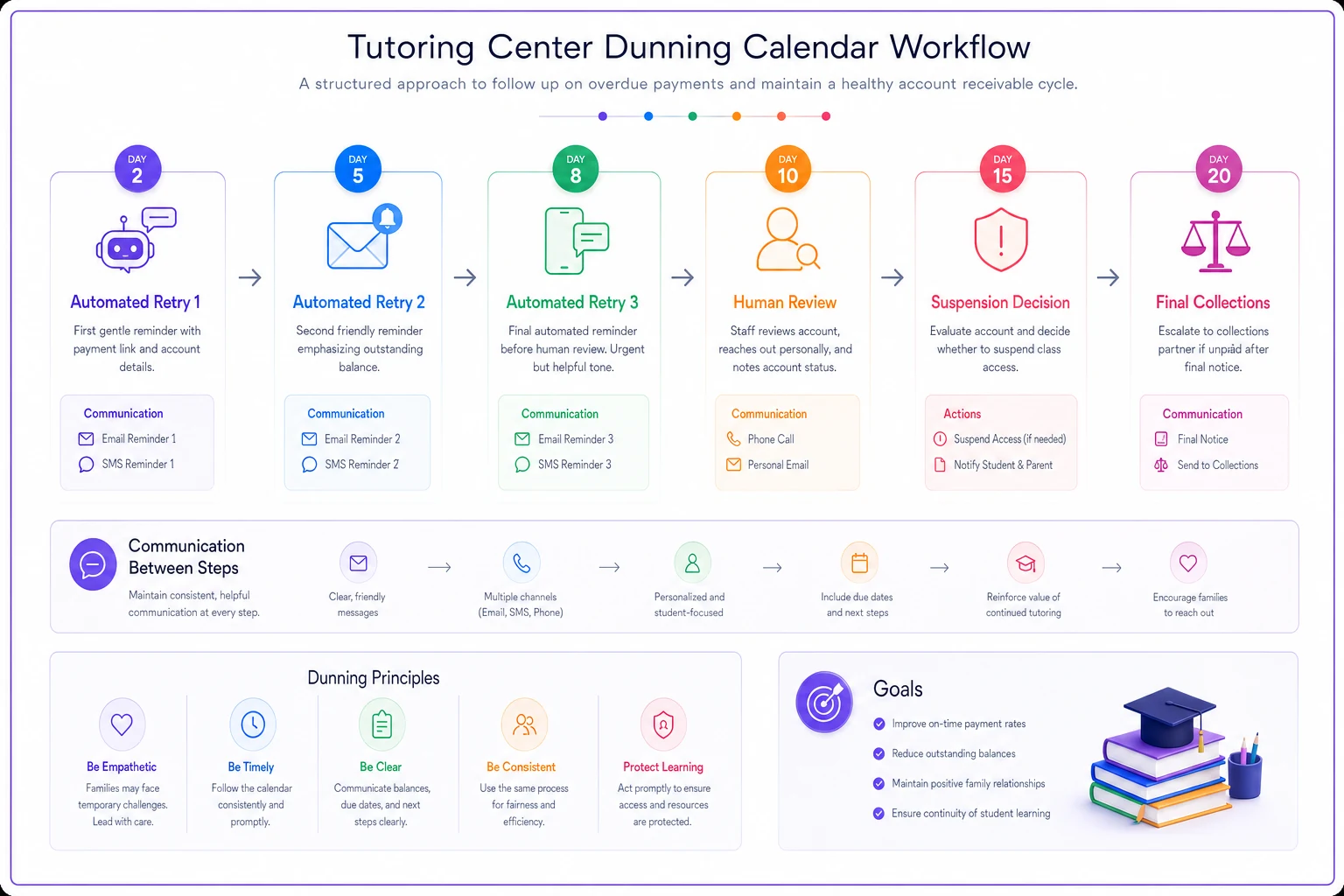
This visual maps the retry schedule and decision points so teams can follow the flow without guessing.
Email and SMS scripts that maintain relationships while collecting payments
The messaging around failed payments determines whether you recover the revenue and keep the client. Too aggressive and you lose families. Too passive and you train non-payment behavior.
Day 2 - Friendly Reminder Email: Subject: Quick heads-up about your TutorCenter payment Hi [Parent Name], Your payment for [Child]'s tutoring this month didn't go through—probably just a card issue or timing thing. We'll automatically retry in a couple days, but if you want to update your payment method now, here's the link: [Update Payment] [Child] is doing great with [Tutor Name], and we don't want any interruption to their progress. Thanks, [Your Name]
Day 5 - Problem-Solving SMS: Hi [Parent Name], still having trouble processing your TutorCenter payment. Different card needed? Reply CALL if you'd like us to help sort this out. [Child]'s next session is [Day].
Day 8 - Increased Urgency Email: Subject: Action needed: [Child]'s tutoring sessions Hi [Parent Name], We've tried processing your payment three times now without success. To keep [Child]'s tutoring on schedule, we need this resolved by [Date]. Options:
-
- Update payment method
[Link]
-
- Call us to discuss alternatives
[Phone]
-
- Reply with questions
Without payment by [Date], we'll need to pause [Child]'s sessions, which would disrupt their learning momentum. Let's figure this out together. [Your Name]
Day 10 - Personal Outreach Call Script: "Hi [Parent Name], it's [Your Name] from TutorCenter. I wanted to personally reach out about the payment issue we're having. I know these things happen—what's the best way we can work this out? [Child] is making great progress and we want to keep that momentum going."
Each message acknowledges the relationship while creating appropriate urgency. You're partnering with parents to solve a problem, not demanding money.
The reconciliation checklist that prevents service delivery chaos
Payment failures create downstream operational chaos if you don't have clear reconciliation processes. Sessions get delivered without payment. Tutors don't get informed about suspensions. Makeup lessons compound the confusion.
Start with a daily reconciliation routine. Every morning, someone reviews:
-
- Previous day's failed payments
-
- Upcoming sessions for accounts in dunning
-
- Tutor schedules that might be affected
-
- Family accounts with multiple services enrolled
This prevents the nightmare of realizing two weeks later that you've delivered $800 in unpaid sessions.
Your reconciliation checklist needs specific triggers:
Daily Check (5 minutes):
-
- [ ] Review overnight payment failures
-
- [ ] Flag affected sessions for next 48 hours
-
- [ ] Note families with multiple children affected
-
- [ ] Check for previous payment issues
Day 5 Review (15 minutes):
-
- [ ] List all unresolved failures from day 0-2
-
- [ ] Calculate delivered service value at risk
-
- [ ] Identify high-value accounts needing personal attention
-
- [ ] Prepare suspension notices if needed
Day 10 Deep Dive (30 minutes):
-
- [ ] Full account review for each failure
-
- [ ] Calculate total exposure per family
-
- [ ] Assess relationship value vs. payment risk
-
- [ ] Document decision rationale
-
- [ ] Notify affected tutors of potential changes
Day 15 Suspension Protocol:
-
- [ ] Confirm all recovery attempts exhausted
-
- [ ] Calculate final amount owed
-
- [ ] Notify tutor with 24-hour warning
-
- [ ] Send formal suspension notice to parent
-
- [ ] Block future session bookings
-
- [ ] Document entire history for potential collections
This kind of systematic approach stops small payment issues from turning into major operational problems.
Decision framework: when to suspend vs. offer payment plans
The suspend-or-support decision makes or breaks your recovery rates and retention. Rigid policies lose good families going through temporary struggles. Too much flexibility and you train payment problems across your whole base.
Start by categorizing families:
Green Flags (Offer Payment Plan):
-
- Payment history of 6+ months without issues
-
- Proactive communication about the problem
-
- Specific timeline for resolution
-
- Multiple children enrolled
-
- High session frequency (3+ weekly)
Yellow Flags (Case-by-Case):
-
- 3-6 months payment history
-
- Sporadic previous issues but recovered
-
- Single child enrolled
-
- Lower session frequency
-
- Partial payment attempted
Red Flags (Suspend Services):
-
- Previous payment plans defaulted
-
- No response to outreach attempts
-
- History of disputes or chargebacks
-
- Less than 3 months as a client
-
- Pattern of payment delays
Categories don't make decisions by themselves though. You need clear criteria for payment plans that actually hold up.
A functional payment plan for tutoring services should span 2-4 weeks maximum. Longer plans rarely succeed and create ongoing administrative drag. Structure them as:
-
- 50% immediately to restart services
-
- 25% in one week
-
- 25% in two weeks
-
- Current month paid in full upfront
This works because it demonstrates commitment while giving families some breathing room. Families who can't meet these terms usually can't sustain tutoring expenses long-term anyway.
Document every payment plan clearly:
-
- Total amount owed
-
- Payment schedule with specific dates
-
- Consequences of missing payments
-
- No second payment plans for 12 months
-
- Services continue only with current payments
The documentation protects both parties and prevents the kind of misunderstandings that damage relationships long after the money is resolved.
Recovery metrics that actually matter
Most tutoring centers track the wrong recovery metrics. Collection rate percentage sounds important but doesn't reflect operational impact. You need metrics that drive behavior and protect margins.
-
Recovery Speed Index
Days between failure and recovery. Target: 6-8 days average. Beyond 10 days, recovery rates drop sharply and relationship damage increases. This metric pushes quick action over prolonged chasing.
-
Service Delivery Exposure
Dollar value of services delivered while payment is pending. Target: Less than $150 per failure. This prevents delivering weeks of unpaid sessions before anyone notices.
-
Payment Plan Success Rate
Percentage of payment plans completed successfully. Target: Above 70%. Below this, your qualification criteria probably need adjustment.
-
Tutor Impact Hours
Hours of tutor schedule disrupted by payment issues. Target: Less than 2% of total scheduled hours. This surfaces operational friction beyond just revenue numbers.
-
Voluntary Recovery Rate
Percentage of failures resolved without manual intervention. Target: 60-65%. Higher means your automated messages are working. Lower means better scripts or different timing.
Real recovery performance in a 200-student center might look like:
-
- Month 1
15 failures, 11 recovered, average 7 days, $1,800 exposure
-
- Month 2
12 failures, 10 recovered, average 6 days, $1,400 exposure
-
- Month 3
13 failures, 11 recovered, average 5 days, $1,100 exposure
The trend matters more than the absolute numbers. Improving recovery speed and reducing exposure protects margins even if recovery rate stays flat.
Automation opportunities that solve the consistency problem
The biggest operational gap in payment recovery isn't the process—it's consistency. Different staff handle situations differently. Busy periods mean missed follow-ups. Personal relationships cloud judgment.
Automate the predictable pieces first. Payment retry schedules should run automatically based on your billing cycle. No human should manually process retry attempts or try to remember when to try again.
Automate retry attempts and the Day 2/5/8 messaging so staff can focus on relationship decisions.
Communication sequences benefit enormously from automation. The Day 2 friendly reminder? Automatic. Day 5 SMS? Automatic. Day 8 urgency email? Automatic. Staff should focus on personal outreach and actual decisions, not routine messages.
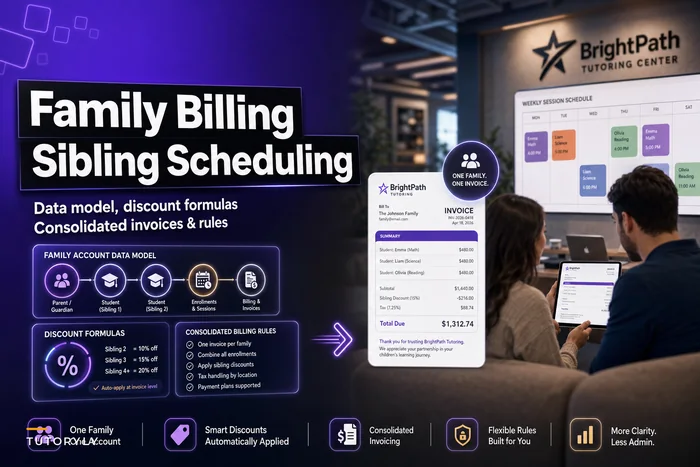
This is where having solid operational software pays off. Platforms built to handle consolidated billing scenarios for families with multiple children can automatically flag all affected services when one payment fails, calculate total exposure across a family account, and adjust communication accordingly—without anyone manually piecing it together.
Session scheduling integration prevents the delivered-but-unpaid problem. When an account enters dunning status, upcoming sessions get flagged automatically. At suspension point, the system blocks new bookings without manual intervention.
The decision points still need human judgment, but automation provides the information needed to make good decisions quickly. Dashboards showing payment history, lifetime value, and current exposure let staff assess each situation in seconds rather than digging through spreadsheets.
Most importantly, automation creates an audit trail. Every retry, every message, every decision gets logged. This protects you in disputes and helps identify what's working over time.
Warning signs your current approach is failing
Some tutoring centers don't realize their payment recovery process is broken until they're deep in a cash flow problem. A few early warning signals worth watching:
-
Sessions continuing despite non-payment for over a week indicates process breakdown. Staff might be making undocumented exceptions, or your reconciliation isn't catching failures fast enough.
-
Tutors asking about payment status means your communication flow has gaps. They shouldn't be finding out about suspensions from parents or wondering why sessions got cancelled.
-
Wide month-to-month swings in recovery rate suggest inconsistent execution. Some variation is normal—swings from 50% to 80% point to process problems, not market conditions.
-
Parents surprised by suspension notices reveals a communication failure. Every suspension should follow multiple attempts and clear warnings. Surprise means your messages aren't getting through or aren't clear enough.
-
Staff spending more than 10% of their time on payment issues signals manual process overload. Recovery shouldn't dominate operational time.
Recovery shouldn't dominate operational time.
A real tutoring center's transformation
Park Heights Tutoring ran 180 active students across math, reading, and test prep. Their payment failure rate hit 8% monthly, but recovery averaged only 45%. The owner was spending 15 hours monthly on payment chase while still losing around $3,200 in unrecovered revenue.
The breaking point came when they discovered they'd delivered three weeks of SAT prep sessions to a family whose payment had failed on day one—$1,200 in services with a tutor who needed to get paid regardless.
Implementing the structured dunning calendar changed things fairly quickly. Clear retry schedules meant about 60% of failures resolved automatically within 5 days. The decision framework helped identify which families deserved payment plans versus suspension.
-
- Recovery rate increased to 78%
-
- Average recovery time dropped to 6 days
-
- Service delivery exposure fell from $4,100 to $1,200 monthly
-
- Staff time on payment issues dropped by 65%
-
- Monthly revenue recovered increased by $2,100
But the biggest win was operational calm. Tutors knew they'd get notified about changes. Parents appreciated the professional but understanding approach. Staff followed clear protocols instead of making gut calls each time.
Making your dunning system work with your pricing structure
Your dunning approach needs to align with how you actually price and package your tutoring services. Package deals and prepaid sessions create different recovery challenges than month-to-month billing.
For monthly recurring billing, the calendar approach described above works directly. But many centers offer packages—10 sessions for $550, semester-long programs, or intensive test prep courses. These need modified approaches.
Package payment failures require faster action since the upfront amount is larger. Your retry schedule might compress to days 1, 3, and 5, with suspension by day 7. The financial exposure is too high for extended dunning periods.
Prepaid session packages that fail mid-delivery create unique challenges. You might have delivered 3 of 10 sessions when payment fails. Your decision framework needs clear rules: suspend at session 4, offer a payment plan for the remaining 7 sessions, or convert to higher-priced drop-in rates.
Academic term-based billing affects your dunning timing too. Payment failures in week 1 of a semester need aggressive recovery. Failures in week 10 might warrant more flexibility since the term is ending anyway.
Consider how different service tiers affect recovery priorities. High-value test prep at $120/hour deserves more aggressive recovery efforts than homework help at $35/hour. Your staff time investment should match the revenue actually at risk.
Preventing payment failures before they happen
The best payment recovery is prevention. A few simple operational changes can reduce your failure rate by 30-40%, which eliminates a lot of downstream chaos entirely.
Two weeks before a card expires, send a friendly update request. Most parents appreciate the heads-up and update proactively.
-
- Card update campaigns before expiration catch the most common failure type.
-
- Payment method diversity reduces overall risk. Offering ACH alongside cards gives families options—ACH fails less frequently and typically costs less in processing fees. Some centers incentivize ACH with a small discount.
-
- Clear billing date communication sets expectations. Parents should know exactly when charges process, how much, and for what services. Surprise charges trigger disputes and sometimes deliberate failures.
-
- Grace period positioning helps families plan around it. "Payments process on the 1st with a 5-day grace period" feels more flexible than "Payment due on the 1st," even though the operational outcome is identical.
-
- Regular payment health checks identify problems early.
If a family pays late twice in a row, that's worth a brief conversation before it becomes a failure pattern.
From payment chaos to operational control
Payment failures don't have to create operational chaos. A billing-aligned dunning calendar, clear communication scripts, systematic reconciliation, and data-driven decision rules together transform a major stress point into a managed process.
The balance matters. Let systems handle the routine—retries, standard messages, basic tracking. Reserve human effort for relationship decisions—payment plans, personal outreach, unusual circumstances.
Most tutoring centers see meaningful improvement within 60 days of implementing structured dunning processes. Recovery rates improve, but more importantly, the operational friction disappears. Tutors stay informed, parents feel supported rather than pressured, and staff stop wasting time on payment detective work.
The metrics tell the story, but the daily experience is what actually sells the value. Instead of scrambling when payments fail, you execute a proven playbook. Instead of awkward conversations, you follow tested scripts. Instead of delivered-but-unpaid services, you have clear suspension triggers.
This isn't about being harsh with families or prioritizing money over education. It's about building sustainable operations that let you focus on what matters—helping students succeed. When payment recovery runs smoothly in the background, your team can concentrate on matching students with the right tutors, improving educational outcomes, and growing the center.
The centers that thrive long-term treat payment operations as seriously as educational quality. Both directly impact your ability to serve families and keep your business running.
Ready to streamline your tutoring operations?
Join 500+ tutors and centers using Tutoryly to save time, improve scheduling accuracy, and enhance student experiences.