

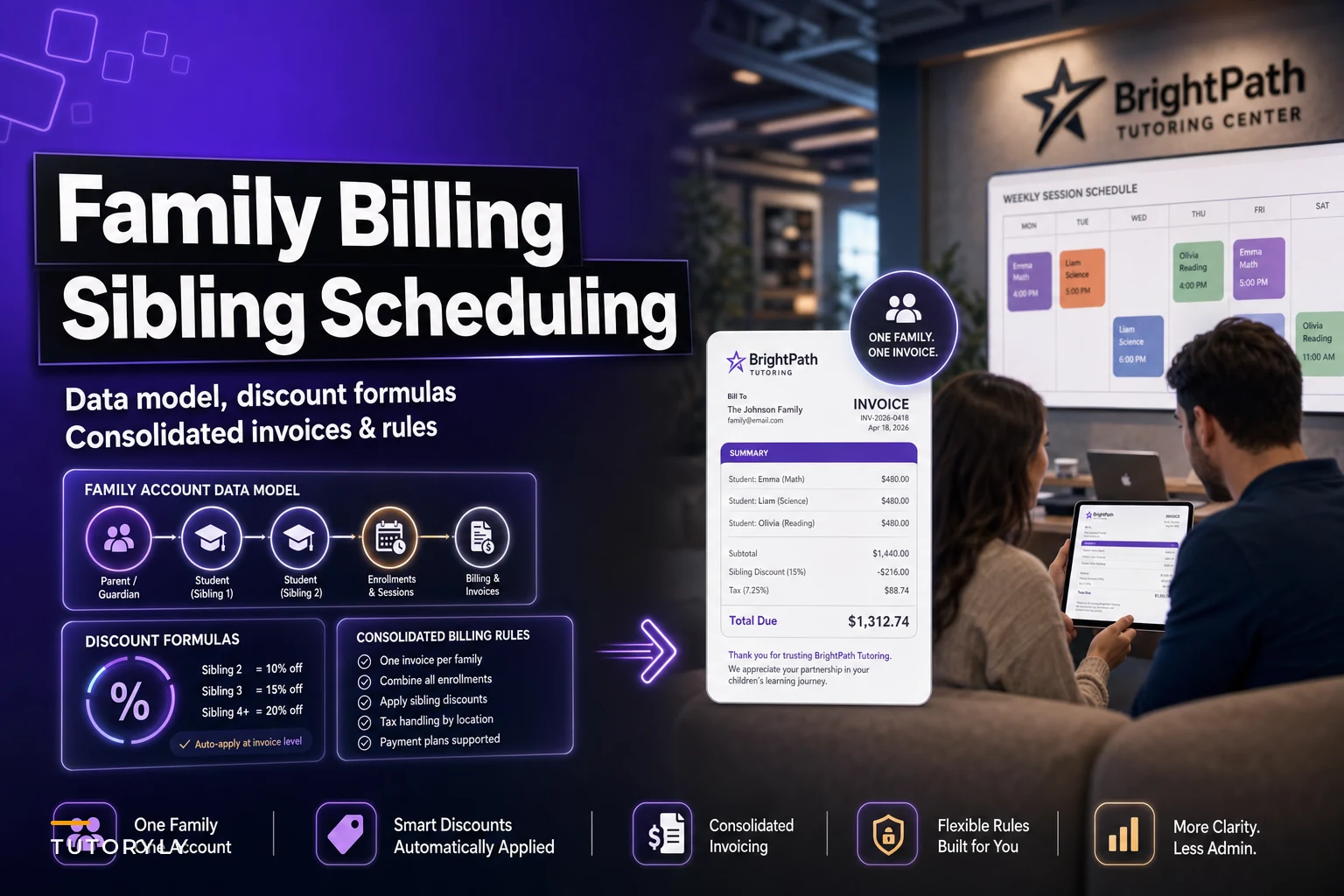

Running a tutoring center means dealing with families. Not single students—families. And families with multiple kids create operational chaos that most centers handle badly. You end up with three separate invoices for the Johnson family, conflicting schedule requests between siblings, and discount calculations that make your head spin.
The worst part? Parents expect you to handle this smoothly. They want one invoice, coordinated schedules, and automatic sibling discounts. Meanwhile, you're manually tracking which kids belong to which family in a spreadsheet that breaks the moment something changes.
The family account structure that actually works
Centers that get this right use a parent-child data structure where the family account sits above individual student profiles. It sounds obvious, but most centers don't actually build it this way.
Think of it like this: The Martinez family has one master account. Under that account live three student profiles—Sofia (grade 10), Carlos (grade 8), and Isabella (grade 6). Each student has their own academic data, progress tracking, and tutor assignments. But billing, communication, and major scheduling decisions flow through the family account level.
This isn't just organizational preference—it's operational necessity. When Mrs. Martinez calls to reschedule all three kids because of a family event, you need to see all three schedules at once. When you send the monthly invoice, it needs to show all three students with proper discounts applied. When Carlos drops out but Sofia and Isabella continue, the discount structure needs to adjust automatically.
Most centers try to fake this with tags or custom fields. They'll mark students as "Martinez Family" in their CRM and hope someone remembers to check for siblings when scheduling or billing. It never works. By month three, you've got duplicate family accounts, orphaned student records, and billing disasters that take hours to untangle.
Building your discount formula without creating billing nightmares
Nobody tells you this about sibling discounts: the formula matters less than the implementation. A 10% discount for the second child sounds simple until you realize someone needs to track which child is "second" and what happens when the first child pauses lessons during exam season.
Never miss another tutoring session.
Tutoryly helps you schedule, confirm, and manage every tutoring session efficiently.
- Unified session scheduling
- Automated student notifications
- Tutor calendar & availability management
No credit card required
-
First child
Full price
-
Second child
10% discount
-
Third+ children
15% discount each
The discount applies to the lower-priced services first. If Sofia takes $80/hour SAT prep and Carlos takes $60/hour algebra tutoring, Carlos gets the discount. This prevents families from shuffling kids around to maximize discounts on more expensive services.
Some centers try flat-dollar discounts ($10 off per additional sibling) thinking it's simpler. It's not. Percentage discounts scale naturally as you raise prices. Flat discounts require manual updates every time you adjust rates, and someone always forgets, leading to months of incorrect billing.
The real complexity comes from edge cases. What happens when one sibling takes summer off but plans to return in fall? Do they lose their discount position? What if a family adds a third child mid-month? Most centers handle these situations differently every time, which creates billing inconsistencies that parents notice and question.
Consolidated invoices that parents actually understand
Parents receive a flood of emails daily related to their kids' activities. Your invoice needs to be immediately readable or it ends up in the "deal with later" pile that never gets dealt with.
Family Summary Section
-
Total due
$742.00
-
Payment due date
March 1, 2024
-
Applied credits
-$50.00
-
Previous balance
$0.00
Individual Student Breakdown
Sofia Martinez - SAT Prep 4 sessions @ $80/hour = $320.00 Discount (0%) = $0.00 Subtotal: $320.00 Carlos Martinez - Algebra II 4 sessions @ $60/hour = $240.00 Sibling discount (10%) = -$24.00 Subtotal: $216.00 Isabella Martinez - Reading Support 4 sessions @ $55/hour = $220.00 Sibling discount (15%) = -$33.00 Subtotal: $187.00
Payment History
-
Previous payment received
Feb 1, 2024
-
Amount
$715.00
-
Method
ACH transfer
Notice what's not there? Line items for individual sessions. Parents don't need to see that Isabella had tutoring on the 3rd, 7th, 14th, and 21st. They need to see the total picture—what they're paying per child and why.
The consolidated structure also solves the credit allocation problem. When the Martinez family has a $50 credit from a cancelled session, it applies at the family level, not to a specific child. This prevents the awkward conversation about why Sofia's cancelled session created a credit that can only be used for Sofia's future sessions when mom wants to put it toward Carlos.
Schedule coordination rules that prevent parent meltdowns
A parent with three kids in tutoring wants them all on Tuesday/Thursday or all on Monday/Wednesday. She doesn't want to drive to your center at separate times across the week. But coordinating sibling schedules creates a level of complexity that most scheduling systems genuinely can't handle well.
Priority 1: Same-day scheduling When possible, schedule siblings on the same days, even if times don't perfectly align. Parents would rather wait 30 minutes between sessions than make two separate trips.
Priority 2: Back-to-back when possible If tutor availability allows, schedule siblings consecutively. Sofia from 4-5pm, Carlos from 5-6pm works better than sessions with a two-hour gap between them.
Priority 3: Age-appropriate grouping Elementary kids can sometimes share homework help sessions. Middle schoolers need individual attention. High schoolers need one-on-one, especially for test prep.
Designate 'family days' on your scheduler (e.g., Tuesdays/Thursdays) to simplify multi-child bookings and give families predictable options.
Where this breaks down in practice: tutor availability. Your SAT specialist who works with Sofia might only be available Mondays and Wednesdays. The math tutor for Carlos works Tuesday through Friday. Unless you have real tutor depth, perfect sibling coordination stays a fantasy.
The compromise that actually works: designate certain days as "family days" where you cluster tutor availability. Tuesdays and Thursdays become your multi-sibling days with broader coverage. Families with multiple kids get scheduling priority on these days. Single-student families fill in elsewhere.
This sounds restrictive, but it creates predictable patterns. Parents know Tuesday/Thursday gives them the best shot at coordinated scheduling. Tutors know these days require flexibility. Your scheduler stops playing impossible Tetris trying to accommodate every family's preferred time slot.
Sample billing cycles that reduce payment friction
Monthly billing seems logical until you realize it creates 12 opportunities per year for payment failures, disputes, and cancellations. Centers with the least billing friction tend to use a hybrid approach:
Academic Year Package (September-May)
-
36 weeks of instruction
-
Divided into 9 monthly payments
-
Includes built-in breaks for holidays
-
Auto-adjusts for snow days and cancellations
Summer Intensive (June-August)
-
Separate 8-week program
-
Higher frequency, shorter duration
-
Paid upfront or in 2 installments
-
Different pricing structure
This split makes sense because family dynamics genuinely change between the school year and summer. During the school year, you're supplementing classroom learning with consistent weekly sessions. Summer often becomes intensive catch-up or advancement work with different scheduling needs altogether.
For family billing specifically, synchronized billing cycles across all siblings matter a lot. Nothing frustrates parents more than receiving separate charges on different days because their kids started at different times. When a second or third child enrolls mid-cycle, prorate their first month to align with the family billing date.
A real scenario: The Chen family enrolls their eldest in September. In November, they add their younger child. Instead of billing the younger child on the 15th of each month based on their start date, you prorate November and December so everyone lands on the same January 1st cycle. Yes, it adds some complexity upfront. But it prevents months of confused parent emails asking why they got charged twice.
The data model that makes this possible
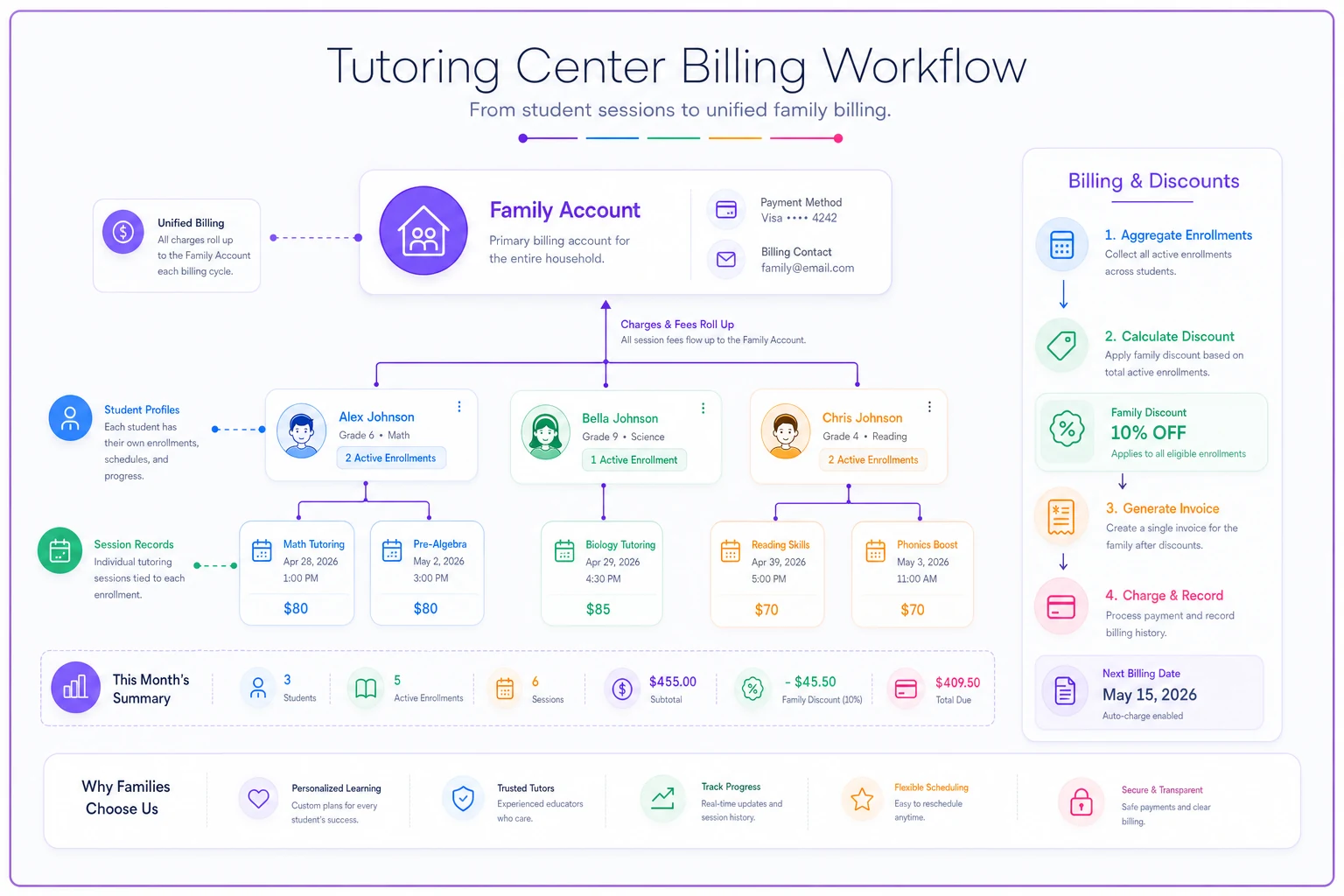
Bad data structure creates permanent operational friction. You need three interconnected entities:
| Entity | Fields |
|---|---|
| Family Account | Primary contact info; Billing method; Discount rules; Payment history; Communication preferences |
| Student Profiles (linked to Family Account) | Academic information; Learning goals; Tutor assignments; Progress tracking; Attendance records |
| Session Records (linked to Student Profiles) | Date/time; Tutor; Subject/topic; Duration; Notes; Billing status |
This seems obvious but most tutoring centers grow organically using spreadsheets or basic CRMs that don't support proper relationship mapping. They end up with duplicate parent records, orphaned student profiles, and no clean way to connect siblings without manual work.
Here's a quick visual of the workflow that ties family accounts to students and sessions.
One critical decision: should inactive students remain linked to active family accounts? Yes, always. When Carlos takes a break for soccer season but Sofia continues, Carlos stays in the family structure as "inactive." This preserves discount calculations, makes reactivation easy, and keeps historical data intact.
Common family billing disasters and their fixes
The "Who gets the discount?" dispute This happens when parents assume discounts apply to the most expensive service while your policy applies them to the cheapest. Clear documentation during initial family onboarding prevents this. State explicitly in your intake process that discounts apply to lower-cost services first.
The "My kids have different last names" problem Blended families create data chaos when systems assume shared surnames. Your family account structure needs to handle different last names, multiple parent contacts, and complex custody arrangements. Don't assume mom's last name matches the kids' or that all siblings share a surname.
The "Summer break discount preservation" mess When one child pauses for summer but plans to return, do they keep their discount position? A clear policy helps: students who pause for less than 3 months maintain their discount position. Longer gaps require re-enrollment at current rates. Document this during family account setup.
The "Partial month nightmare" When families start mid-month, most centers either overcharge (billing a full month) or undercharge (waiting until the next cycle). Neither works well. Prorate the first month based on remaining sessions, then align to the standard billing cycle. Your billing system needs to handle prorated calculations automatically or someone will get it wrong regularly.
Why manual family billing becomes impossible at scale
At 10 families, you can track siblings in your head. At 30 families, a spreadsheet might work. But at 100+ families with multiple children, you're tracking somewhere around 250-300 students across over 100 family units. Each family has different discount structures based on current enrollment. Some have credits from cancellations. Others carry outstanding balances. Payment methods vary across ACH, credit card, and the occasional check.
Add daily operations on top: schedule changes, makeup sessions, sibling additions and drops, rate adjustments, summer breaks. Without proper systems, you're spending 15-20 hours per month managing family billing alone. That's time that adds zero educational value.
The breaking point usually hits somewhere around 80-100 families. By then, your data is scattered across spreadsheets, billing has gotten inconsistent, and cleaning it all up feels overwhelming.
Centers that scale successfully build proper family account infrastructure before hitting this wall. They implement consistent discount formulas, standardized billing cycles, and data structures that can grow with them. The ones that don't end up with operational chaos that limits growth and frustrates everyone involved.
When family billing automation makes sense
The economics start to make sense around 50 family accounts. At that scale, you're managing roughly 120 students with varying schedules, different discount tiers, and constant changes. The administrative burden can easily consume 20+ hours monthly—basically a part-time role dedicated entirely to billing logistics.
Good automation handles the repetitive calculations. When the Thompson family adds a third child, the system automatically adjusts everyone's discount tiers. When the older Kim sibling graduates, the younger ones' discounts recalculate. Invoice generation becomes a one-click process rather than a half-day spreadsheet project.
But automation without proper data structure makes things worse, not better. If your family relationships aren't correctly mapped, automation just speeds up the creation of wrong invoices. The foundational data model has to come first.
AI-powered operational software built for tutoring centers handles these family relationships natively. It understands that siblings need coordinated scheduling, that discounts cascade based on enrollment status, and that parents want consolidated communication. Instead of forcing family data into generic CRM fields, purpose-built platforms model these relationships correctly from the start—which is what makes the automation actually work.
Moving forward with family billing
Family billing in tutoring isn't just about sending invoices. It's about recognizing that families operate as units—they make decisions together, coordinate schedules together, and pay bills together. Your operations need to reflect that reality.
Start by auditing your current family accounts. How many have siblings enrolled? What discount patterns do you actually apply versus what you claim to offer? How much time does family billing coordination genuinely consume each month?
Then build the right structure. Create true family accounts that properly link siblings. Implement consistent discount formulas that adjust when enrollment changes. Design consolidated invoices that parents can read at a glance. Establish scheduling rules that prioritize family coordination without creating constraints that are impossible to honor.
Centers that get this right treat family billing as a competitive advantage. Parents stay longer when switching means re-establishing discount structures somewhere else. They refer other families when the billing experience feels professional and organized. And they trust you to handle the administrative complexity so they can stay focused on their kids' progress.
Your family billing system reveals a lot about your operational maturity. Chaos in family accounts usually means chaos elsewhere too. Get this right, and you've built a foundation for growth that keeps families happy and keeps your team from drowning in administrative work.
Ready to streamline your tutoring operations?
Join 500+ tutors and centers using Tutoryly to save time, improve scheduling accuracy, and enhance student experiences.