



Tutoring pricing feels straightforward until you actually run the numbers. Most centers pick a model that looks reasonable upfront and don't realize it's working against them until growth stalls and they can't figure out why.
Why most tutoring businesses quietly leave $40k+ on the table every year
The problem isn't finding the "right" hourly rate. Session-based, subscription, and bundle models create completely different cash flows, margin structures, and parent behaviors. Pick the wrong one for your operation and you'll work twice as hard for half the revenue.
Centers that understand their model's margin mechanics and LTV implications tend to grow predictably. Those that don't hit invisible ceilings somewhere around $15k–$20k monthly and keep spinning their wheels.
Why Generic Pricing Advice Breaks Down for Tutoring
Standard pricing formulas assume tutoring works like other service businesses. It doesn't. A haircut has predictable duration and margin. A therapy session has regulated billing codes. Tutoring has neither.
Never miss another tutoring session.
Tutoryly helps you schedule, confirm, and manage every tutoring session efficiently.
- Unified session scheduling
- Automated student notifications
- Tutor calendar & availability management
No credit card required
Your pricing architecture determines everything downstream — how many admin hours you need per student, whether parents ghost after three sessions or stay for eighteen months, whether tutors cherry-pick high-rate students, and when cash flow gaps appear.
The worst part is these problems don't show up immediately. A session-based model might generate solid revenue in September. By November you're chasing payments, tutors have inconsistent hours, and parents are shopping competitors because they don't see clear progress milestones.
Session vs Subscription vs Bundle: The Real Trade-offs
Session-Based Model
Most tutors start here because it feels safe. Parents pay per session, no commitment required. The operational reality is messier than it looks.
Revenue Pattern: Spiky and unpredictable. A typical center sees 30–40% swings month to month. Holiday breaks kill December revenue. Summer requires complete restructuring.
Margin Reality: Sessions look profitable until you factor in:
-
15 minutes prep per session (unbilled)
-
10 minutes documentation (unbilled)
-
Payment processing per transaction — roughly 3% each time vs once monthly
-
Scheduling coordination, usually 3 back-and-forths per session on average
Real margin on a $75 session often drops to around $42 after those hidden costs.
LTV Impact: Session-based students average 8–12 sessions total. At $75/session, that's $600–$900 lifetime value. The constant decision to "book another session" creates natural exit points at every single scheduling touchpoint.
Operational Load: Every session requires invoice generation, payment collection, schedule confirmation, and some form of progress communication. For 100 sessions monthly, that's 400+ administrative tasks your team has to execute consistently.
Subscription Model
Revenue Pattern: Smooth monthly recurring revenue once established — but getting to critical mass takes 4–6 months longer than session-based. That lag surprises a lot of operators.
Margin Reality: Subscriptions improve margins through batch payment processing, reduced scheduling friction, and lower acquisition cost per session delivered. A $300/month subscription (4 sessions) yields roughly $195 margin versus $168 for equivalent session-based volume.
LTV Impact: Subscription students stay 6–9 months on average. At $300/month, that's $1,800–$2,700 LTV. The default becomes continuation rather than cancellation, which is a fundamentally different dynamic.
The challenge most centers underestimate: subscription students expect consistency. Miss one week due to tutor illness and parents immediately expect make-ups or credits. Scheduling complexity multiplies fast once you have 30+ subscription families.
Bundle Architecture
Revenue Pattern: Front-loaded cash flow with deferred service delivery. Great for cash position, but genuinely dangerous if you can't manage the liability side of it.
Margin Reality: Bundles typically offer 10–20% discounts for prepayment. A 10-session bundle at $675 (vs $750 session-based) seems like leaving money on the table — until you factor in one payment processing fee, zero collection effort, committed schedule slots, and no mid-month cancellations.
Real margin often exceeds both session and subscription models.
LTV Impact: Bundle buyers behave differently. They've psychologically committed. They use sessions more consistently and re-purchase at around 65% versus 35% for session-based. Total LTV typically lands between $2,000–$3,500.
Building Your Margin Model (With Real Numbers)
Scenario: 20 active students, 4 sessions/month average, $75 target session value
Session-Based Calculation
| Component | Calculation | Monthly Impact |
|---|---|---|
| Gross Revenue | 20 students × 4 sessions × $75 | $6,000 |
| Tutor Cost | 80 sessions × $35 | -$2,800 |
| Payment Processing | $6,000 × 3% | -$180 |
| Admin Time | 80 sessions × 15 min × $20/hr | -$400 |
| Scheduling Overhead | 80 sessions × 10 min × $20/hr | -$267 |
| Net Margin | $2,353 | |
| Margin % | 39.2% |
Subscription Calculation
| Component | Calculation | Monthly Impact |
|---|---|---|
| Gross Revenue | 20 students × $280/month | $5,600 |
| Tutor Cost | 80 sessions × $35 | -$2,800 |
| Payment Processing | $5,600 × 2.9% | -$162 |
| Admin Time | 20 students × 30 min × $20/hr | -$200 |
| Platform/Automation | Monthly software cost | -$150 |
| Net Margin | $2,288 | |
| Margin % | 40.9% |
Bundle Calculation (10-session packages)
| Component | Calculation | Monthly Impact |
|---|---|---|
| Gross Revenue | 8 packages sold × $675 | $5,400 |
| Tutor Cost (delivered) | 60 sessions × $35 | -$2,100 |
| Payment Processing | $5,400 × 2.9% | -$157 |
| Admin Time | 8 packages × 20 min × $20/hr | -$53 |
| Deferred Liability | 20 unused sessions | $0 (this month) |
| Net Margin | $3,090 | |
| Margin % | 57.2% |
The bundle model shows the highest margins, but you're carrying $1,500 in deferred session liability. Lose track of that and the model breaks fast.
LTV Calculations That Actually Matter
Lifetime value determines whether you can afford to acquire customers. Most tutoring businesses calculate it wrong — usually total revenue divided by total customers, which smooths over everything that actually matters.
Session-Based LTV
-
Average sessions per student
11
-
Average session value
$73
-
Gross LTV
$803
-
Margin-adjusted LTV
$315
-
Acquisition cost tolerance
$95
Subscription LTV
-
Average subscription duration
7.5 months
-
Monthly subscription value
$280
-
Gross LTV
$2,100
-
Margin-adjusted LTV
$859
-
Acquisition cost tolerance
$260
Bundle LTV
-
Average bundles purchased
2.4
-
Bundle value
$675
-
Gross LTV
$1,620
-
Margin-adjusted LTV
$926
-
Acquisition cost tolerance
$280
The implications are significant. If Facebook ads cost $120 per acquisition, session-based is unprofitable. Subscriptions barely break even. Bundles generate roughly a 2.3x return. Same ad spend, completely different business outcomes depending on what you're selling.
Package Templates You Can Copy
Template 1: Academic Recovery Bundle
Positioning: "Get back on track in 6 weeks"
Structure:
-
12 sessions over 6 weeks (2 per week)
-
Diagnostic assessment included
-
Weekly progress reports
-
Parent consultation at week 3
Pricing: $850 (vs $900 session-based)
Margin optimization:
-
Fixed schedule reduces coordination overhead
-
Batch documentation across the cohort
-
Clear end point naturally encourages renewal conversation
Template 2: Test Prep Intensive
Positioning: "8-week SAT transformation"
Structure:
-
16 sessions (2 per week)
-
3 practice tests with analysis
-
Digital practice materials
-
Strategy session with parents
Pricing: $1,400 (vs $1,200 session-based equivalent)
Why it works: Premium pricing is justified by materials and structure. Parents will actually pay more for clarity and defined outcomes — the package format does the selling.
Template 3: Maintenance Subscription
Positioning: "Consistent support all semester"
Structure:
-
4 sessions monthly
-
Flexible scheduling with 48-hour notice
-
Homework help between sessions (email)
-
Quarterly progress reviews
Pricing: $295/month (vs $300 session-based equivalent)
Operational benefit: Predictable schedule, recurring billing, reduced acquisition cost per retained student.
Setting Pricing Anchors That Drive Decisions
Pricing anchors aren't manipulation — they help parents understand relative value. The wrong anchor kills conversion. The right one can double it without changing the underlying price.
Bad Anchor Example:
-
Session
$75
-
Bundle
$675 (save $75!)
Parents think: "I'll just try one session first."
Better Anchor Structure:
-
Premium 1-on-1
$95/session
-
Standard 1-on-1
$75/session
-
10-Session Package
$67/session
-
Monthly Unlimited
$450
Now the package looks like smart value rather than a risky commitment. The framing does most of the work.
Revenue Forecasting Framework
Most tutoring businesses forecast by multiplying students by price. That tells you almost nothing useful for actual planning.
Month 1 Baseline:
-
Active students
20
-
Model mix
40% session, 35% subscription, 25% bundle
-
Average sessions/student
4.2
-
Tutor capacity
120 sessions
Month 2 Projection:
-
New students
+4 (from waitlist)
-
Churn
-2 session-based, -1 subscription
-
Model shift
Convert 3 session-based students to bundle
-
Revenue impact
+$780
-
Capacity needed
98 sessions
Month 3 Projection:
-
Renewal rate
65% of expiring bundles
-
Summer drop
-15% session-based
-
Add evening slots
+20 capacity
-
Revenue impact
-$340
-
Margin improvement
+4% from renewal concentration
This approach tells you when you'll need additional tutors, which model shifts improve margins, and where capacity constraints will actually hit you before they do.
Conversion Trade-offs Worth Understanding
Higher prices don't always mean lower conversion. Sometimes they improve it.
| Price Point | Conversion Rate | Student Profile |
|---|---|---|
| $65/session | 42% | Mostly price shoppers |
| $75/session | 38% | Mixed commitment |
| $85/session | 35% | Highly committed parents |
The operational picture told a different story though:
-
$65 students cancelled roughly 3x more often
-
$65 students required 2x more scheduling changes
-
$65 parents complained significantly more about everything
The $85 price point generated 15% less gross revenue but around 40% more margin due to operational efficiency alone. That's a tradeoff worth thinking hard about — especially once you're managing 30+ students.
Warning Signs Your Model Is Breaking
Session-Based Red Flags
-
Payment collection takes 10+ hours weekly
-
Tutors have wildly inconsistent weekly hours
-
December revenue drops 40%+
-
Parents ghost after 3–4 sessions
Subscription Warning Signs
-
Make-up sessions exceed 20% of delivered sessions
-
Cancellation spikes at month 3
-
Tutors resist taking subscription students
-
Platform fees eat 5%+ of revenue
Bundle Breakdown Indicators
-
Unused sessions exceed 30% of sold sessions
-
Parents demanding refunds mid-bundle
-
Cash flow gaps between bundle cycles
-
Session tracking becomes an admin burden
When you see these patterns, the problem usually isn't execution — it's model-market fit.
Practical Package Deployment Guide
A practical four-week sequence helps you test without wrecking operations.
Week 1: Analyze Current State
Pull 90 days of data and examine sessions per student, payment collection time, cancellation patterns, and margin by student type. Look for concentration risk. If 80% of revenue comes from session-based students, you're exposed to churn in ways that aren't obvious until something shifts.
Week 2: Design Test Packages
Create two package options — one solving an acute problem like test prep, one providing ongoing support like homework help. Price bundles at roughly 85% of equivalent sessions, subscriptions at around 95%.
Week 3: Soft Launch
Offer the new packages to 5 existing session-based families. Position it as an exclusive pilot program. Track objections, questions, conversion rate, and any operational friction you didn't see coming.
Week 4: Refine and Scale
Adjust based on what you actually heard. Shorten bundles if commitment scared parents. Add bonuses if value wasn't landing. Fix anything operationally messy before expanding to new student onboarding.
Here's the deployment sequence in order:
-
Pull 90 days of current data and map your real margin by student type
-
Identify your two highest-concentration risk areas — usually model mix and churn timing
-
Design two test packages targeting different parent needs
-
Soft launch to 5 existing families and gather live feedback
-
Adjust pricing, structure, or ops based on what actually broke
-
Roll out to new students first, grandfather existing customers
Soft-launch packages to five engaged families to catch operational issues early.
Centers that skip steps 1–2 almost always design packages based on assumptions rather than what the data actually shows.
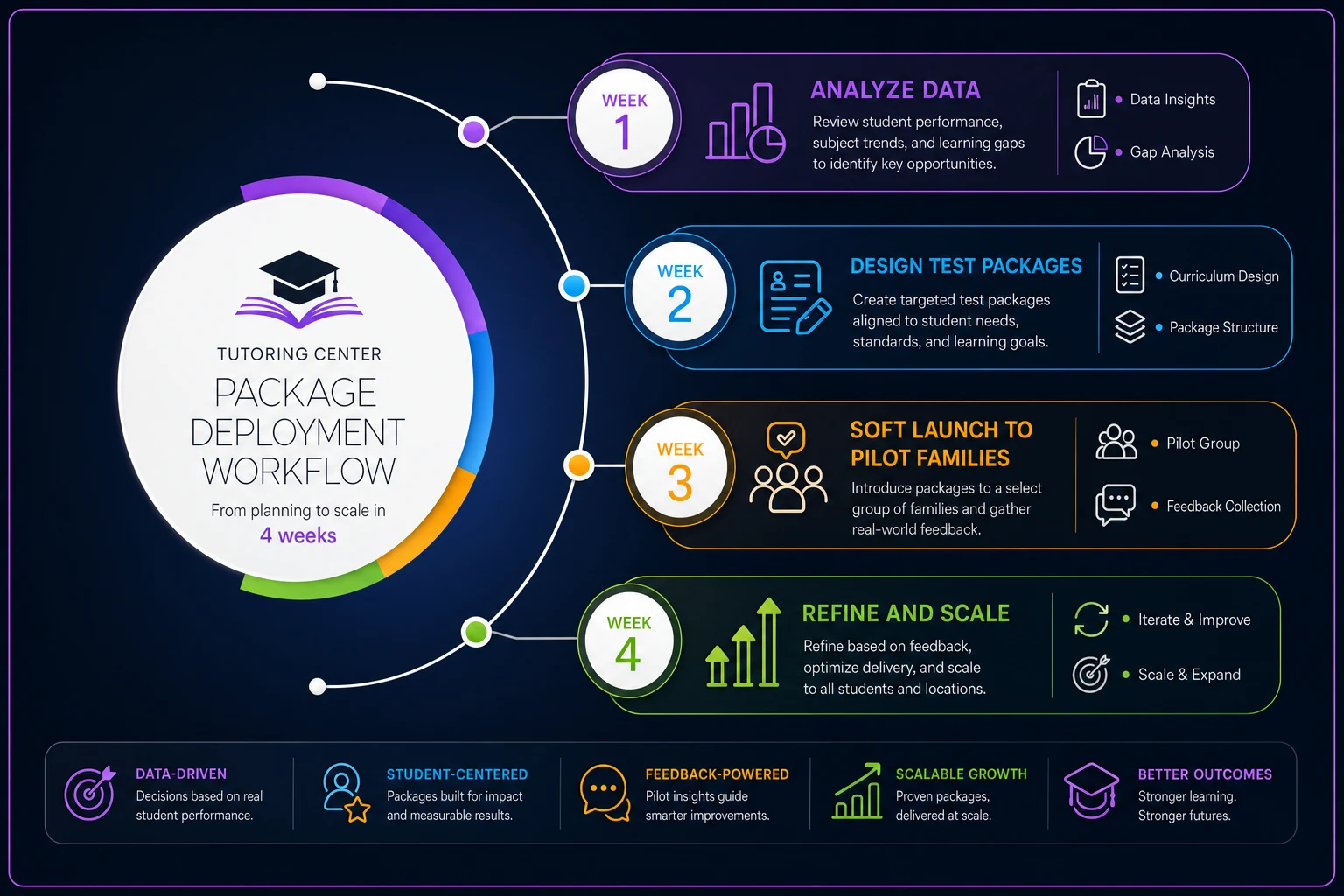
A quick visual of the week-by-week rollout.
The Hidden Cost of Model Switching
Changing your pricing model mid-stream creates real chaos if it's done carelessly. A center switching from pure session-based to subscription lost around 35% of customers in 60 days — not because prices went up, but because the transition itself was botched.
What typically breaks: tutors lose consistent students, parents feel pushed into commitments they didn't ask for, billing becomes a nightmare of mixed models running simultaneously, and staff can't explain the options clearly enough to actually close anyone.
A better approach is to grandfather existing customers while requiring the new model for incoming students. Over 6 months, natural churn migrates your base without the drama. It's slower, but retention stays intact and the team doesn't lose their minds.
When Each Model Actually Makes Sense
Choose Session-Based When:
-
Starting out with under 10 students
-
Testing new service offerings
-
Serving highly transient populations like college students
-
Tutors are pure contractors with variable availability
Choose Subscription When:
-
Core service is ongoing academic support
-
Parents want billing predictability
-
Operational systems are solid enough to support it
-
Retention matters more than acquisition volume
Choose Bundles When:
-
Solving a defined problem like test prep or summer catch-up
-
Parents can commit to a schedule
-
You need upfront cash flow
-
Your market responds well to structured programs
Most successful centers end up using all three, segmented by use case rather than trying to standardize everything.
Margin Optimization Through Smart Packaging
The biggest margin gains rarely come from raising prices. They come from packaging more intelligently.
One center offering $75 sessions added a "Study Skills Bootcamp" — same tutoring, packaged as 8 sessions over 4 weeks with workbooks included. Price: $750. A $30 workbook cost justified a $150 premium. Parents loved the structure. Margin increased around 22% on those students.
Another center bundled assessment plus 6 sessions plus a progress report for $595. The assessment took 30 minutes but positioned the entire package as "diagnostic tutoring." Conversion increased 40% compared to selling sessions individually.
Neither center raised their hourly rate. They just changed what they were selling.
Building Your Financial Model
A basic framework to model your tutoring pricing scenarios:
Revenue Inputs:
-
Students by type (session/subscription/bundle)
-
Price points for each
-
Sessions per month per type
-
Conversion rates by type
-
Churn rates by type
Cost Structure:
-
Tutor cost per session
-
Admin hours per student type
-
Payment processing by type
-
Software/platform costs
-
Physical space if applicable
Key Metrics to Track:
-
Margin by student type
-
LTV
CAC ratio by type
-
Capacity utilization
-
Revenue per tutor hour
-
Admin hours per $1,000 revenue
Run scenarios for different model mixes. You'll generally find that something around 20% bundle, 50% subscription, and 30% session-based optimizes for both margin and operational complexity — though that ratio shifts depending on your market and how seasonal demand actually is in your area.
Technology and Pricing Models
The right operational software makes complex pricing models manageable. Without it, anything beyond basic session-based billing becomes an administrative burden that scales poorly.
Manual tracking typically breaks around 15 students for mixed models, 25 students for a single model, and 40 sessions weekly regardless of model. That's when automated scheduling, billing, and communication stop being optional.
AI-powered operational platforms earn their cost quickly through reduced admin hours and better payment collection rates alone. Centers running integrated platforms tend to see meaningful reductions in scheduling coordination time, faster payment collection, more consistent parent communication, and far fewer double-bookings. That efficiency gain means you can actually offer more complex, higher-margin packages without drowning in administrative work every week.
Real Growth Pattern Analysis
A tutoring center's growth stages tend to follow a predictable pricing evolution:
-
Stage 1 (0–15 students)
Pure session-based, manual everything
-
Stage 2 (15–30 students)
Introduce first bundle, basic software
-
Stage 3 (30–50 students)
Add subscriptions, automated billing
-
Stage 4 (50–75 students)
Segment packages by use case, fuller automation
-
Stage 5 (75+ students)
Dynamic pricing by demand, multi-tutor coordination
Each stage requires different pricing strategies and operational capabilities. Trying to skip stages usually fails — not because the strategy is wrong, but because the operations aren't ready to support it yet.
Making the Decision
Your pricing and packaging system isn't really about price. It's about aligning your business model with operational reality and what parents actually expect.
Start by understanding your true margins, not just revenue. Build packages that fit your actual operational capacity. Test with small groups before rolling out broadly. And be honest — the best pricing model is the one you can deliver consistently, not the one that looks best in a spreadsheet.
Centers that thrive long-term don't chase the highest prices or the most students. They find the intersection where margin, operations, and customer value line up and stay there.
Most tutoring businesses never do this analysis. They pick a price, hope it works, and wonder why growth stalls. You now have the framework to build something better — whether you actually use it is a different question entirely.
Ready to streamline your tutoring operations?
Join 500+ tutors and centers using Tutoryly to save time, improve scheduling accuracy, and enhance student experiences.