


Most tutoring centers hire the person who interviews well. They're warm, they went to a good school, they say the right things about "meeting students where they are." Three weeks later you're sitting in on a session where they're lecturing a 9-year-old about photosynthesis while the kid stares at the ceiling, and you realize the interview told you almost nothing about whether they could actually teach.
That gap — between how someone presents and how someone performs — is the whole problem with gut-based hiring. And it compounds as you grow. Every mis-hire isn't just a wasted salary. It's the families that tutor churned through, the schedule chaos of replacing someone mid-term, and the reputation damage that spreads quietly through parent group chats.
A real tutor recruitment and onboarding system isn't about running more interviews. It's about building a funnel where each stage removes people who can't do the job, so by the time someone is sitting with a paying student, you already have evidence they're good. Below is the full pipeline: sourcing, skills tests, mock sessions, and a 30/60/90 ramp with a mentor loop that actually catches problems early.
Why gut hiring falls apart the moment you have more than a few tutors
When you're small — two or three tutors, maybe yourself doing half the sessions — you can get away with instinct. You know teaching. You can tell within one conversation whether someone gets it. And because you're personally close to almost everything, mistakes surface fast.
That breaks the second you're hiring people you won't personally supervise every day. A pattern that shows up a lot: a center grows from 4 tutors to 12 in about a year, the owner keeps interviewing the same casual way, and suddenly retention gets strange. Some tutors have renewal rates north of 80%, others are quietly losing families month after month, and nobody can explain why because there's no real standard for what "good" looks like at that place.
The deeper issue is that interviews measure the wrong skills. A good interview measures how someone talks about teaching. The actual job is:
-
explaining a tricky concept three different ways until one lands
-
noticing when a student is confused but pretending not to be
-
managing a session's pace so you cover material without rushing
-
handling a parent who's anxious about a grade
-
writing notes clear enough that another tutor could take over
None of that shows up in "tell me about a time you helped a struggling student." You have to make people do the job, in low-stakes conditions, before they do it for real.
The funnel: four stages, each one filtering harder
Think of recruitment as a filter with progressively higher cost per stage. You want the cheap filters — resume screen, short async test — to remove the obvious no's, so your expensive time (mock sessions, live interviews) is spent only on people who've already proven the basics.
Never miss another tutoring session.
Tutoryly helps you schedule, confirm, and manage every tutoring session efficiently.
- Unified session scheduling
- Automated student notifications
- Tutor calendar & availability management
No credit card required
Here's roughly how the pass-through looks in a healthy pipeline:
| Stage | Applicants entering | Typical pass rate | Time cost per candidate |
|---|---|---|---|
| Application + resume screen | 100 | ~35% | 3–5 min |
| Async skills test | 35 | ~40% | 0 (self-graded first pass) |
| Mock session | 14 | ~50% | 30–40 min |
| Final interview + reference | 7 | ~70% | 45 min |
| Offer | ~5 | — | — |
Those numbers shift by subject and market, but the shape holds: you're interviewing maybe 5–7 people live out of 100 applicants, and every one of them has already shown they can teach. Compare that to gut hiring, where you're doing full interviews with 20+ people and still guessing.
This diagram shows the funnel stages and how candidates move through them.
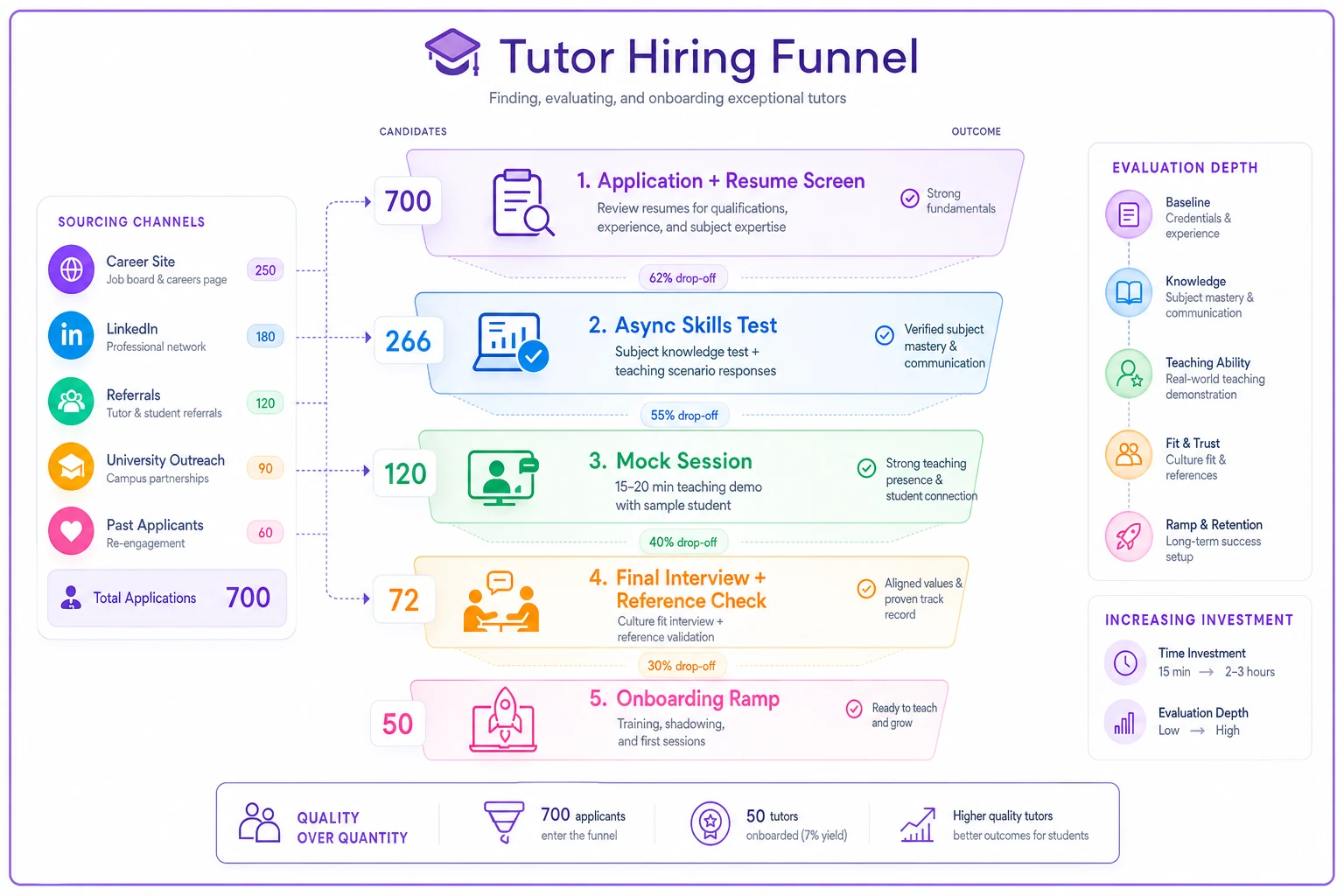
The mistake most owners make is skipping straight from resume to a live interview. That's where charming-but-can't-teach candidates slip through, because a live conversation rewards exactly the wrong traits.
Stage 1: Sourcing that doesn't just attract warm bodies
Where you post determines who applies, and most centers cast a net that's too wide and too generic. "Tutors wanted, flexible hours" pulls in everyone who wants a side gig, and you spend your filtering energy on people who were never serious.
A sharper approach: write the posting to repel the wrong people. State the real expectations up front — required availability blocks, that there's a skills assessment and a paid mock session, that you track student outcomes. The people who bail at "there's a skills test" were going to be your headaches anyway.
-
University subject departments and honor societies, not general job boards — you get people who actually know the material deeply
-
Referrals from current strong tutors, weighted heavily; good tutors tend to know other good tutors and won't refer someone who'll embarrass them
-
Former high-performing students who've aged into it, especially for test prep
-
Retired or part-time teachers for academic depth, though you'll screen harder for flexibility and tech comfort
One thing worth noticing: candidates who write a specific, non-generic application — mentioning your center by name, referencing a subject they're genuinely excited about — convert to strong hires at a noticeably higher rate than mass-applied resumes. It's a cheap signal and it costs nothing to weight it.
Stage 2: The async skills test (your cheapest, most powerful filter)
This is the stage most centers skip, and it's the one that saves the most time. Before anyone talks to a human, they complete a short take-home assessment. Keep it under 30 minutes of their time or your completion rate craters.
Part A — Content accuracy (10 min). Five problems at the level they'd teach, plus one deliberately one grade level above it. You're checking they actually know the material cold. A tutor who fumbles the content loses student trust in the first week.
Part B — Explanation quality (15 min). Give them a wrong student answer and ask them to write how they'd walk the student to the correct one — without just giving the answer. This is the single most predictive item on the whole test. Example prompt: > A student solved 3(x + 4) = 21 and got x = 3. Write out, step by step, how you'd help them find and fix their own mistake. Do not just show the correct solution.
Part C — A short parent message (5 min). "Write a 4–5 sentence update to a parent whose child had a rough session and got frustrated." You're checking tone, professionalism, and whether they can be honest without being alarming.
Keep the test under 30 minutes and prioritize the explanation prompt — it's the single best predictor of classroom behavior.
A simple scoring rubric
| Dimension | 1 (reject) | 2 (weak) | 3 (solid) | 4 (strong) |
|---|---|---|---|---|
| Content accuracy | Multiple errors | One error, shaky | All correct | All correct + handles the above-level item |
| Explanation method | Just gives the answer | Explains but talks at student | Guides student to find error | Guides + anticipates the misconception |
| Parent communication | Unprofessional or alarming | Vague / robotic | Clear and warm | Clear, warm, gives a next step |
Hard gate: any 1 in Content or Explanation = out. You cannot coach someone into knowing the material or wanting to guide instead of lecture. Those are dealbreakers, not development areas.
The explanation section is where most technically-qualified people fail. Plenty of applicants can do the math. Far fewer can resist the urge to just tell the student the answer — and that urge is exactly what kills tutoring outcomes.
Stage 3: The mock session (where teaching actually reveals itself)
If someone passes the async test, you run a paid 25–30 minute mock session. Pay them for it — it's respectful, it improves your completion rate, and it signals you take this seriously. The cost is trivial compared to a bad hire.
Two options for the "student": use a real student volunteer (a current family who's game for it), or have a staff member role-play. Real students are more revealing because you can't script a real kid's confusion. If you're role-playing, commit to it — actually get things wrong, actually get distracted.
Sample mock-session script (for the role-player)
> Scenario: You're a 7th grader working on fractions. You're a little checked out. You understand adding fractions with the same denominator but you think you can add across when denominators are different (you'll say "so 1/2 + 1/3 is 2/5, right?"). > > Your behavior: > - First 5 min: be slightly guarded, give short answers. > - When they explain something, nod along even if you don't get it (don't volunteer that you're lost). > - At the ~10 min mark, make the 2/5 mistake confidently. > - If they correct you kindly and check your understanding, warm up and engage more. > - If they rush or make you feel dumb, go quiet.
What you're watching for: do they diagnose before teaching, or launch straight into a lecture? Do they catch that the nodding student isn't actually following? How do they handle the fraction error — pounce on it, or guide toward it? Does the energy in the room shift based on how they treat the "student"?
Mock session scorecard
-
Rapport / read of the room — did they notice the disengagement and adjust?
-
Diagnosis before instruction — did they figure out what the student actually knew first?
-
Error handling — how they responded to the 2/5 mistake
-
Pacing — did they cover ground without rushing or dragging?
-
Checks for understanding — did they verify learning, or assume it?
A candidate who scores 4–5 on rapport and error handling but 3 on pacing is a strong hire — pacing improves with reps. A candidate who's a 5 on content but a 2 on reading the room is the classic trap hire. They'll frustrate students and you'll wonder why families keep leaving a "qualified" tutor.
Stage 4: Final interview and reference check
By now you have real evidence, so the final interview isn't about assessing teaching — it's about fit, reliability, and logistics. Confirm availability against your actual schedule gaps. Talk through a tricky parent scenario. Ask about the messiest session they've ever had and what they'd do differently. You're looking for self-awareness more than a perfect answer.
For references, skip the generic "was she a good employee" questions. Ask: Would you put this person in front of your most anxious parent unsupervised in week one? Why or why not? The pause before the answer tells you more than the answer itself.
The 30/60/90 ramp: hiring is only half the system
A strong hire with a bad onboarding still produces a mediocre tutor. The ramp is where you turn someone who can teach into someone who teaches your way, hits your documentation standards, and gets held accountable to real outcomes.
The ramp needs measurable milestones, not vibes. "You're doing great" is not onboarding. Here's the structure:
-
Days 1–10 (shadow + co-teach) They observe 3–4 sessions run by a strong tutor, then co-teach 2–3 where the mentor is present and steps in as needed. By day 10 they should have run at least one segment solo with the mentor watching. Milestone: mentor signs off that they can run a single session independently.
-
Days 11–30 (solo with heavy QA) They take a light caseload — maybe 4–6 recurring students. Every session generates notes from day one, no exceptions, and the mentor reviews notes for the first two weeks. Milestone: notes meet your required-field standard without prompting, and first parent feedback is neutral-to-positive.
-
Days 31–60 (build the book) Caseload grows toward full. Mentor shifts from reviewing every note to spot-checking, plus one live observation. You start looking at early retention signals — are their families rebooking? Milestone: at least one live-observed session scored "solid" on your QA rubric, and no more than one flagged note issue.
-
Days 61–90 (accountability to outcomes) Full caseload. Now you're looking at the same metrics you hold veteran tutors to — session-to-rebook rate, parent sentiment, whether students are actually progressing. Milestone: retention and note quality in normal range for your team; a 90-day review that decides keep / coach / cut.
The 90-day new-tutor checklist
-
Completed shadowing of 3+ sessions before teaching
-
Ran a supervised solo segment by day 10
-
Submitting complete session notes every session, on time
-
Passed first live observation on the QA rubric
-
Received and reviewed first parent feedback
-
Caseload ramped to target by day 60
-
90-day retention/outcome numbers in acceptable range
-
Formal 90-day review completed and logged
Notes are load-bearing from day one because of continuity. A new tutor who's inconsistent with documentation becomes a real problem the first time they're sick and someone else has to cover — the substitute has nothing to work from. Getting your mandatory lesson notes standard locked in during onboarding is far easier than retrofitting it onto someone who's had six months of sloppy habits. It also connects directly to how you onboard the students themselves, since a new tutor inheriting well-documented intake info ramps much faster than one starting blind.
The mentor / QA loop that keeps the ramp honest
A ramp plan on paper does nothing if no one owns it. Assign every new hire a mentor — usually one of your strongest tutors — and make it an actual role with time carved out, not a favor. Some centers pay a small mentor stipend per new hire; it's cheap insurance against a failed onboarding.
The loop works like this: the mentor reviews notes and does observations, flags issues to you, and together you decide whether it's a coachable gap or a real problem. The critical discipline is a decision point at day 30 and again at day 90. Too many centers let a struggling new hire drift for months because firing feels harsh and there's no scheduled moment to make the call. A calendared review forces the decision while it's still cheap.
Worth being honest about: the goal of the loop isn't to catch and punish. It's to catch early so you can fix. Most new-tutor problems in the first 30 days are habit problems — rushing, under-checking understanding, thin notes — and all of those are coachable if you catch them in week two instead of month three.
When this full system makes sense — and when it's overkill
Build the whole funnel when: you're hiring more than a handful of tutors a year, you can't personally supervise every session anymore, or you've been burned by a hire who interviewed great and taught badly. The moment your retention varies wildly by tutor and you can't explain why, you need standardized filtering and onboarding.
Scale it down when: you're a solo tutor bringing on your first hire. You don't need a four-stage funnel for one person — but you should still run a mock session, because that one filter alone will save you from the most common mistake. Skip the elaborate rubrics; keep the "make them actually teach" principle.
Who should not over-invest here: if you're tutoring part-time with two or three trusted people you already know well, a heavy hiring apparatus is friction for no real benefit. The system pays off in proportion to how many people you're hiring and how little you can personally observe them.
A real scenario
A mid-sized center — roughly 15 tutors, mostly SAT and high-school math — was churning through hires. They'd bring on 8–10 tutors a year and lose about half within the first few months, either because the tutor quit or because families stopped rebooking and the caseload dried up. Turnover was costing them a few thousand dollars per failed hire once you counted lost families and rescheduling chaos.
They added exactly two things: an async explanation-focused skills test, and a paid mock session with a fixed script. Nothing complicated. Within two hiring cycles, new-hire retention past 90 days went from roughly half to somewhere north of 75%. The mock session in particular caught a pattern they'd been blind to — several "impressive" candidates who lectured instead of guided, exactly the trait that had been quietly driving families away.
The other change wasn't captured in any metric. Their existing tutors took the process more seriously once new hires had clearly earned their spot. When everyone's been through the same filter, "we hold ourselves to a standard here" stops being a poster on the wall.
Bringing it together
The centers that hire well aren't better judges of character. They've replaced judgment with evidence — a funnel where content accuracy, explanation ability, and real teaching under pressure all get tested before anyone touches a paying family, followed by a ramp that turns raw ability into consistent performance.
None of this requires exotic tools. It requires deciding what "good" looks like, building the tests and rubrics that measure it, and refusing to skip stages when you're in a hurry to fill a slot. The pressure to skip is exactly when the system matters most, because rushed gut hires are how you ended up here in the first place. Get the funnel right once, write it down, and every hire after that gets a little easier — and your students, who never see any of this, feel the difference.
The centers that hire well aren't better judges of character. They've replaced judgment with evidence — a funnel where content accuracy, explanation ability, and real teaching under pressure all get tested before anyone touches a paying family, followed by a ramp that turns raw ability into consistent performance.
None of this requires exotic tools. It requires deciding what "good" looks like, building the tests and rubrics that measure it, and refusing to skip stages when you're in a hurry to fill a slot. The pressure to skip is exactly when the system matters most, because rushed gut hires are how you ended up here in the first place. Get the funnel right once, write it down, and every hire after that gets a little easier — and your students, who never see any of this, feel the difference.
Ready to streamline your tutoring operations?
Join 500+ tutors and centers using Tutoryly to save time, improve scheduling accuracy, and enhance student experiences.