



Your new student just signed up. Parent paid the deposit. Now you're scrambling to piece together intake questions from three different Google Docs, trying to remember what assessment you used last time, and realizing halfway through the first session that you forgot to ask about the kid's learning style.
Sound familiar?
Most tutoring businesses treat onboarding like an afterthought. You wing it differently each time, hope you covered the essentials, then spend the next two or three sessions backtracking to fill gaps. Meanwhile, parents start wondering if they picked the right tutor because the first impression felt disorganized.
Student onboarding sets the trajectory for the entire tutoring relationship. Get it wrong and you're playing catch-up for weeks. Get it right and you've built trust, captured the right data, and positioned yourself as someone who actually has their act together.
The hidden cost of winging your onboarding
When tutors skip a structured onboarding process, three things happen pretty reliably.
First, you miss information that derails future sessions. Maybe you don't find out until week four that the student has ADHD and needs movement breaks. Or you discover mid-semester that they're actually prepping for a specific entrance exam, not just general math help.
Second, parents lose confidence fast. They're paying $60–120 per hour for expertise, not improvisation. When onboarding feels scattered, they start questioning everything else about your service.
Third, you waste billable time. Instead of actual tutoring, you spend the first few sessions doing detective work—figuring out gaps, understanding goals, learning what motivates this particular kid. That's easily $180–360 in session time that should've been productive from day one.
And if you have other tutors working with you, the problem compounds. Sarah asks about previous tutoring experience. Mike focuses on academic goals. Nobody captures the same baseline data, which makes it nearly impossible to track progress consistently or hand off students when needed.
Why copy-ready templates beat custom questionnaires
Most tutoring operations overthink this. They spend weeks crafting the "perfect" intake form with 40-something questions, build elaborate assessment rubrics, then wonder why parents abandon the process before completing step one.
Never miss another tutoring session.
Tutoryly helps you schedule, confirm, and manage every tutoring session efficiently.
- Unified session scheduling
- Automated student notifications
- Tutor calendar & availability management
No credit card required
The businesses that do this well keep it simple. Same proven templates every time, only the essential questions, a process that feels easy for parents while still capturing what you need.
Every minute a parent spends filling out forms is a minute closer to second-guessing their decision. Every unclear question is friction. The solution isn't more sophistication—it's having tested templates ready to copy, paste, and use. No customization paralysis.
The complete intake form template (copy this exactly)
Stop writing intake forms from scratch. Here's the exact text that captures everything you need without overwhelming parents:
Basic Information Section: Student Name: Grade Level: School: Primary Subject(s) for Tutoring: Parent/Guardian Name: Best Contact Method (text/call/email): Preferred Session Schedule:
Academic Background Section: Current grades in subject(s) needing help: Most recent test/quiz scores: Has your child worked with a tutor before? If yes, what worked/didn't work? Does your child have an IEP, 504 plan, or documented learning differences? What specific topics or skills are most challenging right now?
Learning Style Quick Assessment: How does your child best show what they know? (multiple choice) □ Explaining verbally □ Writing things out □ Drawing/diagramming □ Working through problems What helps your child focus? (select all that apply) □ Quiet environment □ Background music □ Movement breaks □ Fidget tools □ Frequent check-ins When does your child do their best work? □ Right after school □ After dinner □ Mornings □ Weekends
Goals and Expectations Section: What's your primary goal for tutoring? (rank top 3) □ Improve grades □ Build confidence □ Prepare for specific test □ Keep up with class □ Get ahead □ Fill knowledge gaps □ Develop study skills What would success look like in 3 months? What would make you say "this tutoring is really working"? Any concerns or things we should know?
That's it. No questions about educational philosophy. No essays about learning journeys. Just operational data you'll actually use.
The 15-minute benchmark assessment that actually tells you something
Most tutors either skip assessments entirely or pull a generic grade-level test that tells them nothing useful. Both approaches guarantee you'll spend the first month guessing at the student's actual level.
Part 1: Quick Confidence Check (3 minutes) Start with three problems just below grade level. This isn't really about testing knowledge—it's about establishing psychological safety. Students who get these right build momentum. Students who struggle show you immediately that the gaps run deeper than expected.
Part 2: Grade-Level Baseline (5 minutes) Five problems at current grade level, covering different skill types. For math: computation, word problem, conceptual question, pattern recognition, explain-your-thinking. For reading: vocabulary in context, main idea, inference, text structure, short written response.
Part 3: Stretch Indicator (3 minutes) Two problems from the next level up. You're not expecting success—you're checking for exposure and watching how they handle unfamiliar content. Do they shut down or stay in it?
Part 4: Meta-Learning Check (4 minutes) Ask three questions:
-
"Walk me through how you solved problem #3"
-
"Which problem was hardest and why?"
-
"If you had to teach someone else one of these problems, which would you choose?"
This reveals more about how a student learns than any standardized test.
The goal-setting conversation parents actually remember
Skip the generic "what are your goals" conversation. Parents already told you in the intake form. Instead, use this framework to create clarity and buy-in:
Opening Frame: "Based on what you've shared, I'm seeing three main priorities: [repeat their top 3 from intake]. Let me tell you what's realistic in our timeframe..."
The 30-60-90 Framework: "In the first 30 days, we'll focus on establishing routine and identifying exact gaps. You'll see small confidence wins but probably not grade changes yet. By 60 days, we'll have covered the foundation gaps and be working on current material. This is typically when teachers start noticing improvement. At 90 days, we should see measurable progress in grades and test scores. Your child should be attempting harder problems and needing less support on homework."
The Reality Check: "Here's what could slow us down: missed sessions, not doing practice work between meetings, or discovering deeper gaps than expected. If we hit any of these, we'll adjust the timeline, not the goals."
The Commitment Question: "Does this timeline feel realistic? What would need to change in your routine to support this?"
Eight minutes. Prevents months of misaligned expectations.
First session agenda that sets the professional tone
Your first session creates the template for every session after it. Start loose and casual? Good luck adding structure later. Start with clear process and students understand exactly what to expect going forward.
Here's a minute-by-minute agenda that works:
| Time | Activity | Notes |
|---|---|---|
| 0–5 min | Warm-up and Rapport | Favorite class, hobbies, confidence rating on subject |
| 5–15 min | Assessment Review | Go through benchmark together, focus on process not answers |
| 15–35 min | First Teaching Block | Address one gap, use their preferred learning style |
| 35–45 min | Practice and Application | One together, one with support, one independent |
| 45–55 min | Homework Help | Tackle actual homework if they brought it |
| 55–60 min | Wrap-up Protocol | One takeaway, next session focus, parent update |
This trains students from day one: we start on time, we work systematically, we end with clear next steps.
The onboarding automation that removes human error
Even with solid templates, manual onboarding breaks down when you're running multiple students or tutors. Forms get lost. Assessment data lives in random notebooks. First sessions happen without anyone reviewing intake information.
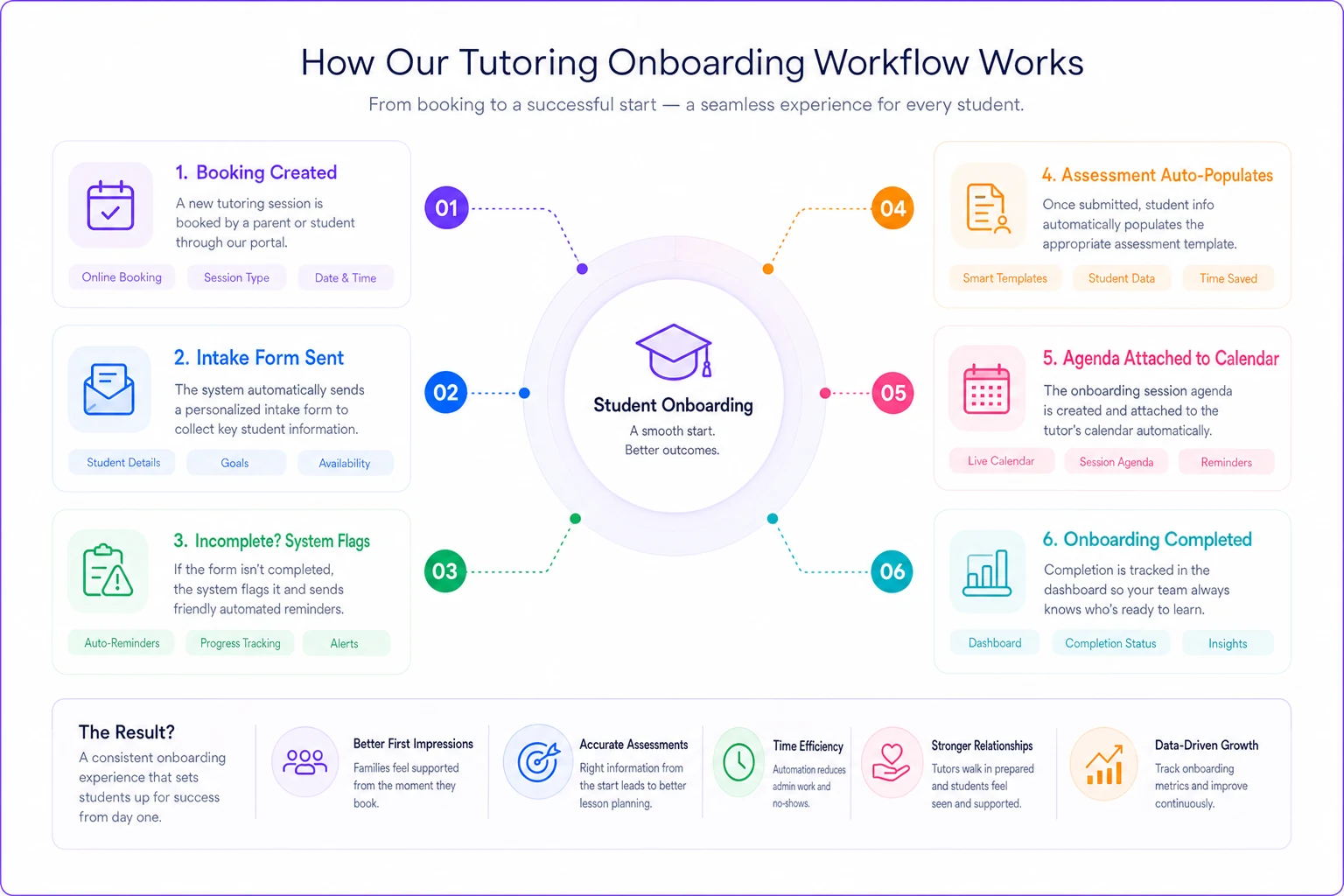
AI-powered operational software addresses this directly. Instead of relying on tutors to remember every step, the platform handles it automatically—sending intake forms after booking, flagging incomplete responses before the first session, populating assessment templates with student info, attaching session agendas to calendar events, and tracking which students have completed each onboarding phase.
The practical effect is real. Tutors spend their energy on actual tutoring instead of chasing paperwork. Parents get consistent communication. Nothing slips through. You have complete data on every student from day one rather than piecing it together two weeks in.
That operational consistency becomes its own competitive advantage. While other tutors are scrambling with admin, your team delivers professional, systematic onboarding that parents notice and remember.
Common onboarding mistakes that hurt retention
Even with good templates, certain patterns reliably tank the process:
Mistake 1: Information overload A 10-page PDF packet feels thorough but guarantees most parents won't read it. Drip information across multiple touchpoints instead. Intake form today, assessment summary tomorrow, goal confirmation next week.
Mistake 2: Skipping the parent alignment Some tutors onboard only the student, assuming parents absorb information by osmosis. Parents are your actual client. They need their own onboarding track with clear expectations, communication preferences, and success metrics.
Mistake 3: One-size-fits-all assessment Using the same assessment for a struggling 3rd grader and an advanced 11th grader tells you almost nothing. Build grade-band assessments—K–2, 3–5, 6–8, 9–12—that measure relevant skills at each level.
Mistake 4: No handoff protocol When a student switches tutors, most businesses restart onboarding from scratch and lose weeks of relationship building. A simple handoff template that transfers onboarding data, session notes, and relationship context to the new tutor fixes this completely.
Building onboarding into your actual workflow
Good onboarding templates are only useful if they integrate into how your business actually runs.
Create a single source of truth. Whether that's a Google Drive folder, a project management tool, or dedicated tutoring software, every template needs to live in one accessible place—not scattered across emails and personal files.
Add intake form links to calendar invites so parents see them immediately.
Train the process, not just the content. Don't just hand tutors the templates and call it a day. Walk them through when and how to use each one. Role-play the goal-setting conversation. Practice the assessment delivery. The process needs to become muscle memory.
Diagram of the onboarding workflow:
Measure what matters. Track completion rates for each onboarding step. Which tutors consistently skip the assessment? Which parents never finish intake forms? These patterns show you exactly where the process is breaking down.
After 50 or so students go through onboarding, real patterns emerge. Maybe every parent asks the same question that's not on your intake form. Maybe one assessment question consistently confuses students. Refine the templates based on what actually happens, not what you assumed would work when you built them.
The 72-hour window that determines everything
There's a window between payment and first session—roughly 72 hours—where parents are either building confidence in their choice or quietly developing buyer's remorse. Every communication, every form, every interaction during that window either reinforces that they picked a professional or confirms their growing uncertainty.
This is why systematized onboarding matters. It's the difference between a tutoring side hustle and an actual education business. When parents experience smooth, professional onboarding, they stay longer, refer more people, and rarely push back on price.
The templates and frameworks here aren't theoretical. They come from tutoring operations that maintain strong retention rates and generate consistent referrals. The difference usually isn't the quality of tutoring itself—it's the quality of operations behind it.
Turning templates into competitive advantage
Most tutors will read this, think it makes sense, and keep winging their onboarding. They'll keep losing students to more organized competitors, keep spending sessions on catch-up instead of progress, keep wondering why parents don't see their value.
The ones who act on it will copy these templates, use them with the next student, and refine from there. They'll realize that doing onboarding well creates compounding advantages: more confident parents, better-prepared tutors, stronger outcomes, and a more valuable business overall.
Take the templates. Use the assessment framework. Follow the first-session agenda. Stop treating onboarding as an afterthought and start treating it as the operational foundation of your tutoring business.
Parents aren't just paying for tutoring sessions. They're paying for a result. And results start with an onboarding process that actually works.
Ready to streamline your tutoring operations?
Join 500+ tutors and centers using Tutoryly to save time, improve scheduling accuracy, and enhance student experiences.