



Most tutoring centers don't decide to become multi-product businesses. It just sort of happens. You start with 1:1 sessions, a parent asks about small groups, a local school district wants a block of contract hours, and someone on your team pitches a monthly membership to smooth out cash flow. Six months later you're running four distinct product lines with one scheduling system, a price sheet nobody fully understands, and a growing suspicion that your new subscription is quietly stealing revenue from your highest-margin 1:1 work.
That suspicion is usually correct. And it's not because any single product is badly designed — it's because there's no operating model underneath all of them, telling each product where it starts, where it stops, and who it's actually for.
This is a systems article, not a pricing-tactics one. The question isn't "what should I charge for cohorts." It's "how do all four products share the same tutors, rooms, hours, and parent attention without colliding." When a tutoring business crosses into multiple products, the cannibalization problem is really an arbitration problem — and it shows up in catalog structure, revenue recognition, capacity allocation, and the numbers you're watching.
Why cannibalization happens even when every product looks fine on its own
Cannibalization almost never comes from a bad product. It comes from overlapping value propositions competing for the same customer at the same moment of decision.
A family comparing your $75/hour 1:1 against your $40/seat cohort isn't choosing between two products — they're choosing between two prices for what feels, to them, like roughly the same outcome. If you haven't clearly separated what each product is for, the cheaper option wins. You've just converted a high-margin customer into a low-margin one without gaining a single new family.
In real operations this tends to show up in three specific ways:
-
The subscription absorbs 1
1 demand.
You launch a flat monthly membership to stabilize revenue. Parents who would have booked 1:1 as needed now self-ration under the membership, and your best tutors get booked solid on your lowest per-hour-yield product. -
Cohorts poach from 1
1 without a qualification rule.
A struggling student who genuinely needs individual attention gets steered into a cheaper group because a seat was open. Outcomes slip. The family churns. -
B2B contracts eat your prime-time capacity. A school contract looks great on paper until you realize it's consuming your 4–7pm slots — the exact window your retail families fight over.
None of these are pricing mistakes. They're boundary mistakes. The products were never told where they're allowed to operate.
The four layers of a multi-product tutoring operating model
A working multi-product operating model has four layers, and they have to agree with each other. When centers struggle, it's almost always because one layer contradicts another — the catalog says one thing, the scheduling behavior says something else entirely.
Never miss another tutoring session.
Tutoryly helps you schedule, confirm, and manage every tutoring session efficiently.
- Unified session scheduling
- Automated student notifications
- Tutor calendar & availability management
No credit card required
Layer 1 — Catalog taxonomy (what each product is, in writing)
Before anything else, each product needs a one-line job description that a front-desk person could repeat without looking it up. Not marketing copy — an operational definition that includes who it's for and, critically, who it's not for.
| Product | Primary job | Ideal student | Explicitly NOT for | Yield priority |
|---|---|---|---|---|
| 1:1 | Fast, targeted remediation or acceleration | Student 2+ grade levels off target, or prepping for a dated high-stakes exam | Students who just need practice reps | Highest per-hour |
| Cohort | Structured progression with peer pacing | Student near grade level needing consistency | Students needing individualized diagnosis | Highest per-room |
| Subscription | Ongoing habit + light-touch support | Families wanting steady, predictable help | Families with acute, time-boxed needs | Highest LTV / retention |
| B2B | Contracted volume at predictable margin | Schools/orgs buying blocks | Anything that conflicts with retail prime time | Highest stability |
The "Explicitly NOT for" column is the one everyone skips, and it's the one that actually prevents cannibalization. If your subscription explicitly excludes acute exam prep, your staff has a real reason to route that family into 1:1 instead of letting them under-use a membership.
Layer 2 — Revenue-recognition rules (so the P&L tells the truth)
This is the layer that gets ignored until tax season, and it quietly poisons decisions long before then. If you recognize a 10-session 1:1 package the moment it's paid, your "best month ever" might actually be a liability-stacking month where you owe 50 unused sessions across your families.
Keep it simple but consistent:
-
1
1 packages:
recognize per session delivered, not on purchase. Track unredeemed sessions as a liability. -
Cohorts recognize per week of the term delivered. A dropped mid-term seat has a known, bounded exposure.
-
Subscriptions recognize monthly, but watch utilization separately — a profitable subscription and an over-used one look identical on the revenue line and opposite on the margin line.
-
B2B recognize against the contract's delivery schedule, with a separate line for contracted-but-undelivered hours.
The point isn't accounting purity. It's that you cannot see cannibalization if every product dumps into one undifferentiated revenue number. When you separate recognition by product, the shift from high-margin to low-margin demand becomes visible months before it hits your bank balance.
Layer 3 — Capacity arbitration (who gets the tutor and the room)
This is the heart of the system and the layer most centers have never formalized. When two products want the same Tuesday-5pm slot with the same tutor, what decides?
Without a rule, the answer is "whoever asked first" or "whoever the front desk likes." That's how you end up with your strongest tutor running a $40 cohort seat while a $75 1:1 family sits on a waitlist.
A workable arbitration table assigns each capacity type a priority by product — and it changes by time block:
| Time block | 1st priority | 2nd | 3rd | Protected for |
|---|---|---|---|---|
| Prime (weekday 4–7pm) | 1:1 (high-need) | Cohorts | Subscription drop-ins | Never B2B |
| Shoulder (weekday 2–4pm) | B2B contracts | Subscription | 1:1 | — |
| Off-peak (mornings/weekday early) | B2B / cohorts | Subscription | 1:1 | — |
| Weekend | Cohorts | 1:1 | Subscription | — |
The logic is straightforward: your scarcest, highest-demand capacity goes to your highest-yield and highest-need product. Lower-demand windows absorb B2B and subscription load. This single table resolves most cannibalization because it stops low-yield products from consuming high-demand slots by default.
Pair this with hard capacity triggers for when to hire rather than keep arbitrating scarcity. The logic in this guide on staffing, capacity triggers and stage-based SOPs connects directly here — arbitration is a stopgap, and hiring is the real fix once you're consistently turning away prime-time 1:1 demand.
When a booking request comes in, it moves through a defined sequence before a slot gets confirmed: the request enters the system, the time block is checked against the arbitration table, the product is matched to its priority tier for that block, and either a slot is assigned or the family goes to a waitlist with a reason logged. That flow sounds obvious written out, but most centers are doing a fuzzy version of it in someone's head, which is exactly where it breaks down.
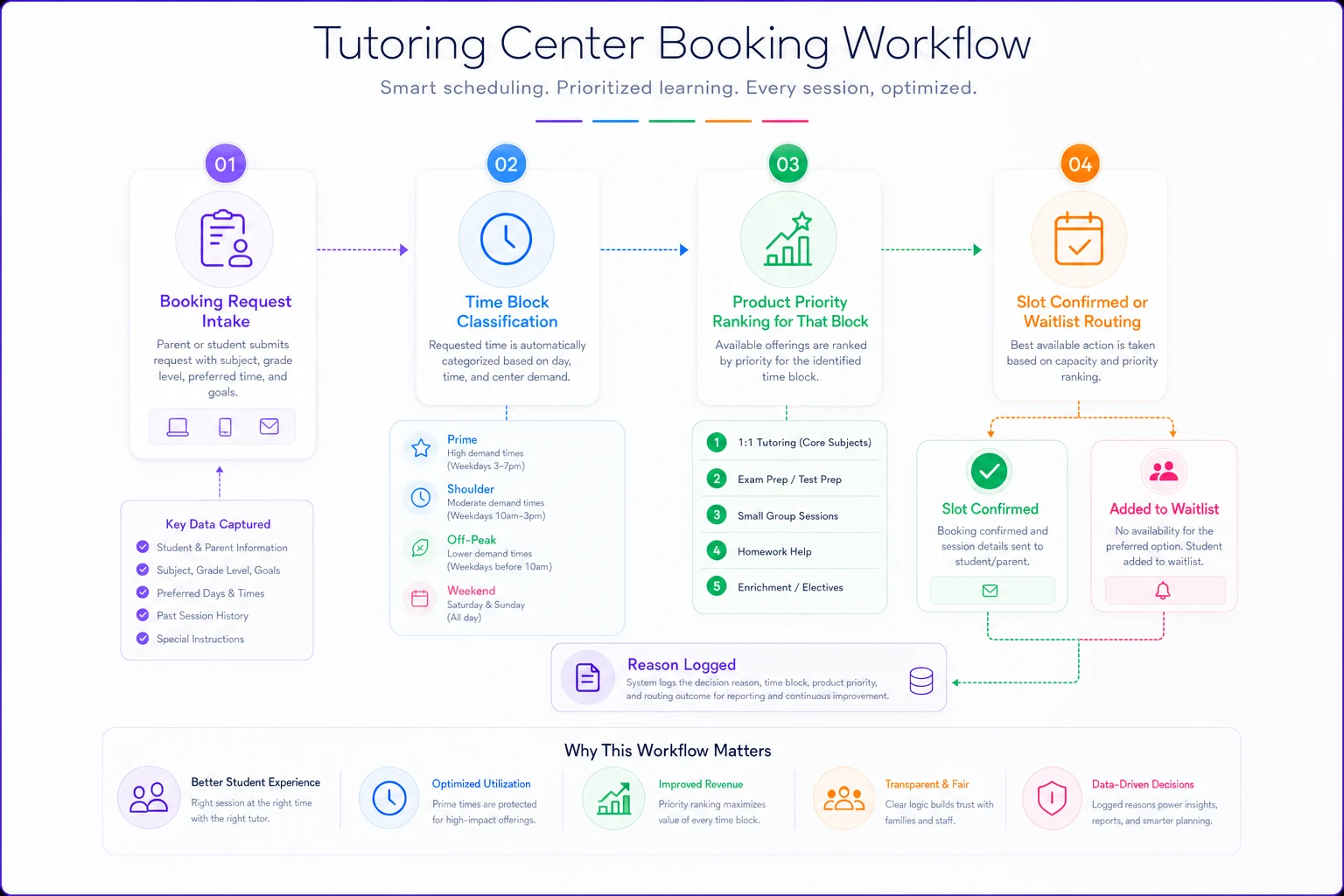
A simple diagram like this makes it clear where the arbitration table is applied during intake.
Log the reason for any downgrade or reroute at intake so you can spot systemic misrouting quickly.
Layer 4 — The KPI map (watching the right numbers per product)
A blended set of KPIs will actively hide cannibalization. Total revenue can rise while margin erodes, because a flood of subscription signups masks the loss of 1:1 hours. You need product-level KPIs plus a few cross-product ones that specifically catch cannibalization in motion.
Per product, watch:
-
1
1:
utilization of prime-time slots, package redemption velocity, per-hour yield -
Cohort seat fill rate, per-room yield, mid-term drop rate
-
Subscription utilization ratio (sessions used ÷ sessions budgeted), churn, contribution margin after heavy users
-
B2B contract delivery pace, prime-time encroachment hours, margin vs. retail
Cross-product signals that cannibalization is happening:
-
Subscription signups rising while 1
1 hours fall among the same family segment
-
Cohort fill rising while 1
1 waitlist also rises — that's misrouting, not growth
-
B2B prime-time hours creeping above zero when your policy says they shouldn't
Keeping an eye on these cross-product signals is what separates a center that catches the problem early from one that notices it six months later on a quarterly review.
The decision rules that actually prevent collisions
Taxonomy and tables are useless without routing rules your staff apply at the point of decision. These are the ones that do the heavy lifting:
-
Diagnosis before product. No family is sold a product before a short assessment places them. The assessment — not the open seat — decides 1:1 vs. cohort. This one rule kills the most expensive form of cannibalization.
-
The acute-need override. Any student with a dated high-stakes goal (exam in under 8 weeks, 2+ grade levels behind) gets routed to 1:1 regardless of what they ask for. Subscription and cohort are explicitly not for this.
-
Subscription utilization caps. A membership includes a defined number of sessions. Beyond that, overflow bills at a 1:1-adjacent rate. This stops your membership from becoming unlimited access to your best tutors at a steep discount.
-
B2B prime-time lockout. Contracts are quoted and scheduled against shoulder and off-peak capacity only. If a contract needs prime time, it's priced at a premium that makes displacing retail a deliberate decision — not a default.
-
No same-tutor downgrade without a reason logged. If a family is moving from 1:1 to cohort or subscription, someone records why. Pattern-spotting here tells you whether you're losing margin to price sensitivity or genuine need changes.
How these products are priced relative to each other is where many of these rules succeed or fail. If your cohort and 1:1 prices are too close, no routing rule will hold. The margin and LTV worked examples in this breakdown of designing a pricing and packaging system pair naturally with the arbitration logic above — arbitration decides who gets capacity, and pricing decides whether the boundary is defensible.
Phased rollout: don't launch all four products at once
The centers that get wrecked by cannibalization usually launched products faster than they built the operating model underneath them. A sane sequence:
Phase 1 — Stabilize 1:1. Don't add anything until your core product has clean per-session revenue recognition and a working assessment-first intake. Guardrail: prime-time utilization consistently above roughly 80% before you expand.
Phase 2 — Add cohorts. Launch groups only in time blocks where 1:1 isn't saturating capacity, or for student profiles your assessment flags as cohort-appropriate. Guardrail: cohort fill shouldn't correlate with a rising 1:1 waitlist. If it does, you're misrouting.
Phase 3 — Add subscription. Introduce the membership with utilization caps from day one. Launching an uncapped subscription is the single most common self-inflicted cannibalization wound. Guardrail: subscription contribution margin stays positive after your top 10% heaviest users.
Phase 4 — Add B2B. Only once your retail prime-time demand is predictable enough to protect. Guardrail: zero prime-time encroachment unless deliberately priced for it.
Each phase earns the next. Skipping gates is how you end up with four products and no idea which one is actually making money.
A real scenario: the subscription that ate the center
A mid-sized center — roughly 120 active families, mostly 1:1 at around $70/hour — launched a flat $240/month membership to smooth out lumpy cash flow. On paper it worked. Within a quarter they had about 35 memberships and revenue looked steadier than it had in years.
The problem showed up in margin, not revenue. Because the membership had no utilization cap, the families who adopted it were disproportionately their existing high-frequency 1:1 families — the exact customers who'd been paying $70/hour for 3–4 sessions a month. Those families had been generating somewhere around $840–$980 monthly. Under the membership, they paid $240 and used more sessions, because it now felt "free."
Total revenue barely moved. Effective per-hour yield on those families dropped by more than half. And because those were high-frequency families, they consumed a chunk of prime-time capacity — pushing newer, full-price 1:1 inquiries onto a waitlist.
The fix wasn't killing the product. It was building the operating model. They added a utilization cap (8 sessions/month included, overflow at $55), moved subscription sessions out of protected prime-time blocks, and routed new high-need inquiries to 1:1 via assessment. Within two terms, the membership became what it was supposed to be all along — a convenience product for steady, near-grade-level families — and prime-time yield recovered close to where it had been. The subscription stopped being a discount on their best customers and started filling a genuinely different need.
When running multiple products is a bad idea
Not every center should be multi-product. The systems overhead is real, and it's worth being honest about a few situations where it doesn't make sense:
-
You're under one location and around 60 families. The arbitration and recognition complexity probably costs more than the revenue diversification earns. Get 1:1 clean first.
-
Your assessment and intake isn't consistent. Without reliable diagnosis, every routing rule above collapses, and you'll misroute students into whatever product has an open seat.
-
You can't yet see product-level margin. If your books blend everything into one revenue number, you're flying blind. A second product just adds fog.
-
Your prime-time capacity is already fully sold at full price. Adding lower-yield products here is pure cannibalization — you'd be converting scarce, high-value hours into cheaper ones.
Multi-product makes sense when you have demand you're currently turning away that doesn't fit your core product: off-peak capacity sitting idle, near-grade-level students who don't need 1:1, or organizations wanting volume. The new product should fill a gap rather than overlap an existing strength.
Where software quietly earns its keep
None of this requires software to design. It requires software to hold the line at scale. Manual arbitration fails not because owners can't make good calls — it's that a front-desk team making fifty scheduling decisions a day can't consistently apply a five-rule routing matrix under pressure.
AI-assisted operational platforms pull their weight by encoding the taxonomy and arbitration table into the scheduling flow so the default placement already respects prime-time protection and acute-need routing. They flag when a family's product mix suggests cannibalization — a subscription sign-up following a 1:1 drop in the same household, for example — and separate revenue recognition by product automatically, so your margin picture stays honest without a monthly spreadsheet exercise. The rules are yours. The system just stops them from quietly decaying every time the center gets busy, which is exactly when those boundaries matter most.
Pulling it together
Cannibalization in a multi-product tutoring center isn't a pricing failure or a staff failure. It's what happens when four products share one set of tutors, rooms, and hours with no operating model deciding who gets what. The catalog taxonomy tells each product where it belongs. Revenue recognition keeps the P&L honest about which product is actually earning. The arbitration table decides who wins when capacity is scarce. And a product-level KPI map lets you catch the slow bleed before it reaches the bank account. Build those four layers in order, gate each new product behind a guardrail, and the products stop competing with each other and start covering each other's gaps — which is the whole point of being multi-product in the first place.
Ready to streamline your tutoring operations?
Join 500+ tutors and centers using Tutoryly to save time, improve scheduling accuracy, and enhance student experiences.