


Your best math tutor spends 45 minutes preparing for each 60-minute session. That's not sustainable at scale. The geometry tutor pulls together worksheets from three different sources every Tuesday. Your SAT specialist rebuilds practice sets from scratch because they can't remember which ones worked last month.
This isn't about lazy tutors or poor planning. It's an operational failure that most tutoring centers never properly address until they're bleeding money on prep time or watching quality tank because tutors stop preparing altogether.
The solution isn't telling tutors to "work faster" or buying another curriculum subscription. You need a content library built around reusable lesson fragments, proper tagging systems, and clear metrics to track whether your prep reduction actually maintains learning outcomes.
Why tutors waste so much time on redundant prep work
Every tutoring center owner thinks their tutors are efficient until they actually track prep time. Run the numbers on any center with 8-10 tutors and you'll find somewhere around 100-140 hours of weekly prep work happening across the team. A significant chunk of that is completely redundant.
The waste happens in predictable patterns. Tutors create new worksheets for concepts they've taught dozens of times. They rebuild review exercises instead of pulling from previous sessions. They spend 20 minutes digging through Google Drive folders trying to find that explanation they wrote up three months ago.
What makes this worse is that good tutors often create excellent materials—then those materials disappear into their personal folders. You end up with five different tutors each building their own quadratic equation worksheet, each spending 30 minutes on basically the same thing.
The financial hit is larger than most owners realize. If your tutors bill at $50/hour but you're paying them $25/hour for prep time, 12-18 weekly prep hours per tutor costs you $300-450 in labor. Multiply that across your team and you're looking at a few thousand dollars weekly just in prep costs—before factoring in the opportunity cost of tutors who could be taking additional sessions if prep wasn't eating their schedule.
Building a fragment-based content library that actually gets used
The traditional approach—dumping everything into shared folders and hoping tutors find what they need—doesn't work. Neither does buying expensive curriculum packages that don't match your teaching style. You need a library built around reusable fragments that tutors can quickly combine into complete lessons.
Never miss another tutoring session.
Tutoryly helps you schedule, confirm, and manage every tutoring session efficiently.
- Unified session scheduling
- Automated student notifications
- Tutor calendar & availability management
No credit card required
Think of fragments as lesson building blocks. A fragment might be a 5-minute warm-up exercise for factoring polynomials, a 10-minute guided practice on thesis statements, a 3-problem set on percentage word problems, a 7-minute explanation video for the Pythagorean theorem, or a short reading comprehension passage with questions attached. Each fragment should be self-contained and clearly labeled with a time estimate. This lets tutors assemble a 60-minute session by combining fragments rather than creating everything from scratch.
The key is making fragments granular enough to be flexible but substantial enough to actually be useful. A single math problem isn't a fragment—that's too small. An entire chapter review is too large. The sweet spot is 5-15 minute chunks that address specific skills or concepts.
Subject → Topic → Skill Level
-
Math → Algebra → Quadratic Equations → Beginner (never seen the concept)
-
Math → Algebra → Quadratic Equations → Intermediate (can solve basic problems)
-
Math → Algebra → Quadratic Equations → Advanced (ready for word problems)
This structure lets tutors navigate to exactly what they need without scrolling through hundreds of files.
Tagging rules that prevent your library from becoming a digital landfill
A content library without proper tagging becomes useless within months. Tutoring centers build elaborate libraries only to abandon them because finding materials takes longer than creating new ones.
Your tagging system needs five mandatory fields:
1. Primary concept tag The main academic concept the fragment addresses. Keep it specific: "factoring trinomials" not just "algebra."
2. Time duration tag How long the fragment takes to complete: "5min," "10min," "15min."
3. Difficulty level tag Use a simple 1-5 scale where 1 is introduction/never seen before, 2 is basic understanding, 3 is developing proficiency, 4 is advanced application, and 5 is mastery/test prep.
4. Activity type tag What the student actually does: guidedpractice, independentwork, discussion, assessment, review, or introduction.
5. Prerequisite tags What concepts the student needs to know first. This prevents tutors from accidentally pulling materials that are too advanced for where a student currently sits.
Here's what this looks like in practice for a single fragment:
| Field | Value |
|---|---|
| Fragment name | Solving quadratics by factoring - guided practice set A |
| Primary concept | factoring_quadratics |
| Time duration | 10min |
| Difficulty | 3 |
| Activity type | guided_practice |
| Prerequisites | factoringbasics, FOILmethod |
Enforce these tags through your operational software. Don't rely on tutors remembering to tag correctly—make it impossible to save a fragment without completing all required fields.
Require tags at save time: make the system impossible to save a fragment without all five tags.
The tagging system also needs regular audits. Every quarter, assign someone to review random samples of fragments and verify the tags are still accurate. Tags drift over time as different tutors interpret them differently. A 10-minute activity becomes 15 minutes with struggling students. Difficulty 3 materials get used for difficulty 2 students. Without audits, the system gradually becomes unreliable.
Creating reusable lesson templates tied to common learning objectives
Templates turn your fragment library from a resource collection into an actual prep-time reduction system. Instead of building lessons from scratch, tutors select a template and the system suggests appropriate fragments based on subject and level.
Start with your five most common session types. A new concept introduction template for a 60-minute session might break down as follows: 5-10 minutes of review and warm-up, 15-20 minutes of concept introduction, 15-20 minutes of guided practice, 10-15 minutes of independent practice, 5 minutes of an assessment check, and 5 minutes for wrap-up and homework. A test prep session might open with 10 minutes of diagnostic problems, move into 20 minutes of skill review based on the diagnostic, follow with 20 minutes of timed practice problems, and close with 10 minutes reviewing corrections. A homework help session runs differently—20 minutes on the current assignment, 15 minutes clarifying the underlying concepts, 15 minutes of similar problems, and 10 minutes previewing what's coming next.
Each template links to suggested fragments based on subject and level. If a tutor selects "Algebra 2 - New concept introduction - Quadratic formula," the system surfaces relevant fragments for each section.
Where most centers go wrong: they make templates too rigid. Templates should be frameworks, not prescriptions. Tutors need flexibility to adjust based on what's actually happening in the room. The template suggests 15 minutes of guided practice, but if the student is struggling, the tutor might stretch it to 25 minutes and cut the independent work entirely.
Build this flexibility into your operational software by letting tutors mark which template sections they actually used and for how long. That data helps refine templates over time and shows which fragments hold up in real sessions versus which ones only look good on paper.
KPIs that actually measure prep reduction without hiding quality drops
Most tutoring centers track the wrong metrics when trying to reduce tutor prep time. They celebrate when prep hours decrease but don't notice that session quality slipped or student progress slowed.
You need paired metrics that track both efficiency and effectiveness. On the efficiency side: average prep time per session (target under 15 minutes), fragment reuse rate (target 70% or more of sessions using existing fragments), new content creation hours per week (target under 2 hours per tutor), and template usage rate (target 80% of sessions starting from a template). On the effectiveness side: student progress assessment scores, parent satisfaction ratings (should stay above roughly 4.2/5), session completion rates, and homework completion rates.
Track these metrics at three levels:
-
1. Individual tutor level Which tutors successfully reduce prep while maintaining quality? These become your model for training others.
-
2. Subject area level Math might show great fragment reuse while English still requires heavy custom prep. This tells you where to focus library development.
-
3. Center-wide level Overall trends show whether your system actually works.
Here's a simple tracking framework:
| Tutor | Avg Prep Time | Fragment Reuse % | Student Progress | Parent Rating |
|---|---|---|---|---|
| Sarah M. | 12 min | 78% | +1.3 grade levels | 4.5/5 |
| James K. | 8 min | 85% | +0.9 grade levels | 4.3/5 |
| Maria P. | 22 min | 45% | +1.4 grade levels | 4.6/5 |
| Target | <15 min | >70% | +1.0 grade levels | >4.2/5 |
Maria's data tells an interesting story—high prep time, but also high progress and satisfaction. Maybe her subjects require more customization, or maybe she's creating valuable new fragments that the rest of the team will eventually use. Don't automatically flag high prep time as a problem without understanding what's driving it.
The fragment review cycle that keeps your library from going stale
Content libraries die from two causes: they get cluttered with outdated materials, or they stagnate without new additions. You need a review cycle that maintains quality while keeping things growing.
Every fragment needs a "last reviewed" date and a usage count. Fragments unused for six months get flagged for review. High-usage fragments get priority for updates and variations.
Monthly fragment review sessions should be efficient—not everyone sitting around discussing worksheets for two hours. Focus on the top 10 most-used fragments (are they still effective?), the bottom 10 least-used ones (worth keeping or removing?), fragments with poor outcome correlation, and missing fragments identified by tutors in the field.
Use actual data during these reviews. If a fragment shows lower comprehension rates, examine why. Maybe it moves too quickly, assumes too much prior knowledge, or uses confusing examples. Create variation fragments for your most successful materials—if your "Introduction to fractions" fragment works well, build versions for different learning styles: visual learners, verbal processors, hands-on learners. This multiplies the value of proven content without starting from scratch.
Set a monthly quota for new fragment creation, but tie it to identified gaps rather than arbitrary numbers. If three tutors independently request materials for the same concept, that's your priority. Random fragment creation just clutters the library.
Avoiding the quality trap when standardizing lesson materials
The biggest fear when implementing reusable fragments is "cookie-cutter" tutoring that ignores individual student needs. This fear paralyzes tutoring centers into maintaining inefficient, fully-custom prep that burns out tutors and limits scalability.
You don't have to choose between standardization and customization—you build smart flexibility into the system.
Fragments should be modifiable, not rigid. A vocabulary worksheet might have 20 words, but tutors can circle the 10 most relevant for their student. A math problem set might include 15 problems, but tutors assign only the odd numbers for students who need less practice. Maintain "customization notes" for each student profile. When creating assessment-based lesson plans, these notes guide fragment selection. A student with ADHD might need shorter fragments with more variety. A perfectionist student might need some confidence-building work before tackling harder material.
Give tutors clear fragment modification guidelines. Show them how to adapt materials without full recreation:
-
Adjust difficulty by changing numbers in math problems
-
Simplify vocabulary in reading passages
-
Add visual aids to text-heavy materials
-
Break longer activities into smaller chunks
-
Provide sentence starters for writing exercises
Track these modifications in your operational software. When multiple tutors make similar changes to the same fragment, that's a signal to create an official variation.
Implementation roadmap without disrupting ongoing operations
You can't rebuild your entire content system overnight while tutors are actively teaching. Implementation needs to be gradual, starting with your highest-impact areas.
Weeks 1-2: Audit and prioritize Track actual prep time for every tutor across one full week. Identify which subjects and topics consume the most prep time. These become your fragment development priorities.
Weeks 3-4: Create your first fragment batch Develop 20-30 fragments for your most common tutoring scenario. If 40% of your sessions are SAT math prep, start there. Get three experienced tutors to test these fragments with actual students before you go any further.
Weeks 5-6: Build the tagging system Implement your tagging structure in whatever system you're using—even organized Google Drive folders work at the start. Train tutors on consistent tagging in a single 30-minute session.
Weeks 7-8: Launch with a pilot group Select 3-4 tutors who are generally open to new systems. Have them use the fragment library for two weeks. Gather daily feedback on what's missing, what's confusing, and what actually works.
Weeks 9-10: Refine and expand Based on pilot feedback, adjust your fragments and tagging. Add the next 30-40 fragments based on what pilot tutors requested. Fix any workflow friction before wider rollout.
Weeks 11-12: Full rollout Bring all tutors into the system with clear expectations. Start with a goal like "50% of sessions should use the fragment library," ramping up to 80% over the following month.
The key is making the new system easier than the old way. If tutors have to click through seven screens to find a fragment, they'll just create their own. Your interface—whether it's AI-powered software or well-organized folders—needs to be faster than starting from scratch.
Below is a rough picture of how the full implementation cycle flows, from audit through sustained operations:
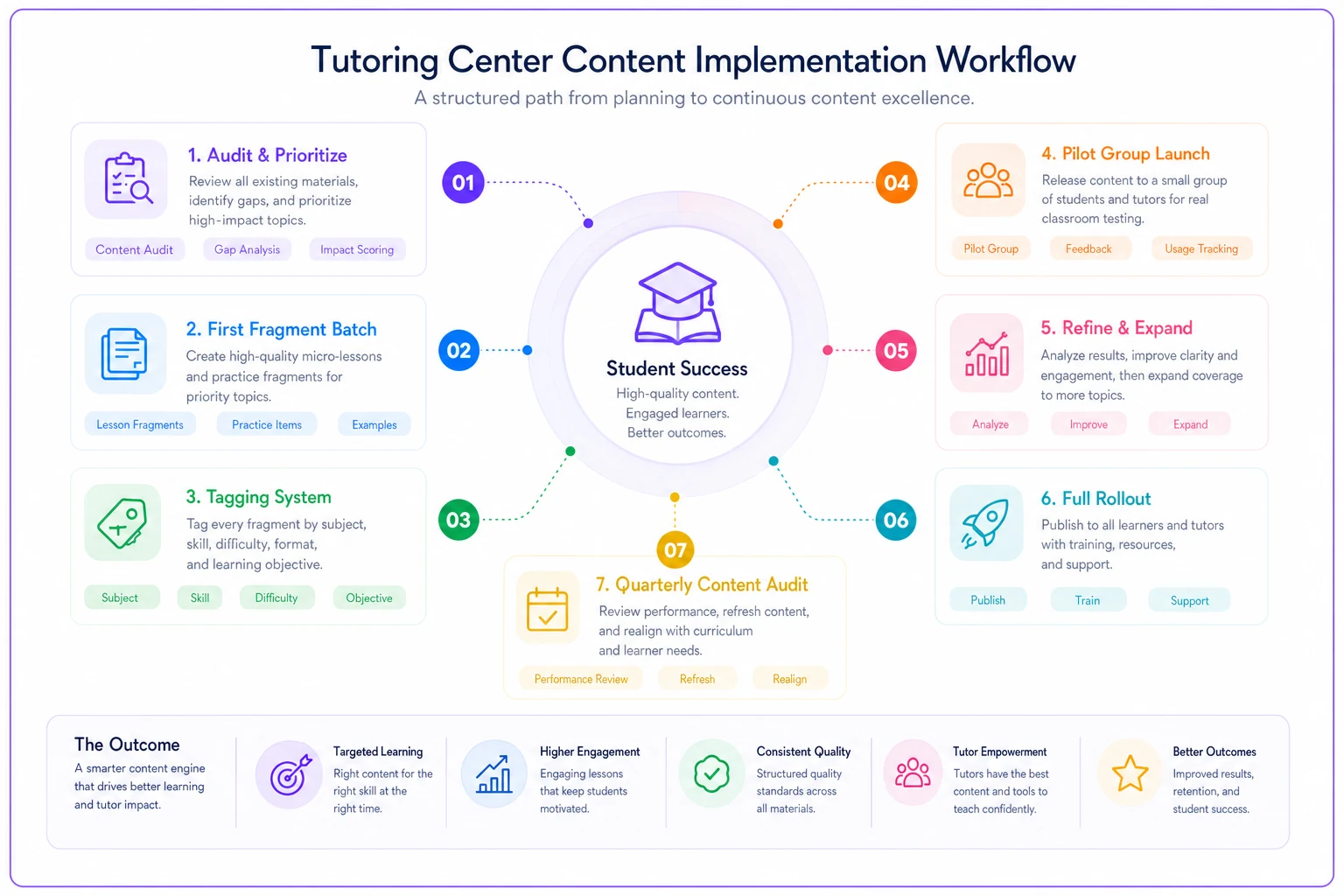
This flow diagram shows the stages and how each feeds into ongoing audits and improvements.
The compound effect of prep-time reduction on business growth
When you cut tutor prep from 45 minutes to 15 minutes per session, the impact goes beyond labor savings. You've just created capacity for each tutor to handle one or two additional students weekly without increasing their total work hours.
For a center with 10 tutors, that's potentially 10-20 additional student slots without hiring anyone new. At $200 per student per month, that's meaningful additional revenue from resources you already have.
The bigger impact, though, is tutor retention. Tutors who spend less time on administrative prep can focus on actual teaching. They're less likely to burn out, more willing to take on extra students, and more likely to cover for colleagues when needed.
Systematic content operations also makes onboarding dramatically faster. Instead of each new tutor slowly building their own material library over several months, they can deliver quality sessions from week one using your fragment library. This reduces the continuity problems that happen when tutors leave or when students need substitute coverage.
Quality tends to improve too, not just hold steady. When tutors use refined, proven materials, your best tutors' methods get embedded in fragments that everyone uses. Struggling tutors get scaffolding from successful templates. The library gradually encodes what actually works across your team.
Moving from ad-hoc prep to systematic content operations
The shift from individual prep to systematic content operations requires more than just building a library—it needs operational discipline and tools that actually support ongoing use.
Most tutoring centers that fail at this make the same mistake: they treat it as a one-time project instead of an ongoing system. They build a library, declare victory, and watch it slowly decay into irrelevance.
Assign a "content coordinator" role—even if it's just 2-3 hours weekly of someone's time—to maintain the library, review usage data, and identify gaps. This person becomes the bridge between what tutors need in the room and what the library actually provides.
Build feedback mechanisms into daily operations rather than relying on monthly meetings. A simple form where tutors flag missing fragments or report problems immediately after sessions works far better than a suggestion box that gets checked quarterly.
Modern operational software makes this more practical. AI-enhanced platforms can automatically tag content, surface relevant fragments based on lesson objectives, track usage patterns, and flag outdated materials. The same system managing your scheduling and billing can integrate your content library, so fragment selection becomes a natural part of lesson planning rather than a separate extra step. When finding and using fragments requires less friction, tutors stop defaulting to old habits—they just use what's there because it's faster.
Measuring long-term impact on learning outcomes
Six months after implementing a fragment-based content system, you need hard data on whether learning outcomes improved, maintained, or declined. This isn't about celebrating operational efficiency—it's about proving the changes actually benefit students.
Track outcomes across three categories. For academic progress: grade improvements in school, standardized test score changes, skill assessment improvements, and time to concept mastery. For engagement: session attendance rates, homework completion rates, student self-reported confidence, and continuation rates past an initial package. For parent perception: progress report satisfaction, likelihood-to-recommend scores, renewal rates, and referral generation.
Compare these metrics for students taught with fragment-based lessons versus those taught with fully custom prep, if you have a comparison group. The data usually shows that well-designed fragments hold up fine—often better—because tutors can focus on actually teaching rather than scrambling through materials mid-session.
Watch for edge cases. Fragments sometimes work well for average students but fall flat for outliers—gifted students get bored, struggling students get overwhelmed. Your metrics need to catch these situations before they turn into retention problems.
Building sustainable content operations for long-term growth
The fragment library and tagging system are just the foundation. Sustaining it requires quarterly content audits that look at which fragments consistently correlate with progress, which subjects have gaps, which tutors create the most reused content, and which templates get modified most often.
Use this data to prioritize development. If every tutor modifies the same template, it probably needs redesigning. If certain fragments never get used despite covering common topics, figure out why before you create more material in that vein.
Create real incentives for tutors to contribute quality fragments—whether that's a small cash bonus for fragments that hit a usage threshold, priority scheduling, or something else that actually drives behavior in your specific culture.
Document everything in operational procedures that new coordinators can follow. Include fragment creation standards, tagging guidelines with examples, review cycle procedures, quality assessment rubrics, and usage tracking methods. As your center grows, content operations becomes a genuine competitive advantage. New locations launch with a full fragment library instead of starting from zero. Franchisees get operational systems that would otherwise take years to build independently.
The math is straightforward: reduce prep time by 30 minutes per session, multiply by your weekly session count, calculate the labor savings and capacity gain. But the compound effects—better tutor retention, faster onboarding, more consistent quality across the team—are where the real value accumulates over time.
Ready to streamline your tutoring operations?
Join 500+ tutors and centers using Tutoryly to save time, improve scheduling accuracy, and enhance student experiences.