

Most tutoring centers back into payment plans by accident. A parent asks if they can "split it up," the front-desk person says yes without a real policy, and six months later you've got a spreadsheet full of half-paid packages, no clear record of who owes what, and a monthly reconciliation that eats an entire Saturday.
The problem isn't offering plans. Plans are fine — they help you close larger packages and keep families enrolled longer. The problem is offering them without written rules for who qualifies, how much comes up front, and how the money maps back to sessions actually delivered.
This is the part almost nobody documents properly. So here's the whole thing — eligibility, down-payment logic, the accounting side, and the reconciliation steps — with real numbers you can copy.
Eligibility rules matter more than most centers think
The instinct is to offer payment plans to anyone who asks. That feels friendly. It also quietly loads your accounts receivable with the exact families most likely to disappear mid-package.
A tutoring payment plan policy works better when eligibility is tied to something concrete, not vibes. The centers that avoid bad debt use two or three simple gates.
The first gate is package size. There's no reason to offer a plan on a $180 four-session starter pack — the admin overhead costs more than the flexibility is worth. Plans should kick in at a threshold, usually somewhere around the $600–$800 mark, where splitting genuinely helps a family say yes.
The second gate is payment history. A family that's been with you two terms and always pays on time is a completely different risk than a brand-new lead who wants to split their first big package four ways. You don't have to say no to new families — you just ask for more up front.
The third gate, which people forget, is method of payment. Plans should require a card or bank account on file with auto-charge enabled. The moment you're relying on someone to remember to send a transfer every month, your reconciliation workload triples and your collection rate drops.
Here's a clean eligibility table you can adapt:
| Package price | Plan offered? | Down-payment | Remaining split | Card on file required |
|---|---|---|---|---|
| Under $600 | No | Full amount | — | Yes |
| $600–$1,200 | Yes | 30% | 2 monthly payments | Yes |
| $1,200–$2,500 | Yes | 30% | 3 monthly payments | Yes |
| Over $2,500 | Yes, with approval | 40% | 3–4 monthly payments | Yes |
| New family, any size | Case-by-case | 50% | 2 monthly payments | Yes |
The point of the table isn't the exact percentages — adjust those to your margins. The point is that the decision is made in advance, so your front desk isn't negotiating terms live with a parent who's good at negotiating.
Down-payment logic: what the first payment is actually protecting
People treat the down-payment like a formality. It's not. It's the single most important number in the entire policy because it's the part you're guaranteed to collect.
Never miss another tutoring session.
Tutoryly helps you schedule, confirm, and manage every tutoring session efficiently.
- Unified session scheduling
- Automated student notifications
- Tutor calendar & availability management
No credit card required
Think of it this way: the down-payment should cover the sessions a family is most likely to attend before they'd consider quitting. For most centers that's the first three to four sessions. If a family bails after session two, you want the money already in hand for those sessions plus a little buffer for the admin cost of unwinding the plan.
A typical example: a family buys a 24-session package at $1,800 ($75/session). You take a 30% down-payment — $540 — which covers just over seven sessions. The remaining $1,260 splits into three monthly charges of $420. If they cancel after session eight, you've collected $540 up front plus whatever monthly charges have processed. You're rarely in the hole.
Compare that to the center that lets the same family pay $150 down and "the rest as we go." That center is financing the family's education out of its own cash flow and usually doesn't realize it until the quarter closes.
One more thing on down-payments that gets missed: charge it before the first session, not after. The number of centers that deliver session one and then chase the down-payment is surprisingly high. Session one is your best leverage. Once the kid has started and the parent is happy, the down-payment conversation gets easier to postpone — for the parent, not for you.
If you're running family accounts with multiple kids, the down-payment math gets more involved, and it's worth reading how consolidated billing changes the picture in this breakdown of the family account data model and discount formulas before you set your thresholds.
Automated reminders: the boring part that saves the collection rate
The failure mode here is quiet. Nobody misses a payment on purpose. Cards expire, banks flag a charge, a parent switches accounts. What kills your collection rate is the gap between a failed charge and the moment anyone notices.
-
Three days before the charge a short heads-up. "Your next payment of $420 for Maya's package will process on the 15th." This alone cuts surprise disputes.
-
Day of charge, on success a receipt. Silent confirmations reduce "did that go through?" emails.
-
Day of charge, on failure an immediate notice with a one-click update-card link. Speed matters more than tone here.
-
Day 3 after failure a firmer follow-up, and an internal flag so your admin knows to pause scheduling if it's not resolved.
-
Day 7 after failure a pause on future sessions until the balance is current, with a clear, human message explaining why.
Speed matters more than tone; include a one-click update-card link in the failure notice.
The reason to automate this instead of doing it by hand isn't laziness — it's consistency. The manual version depends on someone remembering to check the failed-payment report, and that person is also teaching, scheduling, and answering the phone. AI-assisted operational tools handle this kind of repetitive, time-boxed workflow well: the system watches for the failed charge, fires the right message at the right interval, and only pulls a human in when something actually needs a decision. You stop losing money to charges nobody chased.
Doing this manually at a center with 40+ active plans is genuinely unreliable — not because people aren't trying, but because the volume of small tasks compounds faster than most admin capacity can keep up with.
The accounting side nobody explains: deferred revenue vs. cash
This is where tutoring centers get into genuine trouble, and it has nothing to do with fraud — it's a misunderstanding of what the money represents.
When a family pays $540 down on an $1,800 package, you have not earned $540. You've collected it, but revenue is only earned as sessions are delivered. That $540 is a liability until then — money you owe in the form of future tutoring. Accountants call it deferred revenue. Practically, it means some of the cash sitting in your account is already spoken for.
A center that treats every incoming payment as profit will look flush in months when a lot of plans start, then feel squeezed in months where they're delivering already-paid sessions with little new cash coming in. The business is usually fine — the bookkeeping just made it look like a rollercoaster.
-
On payment received record it as cash in, deferred revenue up.
-
After each session delivered move that session's value ($75 in our example) from deferred revenue to earned revenue.
-
On refund or cancellation reverse the unearned portion out of deferred revenue.
You don't need enterprise accounting software for this. You need one consistent rule — recognize revenue per session delivered, not per payment collected — and a report that shows your outstanding deferred balance. That number is your honest picture of how much tutoring you've already been paid for but haven't yet delivered.
For centers thinking about how package structure interacts with margin and lifetime value, recognizing revenue per session ties directly into how you should be pricing in the first place — there's a fuller treatment in this guide to building a pricing and packaging system with worked margin examples.
Worked examples across three package prices
Package A — $780, 12 sessions at $65 30% down = $234, covering about 3.6 sessions. Remaining $546 split into two payments of $273. If the family cancels at session 6, they've had 6 sessions delivered ($390 earned) and paid $234 down plus one $273 installment = $507 collected. You're ahead by $117, which comfortably covers admin and any prorated refund conversation.
Package B — $1,800, 24 sessions at $75 30% down = $540. Remaining $1,260 as three payments of $420. When session 24 is delivered, all $1,800 has moved from deferred to earned. Your deferred-revenue report correctly showed a shrinking liability all the way through, so you never mistook the down-payment for profit.
Package C — $2,900, 32 sessions at ~$90.60 This is over the approval threshold, so 40% down = $1,160, with the remaining $1,740 as three payments of $580. If this family walks after 10 sessions (roughly $906 earned), you've still collected $1,160 up front — before any installments — so you're not underwater on delivered value.
The pattern across all three: the down-payment percentage scales with your exposure, and in every case the collected amount stays ahead of the delivered amount during the risky early period. That's the whole design goal.
The monthly reconciliation steps
Reconciliation is where the policy either proves itself or falls apart. Here's a sequence that takes an organized center under an hour a month instead of a lost weekend.
-
Pull the list of active payment plans and their scheduled charges for the month.
-
Match each charge against your payment processor's settled transactions. Anything charged but not settled goes on a follow-up list.
-
Cross-check sessions delivered against sessions paid for. This is the step people skip, and it's the most important one — it's how you catch a family that's burned through 20 sessions on a plan that's only covered 14.
-
Update deferred revenue
move the value of all sessions delivered this month from deferred to earned.
-
Flag any account where delivered sessions exceed collected value. These are your real risk accounts, not just the failed-charge accounts.
-
Reconcile refunds and cancellations, reversing the unearned portion cleanly.
-
Confirm the deferred-revenue balance matches "sessions sold minus sessions delivered, priced out." If it doesn't, something in steps 3–6 slipped.
-
[ ] Every scheduled charge is either settled, failed-and-followed-up, or intentionally paused
-
[ ] Sessions delivered ties to sessions paid for on every plan account
-
[ ] Deferred revenue moved to earned for all delivered sessions
-
[ ] No account is delivering sessions faster than it's paying
-
[ ] Refunds reversed the correct unearned amount
-
[ ] Deferred balance matches the sessions-outstanding math
A quick checklist before you call reconciliation done:
This image shows the reconciliation flow in one glance.
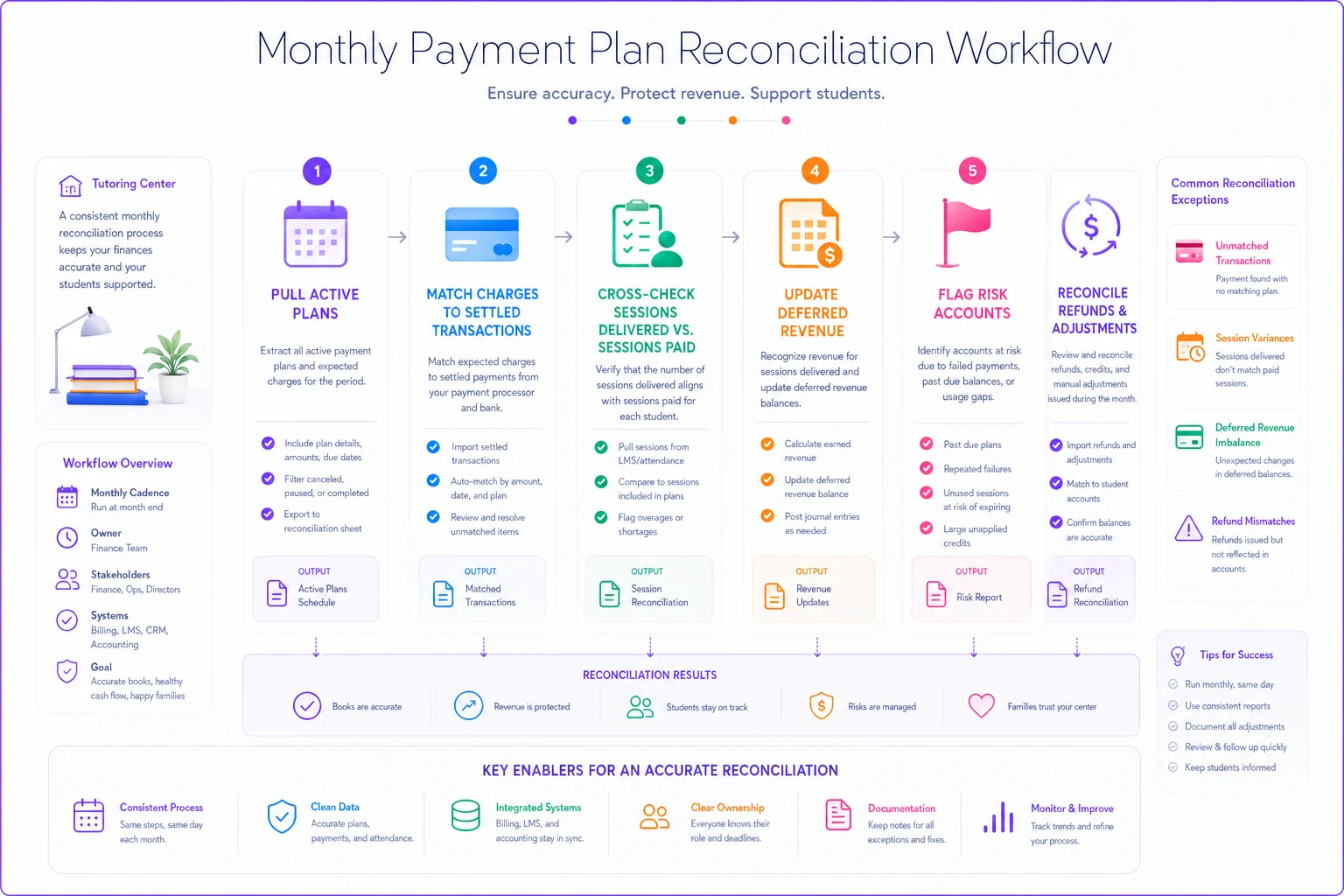
Steps 3 and 5 are what separate centers that quietly lose a few hundred dollars a month from those that don't. The money doesn't disappear in one big dramatic default — it leaks through families who front-loaded their sessions on a plan they never finished paying.
When payment plans actually make sense — and when they don't
When they make sense: larger packages, families with a track record, and situations where a plan is the difference between a yes and a no on a $1,500+ commitment. Plans genuinely expand who can afford consistent tutoring, and consistent tutoring is what produces results that keep families enrolled.
When they're a bad idea: small packages where the admin cost outweighs the benefit, first-time families with no history and no meaningful down-payment, and any situation where you can't get a card on file with auto-charge. If you're relying on manual transfers, you don't have a payment plan — you have an invoice you'll be chasing.
Who should not do this at all: any center that hasn't set up per-session revenue recognition. If every incoming dollar looks like profit in your books, adding payment plans will make your cash flow feel unpredictable and you'll never trust your own numbers. Fix the deferred-revenue tracking first, then offer plans.
A short real scenario
A mid-sized center running mostly one-on-one academic tutoring — around 60 active students — had been offering informal "split it up" arrangements for over a year. No written thresholds, no consistent down-payment, payments coming in by transfer and card in a random mix.
Reconciliation was taking most of a day each month, and they had about $2,600 in slow or stalled plan balances scattered across a dozen families. A few of those families had received more sessions than they'd paid for, and nobody had caught it.
They rebuilt the policy along the lines above: a 30% down-payment minimum, card-on-file required, and a monthly reconciliation step that cross-checked sessions delivered against dollars collected. Within two billing cycles the reconciliation dropped to well under an hour, the stalled balance shrank to a few hundred dollars, and — the part they didn't expect — their close rate on bigger packages improved. Because the plan terms were clear enough to present with confidence instead of being negotiated nervously at the desk.
The lesson wasn't that payment plans are risky. It was that undefined payment plans are risky. Once the eligibility rules, the down-payment logic, and the reconciliation steps were written down and followed consistently, the plans stopped being a liability and went back to doing what they're supposed to — helping more families commit, and stay.
The lesson wasn't that payment plans are risky. It was that undefined payment plans are risky. Once the eligibility rules, the down-payment logic, and the reconciliation steps were written down and followed consistently, the plans stopped being a liability and went back to doing what they're supposed to — helping more families commit, and stay.
Ready to streamline your tutoring operations?
Join 500+ tutors and centers using Tutoryly to save time, improve scheduling accuracy, and enhance student experiences.