

Most tutoring centers treat accommodations as an IEP problem. A student shows up with paperwork, someone reads the paperwork, and the tutor tries to remember what it said mid-session. Everyone else — the kid who reads slowly but has no diagnosis, the one who freezes on timed drills, the ESL student who understands the math fine but not the word problems — gets the standard treatment and slowly disengages.
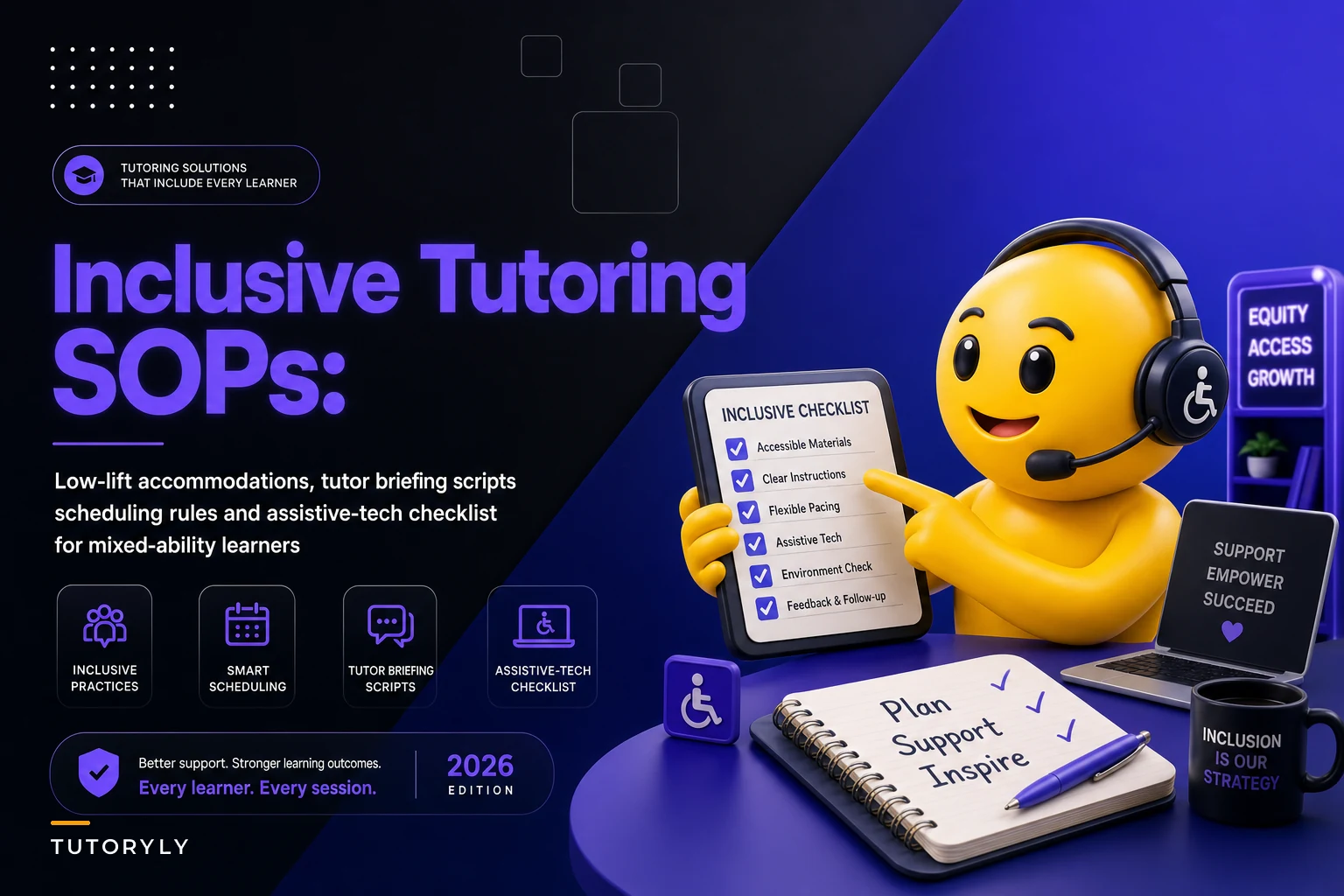
That's the gap this article is about. Not the legally-mandated stuff (we covered that in the IEP-friendly tutoring operations post), but the operational layer underneath it: the accommodations, scripts, and scheduling rules that make your center work for neurodiverse and mixed-ability learners whether or not they arrive with a formal plan.
The insight most owners miss: if accommodations only activate when there's an IEP, you're leaving somewhere between 60 and 70% of the students who'd actually benefit from them without any support. Diagnosis rates lag real need by years. Your SOPs shouldn't wait for paperwork to catch up.
This is the operational version — the stuff you can standardize, hand to a 22-year-old tutor in their second week, and trust to run consistently without babysitting it.
Start with low-lift accommodations, not the fancy ones
The mistake I see constantly: centers try to build elaborate accommodation systems and then abandon them because they're too heavy to run at 4:45pm on a Tuesday with three students waiting.
Low-lift accommodations are the ones a tutor can apply in under 30 seconds, without prep, without asking permission, and without singling anyone out. These should be defaults available to everyone, not special exceptions you unlock for the right diagnosis.
Here's the core set worth standardizing:
| Accommodation | Lift for tutor | Who it helps (beyond IEP) |
|---|---|---|
| Offer "want the timer on or off?" | Near zero | Test-anxious kids, processing-speed differences |
| Read the instructions aloud once, always | Near zero | Dyslexic readers, ESL, distracted learners |
| Break a worksheet into 3 chunks with a check-in between | Low | ADHD, working-memory limits, anyone overwhelmed |
| Let the student choose problem order | Zero | Anxiety, executive-function differences |
| Provide a printed agenda for the session | Low (once templated) | Autistic learners who need predictability |
| Allow verbal answers instead of written when checking understanding | Zero | Dysgraphia, slow writers, kids who "know it but can't write it" |
| Offer a 2-minute movement break at the halfway point | Zero | ADHD, younger kids, late-afternoon slots |
None of these require a diagnosis. None of them hurt a neurotypical learner. That's the test for whether something belongs in your default kit — if applying it to a neurotypical student causes no harm, make it available to everyone and stop gatekeeping it.
The operational win here is that tutors stop having to decide whether a kid "qualifies." The accommodation is just part of how sessions run. Decision fatigue drops, and the quiet strugglers who'd never get flagged get support anyway.
Tutor briefing scripts so support doesn't live in one person's head
The single biggest continuity failure in inclusive tutoring is that knowledge of how to work with a specific student lives entirely in the tutor's memory. Then that tutor gets sick, or a student moves to a different tutor for scheduling reasons, and everything resets.
Never miss another tutoring session.
Tutoryly helps you schedule, confirm, and manage every tutoring session efficiently.
- Unified session scheduling
- Automated student notifications
- Tutor calendar & availability management
No credit card required
You need briefing scripts — short, structured handoffs that transfer the how of working with a student, not just their skill level. This is different from lesson notes (which we broke down in the tutor lesson notes SOP post). Lesson notes tell the next tutor what was taught. Briefing scripts tell them how to approach the learner.
-
What settles this student in the first two minutes? (e.g., "Start with review, never new material. She shuts down if the first thing is unfamiliar.")
-
What phrasing backfires? (e.g., "Don't say 'easy' — he hears it as 'you should already know this' and disengages.")
-
What's the escalation signal? (e.g., "When he starts clicking the pen and looking at the door, he's about 90 seconds from being done. Switch to something concrete or take the break early.")
-
What accommodations are already in play? (Timer off, verbal answers accepted, agenda printed.)
-
What's the win condition for a good session? (e.g., "Finishing calm and willing to come back matters more than finishing the worksheet.")
Most tutors already know these things about their regulars. They just never wrote them down because nobody asked. The briefing script isn't creating new knowledge — it's capturing knowledge that was about to walk out the door.
Make it a required field before any tutor handoff. Ten minutes to fill in, and it saves the next tutor several sessions of figuring out from scratch what the last one already learned.
Where centers get this wrong
They make the briefing script optional, or they build it out to 40 fields. Optional means it never gets filled out. Forty fields means tutors rush through it and write nothing useful. Five fields, mandatory, half a page — that's the version that actually gets used.
Scheduling and assignment rules that quietly do half the work
A lot of what looks like a learning problem is a scheduling problem in disguise. The kid who "can't focus" is booked at 5:30pm after a full school day and a bus ride. The autistic learner who "resists new tutors" got assigned three different tutors in a single month because your scheduling prioritizes tutor availability over continuity.
Scheduling is probably the most underused accommodation lever in the building, mostly because owners treat it as pure logistics rather than support.
-
Continuity lock for flagged students. Once a mixed-ability learner has two solid sessions with a tutor, that pairing gets protected. It doesn't get broken for convenience — only for a genuine mismatch. Rebuilding rapport is expensive and mostly invisible on the schedule.
-
Energy-aware slotting. Students who struggle with sustained attention get earlier slots when possible. A 4:00 slot and a 6:15 slot are not the same session for an ADHD eight-year-old, and pretending they are is how a scheduling choice becomes a "behavior problem."
-
Buffer time on transitions. For students who need predictability, avoid last-minute room or tutor swaps. A short buffer means nothing feels rushed or chaotic.
-
Cap new-face exposure. Some learners can handle one substitute; a rotating cast wrecks them. Set a rule: flagged students get no more than one unfamiliar tutor per two-week window, and when a sub is unavoidable, the briefing script goes with them.
None of this shows up as "accommodation" in a progress report, but it's often what separates a student who stays enrolled for a year from one who quietly stops booking.
The assistive-tech checklist you can actually run
Assistive tech gets overcomplicated fast. Owners picture expensive specialized software when most of the value comes from tools already sitting on the devices in the room.
The goal isn't a tech lab. It's a checklist a tutor can run through in a minute to decide what to offer.
Reading support
-
[ ] Text-to-speech available on the tablet/laptop (built into most operating systems already)
-
[ ] Adjustable font size and spacing on any digital worksheet
-
[ ] Colored overlays or dark-mode option for visual-stress readers
-
[ ] Reading ruler / line guide (physical or on-screen) on hand
Writing support
-
[ ] Speech-to-text enabled for students who think faster than they write
-
[ ] Word-prediction available on typed work
-
[ ] Option to submit answers as a photo of handwritten work instead of retyping
Attention & organization
-
[ ] Visual timer available (and optional, per the accommodation kit)
-
[ ] Printed session agenda template ready to fill in
-
[ ] Noise-reducing headphones available for students who need them
-
[ ] A distraction-reduced seat option (facing a wall, not the door)
Math-specific
-
[ ] Digital or physical manipulatives for concept-building
-
[ ] Graph paper on hand for students who lose alignment
-
[ ] Calculator-use policy that separates "computation practice" from "concept practice"
This checklist should live where tutors actually work — taped inside a supply cabinet, pinned in your shared system — not buried in an onboarding doc nobody reopens. Tech that exists but nobody remembers to offer helps no one.
A real scenario: what changed when the rules got written down
A mid-size center — around 180 active students, six tutors — was losing kids in the 8-11 age range at a rate that didn't match their older cohorts. Retention on younger students sat noticeably below the rest of the roster, and the owner assumed it was a curriculum fit problem.
It wasn't. When they actually looked, the pattern was clear: younger and neurodiverse learners were getting reshuffled between tutors constantly, sessions were slotted late because "the little kids' parents are flexible," and accommodations only happened when a tutor personally happened to be good at that stuff.
They did three unglamorous things: locked continuity for flagged students, moved the younger cohort into earlier slots, and made the five-field briefing script mandatory at handoff. No new curriculum, no new hires.
Over the following term, retention in that age group climbed to roughly match the rest of the center. The owner's takeaway was pretty blunt: they hadn't had a teaching problem, they'd had a consistency problem — and consistency was something they could actually put in an SOP.
How this fits into your broader systems
The practical hurdle is keeping briefing scripts, accommodation flags, and continuity rules attached to the right student without a tutor digging through old emails to find them. An operational platform handles this naturally — flags that follow the student to whoever they're assigned to, briefing scripts that surface automatically at handoff, scheduling rules that respect continuity locks instead of quietly overriding them.
[Student Intake & Flags] ↓ [Briefing Script Created] ↓ [Scheduling Rules Applied] ← continuity lock, energy-aware slotting ↓ [Session Runs with Default Accommodations] ↓ [Lesson Notes Logged] ↓ [Briefing Script Updated at Handoff]
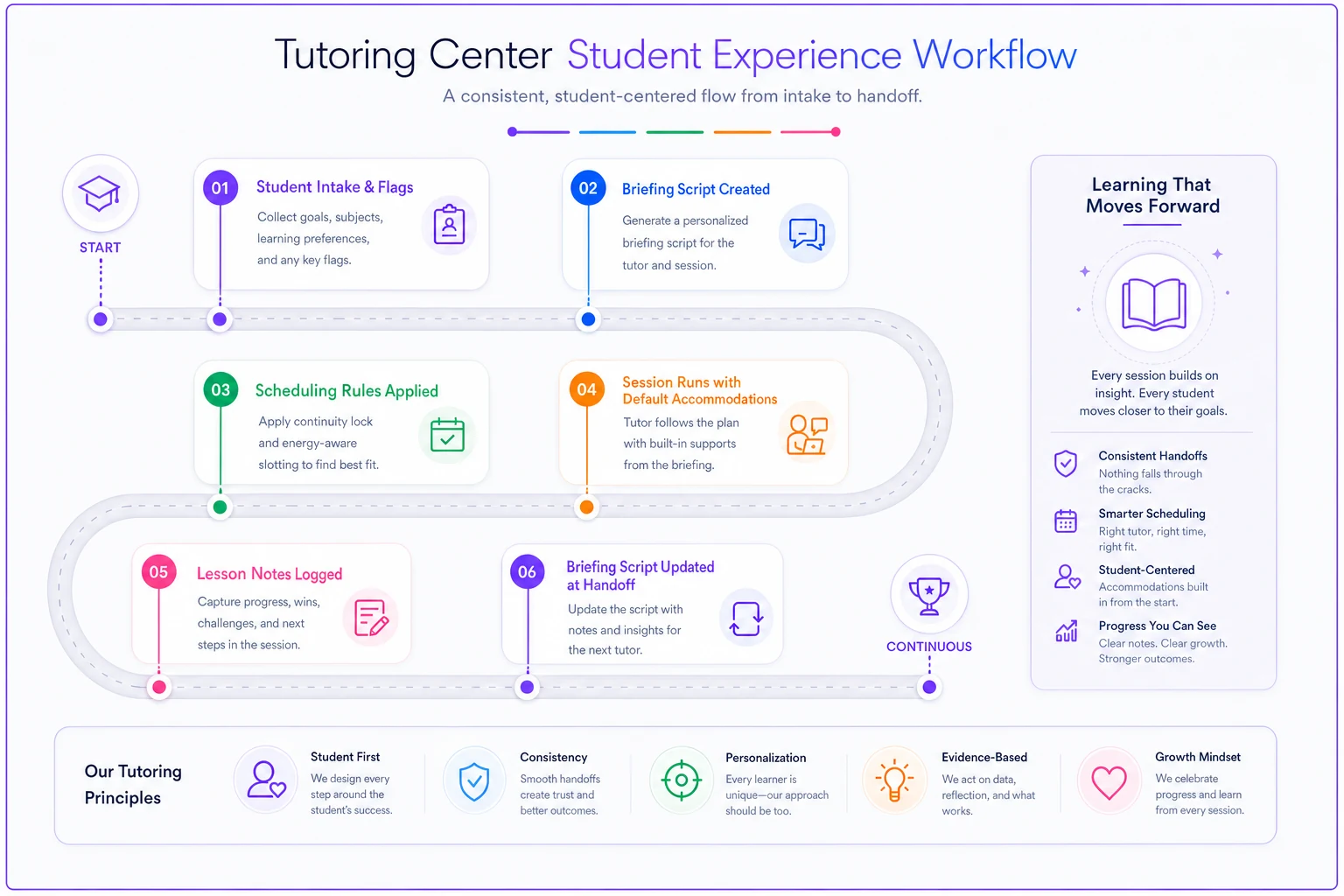
The value isn't anything clever; it's that the accommodation doesn't depend on one person remembering. It's just there, every session, for whoever's running it.
When this makes sense — and when it doesn't
Worth building if: you have more than a couple of tutors, students move between them, and you're seeing quiet churn you can't fully explain. The moment support depends on which tutor a kid happens to get, you have a standardization problem worth solving.
Overkill if: you're a solo tutor with a dozen steady students you know inside out. You are the SOP at that scale. Write things down for your own continuity, but don't build a handoff system for handoffs that never happen.
Who should be careful: centers tempted to turn this into a bureaucratic intake process. If your inclusive-support system means families fill out more forms and tutors do more admin, you've missed the point. The best version of this is mostly invisible — defaults, protected pairings, a half-page script. If it feels heavy to run, it was built wrong.
The real point
Inclusive tutoring isn't a special program you bolt onto the side of your center. It's a set of defaults and rules that make your normal operation work for the full range of learners actually walking through your door — most of whom will never have a formal plan.
Build the low-lift accommodations as defaults. Get the tutor's head-knowledge into short briefing scripts before it walks out the door. Use scheduling and assignment as the quiet support tool it already is. Keep the assistive-tech checklist boring and available. Do those four things and you'll support neurodiverse and mixed-ability learners far more reliably than any center still waiting on paperwork to tell them a kid needs help.
Ready to streamline your tutoring operations?
Join 500+ tutors and centers using Tutoryly to save time, improve scheduling accuracy, and enhance student experiences.