


Most tutoring centers treat IEP students the same way they treat everyone else — until something goes wrong. A parent forwards a 40-page evaluation report the night before the first session. A tutor finds out three weeks in that the student has extended-time accommodations and processing speed concerns nobody wrote down. A school special-ed coordinator emails asking for progress data and nobody knows who's supposed to respond.
None of that is a tutoring problem. It's a documentation and coordination problem. And it's exactly what separates a center that can confidently take on IEP-supported students from one that just hopes it works out.
This is a walkthrough of the SOPs that actually matter for IEP tutoring workflows — intake and consent, documentation standards, tutor qualification gates, school collaboration, and the scheduling rules that accommodations quietly force on you. Not the legal theory. The operational pieces you can build this month.
Where IEP tutoring quietly breaks down
The failure almost never happens at the moment a parent says "my son has an IEP." It happens later, in the gaps between people.
A typical breakdown looks like this: a parent mentions the IEP during a phone inquiry. The front desk writes "has IEP" in a notes field. The student gets matched to a tutor based on subject and availability. Three sessions in, the tutor notices the kid shuts down on timed drills and mentions it to someone. Finally, the parent is asked to send the actual document. It arrives, and buried on page 12 is a specific accommodation — no timed assessments without a movement break beforehand. Nobody knew. Three sessions were spent doing exactly the wrong thing.
The pattern is consistent: IEP information gets captured as a label instead of a set of operating instructions. "Has IEP" tells your tutor nothing. The accommodations, the specific goals, the sensory or processing considerations — those are the operating instructions, and they need to live somewhere structured, not in a free-text note or a parent's memory.
The second failure point is consent. A lot of centers assume that because a parent handed over the IEP, they're allowed to talk to the school about it. Usually they're not, at least not without explicit written permission. That gap creates a specific and awkward problem: the school coordinator reaches out, your center wants to collaborate, and you realize you never got signed authorization to share anything. Now you're stalling a useful conversation because your paperwork wasn't ready.
Intake and consent: capture instructions, not labels
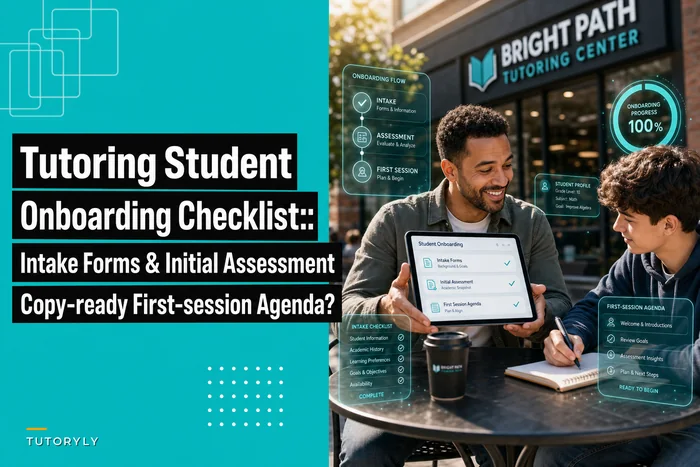
Your standard onboarding process is a fine starting point — if you've already built a solid one, the student onboarding checklist with intake forms and initial assessment covers the base layer. IEP students need a second layer stacked on top of that, triggered whenever a family indicates any formal plan (IEP, 504, or an outside evaluation).
Never miss another tutoring session.
Tutoryly helps you schedule, confirm, and manage every tutoring session efficiently.
- Unified session scheduling
- Automated student notifications
- Tutor calendar & availability management
No credit card required
Here's what the IEP intake layer needs to capture, and why each piece matters:
-
Document upload, not summary. Get the actual IEP or 504 plan, not the parent's paraphrase. Parents routinely misremember accommodations — especially details like the difference between 1.5x extended time and 2x. The number matters.
-
Accommodations that apply to tutoring specifically. Not every classroom accommodation is relevant in a one-on-one setting. Your form should ask families to flag which ones they want honored during sessions, and your team confirms from there.
-
Primary goals from the plan. Two or three measurable goals the student is working toward. This is what school collaboration will eventually revolve around.
-
Sensory, processing, and regulation notes. The stuff that isn't a formal accommodation but changes how a session runs — needs frequent breaks, struggles with transitions, gets overwhelmed by too much on a page at once.
-
The case manager's name and contact. You'll want it later. Ask now.
The consent piece needs to be its own signed document, separate from your general terms. It should authorize, in plain language, three specific things:
-
That the center may store and reference the IEP/504 to deliver services.
-
That the center may communicate with the school (named case manager or department) about the student's tutoring progress and accommodations.
-
That the center may share tutoring progress data back to the school when requested.
Keep the consent scoped and revocable. Parents are far more comfortable signing when the document says exactly what you will and won't do, rather than a vague blanket release. One center I'm aware of saw its school-referral pipeline improve simply because coordinators trusted that consent was already handled — the paperwork readiness itself became a signal that the center knew what it was doing.
Documentation standards for accommodation-based sessions
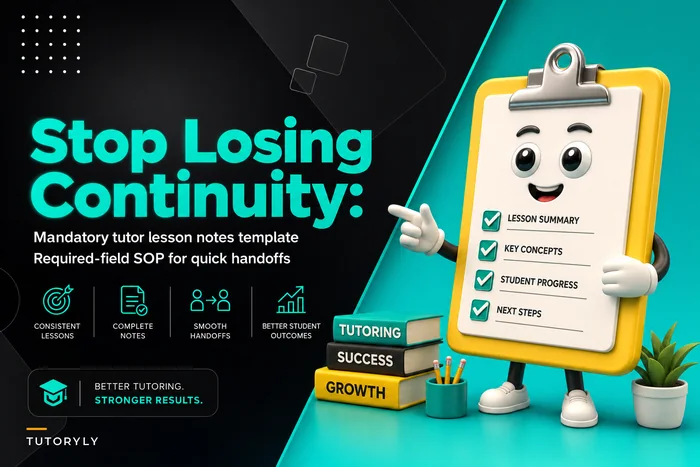
Regular lesson notes aren't enough here. If you already run a required-fields notes system — and if you don't, the mandatory tutor lesson notes template and required-field SOP is the place to start — the IEP version adds a small set of mandatory fields that turn ordinary notes into defensible, school-ready documentation.
| Standard note field | IEP-added field | Why it exists |
|---|---|---|
| What was covered | Which IEP goal it targeted | Ties every session to the plan, not just the subject |
| Student engagement | Accommodations actually used this session | Proves you honored the plan, session by session |
| Homework assigned | Regulation/behavior observations | Feeds progress conversations with the school |
| Next steps | Deviation flag (if an accommodation wasn't applied and why) | Protects you when something goes off-script |
That last field — the deviation flag — is the one people skip and later regret. If a tutor didn't give the movement break because the student refused it, that needs a line in the notes. Otherwise, six weeks later when a parent says "the plan wasn't followed," you have no record of what actually happened. Documentation that only captures the ideal case is useless the moment there's a dispute.
Make the deviation flag required and include a brief reason whenever it's used so reports are defensible later.
Worth naming directly: centers that tie every session note to a specific IEP goal end up with much better progress conversations, because they're not scrambling to reconstruct twelve weeks of work. The summary practically writes itself from the notes. Goal-tagging isn't bureaucratic overhead — it's what makes a school report a five-minute job instead of a two-hour scramble.
Tutor qualification: who's allowed to take these students
Not every tutor should be assigned an IEP-supported student, and pretending otherwise is how centers end up with mismatches that hurt the kid and expose the business.
This doesn't mean you need special-ed credentialed staff for every case. It means you need a qualification gate — a short checklist a tutor clears before being eligible for accommodation-based assignments. What that gate should verify:
-
Has read the center's accommodation-handling SOP and knows how to read an IEP summary sheet
-
Understands the difference between an accommodation (how the student accesses material) and a modification (changing what's expected) — and knows the center's line on which they can and can't provide
-
Knows how to fill out the IEP-added documentation fields correctly
-
Has completed whatever baseline training you require on common accommodation categories: extended time, reduced-distraction settings, chunked instructions, movement breaks
-
Knows the escalation path when a session reveals something the plan didn't prepare them for
For students with more involved plans — significant processing disorders, behavioral support needs, or goals requiring specific instructional approaches — you want a higher tier of tutor, and you should say so explicitly in your matching rules. A simple two-tier system works well in practice: Tier 1 tutors handle straightforward accommodation cases (extended time, quiet environment, break flexibility), Tier 2 tutors handle plans with instructional modifications or behavioral components. Match accordingly.
When a specialized tutor makes sense: the IEP includes specific methodology like Orton-Gillingham, or the goals are genuinely remediation of a diagnosed learning disability. When it's overkill: a capable student with extended-time and reduced-distraction accommodations who mainly needs subject help. Routing every IEP student toward your most credentialed staff prices families out of help they'd benefit from at a lower level.
School collaboration SOPs: turning a good idea into a repeatable process
Collaboration with schools sounds great and stays theoretical at most centers because there's no actual process for it. Someone means to reach out, doesn't, and the relationship never forms.
Make it a defined workflow with three touchpoints:
-
Initial contact (after consent is signed). A short, professional introduction to the case manager: who you are, that you're supporting the student, confirmation that you have signed consent, and a request to align on current goals. Keep it brief. Coordinators are stretched thin; a two-paragraph email that respects their time gets answered. A long one doesn't.
-
Periodic progress share. On a fixed cadence — every 6 to 8 weeks works for most centers — send a structured summary: goals worked on, accommodations honored, observable progress, and any patterns worth flagging. Because your session notes are already goal-tagged, this gets assembled rather than written from scratch.
-
Event-triggered contact. IEP meeting coming up, a concerning regression, a meaningful win worth reporting. Have a lightweight template ready so nobody is drafting from zero under time pressure.
A collaboration template that works keeps a consistent skeleton: Student / reporting period / goals addressed / accommodations used / progress observed / recommendations or questions for the team. Schools respond well to the same structure every time because it slots into how they already document. You're speaking their language, which makes you the provider they actually want to work with.
One honest caution: don't overstep into diagnosing or recommending IEP changes. Your lane is reporting what you observe and how the student responds to their accommodations in a tutoring context. The school owns the plan. Centers that respect that boundary get invited back; centers that start prescribing don't.
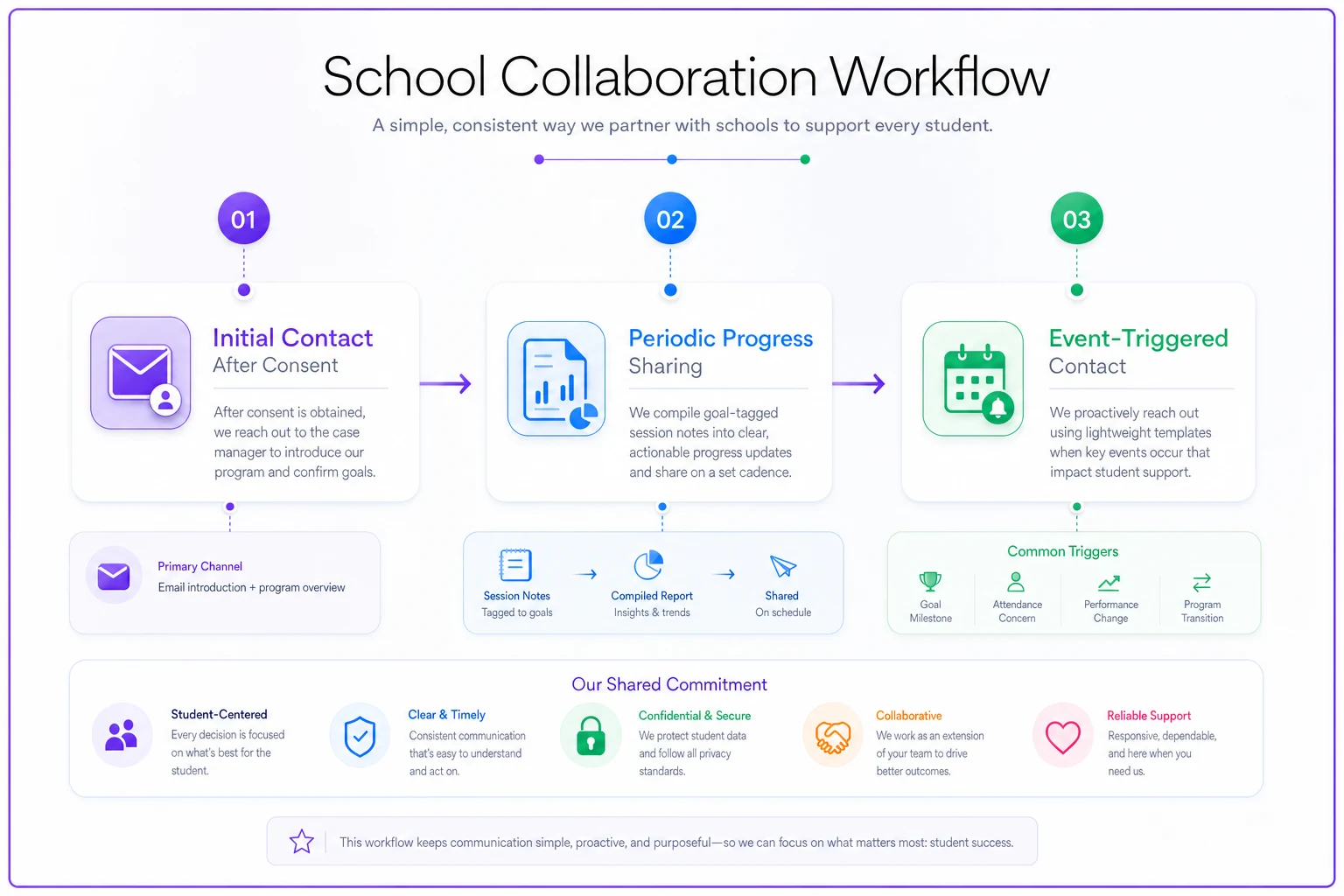
Here's a simple visual of that workflow.
Accommodation-specific scheduling rules
This is the piece that surprises a lot of owners, because accommodations don't just change how a session runs — they change how it has to be scheduled, and generic scheduling logic quietly violates the plan.
Some concrete examples:
-
Extended time. If a student's accommodation is 1.5x on assessments and your session is partly assessment-based, a standard 60-minute block doesn't fit. You need a rule that flags these students for longer blocks or protects buffer time.
-
Fatigue and processing load. Some plans note that the student loses focus after a certain duration. Booking them into a 90-minute session or a late-evening slot after a full school day sets them up to fail before they walk in. Scheduling should steer them toward shorter or earlier slots.
-
Movement breaks. A session that requires a mid-point break of 5–10 minutes is not a 60-minute session in practice. If your capacity math ignores that, your tutor's day runs long and the next student waits.
-
Consistency requirements. Many students with IEPs regulate better with the same tutor, same day, same time. A scheduling system that reassigns freely to fill gaps is actively harmful here. These students need a "protect the pattern" flag.
The fix is attaching scheduling constraints to the student record, not leaving them in a tutor's head. When the constraint lives on the record, whoever is booking sees it before they create a slot that breaks the plan. When it lives in someone's memory, it breaks the first time that person is out sick or distracted.
Most scheduling and center-management platforms let you attach custom flags or constraints to a student profile — extended-block requirements, protected recurring slots, tutor-lock settings. That's the practical place these rules belong. Not because the software does anything magic, but because a constraint that isn't visible at the moment of booking will eventually get ignored. With accommodation students, "eventually" arrives fast.
A short real scenario
A mid-sized center — around 120 active students, roughly 15 of them on IEPs or 504 plans — kept running into the same friction. Intake captured "has IEP" as a note field. Tutors discovered accommodations mid-engagement. Two families in one term complained that the plan wasn't being followed, and one pulled their child.
They rebuilt three things: a stacked IEP intake layer with actual document upload and scoped consent, goal-tagged documentation fields added to their existing notes, and student-record scheduling flags for extended blocks and tutor consistency.
The change wasn't dramatic on paper, but it was real. Mid-engagement surprises about accommodations basically stopped. Their first structured progress summaries to two local schools led to direct referrals over the following months — coordinators started treating them as a center that understood IEP support rather than one that tolerated it. The families who'd previously been shaky renewed. No single number captures it cleanly; the honest version is that a category of chaos they used to absorb every term simply went away.
Where to actually start
If you take on even a few accommodation-based students, don't try to build all of this at once. The order that works:
-
Consent first. You can't collaborate with schools or store plans cleanly without it. Fastest fix, biggest downside if you skip it.
-
Intake layer second. Stop capturing labels. Start capturing instructions.
-
Documentation fields third. Add the goal-tag and accommodations-used fields to your existing notes. Small change, significant payoff at reporting time.
-
Scheduling flags fourth. Move the constraints out of people's heads and onto the record.
-
School collaboration last. Once the first four are solid, the collaboration workflow practically runs itself.
The centers that handle IEP tutoring well aren't necessarily the ones with the most credentials on the wall. They're the ones who treated accommodation support as an operational discipline — clear consent, structured intake, session notes tied to goals, and scheduling that actually respects what the plan requires. Get those pieces in place and IEP students stop being the anxious edge case and start being some of your most loyal, best-referred families.
The centers that handle IEP tutoring well aren't necessarily the ones with the most credentials on the wall. They're the ones who treated accommodation support as an operational discipline — clear consent, structured intake, session notes tied to goals, and scheduling that actually respects what the plan requires. Get those pieces in place and IEP students stop being the anxious edge case and start being some of your most loyal, best-referred families.
Ready to streamline your tutoring operations?
Join 500+ tutors and centers using Tutoryly to save time, improve scheduling accuracy, and enhance student experiences.