



Most tutoring owners who open a second or third site don't fail because they can't find students. They fail because they never built the control layer that keeps a location from quietly becoming a different business. Site #2 starts running its own assessment process. Site #3 invents its own refund policy. By the time you notice, you're not running a brand—you're running three loosely related tutoring shops that happen to share a logo.
Franchising, even informal franchising where you own all the locations, solves this with a surprisingly small set of documents: an operational MOU, a royalty-reporting rhythm, lightweight audits, and a few hard brand-control gates. You don't need to actually sell franchises to use the mechanics. This is the part of a tutoring franchise playbook nobody writes down until something breaks.
Why tutoring locations drift (and why it's not a people problem)
Drift happens because tutoring delivery is judgment-heavy. A center manager at your second location is making dozens of small calls a day—how to handle a late cancellation, whether to bump a struggling student up a level, what to tell a frustrated parent. Each decision is reasonable on its own. Stacked over six months, they produce a location that runs on local common sense instead of brand standard.
The second driver is money ambiguity. When there's no clear royalty or internal-transfer cadence, each location treats its revenue as "ours." Managers start reinvesting locally in ways that make sense to them—nicer furniture, a pay bump for a favorite tutor—without any shared logic for how profit flows back to the parent entity. This is exactly why real franchises enforce royalty reporting on a fixed schedule: it forces financial transparency before resentment or sloppiness sets in.
A typical scenario looks like this: an owner opens a second site 20 minutes away, visits weekly for the first two months, then tapers off as things "seem fine." Around month five, a parent at the original location mentions a referral discount the other site offered that HQ never approved. Now there are two pricing realities, and unwinding one of them will anger families either way.
The fix isn't more visits or more trust. It's structure that works whether or not you're in the building.
The operational MOU: your internal franchise agreement
Even if every location is wholly owned, write an operational MOU for each one. Think of it as the contract between you as the brand and you as the operator of that site. The discipline of writing it forces you to decide what's actually non-negotiable.
Never miss another tutoring session.
Tutoryly helps you schedule, confirm, and manage every tutoring session efficiently.
- Unified session scheduling
- Automated student notifications
- Tutor calendar & availability management
No credit card required
-
Scope of delivery — which programs, levels, and session formats this location is authorized to run. No launching a new test-prep product without sign-off.
-
Brand standards — assessment process, lesson-note requirements, parent-communication cadence, pricing bands, and refund rules. These point to your master SOPs rather than re-explaining them.
-
Financial cadence — what gets reported, how often, and to whom. (More on royalty reporting below.)
-
Quality gates — the specific checkpoints a site must pass before it can do certain things (enroll above capacity, hire independently, change schedules).
-
Correction process — what happens when a site falls out of standard. A written escalation path, not an awkward confrontation.
The mistake most owners make is writing the MOU as aspiration instead of enforcement. "We value consistent quality" is useless. "Each site submits assessment-to-plan turnaround weekly; anything over 72 hours triggers a review" is enforceable. If you've already built out your standards, your MOU should lean heavily on your existing governance and SOP templates for multi-location operations rather than reinventing them per site.
Royalty-reporting cadence (even when you own everything)
The word "royalty" throws people off when they own all the locations. Reframe it: this is your internal profit-transfer and reporting rhythm, and it's the single highest-leverage control in the whole playbook.
Real franchises rely on a fixed reporting cadence because it makes each location prove its numbers on a schedule—problems surface in weeks instead of quarters. For a multi-site tutoring operation, the royalty report is really a standardized financial and operational snapshot submitted on a predictable date.
A practical cadence for a small multi-site operation:
| Cadence | What each site reports | Why this interval |
|---|---|---|
| Weekly | Enrollments, cancellations, utilization %, assessment-turnaround | Catches operational drift fast |
| Monthly | Revenue, refunds issued, payroll %, royalty/transfer amount | Ties operations to money |
| Quarterly | Retention cohort, NPS, tutor turnover, margin vs. plan | Reveals structural trends |
Set the "royalty" as a fixed percentage of collected revenue that transfers from each site's account to the parent entity on the same day each month—say the 5th. The exact percentage matters less than the discipline of a fixed number on a fixed date. What this does operationally is force each location to run its own clean P&L, because they can't transfer an accurate number if their books are a mess.
The sites that resist a reporting cadence are almost always the ones hiding a soft problem—under-collected tuition, informal discounts, or a utilization rate they'd rather not explain.
Simple audit checklists that don't eat your week
Audits sound heavy. In tutoring they shouldn't take more than 90 minutes per site per month if you've scoped them right. The goal isn't to catch people—it's to verify that the brand gates are actually holding.
Schedule the self-audit for the day before the royalty report is due so issues are visible during review.
The monthly self-audit (done by the site manager, submitted with the royalty report):
-
Are all active students' assessments on file and current?
-
Do a random 10 lesson notes meet the required-field standard?
-
Is current pricing within approved bands with no unauthorized discounts?
-
Are refund and cancellation actions logged with reasons?
-
Does utilization match the reported schedule?
-
Are tutor certifications/levels accurate in the roster?
The quarterly cross-audit (done by you or a second-site manager, so no one grades their own homework):
-
Pull 5 random student files and trace the full path
intake → assessment → plan → session notes → progress report.
-
Verify two months of refunds actually match policy.
-
Spot-check three parent-communication threads against the required cadence.
-
Reconcile reported revenue against the payment processor.
Self-audits catch sloppiness. Cross-audits catch systematic drift. A manager who's cut the same corner for three months will pass their own checklist every time because they no longer see it as a corner. The cross-audit is what breaks that blind spot.
Brand-control gates: the hard stops that protect the whole system
Gates are the difference between guidelines and standards. A guideline is something a site should do. A gate is something a site cannot proceed without. You want a small number of gates—four or five—placed where drift does the most damage.
The highest-value gates for tutoring:
-
Pricing gate. No published price, package, or discount outside approved bands without written HQ sign-off. This is where multi-site operations fragment fastest.
-
Program-launch gate. A site can't offer a new subject, format, or product until it's been approved and the SOP exists. Protects you from quiet product sprawl.
-
Hiring gate. New tutors must pass the standard recruitment process and ramp plan before solo sessions—no "we were desperate so I just started her Monday."
-
Capacity gate. A site can't enroll past a defined utilization threshold without a staffing plan, because over-enrollment is how quality quietly collapses.
-
Refund/comp gate. Anything above a set dollar threshold needs a second approver.
If every decision needs approval, managers stop running the business and start running everything past you—which defeats the point of multi-site. Gate the few things that cause irreversible brand damage; delegate everything else freely.
Training playbooks that make a new site look like the original
A new location is a copy operation. The question is whether you're copying your actual standard or copying whatever the new manager absorbed from their last few visits.
A training playbook per role turns onboarding into a repeatable sequence instead of a shadowing exercise. For a new site manager, that means a structured ramp covering the assessment process, the royalty-reporting workflow, the audit checklists, how each gate works, and the escalation path—with checkpoints at 30, 60, and 90 days where they demonstrate (not just describe) each one.
A training playbook is only as good as the operating rhythm behind it. Documents don't maintain themselves. You need a recurring review where site performance, audit results, and gate exceptions get looked at together—which is exactly what a leadership operating cadence that aligns KPIs is built to do. Without that rhythm, the playbook becomes a binder nobody opens by month four.
A real scenario: three sites, one drifting
An owner running three tutoring centers in a mid-size metro, roughly 180 active students across all three. Sites one and two were performing in line with plan. Site three looked fine on revenue but its quarterly retention cohort came in noticeably weaker—families leaving around the three-month mark at nearly double the rate of the other sites.
The monthly self-audits had all passed. The cross-audit is what surfaced the problem: tracing five student files showed assessments were being done, but the assessment-to-plan step was routinely slipping past a week, and lesson notes were thin. Students were getting sessions but not directed sessions. The manager wasn't lazy—he'd been slammed, and quietly let the one judgment-heavy step slide.
The fix wasn't dramatic. The assessment-turnaround metric moved into the weekly royalty report, so the slip became visible within days instead of a quarter. Within about two months Site three's early-stage retention pulled back toward the other sites. Total cost of the fix: one added line on a report and one cross-audit that already existed in the playbook.
That's the whole argument for this system. The problem was invisible under trust and visible under cadence.
When this makes sense—and when it doesn't
This makes sense when you're running two or more locations, or you're about to open your second. The cost of building the MOU, cadence, audits, and gates is a few weekends. The cost of not having them is a location that takes a year to realign.
This is overkill when you run a single site. Don't impose royalty reporting on yourself when you are the P&L. A single-location owner needs clean SOPs and a weekly operating rhythm, not internal franchise mechanics.
Who should not do this: owners who haven't yet nailed standards at their first location. You can't franchise chaos. If your original site doesn't have a documented assessment process, pricing bands, and lesson-note requirements, build those first. The playbook copies what exists—if what exists is improvisation, you'll just scale improvisation faster.
Where software quietly carries the load
None of this requires fancy tooling to start—a spreadsheet and a shared folder will get your first version live. But the weak point in every manual version is the same: the cadence depends on humans remembering to report, audit, and escalate on time.
That's exactly the kind of recurring, rule-based work that an operational platform with AI-assisted automation handles well. Think auto-pulling utilization and revenue into the monthly snapshot, flagging when a site's assessment-turnaround crosses the threshold, routing a refund above the gate limit to a second approver, reminding a manager their self-audit is due before the royalty date. The point isn't to automate judgment. It's to remove the "nobody remembered to check" failure mode so your gates actually hold between visits.
This sketch shows how software automates the reporting, flagging, and approval steps.
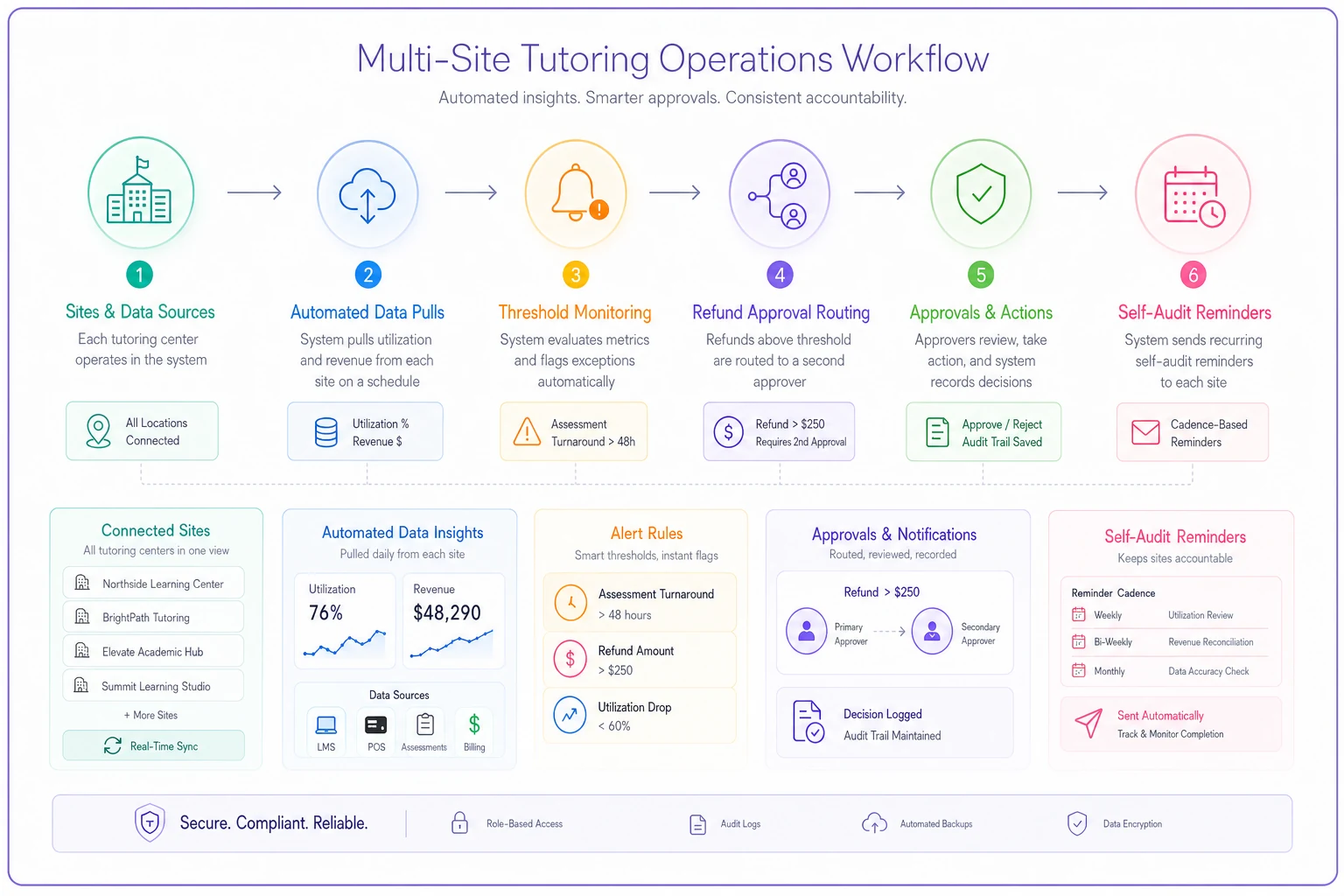
When the reporting and audit rhythm runs on its own, your site visits can focus on coaching and quality—the things that genuinely need you in the room.
Pulling it together
A tutoring franchise playbook isn't about selling franchises—it's about keeping multiple locations honest to one standard without you being everywhere at once.
The four pieces work as a set: the MOU decides what's non-negotiable, the royalty cadence forces financial transparency, the audits verify the standard is holding, and the gates stop the handful of decisions that cause lasting brand damage. Build them in that order, keep each one lighter than feels responsible, and let the operating rhythm do the maintaining. Locations drift in silence; this system just makes the silence impossible.
A tutoring franchise playbook isn't about selling franchises—it's about keeping multiple locations honest to one standard without you being everywhere at once. The four pieces work as a set: the MOU decides what's non-negotiable, the royalty cadence forces financial transparency, the audits verify the standard is holding, and the gates stop the handful of decisions that cause lasting brand damage. Build them in that order, keep each one lighter than feels responsible, and let the operating rhythm do the maintaining. Locations drift in silence; this system just makes the silence impossible.
Ready to streamline your tutoring operations?
Join 500+ tutors and centers using Tutoryly to save time, improve scheduling accuracy, and enhance student experiences.