



Most tutoring centers already have an informal version of this. A parent emails saying money got tight, the owner replies "no problem, we'll pause you for a month," and then that promise lives in nobody's head but the owner's. Three weeks later the card gets charged anyway, or the student shows up to a session that was supposedly on hold, or the family comes back after two months and nobody remembers what was agreed.
The awkward part isn't the kindness. Pausing families through a rough stretch is good business and good human behavior. The problem is that "we'll figure it out" is not a workflow, and the gaps it creates cost you money in ways you can't see until tax season — or until a frustrated parent accuses you of treating them differently than their neighbor.
This post is about building a real, boring, repeatable tutoring financial hardship policy — one with decision rules, intake language, clean accounting, automatic restart triggers, and a fairness check so you're not quietly giving better deals to the families who complain loudest.
Why the "just handle it informally" approach quietly leaks money
The informal version breaks in four specific places, and they're worth naming because each one has a different fix.
Billing drift. A pause agreed over email rarely makes it into the payment processor on time. A card charges on the 1st, the parent emailed on the 3rd, and now you're issuing a partial refund and eating the processing fee. One center running monthly subscriptions was refunding small amounts almost every month just because the pause conversation and the billing cycle never lined up.
Ghost enrollment. The student stays on the schedule because nobody told the scheduler. A tutor preps, shows up, and the slot sits empty — or worse, the tutor runs the session and now you have to decide whether to bill a paused family for a session you said was paused.
Records that don't reconcile. When you pause revenue informally, your books still expect it. Your P&L shows a dip that nobody can explain months later, and when a family reinstates, the "catch-up" money gets booked wrong. This is the stuff that makes your accountant email you in March.
And the one owners underestimate — fairness exposure. When every hardship case is handled by feel, you end up with wildly different outcomes. Family A got three months free. Family B got a 50% rate for six weeks. Family C got told no. If any of those families compare notes, or if one of them happens to be in a protected category and feels singled out, you have a problem that a documented policy would have prevented entirely.
Start with a decision table, not a judgment call
The single biggest upgrade you can make is replacing "the owner decides case by case" with a decision table that anyone on staff can apply the same way. You keep discretion for genuinely unusual situations, but 90% of requests should route through a rule.
Never miss another tutoring session.
Tutoryly helps you schedule, confirm, and manage every tutoring session efficiently.
- Unified session scheduling
- Automated student notifications
- Tutor calendar & availability management
No credit card required
Here's a working example you can adapt. The point isn't these exact numbers — it's that the inputs are defined and the outputs are consistent.
| Situation | Tenure with center | Pause length allowed | Billing treatment | Seat held? |
|---|---|---|---|---|
| Temporary income loss (job, medical) | Under 3 months | Up to 4 weeks | Full pause, no charge | Yes, 4 wks |
| Temporary income loss | 3+ months | Up to 8 weeks | Full pause, no charge | Yes, 8 wks |
| Ongoing affordability | Any | Reduced rate, not pause | 40–60% rate, 3 mo review | Yes |
| Seasonal gap (parent-initiated) | Any | Up to 6 weeks | Pause allowed, small hold fee | Optional |
| Repeat pause (2nd in 12 mo) | Any | Up to 4 weeks | Pause, but no seat guarantee | No |
A few things make this table actually work in practice:
-
Tenure matters. A family that's been with you eight months has earned more flexibility than one who started three weeks ago. Encoding that stops you from feeling guilty about treating them differently — the rule did it, not your mood.
-
Separate "pause" from "reduce." A lot of what parents call a hardship is actually ongoing affordability, and a temporary pause doesn't solve it. For those cases, a reduced rate keeps the student learning and keeps some revenue flowing. If you don't already have structured rate-reduction options, your payment-plan rules for families are the right place to build them.
-
The seat-hold column is the honest part. You can't promise an in-demand Tuesday 4pm slot is frozen for eight weeks without cost. The table makes you decide that upfront instead of overpromising in an emotional moment.
The point isn't these exact numbers — it's that the inputs are defined and the outputs are consistent.
When a decision table is a bad idea
When a decision table is a bad idea
If you're a solo tutor with 15 families, a formal table is overkill — a one-page note in your records is enough. It earns its keep once you have multiple staff touching billing and scheduling, because that's when inconsistent handling actually starts happening. The rough threshold is the point where the owner is no longer personally approving every single pause.
The intake script: get the right information without an interrogation
How you collect the hardship request matters more than people think. Ask too little and you can't apply your own rules. Ask too much and you make a stressed parent feel audited.
The goal is a short, warm intake that captures exactly the fields your decision table needs — nothing more. You are not verifying income. You are not asking for pay stubs. You're gathering enough to route the request and document that you handled it fairly.
> "Thanks for reaching out — we'd rather pause than lose you, so let's find the right option. A few quick questions: Is this a short-term thing you expect to resolve in the next month or two, or more of an ongoing budget change? And do you want to keep [student]'s current session slot held, or are you flexible on timing when you come back?"
Two questions. One tells you pause vs. reduce. The other tells you whether to invoke the seat-hold cost. The parent's answer, the date, and the resulting decision all get logged in the student's record — not in your inbox.
The mistake centers make here is treating hardship requests like a negotiation. It's not a negotiation. It's an application of a policy you already wrote. The calmer and more procedural you are, the less the family feels like they're begging, and the less you feel like you're being taken advantage of.
Make the accounting clean from day one
This is where almost everyone gets sloppy, and it bites you six months later.
When you pause a family, something has to happen in your books. The right move depends on how you bill, but the principle is the same: a pause is not an invisible event. It should produce a record so your revenue, deferred revenue, and any held-but-unused prepayments stay accurate.
Two common cases:
-
Subscription/monthly billing. The parent isn't charged during the pause, so there's no revenue to recognize — but you should log the pause against their account and track the foregone recurring revenue as a tracked metric, not a write-off. This keeps your MRR reporting honest. If you just stop the charge silently, your month-over-month revenue drop looks like churn when it isn't.
-
Prepaid packages. If a family paid for 12 sessions and pauses after 7, you have 5 sessions of deferred revenue sitting on your books. That's a liability, not income. Keeping it parked in deferred revenue until the sessions are either delivered after reinstatement or refunded prevents you from recognizing revenue you haven't earned — and then scrambling when the family wants those sessions months later.
A simple reconciliation rule: every pause creates a dated entry, every reinstatement closes it, and the two should always net out. Also keep hardship pauses completely separate from genuine payment failures — those belong in your dunning and failed-payment recovery process, not in your hardship workflow. Mixing them means you start dunning families you intentionally paused, which is a fast way to destroy trust.
Automated expiry and reinstatement — the part everyone forgets
The failure mode that actually costs the most: the pause that never ends.
A family pauses for "a month." The month passes. Nobody's watching. Two more months go by. The seat you were holding sat empty, you earned nothing, and eventually you reach out to find they've drifted to another center or just stopped. The pause you meant as a bridge became an exit ramp because nothing triggered a follow-up.
The fix is making the pause self-terminating. Every pause needs an expiry date baked in at the moment it's created, and that date needs to fire reminders automatically.
A clean reinstatement timeline:
-
Pause start confirmation message to parent stating the exact reinstatement date in plain language ("Billing and sessions resume the week of March 10").
-
7 days before expiry friendly reminder — "Looking forward to having [student] back next week, here's the schedule."
-
Expiry date billing resumes, slot reactivates, session scheduled.
-
If no response by expiry the account flips from "paused" to "pending reinstatement," and a staff member gets a task to call — not email, call.
-
14 days past expiry, no response seat releases to the waitlist and the account moves to dormant.
Here's a quick diagram of the automated expiry -> reminder -> reinstatement workflow.
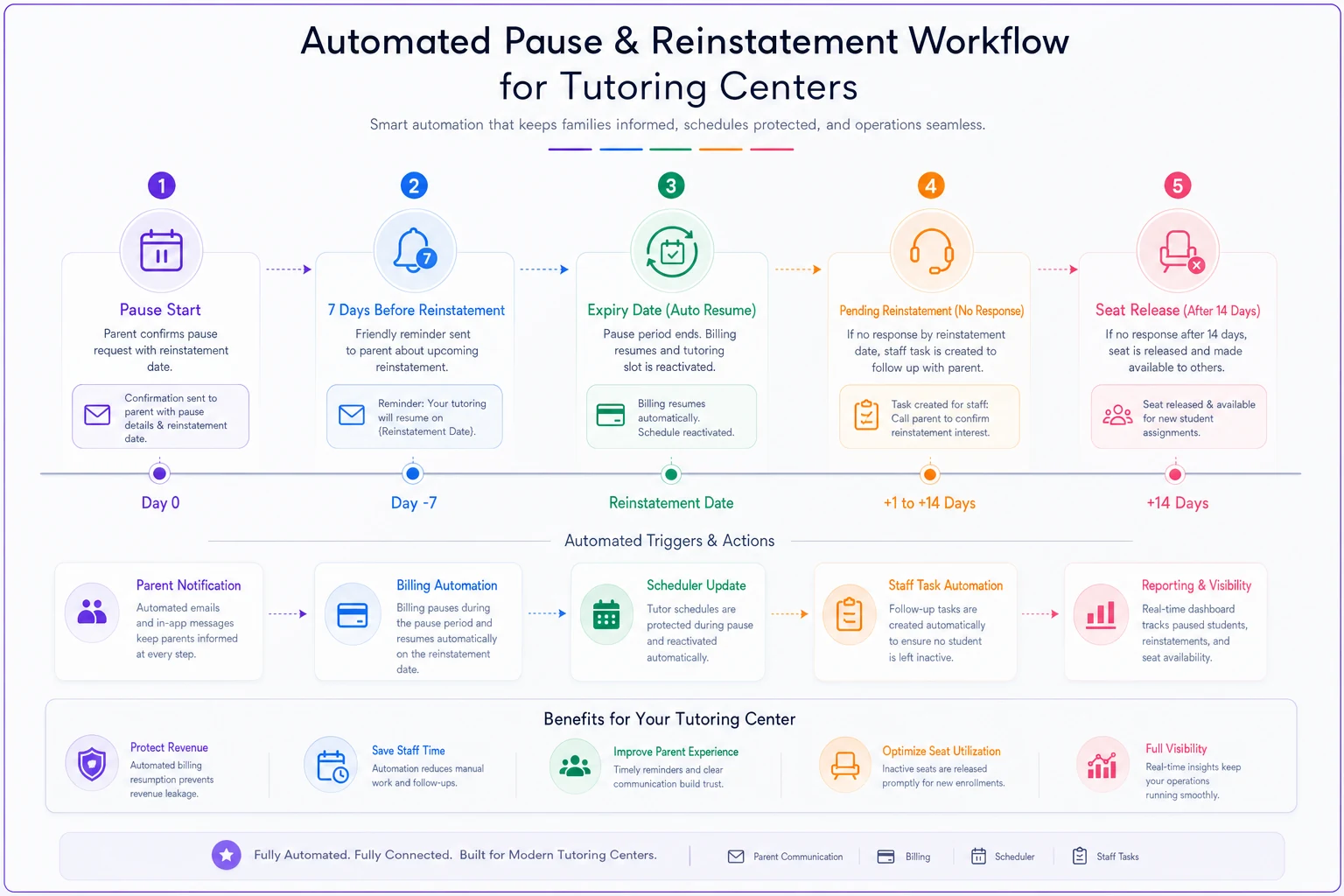
A pause with no expiry is just slow churn you volunteered for. Setting the end date upfront, and automating the nudges around it, is what turns a hardship pause into a retention win instead of a quiet loss. This is also exactly the kind of thing worth running inside your operational software rather than a calendar reminder you'll eventually ignore — a paused status that automatically wakes up and prompts the right person on the right day removes the "nobody was watching" failure entirely.
Track the two numbers that tell you if the policy is working
Revenue impact. Track total paused revenue per month and, more importantly, the reinstatement rate — what percentage of paused families actually come back and resume paying. If most paused families return within the window, your policy is doing exactly what it should: bridging families through rough patches. If reinstatement rates are low, your pauses are functioning as a polite off-ramp, and you should look at whether "reduce the rate" should be the default instead of "pause entirely."
Fairness audit. Once a quarter, pull every hardship decision from the period and look at them side by side. Did similar situations get similar outcomes? Sort by the inputs in your decision table and look for cases where the output doesn't match the rule. Every exception should have a documented reason. If you can't explain why Family B got a longer pause than Family A, that's the gap your policy exists to close.
A small example of what healthy looks like: a center with around 120 active families might see 4–6 hardship requests a month during a tough economic stretch. If roughly 70% reinstate within their window and the rest convert to reduced-rate plans or lapse, that's a reasonable pattern — you're retaining families you'd otherwise lose outright, and the paused revenue is mostly recovered within a quarter rather than written off.
Who should NOT run a formal hardship policy
Who should NOT run a formal hardship policy
If you're running a premium, capacity-constrained practice with a waitlist, a generous pause policy can actively hurt you — every held seat is revenue you're turning away. In that case, "reduced rate or release the seat" is the honest offer, and open-ended pauses shouldn't exist. The policy above assumes you'd rather keep a family through a dip than refill the seat, which is true for most centers but not all.
A real scenario
A mid-sized center — roughly 90 families, monthly subscription billing, two part-time admins handling scheduling and payments — kept handling hardship requests through the owner's inbox. Over the course of a year they'd accumulated several "paused" families nobody had followed up on, a few hundred dollars in refunded partial charges from pauses that landed mid-cycle, and one genuinely uncomfortable conversation when two families compared the very different deals they'd each received.
They built the version above: a five-row decision table, a two-question intake logged in the student record, journal entries for every pause and reinstatement, and automated expiry reminders at 7 days out and on the reinstatement date.
The change wasn't dramatic revenue recovery — it was the leaks closing. Mid-cycle refunds basically stopped because pauses now aligned to the billing date. Two of the long-forgotten "paused" families reactivated once the automated nudge finally reached them. And the fairness piece mattered most: when a family asked why they couldn't get the same deal as someone else, the owner could point to tenure and pause-history rules that applied to everyone, and the conversation ended there instead of escalating.
The thing to actually do this week
You don't need to build the whole system at once. The highest-leverage first step is writing down your decision table — even a rough draft on one page — so the next hardship request gets handled by a rule instead of a mood. Then add an expiry date to every active pause you already have, because those are the ones silently costing you right now.
The warmth of saying "we'd rather pause you than lose you" doesn't disappear when you add structure. It actually gets stronger, because the family can feel that you've done this before, you know how it works, and they're being treated the same as everyone else going through the same thing. That consistency is the whole point.
Ready to streamline your tutoring operations?
Join 500+ tutors and centers using Tutoryly to save time, improve scheduling accuracy, and enhance student experiences.