



Most tutoring waitlists are just a chronological list with a vague sense of guilt attached. First-come-first-served feels fair, so that's what gets used. But the family who inquired on March 2nd might be a tire-kicker who ghosts the moment you call, while the family from March 19th might be a committed parent with a sibling already enrolled, ready to pay for a full year of weekly sessions.
When a slot opens, offering it to the wrong person isn't a neutral event. You burn a follow-up cycle, the slot sits empty for another week or two, and sometimes the family that would have said yes has already enrolled somewhere else. The waitlist order is quietly costing you money, and nobody's tracking it.
This is about fixing that with a scoring sheet. Not a machine-learning model, not a CRM overhaul — a spreadsheet with a handful of columns that ranks waitlisted families by two things that matter: how likely they are to convert, and how much they're worth if they do.
The actual problem with "fair" ordering
A typical example looks like this. A center has 11 students on the waitlist for a Tuesday/Thursday after-school algebra block. One tutor goes on maternity leave, and suddenly two slots open. The front desk calls the top two names on the list. One doesn't pick up for three days. The other says they already found a tutor.
Meanwhile, down at position seven, there's a family whose older kid already attends, who asked specifically about that exact time block, and mentioned they wanted "at least through the end of the school year." High intent, high value — sitting behind two people who were never going to enroll.
This keeps happening because chronological order encodes nothing useful. The date of inquiry tells you almost nothing about conversion probability or lifetime value. It's just a timestamp. You're making a revenue decision using the one variable least correlated with revenue.
Intent signals are usually sitting right there in the intake notes — people just never structure them into something sortable. The parent who asked three detailed questions about curriculum, confirmed their budget, and has a sibling enrolled is a completely different prospect from the one who filled out a form at 11pm and never replied to the auto-response. Your staff knows this intuitively. The problem is intuition doesn't scale, and it definitely doesn't survive staff turnover.
Two numbers that should drive the order
Forget everything except these two:
Never miss another tutoring session.
Tutoryly helps you schedule, confirm, and manage every tutoring session efficiently.
- Unified session scheduling
- Automated student notifications
- Tutor calendar & availability management
No credit card required
Conversion probability — how likely this family is to actually enroll if you offer them the slot right now.
Lifetime value (LTV) — roughly how much revenue they represent if they do enroll, factoring in session frequency, expected duration, and siblings.
You want to rank by a blend of both, because each one alone is misleading. A family with 90% conversion but who only wants four sessions before an exam is worth less than a family with 60% conversion who wants twice-weekly sessions through June. The score has to reflect both the likelihood and the size of the win.
The simplest version that works: score each family 1–5 on a few conversion signals, 1–5 on a few value signals, then multiply a conversion sub-score by an LTV sub-score to get a priority number. Higher number, higher in the queue.
The scoring signals that actually predict behavior
Not every signal deserves a column. The ones below earn their place because they correlate with real outcomes, not because they feel important.
| Signal | What it predicts | Scoring (1–5) |
|---|---|---|
| Responsiveness to last 2 contacts | Conversion | 5 = replies same day, 1 = ghosted once already |
| Specificity of request (time, subject, goal) | Conversion | 5 = named exact block + goal, 1 = vague "need help in math" |
| Budget confirmed / payment method on file | Conversion | 5 = confirmed, 1 = never discussed |
| Sibling already enrolled | Both | 5 = yes active, 1 = no |
| Requested session frequency | LTV | 5 = 2x+/week, 2 = occasional |
| Expected duration | LTV | 5 = "through the school year", 1 = "a few sessions" |
| Fit with open slot (time/subject) | Conversion | 5 = exact match, 1 = requires schedule gymnastics |
A few notes on how these actually play out:
Responsiveness is the strongest single predictor. A family that already ghosted one of your calls is dramatically less likely to enroll than one that replies within hours — regardless of how enthusiastic they sounded at first. Weight it accordingly.
Fit-with-open-slot is the one people forget. It doesn't matter how high-value a family is if the slot that opened is Tuesday 4pm and they can only do mornings. Offering it to them anyway just wastes a cycle while they decline. Slot-matched families should float up; slot-mismatched families should drop, even if their other numbers look solid.
Sibling enrollment is a double signal. It boosts both conversion (they already trust you) and LTV (consolidated family, longer tenure). It's one of the few signals that legitimately counts twice.
Building the sheet
Here's the actual build, column by column. Takes about an hour to set up, and you'll probably tweak it after a month of real use.
-
Family / student name and inquiry date (keep it for reference, not for sorting).
-
Conversion sub-score columns — responsiveness, specificity, budget confirmed, slot fit. Score each 1–5.
-
Average the conversion columns into a single Conversion score.
-
LTV sub-score columns — frequency, expected duration, sibling. Score each 1–5.
-
Average the LTV columns into a single LTV score.
-
Priority = Conversion × LTV. This gives a spread from 1 to 25.
-
Sort descending by Priority. That's your call order when a slot opens.
The multiply-not-add detail matters. If you add the two scores, a family with great LTV but terrible conversion floats too high — someone who'd be worth a lot but will probably never say yes. Multiplying punishes weakness in either dimension, which is what you want. You're looking for families strong on both.
Keep a short notes column too. A score of 20 means nothing six weeks later when you've forgotten the context. "Confirmed budget, sibling in reading program, wants T/Th through June" is what lets anyone on your team make the call without digging through old emails.
Below is a rough illustration of how a scored family moves through your process once a slot opens:
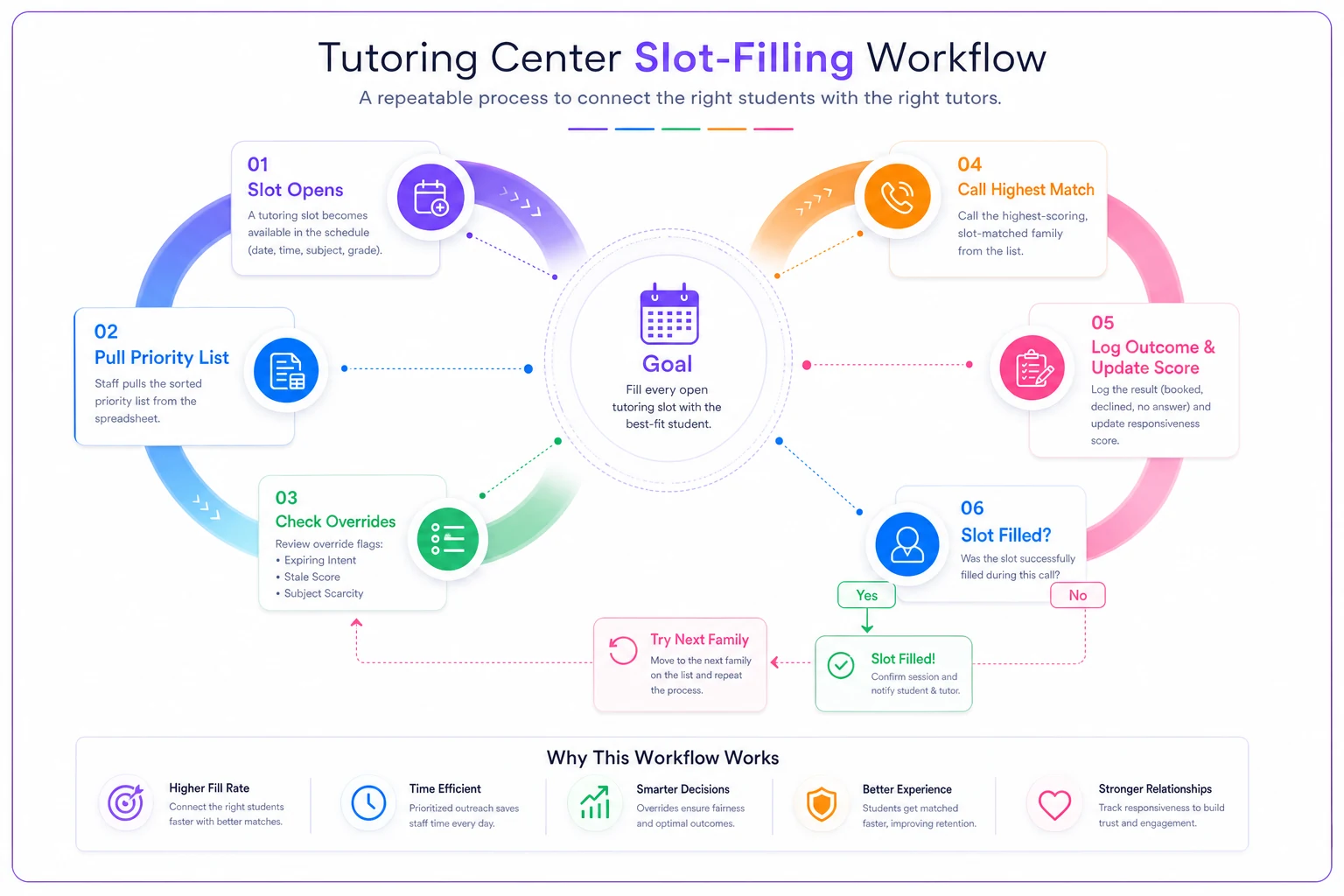
Nothing fancy — it's just a reminder that the sheet is the decision-making layer, not a static archive.
A quick heuristic layer on top
Pure scores can produce weird edge cases, so add two or three override rules that reflect your actual business judgment:
-
Expiring intent. If a family explicitly said "we need to start before [date]" and that date is within two weeks, bump them up regardless of score. Timing-sensitive families convert now or not at all.
-
Capacity-constrained subjects. If the open slot is in a subject where you have almost no supply — say, SAT physics — the slot-matched family wins even at a lower overall score, because you can't easily re-offer that slot.
-
Stale scores. Any family whose scores are more than roughly 30 days old gets flagged for re-verification before you call. Responsiveness especially decays — someone eager a month ago may have already enrolled elsewhere.
These overrides are where your real operational knowledge lives. The spreadsheet handles the mechanical 80%; the heuristics handle the judgment calls.
A real scenario
A two-location center running mostly K-8 support had a chronic waitlist for its 4–6pm weekday blocks — usually somewhere between 9 and 14 families waiting at any given time. Slots opened irregularly as students aged out or paused. Front desk called in list order.
They switched to a scored sheet with roughly the columns above. Nothing complicated — just the 1–5 scoring and a Priority = Conversion × LTV sort. Within a couple of months, two things shifted. Slots were filling faster, with fewer "called three people before someone said yes" cycles. And the families enrolling were sticking around longer, because the LTV signals were surfacing the committed ones earlier.
The owner's rough estimate was that reduced vacant-slot time was worth somewhere in the low thousands per term across both locations. Not transformational, but real money that was previously leaking out through bad call order. The bigger surprise was what the scoring exposed: several top-of-list families had quietly moved on weeks earlier, and nobody had noticed because the list just kept them at the front.
Where automation plugs in later
You don't need software to start — the sheet is the point. But once it's running, a few things are worth automating without much effort.
The scores that decay — responsiveness, stale flags — are a natural fit for automated nudges. AI-powered operational software can flag waitlisted families whose scores are over 30 days old, trigger re-verification reminders automatically, or alert staff when a family stops responding mid-waitlist cycle. These aren't complicated automations, but they remove the part that reliably falls through the cracks when someone's juggling a full front desk.
The metric worth tracking is simple: your offer-to-acceptance rate before and after scoring. If it's working, a higher share of the people you call should be saying yes, and average time-to-fill should drop.
This connects naturally to the broader waitlist strategy around priority rules and messaging flows, and the conversion side ties directly into your trial-to-paid playbook — the same intent signals that score a waitlist family also predict whether a trial student sticks around.
When this is worth it — and when it isn't
Worth doing if your waitlist regularly has more than a handful of families, slots open unpredictably, and you've ever offered a spot to someone who declined while a better-fit family waited. That's exactly the situation scoring fixes.
Skip it if your waitlist is usually one or two families deep. Sorting two names is not a problem worth a spreadsheet.
And don't over-engineer it. The moment you have fifteen scoring columns and weighted sub-indices, you've built something nobody on your front desk will actually maintain. The whole value here is that it's lightweight enough to use when the phone's ringing and a slot just opened. The point isn't precision — it's replacing "whoever asked first" with "whoever's most likely to enroll and stay," using signals your intake process is already capturing, just never organizing into something you can sort.
Ready to streamline your tutoring operations?
Join 500+ tutors and centers using Tutoryly to save time, improve scheduling accuracy, and enhance student experiences.