



Most tutoring centers track their trial-to-paid conversion rate wrong. They count students who show up for trial sessions, then divide by those who eventually pay. That calculation misses the entire middle ground—students who wanted to continue but fell through operational cracks.
The real conversion killer happens between session 2 and session 4. Not because parents decide against tutoring, but because nobody follows up at the right moment with the right message. Your tutors finish a great trial session, parents seem engaged, then nothing. Two weeks later that family has enrolled somewhere else.
Centers with structured post-trial sequences convert somewhere around 70-75% of trials. Those who wing it hover near 35-40%. The difference isn't teaching quality or even pricing—it's having a mapped sequence that triggers specific actions at specific times.
The fatal gap between trial session and enrollment decision
Parents don't reject tutoring after trials. They get distracted, overwhelmed, or simply forget to take the next step. Meanwhile your competitor sent a well-timed text on day 3 asking how their child felt about the session.
The breakdown usually looks something like this: parent books trial → child attends → tutor thinks it went well → tutor vaguely mentions enrollment → parent says they'll think about it → nobody follows up systematically → parent assumes you're not that interested → they book elsewhere.
Picture a typical center. Tutor finishes a trial session at 5pm Tuesday. Makes a mental note that it went well. Maybe mentions to the owner that the family seemed interested. Owner makes a mental note to follow up. Gets buried in scheduling issues Wednesday. Thursday passes. By Friday when they finally remember, the parent has already started comparing other options online.
Your real competition isn't other tutoring centers—it's the parent's busy schedule, their uncertainty about committing, and the friction of making another decision. Every day without follow-up, conversion probability drops roughly 15-20%. By day 5, even engaged parents have mentally moved on.
Mapping your trial conversion sequence to tutoring session cadence
The post-trial sequence needs to align with your actual session schedule, not arbitrary marketing timelines. A Monday trial requires different follow-up timing than a Thursday trial, especially around school schedules and parent work hours.
Never miss another tutoring session.
Tutoryly helps you schedule, confirm, and manage every tutoring session efficiently.
- Unified session scheduling
- Automated student notifications
- Tutor calendar & availability management
No credit card required
Here's the exact sequence that works:
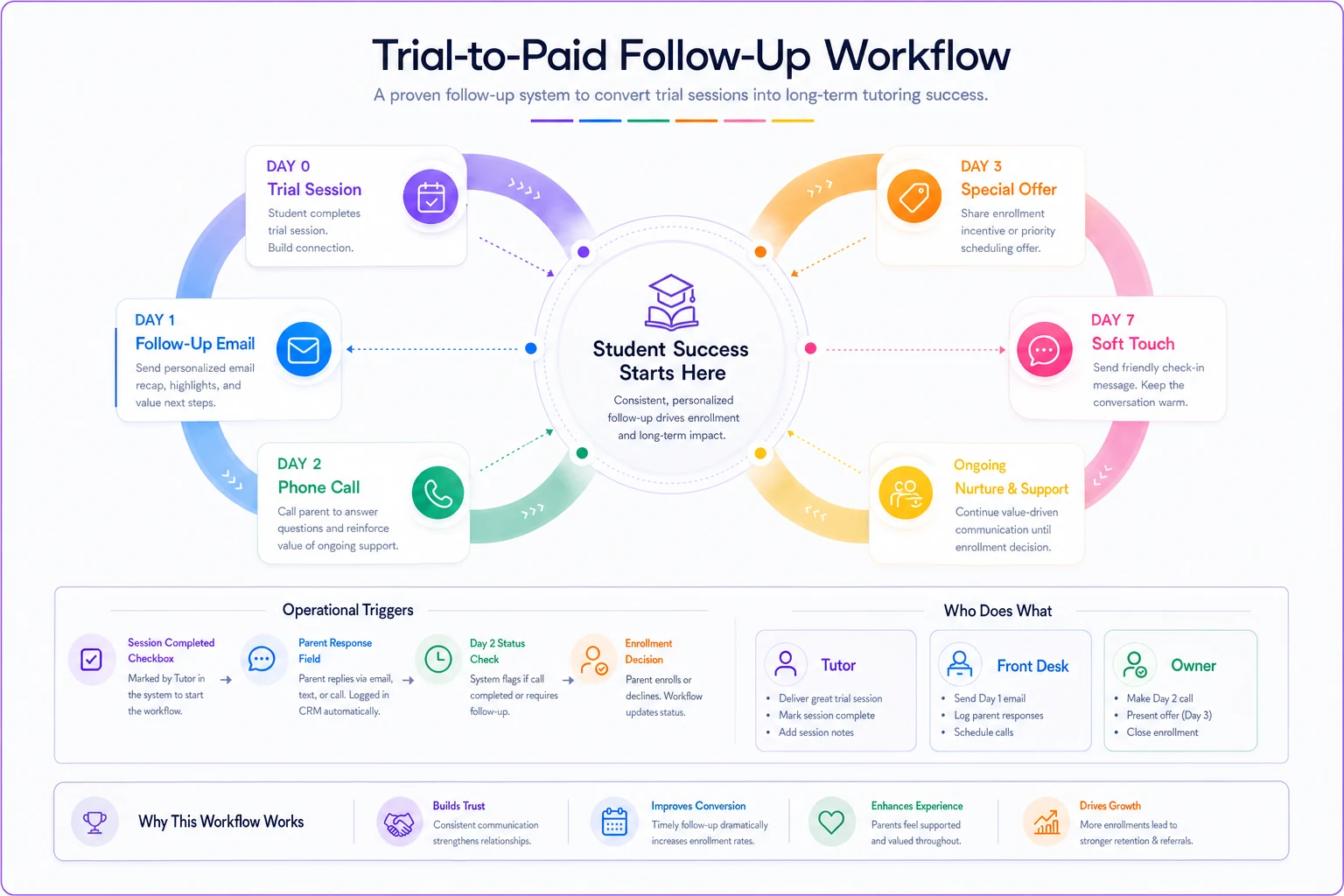
Day 0 (Trial session day): Send a confirmation text within 2 hours of the session ending. Not an email—a text. Parents check texts immediately; emails pile up. Text template: "Hi [Parent], [Tutor] just finished with [Student]'s session and mentioned [specific positive observation]. [Student] seemed to really connect with [specific topic/approach]. Would you like me to reserve [Student]'s spot for next [usual session day]?" Note what this does: confirms the session happened, provides specific feedback, assumes continuation, and creates urgency around scheduling.
Day 1 (Next morning): Email with session notes and a next-session preview. This works as both documentation and value reinforcement.
-
What was covered (brief, 2-3 bullets)
-
What the tutor observed about learning style
-
Suggested focus for the next 2-3 sessions
-
One specific thing the parent can do to support (keeps them engaged)
Day 2: Only if there's been no response to the day 0 text. Call between 4-6pm, when parents are likely wrapping up the workday. Phone script: "Hi [Parent], I wanted to check if you had any questions about [Student]'s session with [Tutor]. They mentioned [Student] picked up [concept] really quickly. We have a spot on [day] at [time]—should I put [Student] down for that?"
Day 3-4: If still no response, shift to email with a limited-time offer. Creates decision urgency without feeling desperate. "Hi [Parent], I wanted to follow up on [Student]'s trial session. [Tutor] has availability for 2 more students this month. If you'd like to continue, we can lock in the same [day/time] slot and include our trial conversion bonus: [specific offer]. This rate is available through [date, 3 days out]."
Day 7: Final soft touch. No offer, just helpful. "Hi [Parent], Just wanted to share this resource about [specific topic related to what the student worked on]. Even if you decide not to continue with us, this might help [Student] with [specific challenge]. If you change your mind about tutoring, we'd love to work with [Student]—just let me know."
This sequence respects the parent's decision process while keeping you present. Most centers either follow up too aggressively right away or never follow up at all. This approach maintains professionalism while creating appropriate urgency.
Owner vs tutor follow-up scripts that actually convert
Who makes the follow-up call matters more than most centers realize. Parents respond differently to tutors versus owners, and mixing up the roles costs conversions.
Tutor follow-up advantages:
-
Already has rapport with the student
-
Can speak specifically to session details
-
Feels like educational consultation, not sales
Tutor script framework: "Hi [Parent], this is [Tutor] from yesterday's session. I wanted to share something I noticed about how [Student] learns... [specific observation]. Based on that, I think if we focus on [specific approach] for the next few sessions, we could see real improvement in [specific area]. Would you like to continue working together?" The tutor shouldn't discuss pricing or packages—that shifts the conversation into sales mode. Keep it educational.
Owner follow-up advantages:
-
Can offer scheduling flexibility
-
Can make package decisions
-
Represents the business professionally
Owner script framework: "Hi [Parent], I'm [Name], the owner here at [Center]. [Tutor] mentioned that [Student]'s session went really well, particularly with [specific area]. I wanted to personally make sure we can accommodate your schedule if you'd like to continue. We have a few options..." Then bridge to packages naturally: "Most students with [Student]'s goals see the best results with [frequency]. We could start with [package option] and adjust as needed."
The key distinction: tutors talk about educational fit, owners handle logistics and packages. Mixing these roles confuses parents and weakens both messages.
For best results, use both in sequence. Tutor reaches out days 0-1 about educational fit. If the parent engages positively but doesn't commit, the owner follows up days 2-3 with logistics and packages. It feels like a team invested in the student's success, not a sales pipeline.
Anchoring offers that create commitment without discounting
Stop offering percentage discounts on trials. They train parents to expect lower prices and quietly signal that your standard rates are negotiable. Instead, use anchoring offers that add value while creating commitment.
The "Trial Graduate Package" Instead of 20% off the first month, offer: "Students who complete trials this week can lock in our Trial Graduate rate—current pricing guaranteed for 6 months, even when we adjust rates in January." This creates urgency (this week), commitment (6 months), and value (protected pricing) without reducing current revenue.
The "Learning Momentum Bonus" "When you start within 7 days of your trial, we include our Learning Momentum package: 3 pre-recorded skill workshops (valued at $150) plus priority scheduling for the rest of the semester." Parents get immediate extra value; you get faster conversion. The workshops cost nothing after initial recording.
The "Assessment Upgrade" "Trial students who enroll this week receive our comprehensive learning assessment (normally $200) included with their first month. This helps us customize their learning plan and shows you exactly where they need support." Frame the assessment as a bonus, not a requirement. Parents respond well to data about their child's learning.
Realistic example from a math tutoring center: The center was converting at 42% with a standard "first session free" trial. They switched to: "Trial session for $30, fully credited to your first package when you enroll within 5 days, plus we include our digital practice workbook (normally $45)." Conversion jumped to around 64%. Parents who pay for trials are pre-qualified. The credit removes purchase friction. The workbook provides immediate value. The 5-day window creates urgency without pressure.
The money isn't really the point—commitment is. Free trials attract shoppers. Paid trials with value-adds attract families already serious about investing in their child's education.
Building conversion triggers into your operational flow
Follow-up fails when it depends on someone remembering to do it. Build triggers directly into your session workflow so follow-up happens regardless of how busy the week gets.
Start with session documentation. If you're already using a structured intake and assessment process, extend it to include trial conversion triggers.
Required trial session documentation:
-
Session completed checkbox → triggers day 0 text
-
Parent response field (responded/not responded)
-
Day 2 status check → triggers call if no response
-
Enrollment decision field → triggers appropriate sequence
Make these fields required before tutors can log session hours. It forces the conversion process to start immediately.
Physical triggers in your center:
-
Trial session forms printed on different color paper
-
Trial family folders stay on the front desk until enrolled or declined
-
Whiteboard with this week's trial families and follow-up status
-
Daily standup includes a quick review of yesterday's trials
Digital automation triggers:
-
Your scheduling system should flag trial sessions differently from regular bookings.
-
When a trial is scheduled, add the parent to a trial sequence email or text flow, set calendar reminders for follow-up days, create tasks for the assigned staff member, and generate a conversion tracking entry.
-
Even basic tools can handle this—email templates with scheduled sends, Google Calendar reminders, a simple spreadsheet that calculates follow-up dates when you enter trial dates.
AI-powered operational software can automate much of this while keeping messages personalized, but a consistent simple system will outperform a sophisticated one that nobody actually uses.
Require the session completed checkbox in your LMS so follow-up actions can't be skipped.
Here's a simple workflow visualization:
Even basic tools can handle this—email templates with scheduled sends, Google Calendar reminders, a simple spreadsheet that calculates follow-up dates when you enter trial dates. AI-powered operational software can automate much of this while keeping messages personalized, but a consistent simple system will outperform a sophisticated one that nobody actually uses.
Measuring actual ROI of your follow-up sequence
Most centers track conversion rate and call it done. That misses the actual revenue impact of getting follow-up right.
| Metric | What It Tells You |
|---|---|
| Baseline conversion rate | Your current trial-to-paid percentage |
| Time to conversion | Days between trial and enrollment |
| Package size at conversion | What they actually buy |
| 6-month retention rate | How long trial converts stay enrolled |
Centers typically focus only on the first number. Here's what changes when you track all four.
Example from an SAT prep center:
-
Before systematic follow-up
45% conversion, 8 days average, $400 package average, 3-month retention
-
After implementation
61% conversion, 3 days average, $650 package average, 5-month retention
Faster conversion meant fewer scheduling gaps. Larger packages came from timely consultation during the decision window. Better retention followed because properly onboarded families stayed engaged longer.
Calculate your actual follow-up ROI: Monthly trials × (new conversion rate - old rate) × average package value × average retention months
If you run 20 trials monthly, improve conversion from 40% to 60%, with $500 packages lasting 4 months: 20 × 0.20 × $500 × 4 = $8,000 additional monthly revenue
That's from the same number of trials—just better follow-up.
Set up simple tracking with these fields:
-
Trial date
-
Follow-up dates completed
-
Response received (Y/N)
-
Enrolled (Y/N)
-
Package purchased
-
Drop date (if applicable)
After 3 months, patterns emerge. Maybe Tuesday trials convert better than Saturday. Maybe owner follow-up works better for high school students while tutor follow-up works better for elementary families. Use these patterns to refine the sequence. Small improvements compound—going from 55% to 60% might look minor, but across a year that's a meaningful revenue difference from work you're already doing.
Common conversion killers hiding in your trial process
Even with a solid follow-up sequence, certain operational mistakes kill conversion before it ever gets started.
The preparation gap. Tutors who don't know it's a trial session can't optimize for conversion. They treat it like a regular session instead of a demonstration of value. Make trial status visible in scheduling. Give tutors a specific trial session structure: quick win in the first 15 minutes, parent communication in the last 5 minutes, clear next-step recommendation.
The handoff fumble. Parent picks up their child, tutor is already with the next student, and nobody actually connects about the session. You've lost the highest-emotion moment for conversion. Build 5-minute buffers after trial sessions for tutor-parent connection. If that's not possible, have front desk staff equipped with specific questions to ask about how the session went.
The package paralysis. Offering too many options during follow-up slows everything down. Parents facing 5 package choices delay deciding. Recommend one specific package based on their goal, mention one alternative, stop there. "Based on what [Tutor] observed, I'd recommend our twice-weekly package. Some families also choose once-weekly if schedule is tight."
The availability illusion. "We can work with whatever schedule you need!" sounds accommodating but creates decision fatigue. Instead: "We have two spots that would work well for [Student]: Tuesdays at 4pm or Thursdays at 5pm. Which do you prefer?" Specific options move decisions forward.
The reference confusion. Different staff using different names, mispronouncing names, or forgetting key details from intake. Keep a trial tracking sheet with correct pronunciations, grade level, specific goal, and any important context. Every staff interaction should reference these specifics.
These seem minor individually, but they compound into real friction. Parents choosing between tutoring options will go with the center that feels most organized and attentive. Your follow-up sequence can be excellent, but if the overall trial experience feels chaotic, conversion still suffers.
When conversion isn't the right goal
Sometimes the best business decision is not converting a trial. Recognizing those situations early saves everyone time.
Clear non-conversion signals:
-
Parent wants guarantees about specific grade improvements
-
Student explicitly said they don't want tutoring
-
Parent pushes back on the trial session fee
-
Scheduling demands that would require constant special accommodation
-
Parent speaks negatively about the child's ability during intake
When you see these signals, shift from conversion to graceful exit. Send resources, recommend alternatives, leave the door open for the future, but don't chase the enrollment. One difficult family consistently consumes energy that could go toward ten good ones.
The strategic decline: "Based on what [Student] needs and your scheduling requirements, I think [Competitor] might actually be a better fit—they specialize in [specific situation]. If circumstances change, we'd love to work with you in the future."
This builds reputation even without conversion. Parents remember businesses that prioritized fit over a sale.
Making your trial sequence sustainable
The best conversion system breaks down if your team can't maintain it during busy periods. September trial volume can triple what you saw in summer. The sequence needs to scale without falling apart.
Start with role clarity. One person owns the trial conversion process—tracking, triggering follow-ups, measuring results. Not "whoever's at the front desk." Not "all tutors." One specific person accountable for the whole system.
Build templates for everything. Email templates, text templates, call scripts, even "trial didn't convert" notes for your records. Customization happens in the specific details, not by rewriting messages from scratch each time.
Set follow-up blocks in the calendar. Tuesday and Thursday from 4-5pm is trial follow-up time, nothing else. This prevents follow-up from getting squeezed out by urgent scheduling issues. During busy season, add blocks rather than skipping steps.
Have an escalation plan for high-volume periods. If trial volume exceeds capacity for personal follow-up, decide in advance which parts become automated first. Usually the day 1 email and day 7 soft touch can be fully automated, while the day 0 text and day 2-3 calls stay personal.
Track time investment versus revenue return. If proper follow-up takes 30 minutes per trial and meaningfully improves conversion, that math works clearly. But if an elaborate sequence takes 2 hours per trial for marginal gains, simplify. The goal is sustainable revenue growth, not follow-up perfection.
The compound effect of consistent trial conversion
A tutoring center running 15 trials monthly at 40% conversion gets 6 new students. Improve that to 60% and you're getting 9. Over a year, that's 36 additional students from the same marketing spend.
The real shift goes beyond the numbers, though. Higher conversion means you can be more selective about which trials you accept. You can charge for trial sessions. You can require intake forms. You can schedule trials during optimal windows instead of whenever is convenient for everyone else.
Better conversion also tends to bring better clients. Families who experience professional follow-up come in expecting professional service. They show up consistently, pay on time, and refer others. The quality of your entire client base improves over time.
Trial-to-paid conversion isn't about convincing reluctant parents. It's about removing friction for families who are already interested. They came to a trial because they want tutoring. Your job is to make the path from trial to enrollment obvious, easy, and timely.
The centers doing this well don't necessarily have better tutors or fancier facilities. They have operational systems that respect parent psychology and student needs. They follow up when parents are actively thinking about tutoring, not when it happens to be convenient for the center. They create urgency through value rather than pressure.
Your next trial is probably coming up in the next few days. Before it happens, map out exactly what happens after. Who sends what message and when? What triggers each step? How will you track whether it's working? Start with the sequence outlined here, adjust for your situation, and measure the results.
The difference between scrambling to fill spots and maintaining a waitlist often comes down to converting the trials you're already getting. Fix the conversion sequence, and a lot of other problems start solving themselves.
Ready to streamline your tutoring operations?
Join 500+ tutors and centers using Tutoryly to save time, improve scheduling accuracy, and enhance student experiences.