


Most tutoring centers that offer scholarships started the same way: a family hit a rough patch, the owner didn't have the heart to drop them, and a one-off discount got scribbled into the billing system as a "manual adjustment." Fast forward a year and there are eleven families on some kind of informal arrangement, nobody can explain the logic behind who got what, and the P&L has a soft spot nobody wants to look at too closely.
That's the real problem with tutoring scholarship operations. It's rarely the generosity that hurts — it's the absence of any repeatable system behind it. When subsidies are improvised, you can't forecast them, you can't audit them, and you can't tell a business partner what they actually cost. Worse, you end up giving the deepest discounts to families who ask loudest rather than families who need it most.
This post walks through how to build scholarship operations that are fair, auditable, and margin-aware — the eligibility rubric, intake and verification, tiered subsidy math, how it hits your books, and the KPIs that tell you whether access and margin are actually in balance.
Start with the margin you can afford to give away
Before you touch eligibility criteria, you need one number: your scholarship budget as a percentage of revenue, defined in dollars, not vibes.
The mistake almost everyone makes is deciding eligibility first — "any family under X income qualifies" — then discovering at tax time they gave away far more than the business could absorb. Eligibility should be rationed against a fixed pool, not the other way around.
Here's a simple way to size it. Take your contribution margin per paid session — not your price, your margin after tutor pay and direct delivery cost. Say you charge $60 a session, pay your tutor $28, and have around $4 of other direct cost. Your contribution margin is roughly $28 per session. If you want to fund 120 subsidized sessions a month at an average 50% subsidy, you're giving up about $14 of margin per session, or around $1,680 a month. That's your pool. Everything downstream fits inside it.
Once you frame it this way, the conversation shifts. You're not asking "does this family deserve help?" You're asking "do we still have room in this month's pool, and is this family higher-priority than the next applicant?" That's a much healthier operating question, and it's the only one that keeps you solvent.
Some centers run their pool as a hard cap with a waitlist; others run a soft cap that can flex 10–15% in a strong revenue month. Either works. What matters is that the number exists before you start approving anyone.
The eligibility rubric: score, don't judge
The biggest fairness problem in tutoring scholarship operations is that eligibility lives in the owner's head. Two families in nearly identical situations get different answers because one applied in July when cash was tight and the other applied in September after a good enrollment month.
Never miss another tutoring session.
Tutoryly helps you schedule, confirm, and manage every tutoring session efficiently.
- Unified session scheduling
- Automated student notifications
- Tutor calendar & availability management
No credit card required
The fix is a scored rubric. You convert a subjective judgment into a point total across a few weighted factors, then map point ranges to subsidy tiers. It takes an afternoon to build and removes most of the guilt and inconsistency from the process.
| Factor | What you're measuring | Weight |
|---|---|---|
| Household income relative to local median | Financial need | 35% |
| Dependents / family size adjustment | Need context | 15% |
| Documented hardship event (job loss, medical, etc.) | Acute need | 20% |
| Academic need / risk (failing, IEP, exam year) | Program fit | 20% |
| Commitment signals (attendance history, engagement) | Retention likelihood | 10% |
Each factor gets scored 0–5, multiplied by its weight, and summed into a total out of 100. You then set bands — 80+ qualifies for the top subsidy tier, 60–79 for the middle tier, 40–59 for a modest discount, and below 40 gets a payment plan instead of a subsidy.
That last point matters. Not every "no" to a scholarship should be a hard no. Plenty of families who don't score high enough for subsidized sessions are good candidates for structured payment-plan rules with sensible eligibility and down-payments, which preserves your margin while keeping the family enrolled.
One thing centers that run this well tend to do: they publish the factors but not the exact weights or bands. Families understand they'll be assessed on need, hardship, and fit — they don't see the scoring math, which keeps people from gaming the rubric by overstating a single factor.
Intake and verification without the awkwardness
The part everyone dreads is verification. Nobody wants to interrogate a struggling family for pay stubs. But a scholarship program with zero verification quietly becomes a discount-for-the-assertive program, and your most financially comfortable families eventually learn to ask.
The trick is tiered verification tied to subsidy size. Small discounts need almost nothing. Deep subsidies need real documentation. Friction stays proportional to what's actually at stake.
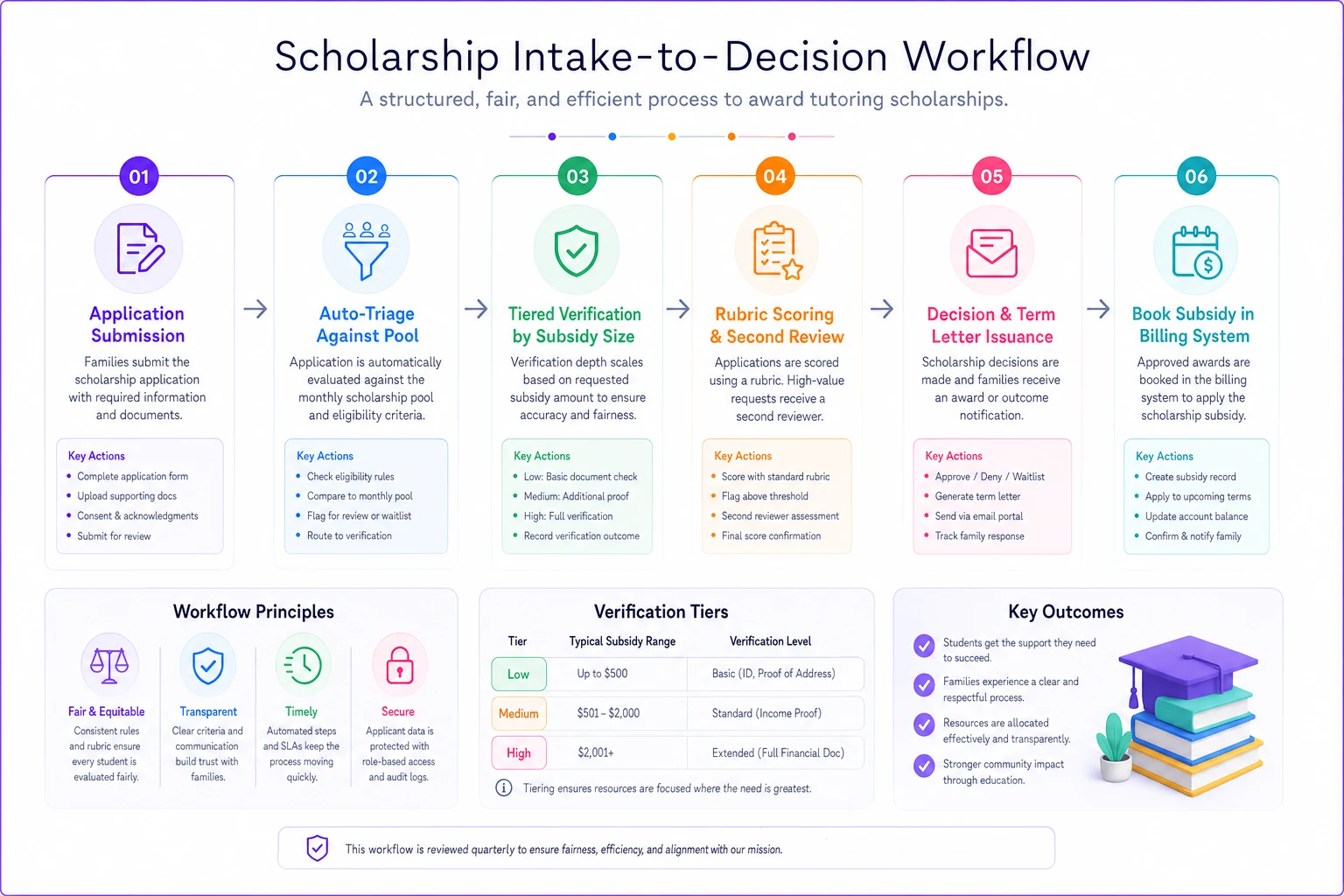
A clean intake-to-decision flow:
-
Application submitted — short form capturing household size, income range, the academic situation, and whether there's been a specific hardship event.
-
Auto-triage against the pool — if this month's pool is already committed, the family goes to a dated waitlist rather than receiving a false promise.
-
Verification request matched to tier — a 10% discount might need nothing; a 50%+ subsidy asks for one income document or proof of a qualifying program (free-lunch eligibility, benefits enrollment, etc.).
-
Rubric scoring — one person scores against the published factors; a second reviews anything above a threshold subsidy to avoid single-approver drift.
-
Decision + term letter — approved families get a written scope
subsidy percentage, number of sessions covered, the review date, and what happens at renewal.
-
Booking the subsidy in your system — recorded as a distinct line, never buried as a generic price override (more on why in the accounting section).
The written term letter is the unglamorous piece that saves you later. When a scholarship is open-ended, families assume it's permanent, and walking it back feels like a betrayal. When it's a defined 12-week award with a stated review date, renewal is a normal operational step — not a confrontation.
For families whose situation is temporary rather than chronic — a parent between jobs, a short medical stretch — a subsidy often isn't the right instrument at all. A time-boxed financial-hardship pause workflow protects the relationship without permanently committing a slice of your scholarship pool. Scholarships are for sustained need; pauses are for shocks. Mixing them up is how pools get drained.
Here's a simple visual of that intake-to-decision flow.
When scholarship awards live in the same system as scheduling and invoicing, the subsidy books itself correctly on every session, session and dollar caps enforce themselves, review dates trigger renewal tasks automatically, and your subsidy-vs-pool number is always current instead of reconstructed at quarter-end.
Tiered subsidy formulas, with the math shown
A flat "scholarship = 50% off" is the second-most common mistake after improvised eligibility. It over-subsidizes families near the top of the band, under-serves families at the bottom, and makes your total exposure jumpy and hard to forecast.
Tiered formulas fix this. You map rubric score bands to subsidy percentages and cap both the per-family subsidy and the session count.
| Tier | Rubric score | Subsidy | Family pays | Margin impact per session |
|---|---|---|---|---|
| A | 80–100 | 60% | $24 | −$36 vs list; margin goes negative ~ −$8 |
| B | 60–79 | 40% | $36 | −$24; margin ~ +$4 |
| C | 40–59 | 20% | $48 | −$12; margin ~ +$16 |
Notice Tier A actually runs a small negative contribution. That's a deliberate choice, and it's fine as long as you've budgeted for it. The way centers keep this sustainable is by limiting Tier A seats as a share of total scholarship seats — maybe Tier A is capped at a third of your subsidized students, with B and C carrying positive margin that partially offsets it.
Then apply two hard limits per award:
-
Session cap — Tier A covers up to 8 sessions per month, not unlimited. A subsidy without a session cap is an open checkbook.
-
Dollar cap — total subsidy dollars per family per term, so a heavy user can't blow the pool alone.
Run the blend and you can forecast the whole program. Say you approve 10 Tier A students (negative ~$8 × 8 sessions = −$640), 15 Tier B (+$4 × 8 = +$480), and 20 Tier C (+$16 × 6 = +$1,920). The program's net contribution lands around +$1,760 a month even with subsidies in place — because the positive tiers are doing real work. That's the balance you're engineering: meaningful access at the bottom, funded partly by the shallower tiers above it.
A well-tiered scholarship program doesn't have to be pure cost. Designed right, the middle and lower tiers fill otherwise-empty capacity at a price that still beats an empty seat, and they fund the deepest-need students structurally rather than through owner guilt.
Getting it onto the books correctly
This is where most tutoring centers create future pain for themselves, and it's completely avoidable.
When a scholarship gets entered as a reduced price — the family's invoice just shows $24 instead of $60 — you lose the one number you most need: the gross value of services delivered versus the subsidy granted. Revenue looks artificially small, the discount is invisible, and at year-end nobody can tell you what the scholarship program actually cost.
The correct approach is to book the full service value and the subsidy as separate lines. The subsidy is a contra-revenue item (or an expense, depending on how your accountant wants it treated) — not a lower price.
A typical journal entry for one Tier A session:
-
Debit Accounts Receivable / Cash $24 (what the family pays)
-
Debit Scholarship Expense (or Contra-Revenue) $36 (the subsidy granted)
-
Credit Tutoring Revenue $60 (full value of the session delivered)
Do it this way and three things become possible. You can report total scholarship spend as a clean line item. You can see your real revenue — gross service value — for capacity and pricing decisions. And if you ever seek grant funding or a community partner to co-fund the program, you have audit-ready numbers showing exactly what you're already contributing.
Tag every scholarship entry with the student and the award ID.
The centers that skip this tagging are the ones who can never confidently answer "how much are we actually spending on scholarships?" — and that uncertainty is exactly what makes owners either kill the program or let it quietly balloon.
The KPIs that tell you access and margin are balanced
Two numbers can both look fine in isolation and still mean your program is broken. A center can be deeply generous while slowly going underwater, or tight enough to stay profitable while helping almost no one. You need a small dashboard that watches both sides at once.
-
Scholarship spend vs pool — are you inside the budget you set? Running at 70–85% of pool is healthy; chronically at 100%+ means the rubric bands are too loose.
-
Subsidy as % of gross revenue — the single-glance program-cost metric. Most small centers land somewhere around 3–7% depending on mission and local market.
-
Tier distribution — what share of awards sit in negative-margin Tier A vs the positive tiers? If Tier A creeps past your cap, the program tilts toward loss.
-
Scholarship retention vs full-pay retention — subsidized families should retain at least as well as full-pay. If they churn faster, you're spending money without buying loyalty, which usually signals a fit or engagement problem, not a pricing one.
-
Conversion-to-full-pay over time — the quiet win. A meaningful share of scholarship families improve financially and roll onto partial or full pricing. Tracking this proves the program is a bridge, not a permanent cost center.
-
Approval consistency — variance in rubric scores between reviewers. High variance means your rubric needs tightening.
The most useful combination is subsidy-as-%-of-revenue paired with scholarship retention. Together they answer the real question: are we buying durable access at a cost we can sustain? If retention is strong and cost sits inside the pool, the program is working — regardless of how it feels in any given cash-tight week.
Where software quietly earns its keep
None of this requires fancy tooling to start. A spreadsheet rubric and disciplined bookkeeping get you most of the way. But the manual version breaks down around the edges: someone forgets a review date and a 12-week award silently runs for eight months, or a scholarship gets entered as a price override and disappears from reporting, or the pool gets overcommitted because nobody was tracking the running total in real time.
That's the practical case for an AI-powered operational platform that handles billing, student records, and reporting in one place. When scholarship awards live in the same system as scheduling and invoicing, the subsidy books itself correctly on every session, session and dollar caps enforce themselves, review dates trigger renewal tasks automatically, and your subsidy-vs-pool number is always current instead of reconstructed at quarter-end. The point isn't automation for its own sake — it's that the system holds the rules so you're not policing them by hand, which is exactly where improvised scholarship programs fall apart.
A real-world scenario
A two-location center had been offering ad-hoc discounts for about two years. By the time they decided to fix it, roughly 14 families were on some informal arrangement and the owner genuinely could not say what it cost. Her best guess was "a few hundred a month." When they finally booked it properly, the real number was closer to $2,100 a month — with the deepest discounts going to three families who had simply been persistent rather than the ones in genuine hardship.
They rebuilt it with a scored rubric, a monthly pool capped near $1,700, tiered subsidies with session caps, and clean contra-revenue bookkeeping. Two of the three over-subsidized families scored into lower tiers and shifted to a structured payment plan. Within a term, program spend sat comfortably inside the pool, scholarship-family retention came in slightly above full-pay retention, and two families whose situations improved rolled onto partial pricing on their own. Same generosity, roughly a quarter less cost, and for the first time the owner could explain the program to her accountant in one sentence.
The takeaway
A tutoring scholarship program isn't a soft-hearted side activity you bolt onto real operations. It's an operational system with a budget, a scoring rule, a verification flow, correct accounting, and a dashboard.
Treat it that way and you can be genuinely generous without wondering each month whether that generosity is quietly eating your margin. Build the pool first, score instead of judge, tier the subsidy, book it honestly, and watch the two or three KPIs that keep access and sustainability in the same frame. Do that, and the hardest decision left is a good one: how many more families you can afford to help next term.
Treat it that way and you can be genuinely generous without wondering each month whether that generosity is quietly eating your margin. Build the pool first, score instead of judge, tier the subsidy, book it honestly, and watch the two or three KPIs that keep access and sustainability in the same frame. Do that, and the hardest decision left is a good one: how many more families you can afford to help next term.
Ready to streamline your tutoring operations?
Join 500+ tutors and centers using Tutoryly to save time, improve scheduling accuracy, and enhance student experiences.