


Most tutoring centers don't actually have a curriculum. They have a folder. Sometimes several folders, scattered across a shared drive, a couple of tutors' laptops, and one very stressed lead tutor's memory. When a parent asks "what level is my kid on and what's next," the honest answer is usually improvised on the spot.
That works when you're running 15 students. It falls apart somewhere around 60–80, and it becomes a genuine liability past that. The core issue isn't content quality—plenty of small centers have brilliant tutors making brilliant materials. The issue is that nobody defined the rules for how a student moves through the material, who decides, and what "done with this level" actually means.
So this is a piece about the connective tissue: the decision rules that turn a scope and sequence into an operating system. Tiered learning ladders, gating and progression rules tied to your session bundles, and the versioning discipline that keeps the whole thing from rotting. If you get this right, your tutoring curriculum scope and sequence stops being a document you update once a year and starts being the thing that actually runs your delivery.
The real problem: pedagogy and operations are usually two separate universes
This pattern shows up in almost every growing center. The pedagogy lives in one place—the tutor's head, a methodology binder, maybe a training doc. The operations live somewhere else entirely—the scheduling tool, the billing system, the package a family bought. These two never talk to each other.
So you end up with situations like this: a family buys a 24-session "Algebra Foundations" bundle. But there's no definition of what those 24 sessions cover, in what order, or what the student should be able to do at the end. Tutor A runs it one way. Tutor B, covering a sick day, runs it completely differently. The student "finishes" the bundle and… now what? Do they move up? To what? Based on whose judgment?
The gap between what you teach and what you sell and schedule is where curricula quietly break. A learning ladder is only real if progression is tied to the operational reality of session bundles, assessments, and tutor handoffs. Otherwise you've got a nice-looking level chart on your website and total chaos underneath it.
Tiered learning ladders: what a level actually needs to be
A "level" in a working curriculum is not a name. "Level 3" or "Intermediate Reading" means nothing on its own. A level is a bundle of four things, and if any one is missing, progression gets fuzzy.
Never miss another tutoring session.
Tutoryly helps you schedule, confirm, and manage every tutoring session efficiently.
- Unified session scheduling
- Automated student notifications
- Tutor calendar & availability management
No credit card required
-
Entry criteria — what a student must demonstrate to belong here (not what grade they're in)
-
Learning objectives — the specific skills the tier develops, written as observable outcomes
-
Exit criteria — the concrete evidence required to leave this tier
-
Session budget — roughly how many sessions the tier is designed to take, so bundles map to reality
That last one is where operations and pedagogy meet, and it's the part most centers skip. If your Reading Fluency tier is designed around 18–22 sessions of work but families keep buying 12-session packs, you've built a structural mismatch. Students will "run out" of paid sessions mid-tier, and your renewal conversation becomes awkward because there's no clean stopping point.
A useful discipline: write your tiers so exit criteria fall near a bundle boundary, not in the middle of one. It's a small design choice that removes a huge amount of friction later.
Here's a simplified example of how one center structured a middle-school math ladder:
| Tier | Entry criteria | Core objectives | Exit evidence | Session budget |
|---|---|---|---|---|
| Foundations | Below grade on diagnostic | Number sense, fractions, ratios | 80%+ on tier checkpoint, 3 clean independent work samples | ~16–20 |
| Bridge | Passed Foundations OR near-grade diagnostic | Pre-algebra, equations, word problems | Checkpoint pass + tutor sign-off on problem-solving | ~20–24 |
| Accelerate | Passed Bridge, self-manages homework | Algebra I readiness, multi-step reasoning | Mock unit test 85%+, parent-facing summary | ~24–28 |
Notice the exit evidence isn't "the tutor thinks they're ready." It's a combination of an objective checkpoint and a documented judgment. That combination matters, and it's the whole reason gating rules exist.
Progression gates: the decision rules that stop level inflation
Left unmanaged, every tutoring ladder inflates. Tutors are kind people. A student is nice, tries hard, the parent is anxious about staying "on track"—so the tutor bumps them up before they're ready. Multiply that across a roster and within a year your "Level 3" students are all over the map, and the level names have lost their meaning.
Progression gates are the antidote. A gate is a rule that must be satisfied before a student advances, and the point of a rule is that it doesn't bend to mood or pressure.
-
Hard gates — a measurable threshold, no exceptions. Example
must score 80%+ on the tier checkpoint. Pass or don't.
-
Soft gates — require documented judgment plus evidence. Example: tutor confirms the student can transfer the skill to unfamiliar problems, with two work samples attached.
-
Override gates — advancement outside the rules is allowed but must be logged, reasoned, and approved by a lead. This is critical. You don't want zero flexibility; you want flexibility that leaves a trail.
That third one is what separates a system from a bureaucracy. Kids are not standardized. A student might blow past a tier because they had a great teacher last year, or need to stay longer because of an anxiety issue. The override gate says: fine, but write down why, and someone senior signs off. Now you can audit your own decisions later and see if your gates are too tight or too loose.
Tie the gate to the bundle explicitly. When a family's session bundle nears completion, the gate check should be part of the closeout, not an afterthought three weeks later. This is where your assessment engine does the heavy lifting—turning raw session data into an advance/hold/repeat decision. If you haven't built that muscle yet, the approach in turning assessment data into weekly lesson plans covers the same decision-tree logic, just applied at the session level instead of the tier level.
Where this breaks at scale
Everything above sounds manageable with a handful of students. The breakage happens when volume and staff turnover hit at the same time.
Failure point one: tutor drift. Every tutor slowly develops their own interpretation of what a tier means. With three tutors, you can align them over coffee. With twelve, across two locations and part-time schedules, you can't. The objectives stay the same on paper but the implementation fragments. A student transferring from one tutor to another effectively changes curricula mid-stream.
Failure point two: version chaos. Someone improves the Bridge tier's word-problem unit. Great. But three tutors are still using last year's version because they downloaded it once and never re-checked. Now "Bridge" means two different things depending on which tutor and which file. Parents notice inconsistency long before you do.
Failure point three: orphaned progress. A tutor leaves. Their students' progression state lived in their notes and their head. The replacement tutor has no idea whether the student is 3 sessions or 13 into the current tier, or which objectives are already solid. Continuity dies, and you re-teach material the family already paid for—which is both an outcome problem and a margin problem.
Failure point four: silent misalignment between sales and delivery. Your front desk sells bundles based on price and calendar availability. Your tutors deliver based on tiers. If those two aren't connected, families buy the wrong-sized packages for where their kid actually is, and someone has to eat the difference.
None of these are teaching problems. They're coordination problems. The curriculum is fine; the system holding it together is missing.
Content versioning: the boring discipline that saves you
Nobody gets into tutoring because they love version control. But a curriculum that scales needs the same basic discipline software teams use for code, just lighter.
-
Every tier and every unit carries a version number and a "last reviewed" date. If a tutor opens a unit and it hasn't been reviewed in 18 months, that's a flag.
-
There is one canonical source. Not "the folder Sarah usually keeps updated." One place, and everyone knows it's the only place.
-
Changes are logged with a reason. "Replaced fractions warm-up—too easy, students finishing in 4 minutes." Two sentences. Future-you will be grateful.
-
Old versions are archived, not deleted. Because when a student's results dip, you want to know whether they were taught the old unit or the new one.
-
Material changes trigger a re-alignment check. If you significantly change a tier's objectives, you have to ask: does this move the exit criteria? Does it change the session budget? Does it break the bundle mapping?
That last rule is the one people forget. Content and gates are coupled. You can't quietly upgrade a unit and pretend the progression rules stayed the same. A curriculum update is a small operational event, not just a file swap.
Tutor-reuse templates: mapping pedagogy to operational gates
This is the piece that makes the whole system actually usable day to day. If a tutor has to reinvent structure every session, none of your gates hold—because there's no consistent evidence being generated to gate against.
The fix is reusable templates that carry the pedagogy and the operational signal at once. A good tier template includes:
-
The objective(s) this session targets (pulled straight from the tier definition)
-
The reusable activity structure (warm-up, core, independent check, exit ticket)
-
A required evidence field that feeds the gate—the checkpoint score, the work sample, the mastery flag
-
A handoff-ready summary so any tutor can pick this student up cold
Baking evidence collection into the session template prevents it from becoming an optional extra.
The template quietly does double duty. It helps the tutor teach, and it produces the exact data your progression gate needs. Don't make evidence collection a separate task. Bake it into the thing tutors are already filling out.
When a session ends, the tutor isn't just logging "we did fractions." They're recording where the student sits against the tier's exit criteria. Over a bundle, those data points accumulate into a clear picture: on track, ahead, or stuck. The gate check at bundle-end becomes almost automatic because the evidence is already there.
This is also how quality stops being a vibe and becomes measurable. When every tutor's sessions map to the same tier structure and produce comparable evidence, you can actually run a quality loop instead of guessing. The mechanics of building that observation-and-coaching cadence are covered in depth in why a tutoring quality-assurance loop is the retention lever you're missing—the curriculum system here is what gives that loop something concrete to measure.
A short real scenario
A center running roughly 90 active students across reading and math had a familiar complaint: parents kept asking why progress felt "random." Two siblings in the same tier were getting noticeably different experiences, and renewal conversations were getting harder.
When they mapped it out, the problem was structural. They had five tutors and, effectively, five versions of each tier. No exit criteria—advancement was tutor judgment alone. Bundles were sold in flat 12-packs regardless of tier, so students routinely ran out of sessions mid-tier with no clean checkpoint.
They spent about six weeks doing unglamorous work: writing real entry/exit criteria for each tier, setting session budgets, and rebuilding bundles to roughly align with tier length. They added one hard gate (a checkpoint score) and one soft gate (a documented tutor sign-off with a work sample), plus an override path for the edge cases. Every tier unit got a version number and a single canonical home.
The visible results weren't dramatic overnight, but they compounded. Handoffs stopped losing information—a covering tutor could see exactly where a student sat. Level inflation basically stopped, because "moving up" now required evidence. The renewal conversation changed tone entirely: instead of "trust us, she's improving," the front desk could show a parent the specific exit criteria their kid had met and what the next tier targeted. Retention through the renewal window improved meaningfully over the following couple of terms, and the "why is progress random" complaint mostly disappeared.
Nothing about the teaching changed. The tutors were always good. What changed was the system connecting the teaching to the operations.
When this level of structure makes sense—and when it doesn't
When it makes sense:
-
You're past ~40–50 students and adding tutors
-
You have more than two or three tutors covering the same subjects
-
Continuity and handoffs are already causing friction
-
You sell multi-session bundles or subscriptions, not just one-offs
-
Parents are asking level/progress questions you can't answer cleanly
When it's a bad idea:
-
You're a solo tutor with 15 students you know by name. You are the version control. Formalizing this now is overhead with no payoff.
-
Your service is genuinely bespoke test-prep where every student's plan is unique and there's no real "ladder." Forcing tiers on that is fake structure.
-
You're mid-crisis on something more urgent—cash flow, staffing gaps. Fix the fire first; curriculum architecture is a build-in-calm-water project.
Who should be careful: centers with a strong founder-tutor whose whole brand is personal, intuitive teaching. Over-systematize and you can strip out the exact thing families are paying for. The goal is a floor of consistency, not a ceiling on judgment—which is precisely why override gates exist.
Where software fits, honestly
You can run all of this on spreadsheets and shared docs, and plenty of centers do at first. The friction shows up in the coordination layer: keeping tier definitions synced, making sure tutors use the current version, connecting bundle status to gate checks, and preserving progression state when staff change.
This is where operational software earns its place—not because it teaches, but because it holds the connective tissue together. A platform that links session bundles to tier definitions, surfaces the current template version automatically, and captures evidence in the same flow tutors already use removes the manual reconciliation that quietly eats your lead tutor's week.
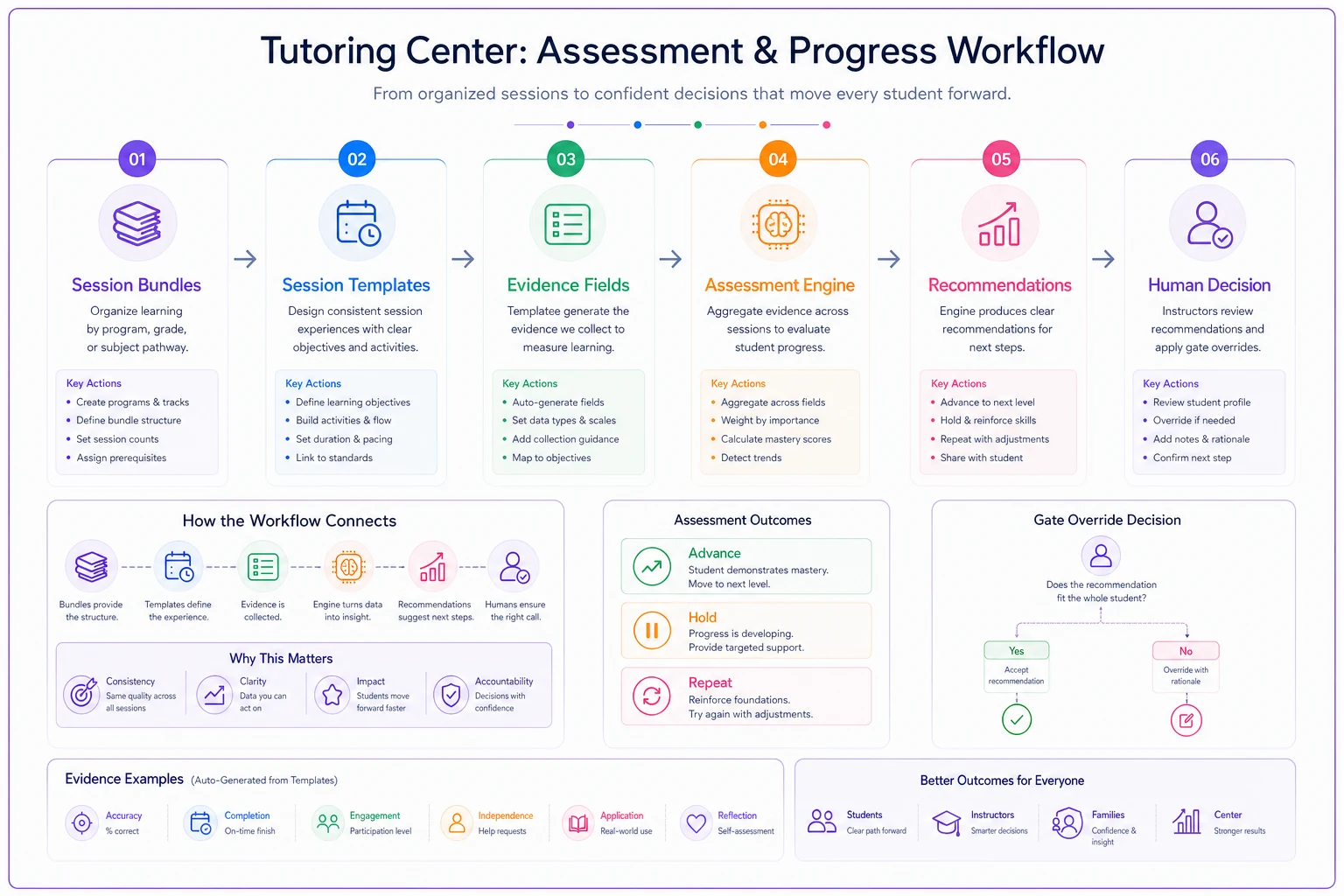
AI-assisted tooling can help by summarizing accumulated session evidence into a plain advance/hold/repeat recommendation, so the human decision-maker starts from a synthesized picture instead of scrolling through 20 sets of notes. The judgment stays human. The busywork of assembling the evidence doesn't have to be. That's a meaningful distinction—because the goal isn't to automate the decision, it's to make the decision less exhausting to reach.
But the software is the last step, not the first. If your tiers, gates, and versioning rules aren't defined, no tool will save you—it'll just organize the chaos more efficiently.
Pulling it together
A curriculum isn't a set of lesson plans. It's a set of decisions—about what a level means, how a student earns their way up, how content stays current, and how any tutor can pick up any student without dropping the thread. Get those decisions written down and wired into how you sell and schedule, and your tutoring curriculum scope and sequence becomes the backbone of your whole operation instead of a document nobody opens.
Start small. Pick your busiest subject. Write real exit criteria for its tiers. Add one hard gate and one override path. Version the units and give them a single home. Then map your bundles to the tier budgets so families stop running out of sessions in the middle of a level. That alone will change how consistent your delivery feels—and consistency, more than any single tutor's brilliance, is what parents actually renew for.
Start small. Pick your busiest subject. Write real exit criteria for its tiers. Add one hard gate and one override path. Version the units and give them a single home. Then map your bundles to the tier budgets so families stop running out of sessions in the middle of a level. That alone will change how consistent your delivery feels—and consistency, more than any single tutor's brilliance, is what parents actually renew for.
Ready to streamline your tutoring operations?
Join 500+ tutors and centers using Tutoryly to save time, improve scheduling accuracy, and enhance student experiences.