

Most tutoring centers treat the day a student "graduates" — hits their target score, finishes the semester, gets into the college — as the end of the relationship. Files get archived. The parent gets one warm thank-you email. And then nothing.
That's a strange thing to do when you stop and think about it. A family that just spent 6–14 months paying you, referring their kid's friends, and watching real results is arguably the warmest audience you'll ever have. Yet the standard operating pattern is to let them walk out the door with no structured way to come back and no reason to send anyone else your way.
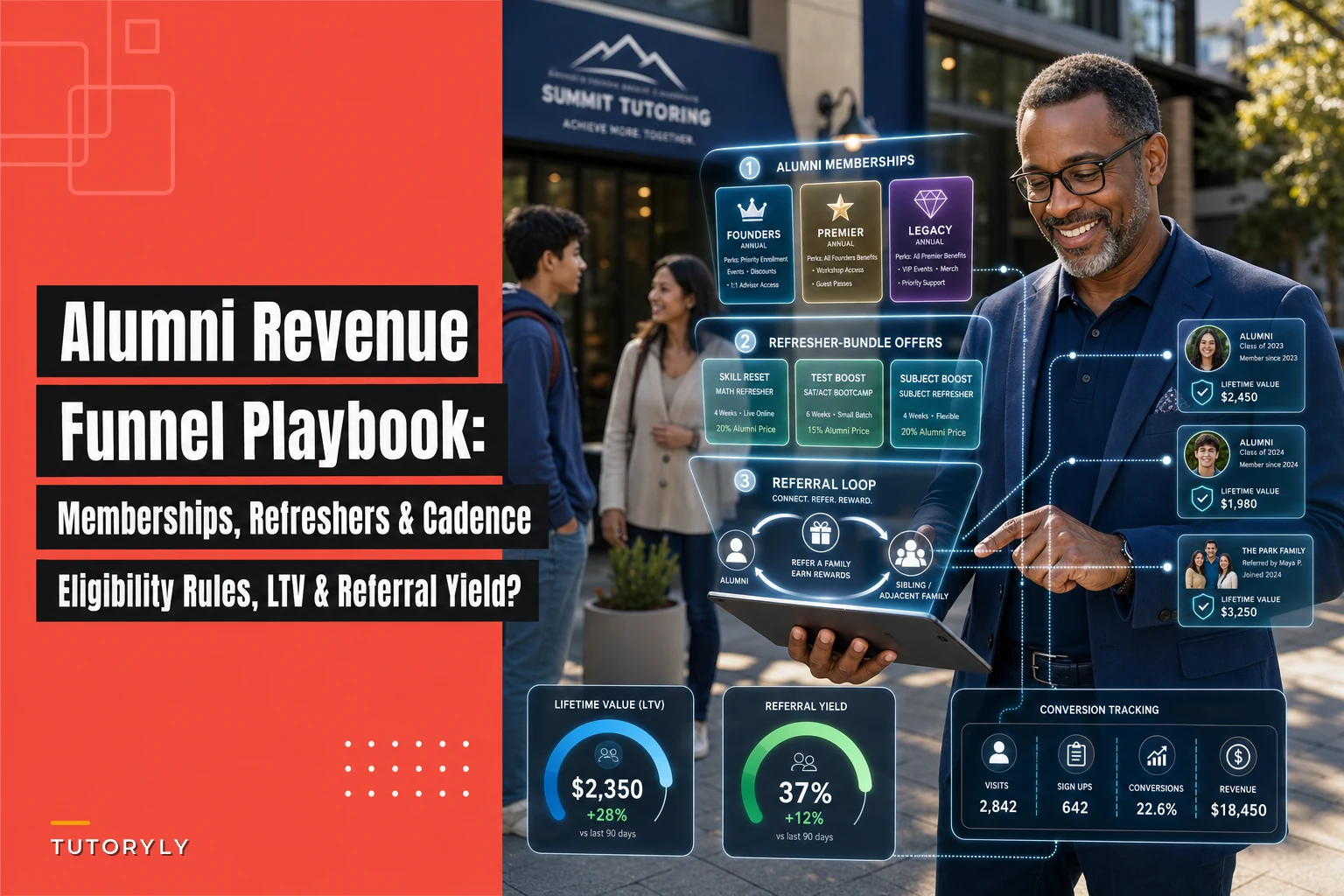
A tutoring alumni program fixes that gap. Not with a vague "stay in touch" newsletter, but with actual membership tiers, refresher bundles, clear eligibility rules, and conversion tracking that lets you forecast the revenue before you build anything. This post walks through the templates and the math.
Why post-exit families are the most under-monetized asset in a tutoring center
A center will spend $180–$300 in marketing to acquire a brand-new lead who has never heard of them. Meanwhile, a family that finished last spring — one that already trusts the brand, knows the tutors by name, and got the outcome they paid for — sits in a dead CRM field marked "inactive."
The economics are lopsided in a way most owners never calculate. Reactivating an alumni family typically costs a fraction of new acquisition, and they convert faster because there's no trust-building phase. In real operations, the reason this asset goes untouched is almost never strategy — it's that nobody owns it. Front desk staff are focused on active students. The owner is focused on filling next month's schedule. Alumni just drift.
There's a second thing happening. The moment of "success" — the kid got the SAT score, passed Algebra 2, got into their reach school — is the single highest-goodwill moment in the entire relationship. That's exactly when families are most willing to refer and most receptive to a "what's next" offer. If you have no structure to capture that moment, the goodwill evaporates within about 30–45 days.
Three template types that make up the program
You don't need a complicated loyalty system. What works is three well-defined offer types, each with its own purpose and eligibility rules.
Never miss another tutoring session.
Tutoryly helps you schedule, confirm, and manage every tutoring session efficiently.
- Unified session scheduling
- Automated student notifications
- Tutor calendar & availability management
No credit card required
1. Alumni membership (the recurring anchor)
A low-friction annual or semi-annual membership that keeps families in the ecosystem. This isn't tutoring — it's a lightweight retainer that delivers small ongoing value and keeps you top-of-mind for when the next academic need shows up.
-
Priority scheduling when they return (skip the waitlist)
-
One or two "check-in" academic consults per year
-
Member pricing on any future sessions (5–15% off)
-
Early access to seasonal bootcamps and test-prep cohorts
-
A referral bonus structure baked in
Price points that tend to work: roughly $99–$249/year depending on your market. The membership itself isn't a big profit center — its job is to hold the relationship open and drive the two things below.
2. Refresher bundles (the re-entry offer)
Small, pre-packaged session bundles designed for the "we're back" moment — the summer slide, the tough new teacher, the standardized test that snuck up. Think 3, 5, or 8-session packs, priced so the decision is easy.
Alumni almost never come back for a full open-ended commitment right away. They come back for a specific, contained problem. A 5-session "midterm rescue" bundle at around $325–$450 converts far better with a returning family than pitching them a 6-month package cold.
3. Annual cadence touchpoints (the rhythm)
Not an offer — a schedule. This is the calendar of when you reach out and with what. Most centers reach out randomly or not at all. A defined annual cadence tied to the academic calendar is what turns a one-time alumnus into a repeat customer over three or four years.
Eligibility rules: who gets what, and why it matters
Eligibility rules aren't bureaucracy — they protect your margins and keep the offers feeling earned rather than desperate. A membership offered to everyone who ever walked in is worth less than one gated behind a clear qualification.
Here's a workable framework:
| Segment | Eligibility criteria | Best-fit offer | Referral incentive |
|---|---|---|---|
| Recent graduates | Completed 8+ sessions, exited within last 90 days | Free 3-month membership trial → paid | Full referral bonus |
| Active alumni | Exited 3–18 months ago, positive outcome | Paid membership + refresher bundles | Full referral bonus |
| Dormant alumni | Exited 18+ months ago | Refresher bundle win-back offer | Reduced bonus |
| Sibling-adjacent | Family has younger children not yet enrolled | Membership + sibling intro offer | Bonus + sibling discount |
| Early-exit / unfinished | Left before completing program | Excluded from premium tier; re-assessment offer only | None until re-engaged |
That last row matters more than people expect. Families who left mid-program — whether from budget, a mismatch, or dissatisfaction — shouldn't get the same premium treatment as families who finished with a win. Lumping them together dilutes the program and can reopen old friction. Keep them in a separate re-engagement path.
Tag sibling-adjacent families at exit so they can be included in a targeted cadence and flagged for sibling offers.
The sibling-adjacent segment is quietly the highest-yield group in most centers. A parent who already trusts you and has a younger child coming up is a near-certain future customer. If you're not flagging that in your account data, you're leaving obvious revenue sitting there.
The conversion KPIs that actually forecast revenue
The reason most alumni programs fail isn't the offer — it's that nobody measures whether it's working until it's too late to adjust. You want a small set of KPIs tied directly to lifetime value (LTV) and referral yield, not vanity metrics like email open rate.
Track these:
-
Alumni reactivation rate — % of eligible alumni who purchase any offer within 12 months. Healthy range: 8–18%.
-
Membership-to-bundle conversion — % of members who buy at least one refresher bundle per year. This is where membership actually pays off.
-
Referral yield per alumnus — average number of qualified referrals generated per active alumni family per year.
-
Incremental LTV lift — added lifetime value per family attributable to the program vs. a no-program baseline.
-
Cost per reactivation — total program cost divided by reactivated families.
That third one — referral yield — is often the real profit engine. The membership and bundles cover the program's costs and keep the relationship warm, but referrals are the compounding return. If you've already mapped your funnels using something like a measurable customer lifecycle model, alumni reactivation slots in as its own late-stage funnel with its own handoff triggers.
A worked example: forecasting the revenue impact
Run realistic numbers for a mid-sized center. Assume roughly 240 alumni families accumulated over three years, launching the program for the first time.
Reactivation:
-
Eligible alumni
240 families
-
Reactivation rate (conservative first year)
12% → ~29 families reactivate
Direct revenue from those 29 families:
-
Membership
29 × $149 = ~$4,320
-
Refresher bundles
assume 60% buy one bundle (avg $380) → ~17 families × $380 = ~$6,460
-
Direct first-year revenue
roughly $10,700
Referral revenue (the bigger lever):
Referral yield: say each reactivated family sends ~0.4 qualified referrals → ~12 new leads Assume 50% of qualified referrals convert to paying students → ~6 new students Average new-student LTV in this center: ~$2,200 Referral revenue value: 6 × $2,200 = ~$13,200
First-year total impact: roughly $23,000–$24,000 off an alumni base you already owned, at a program cost that's mostly your time plus small incentive payouts.
The multi-year compounding is where it gets interesting. Those 29 reactivated families don't vanish — many buy another bundle the following year, some renew membership, and the referral engine keeps producing. By year three, with a growing alumni pool and improving reactivation rates, the same program can realistically drive $40k–$60k+ annually without spending anything on cold marketing. That's the part most owners underestimate: it's not a one-time bump, it's closer to an annuity.
One honest caveat — these numbers assume you actually execute the cadence. A program that launches strong and then goes quiet for eight months pulls reactivation rates down toward 4–6%, and the whole model gets a lot less compelling. Consistency is the variable that makes or breaks the forecast.
The annual cadence: what to send and when
This is the operational backbone. Without a defined rhythm, everything above stays theoretical. Map your outreach to the academic calendar so every touch has a natural reason to exist.
-
Late summer (Aug) "Beat the fall slide" — refresher bundle push before school starts
-
Mid-fall (Oct) Membership renewal + first progress check-in offer
-
Pre-winter (Nov–Dec) Midterm rescue bundles + referral reminder tied to holiday goodwill
-
New year (Jan) "Second-semester reset" — re-engagement for dormant alumni
-
Spring (Mar–Apr) Test-prep cohort early access for members
-
Post-results (May–Jun) Success celebration + referral ask at the highest-goodwill moment
Six touchpoints a year. Not overwhelming, and each one is anchored to something real in the family's world. The mistake centers make is either sending nothing or blasting the same "we miss you!" email monthly until people tune out. Relevance beats frequency every time.
Where the referral ask actually belongs
The best time to ask for a referral is not when someone reactivates — it's at the moment of the original success, and again right after a refresher bundle delivers a result. Goodwill is highest immediately after a win.
This is why the trial-to-paid mechanics matter on the alumni side too. If you've built solid conversion timing into your trial-to-paid playbook, you already understand the principle — the ask has to land when the emotional value is freshest, not weeks later when the memory has cooled.
Bake the referral moment into the cadence with a simple structured ask: a short message, a clear incentive, and an easy way to share. A referral program that requires the parent to remember a code and explain your value to a friend from scratch will underperform one where you hand them a ready-to-forward link with the offer already spelled out.
When this makes sense — and when it doesn't
When an alumni program is worth building:
-
You have at least ~80–100 past families to draw from (below that, the math is thin)
-
Your outcomes are genuinely good, so goodwill exists to activate
-
You serve age ranges or subjects with repeat need (K–12 especially, where the same family has years of future needs ahead)
-
You have someone who can own the cadence, even part-time
When it's premature:
-
You're under a year old with almost no alumni base — focus on core retention first
-
Your churn is driven by dissatisfaction rather than natural completion — fix the product before mining the base
-
You can't commit to running the cadence consistently — a half-executed program trains alumni to ignore you
Centers still struggling with active-student retention shouldn't touch this yet. If families are leaving unhappy, an alumni program just amplifies the negative word of mouth. Get the core experience solid first.
A real scenario
A suburban K–8 tutoring center had built up around 190 past families over four years and was ignoring all of them. New-student acquisition was running about $220 a head through local ads, and growth had flattened out.
They launched a basic alumni program — a $129 annual membership, two refresher bundle options, and a six-touch annual cadence tied to the school calendar. No fancy tech, just a spreadsheet, a defined eligibility table, and someone assigned to actually send the emails.
First year: around 22 families reactivated, membership and bundle revenue came in at roughly $9k, and the referral asks — placed right at success moments — produced about 9 qualified leads, of which 5 enrolled. Between direct revenue and referral LTV, the program returned somewhere in the low-$20k range off a base they'd been treating as dead weight. The bigger shift was cultural: staff started thinking of graduation as a transition rather than an exit.
Keeping it running without it becoming a second job
The honest challenge with alumni programs isn't design — it's maintenance. Six touchpoints across 190+ families, with different eligibility rules and referral tracking per segment, gets tedious fast if it's all manual. That's usually where these programs quietly die around month four.
This is where an AI-powered operational platform earns its place. Tagging alumni by eligibility segment automatically at exit, triggering the right cadence message on the right calendar date, tracking conversions by segment, and flagging sibling-adjacent families so they never slip through — none of that is glamorous, but it's what keeps the program actually running.
Below is a simple workflow the platform should run.
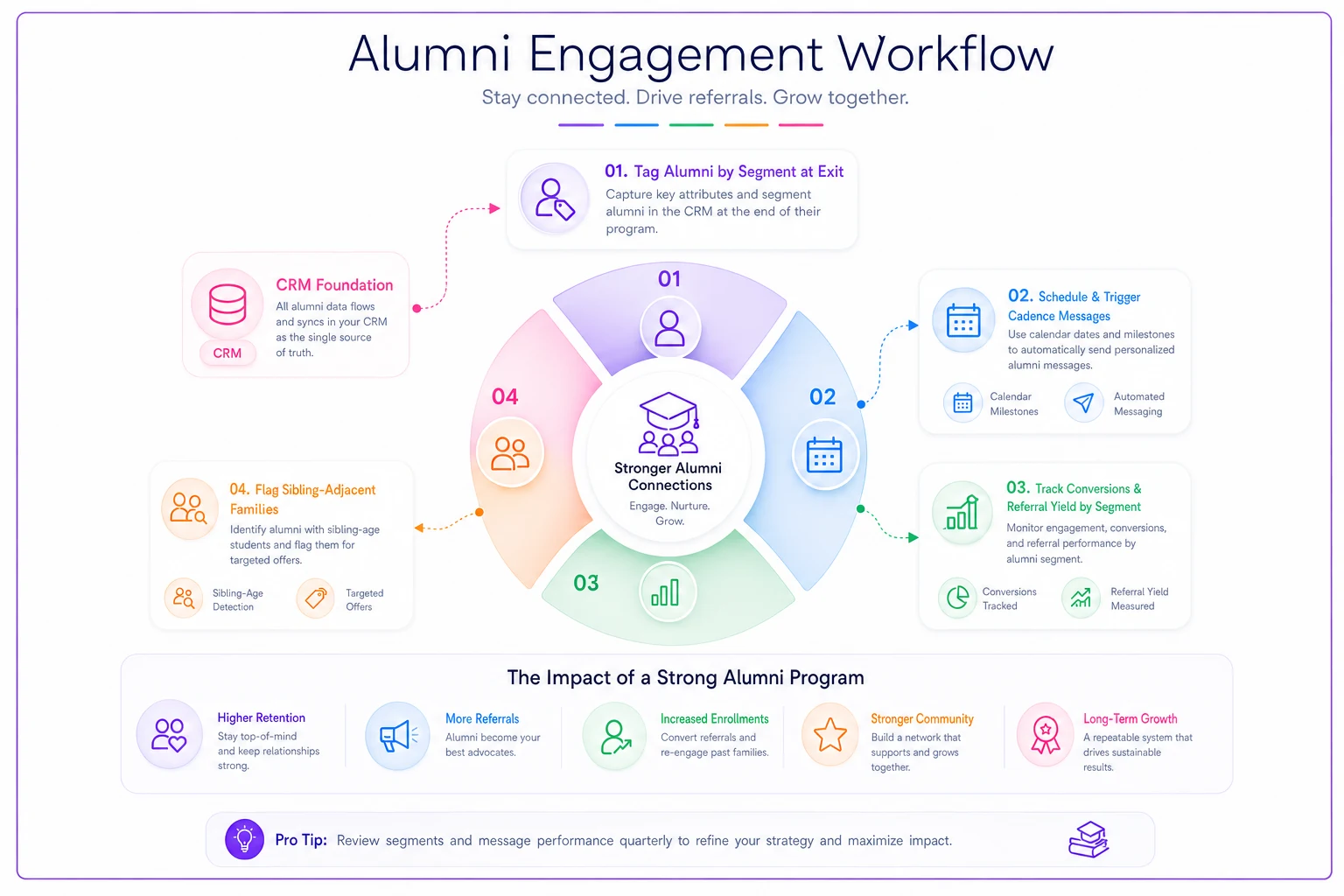
The point isn't automation for its own sake. It's that the cadence keeps happening even when the front desk is slammed and nobody's manually pulling lists. The forecast in this article only holds if the sends actually go out, and that reliability is what turns a good idea into a real revenue line.
Bringing it together
The families who already got results from you are worth far more than a thank-you email and a spot in an archived folder. With three simple template types — membership, refresher bundles, and an annual cadence — plus eligibility rules that protect your margins and KPIs tied to LTV and referral yield, you can turn post-exit families into a compounding revenue channel that costs almost nothing to run.
Start with the segmentation table, run the forecast against your own alumni count before you commit, and pick a cadence you can actually sustain. The centers that treat graduation as the start of a new relationship — not the end of one — are the ones quietly growing without pouring more money into cold marketing every month.
The centers that treat graduation as the start of a new relationship — not the end of one — are the ones quietly growing without pouring more money into cold marketing every month.
Ready to streamline your tutoring operations?
Join 500+ tutors and centers using Tutoryly to save time, improve scheduling accuracy, and enhance student experiences.