



Your best tutors keep leaving for centers paying 50 cents more per hour. Meanwhile, the mediocre ones who lose students every quarter stick around forever because they're comfortable. The compensation structure you thought was fair — $25/hour for everyone with experience — is actually incentivizing the wrong behaviors and bleeding your center through turnover and student churn.
Why traditional tutor pay structures create retention problems most centers never see coming
Centers treat tutor pay like retail wages when they should treat it more like sales compensation. Sales comp rewards outcomes. Traditional tutoring pay rewards showing up.
The real damage happens slowly. A tutor making $28/hour loses three students in two months but keeps their rate. Another tutor consistently retains families for 18+ months and makes the same $28. Eventually that second tutor finds a center that values retention, and now you're scrambling to cover 22 weekly sessions while their replacement struggles through the learning curve.
The hidden economics of tutor turnover that compound every quarter
Most tutoring center owners calculate turnover cost as recruitment expense plus training time — maybe $800 to replace a tutor. The actual number runs closer to $3,000-$3,500 when you factor in student attrition during the transition.
Never miss another tutoring session.
Tutoryly helps you schedule, confirm, and manage every tutoring session efficiently.
- Unified session scheduling
- Automated student notifications
- Tutor calendar & availability management
No credit card required
When a solid tutor leaves, they're typically carrying 18-20 regular students. You redistribute across three other tutors. Two families cancel immediately because of schedule changes. Three more leave within six weeks because the chemistry isn't right. Another two drop from twice-weekly to once-weekly sessions.
That's seven students impacted from one departure. At $200 average monthly revenue per student, you've lost $1,400 in monthly recurring revenue before you've even spent a dollar on recruitment.
The frustrating part is that most of this is preventable with a compensation model that actually rewards the behaviors you want: student retention, consistent scheduling, progress documentation, and professional development.
Building base compensation tiers that reflect real tutor value
Drop years of experience as your primary pay determiner. A tutor with 10 years who churns through students isn't worth more than a second-year tutor who keeps families enrolled for two years straight.
Build your base pay around operational value. Start with a foundation rate — say $22/hour for new tutors — then create clear tiers based on measurable contributions:
Tier 1 ($22-24/hour): New tutors still proving themselves. Standard subjects, regular hours, basic documentation.
Tier 2 ($24-27/hour): Proven retention (students stay 6+ months on average), handle specialized subjects or learning differences, detailed progress notes, consistent 15+ weekly hours.
Tier 3 ($27-32/hour): Elite performers with 12+ month average retention, handle complex cases, mentor newer tutors, 20+ weekly hours, contribute to curriculum.
Movement between tiers depends on performance metrics, not tenure. A strong tutor can reach Tier 3 in eight months. A mediocre veteran might stay in Tier 2 indefinitely. That's the point.
These ranges tie directly to revenue impact. A Tier 3 tutor generating $4,800 monthly with 85% retention justifies the premium over a Tier 1 tutor generating $2,400 at 60% retention.
Designing bonus formulas that reward retention without creating perverse incentives
The bonus layer is where your tutor compensation model really does the heavy lifting — but structure it wrong and you'll create new problems. Pure retention bonuses lead to grade inflation and lowered standards. Pure progress bonuses lead to teaching to the test. Neither is good.
A balanced scorecard with multiple weighted factors works better. Here's a formula worth modeling:
Monthly Bonus = (Retention Score × 40%) + (Progress Score × 30%) + (Operations Score × 20%) + (Growth Score × 10%)
Breaking down each component:
Retention Score: Percentage of students retained month-over-month. If a tutor starts the month with 15 students and ends with 14, that's 93% retention. Scale this to dollars — maybe $2 per percentage point over 80%. So 93% retention = $26 retention bonus.
Progress Score: Based on documented academic improvements, not just grades. Track assignment completion rates, assessment score improvements, parent satisfaction surveys. A tutor whose students average 15% improvement in assessments over 8 weeks might earn $30-50 in progress bonus.
Operations Score: Rewards the unsexy stuff — timely progress notes, consistent scheduling, proper session documentation, responding to parent communications within 24 hours. Full compliance might be worth $40 monthly.
Growth Score: A small incentive for accepting new students, covering substitutions, referring new families. Keeps tutors thinking beyond their own roster. Maybe $10-20 monthly for active participation.
A strong tutor hitting solid marks across all categories could earn $100-150 in monthly bonuses on top of base. That's meaningful money tied directly to behaviors you actually want.
Setting KPI triggers and measurement cadences that actually work
You can't announce a new comp structure and expect magic. The measurement system determines whether this drives real behavior change or becomes another ignored policy.
Most centers try to track everything and end up tracking nothing effectively. Focus on five core KPIs that connect directly to tutor compensation:
| KPI | Measurement Frequency | Minimum Threshold | Maximum Bonus Threshold |
|---|---|---|---|
| Student Retention Rate | Monthly | 85% | 95%+ |
| Average Session Rating | Weekly | 4.2 | 4.6+ |
| Documentation Compliance | Weekly | 90% | 98%+ |
| Student Progress Velocity | Every 4 weeks | 10% improvement | 20%+ improvement |
| Schedule Utilization | Weekly | 80% | 90%+ |
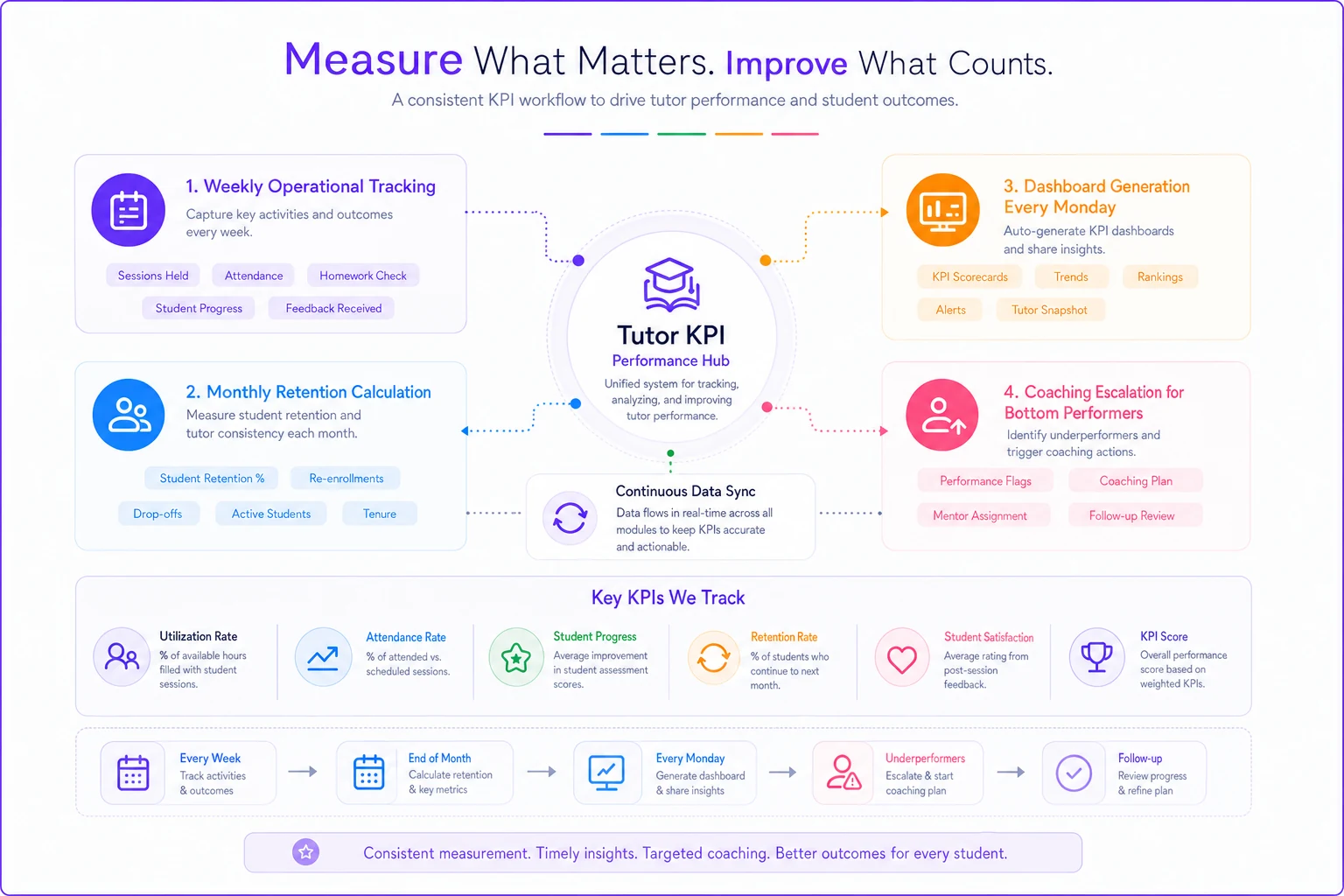
A visual of this workflow clarifies cadence, responsibilities, and escalation points for your team.
The measurement cadence matters as much as the metrics. Weekly operational metrics keep tutors aware of where they stand. Monthly retention metrics smooth out natural variation. Quarterly reviews determine tier advancement.
Student Retention Rate — simple calculation, but requires clean data. Students active at month end divided by students active at month start. Exclude new starts from the denominator.
Average Session Rating — a 1-5 scale completed by students or parents after each session via automated text. Takes 10 seconds and provides immediate feedback.
Documentation Compliance — percentage of sessions with complete notes filed within 48 hours. Binary: either the notes meet requirements or they don't.
Student Progress Velocity — improvement rate on standardized assessments or assignment grades. Requires baseline measurement and consistent tracking.
Schedule Utilization — filled hours divided by available hours. Encourages tutors to maintain consistent schedules and minimize gaps.
Essential guardrails to prevent gaming and protect educational quality
Every compensation system can be gamed. The question is whether you've made gaming harder than just doing good work.
The multi-metric approach is your first defense — it's genuinely hard to game five different metrics simultaneously. But you need additional protections:
Grade Distribution Monitoring: Track grade improvements each tutor's students report. If every student suddenly jumps two letter grades, something's off. Compare distributions across tutors and investigate statistical outliers.
Parent Satisfaction Override: Regardless of other metrics, substantiated parent complaints can nullify bonuses. Three complaints in a quarter zeros out performance bonuses for that period.
Minimum Session Requirements: Bonuses only apply to tutors maintaining 12+ hours weekly. Prevents gaming through selective student picking — only working with easy, naturally high-performing students.
Progress Verification Audits: Randomly audit around 10% of reported progress metrics. Compare tutor-reported improvements against school report cards or independent assessments. Misrepresentation leads to immediate bonus forfeiture.
Forced Distribution Curves: Not every tutor can be top tier. If more than 30% qualify for Tier 3, raise the bar. Keeps compensation budget in check while maintaining meaningful differentiation.
New Student Protection Period: First 60 days with any new student excluded from retention metrics. Gives tutors time to assess fit without penalty for necessary reassignments. Prevents the situation where nobody wants challenging students.
Building dashboards that make performance visible without creating anxiety
Tutors need to see their metrics, but constant surveillance creates a toxic environment. The balance is transparency without oppression.
-
Current tier and progress toward next tier
-
Last week's key metrics with trend arrows
-
Month-to-date bonus calculation
-
One specific area for improvement
-
One recognition point for strong performance
Keep it visual and digestible. Five key numbers maximum on the main view — anything more and people stop looking.
Send weekly summaries on Mondays so tutors get a predictable snapshot without real-time pressure.
The psychological design matters too. Show performance relative to personal goals, not constant peer comparison. A tutor at 87% retention sees they're 3% from their 90% bonus threshold, not that they're ranked 8th out of 12 tutors. Those feel very different.
Make the data actionable. Below each metric, include one specific suggestion. Low documentation compliance? "Complete notes immediately after sessions instead of batching." Retention dropping? "Schedule check-ins with at-risk families this week."
Separate views for tutors versus management also help. Tutors see their own detailed data plus anonymized center averages. Managers see everything, with the ability to drill into individual performance and identify coaching opportunities.
The QA integration loop most centers completely miss
This is where the system becomes genuinely powerful rather than just complicated. Your compensation model needs to feed directly into your quality assurance and coaching processes.
Every month, the bottom 20% of performers by composite score should automatically trigger coaching interventions — not punitive ones, developmental ones. A tutor struggling with retention gets paired with a high-retention tutor for shadowing sessions. Someone with low progress scores gets curriculum training.
-
Live session observation with structured feedback
-
Student and parent feedback review
-
Goal setting for the next period
-
Skills gap assessment and training plan
-
Compensation adjustment discussion
This creates a natural performance management cycle. Underperformers either improve through coaching or self-select out. High performers feel valued and see clear advancement paths. The compensation data also feeds your hiring profiles over time — if you notice tutors with teaching certificates averaging 91% retention versus 83% for those without, that's worth paying $2/hour more in starting wage.
Rolling out the new system without triggering a revolt
Even the best compensation system fails if implementation causes your entire team to quit. The rollout requires careful choreography.
Start with transparency about the problem you're solving. Share anonymized data about retention rates, student outcomes, and the connection to center sustainability. Most tutors don't realize that keeping students enrolled directly impacts whether the center survives.
Then run a pilot with your top performers. Choose three or four tutors who already embody the behaviors you want. Put them on the new system for two months. Let them help refine the metrics and thresholds. When they start earning meaningful bonuses, word spreads naturally.
Phase 1 (Month 1-2): Begin tracking all metrics but don't tie them to compensation yet. Share weekly dashboards so tutors understand how they're measured. Run parallel to the existing pay structure.
Phase 2 (Month 3-4): Introduce bonus components only. Keep base pay unchanged. Tutors can earn more without anyone earning less. Iron out measurement issues.
Phase 3 (Month 5-6): Implement the tier system for new hires only. Existing tutors are grandfathered at current rates but can opt into the tier system if it benefits them.
Phase 4 (Month 7+): Full system implementation with 90-day notice for existing tutors. Most will have already opted in after seeing others' success.
Throughout the rollout, hold weekly office hours where tutors can ask questions, dispute metrics, and suggest improvements. The system should feel collaborative, not imposed.
Troubleshooting common compensation system failures
Even with careful planning, certain problems emerge predictably.
The Superstar Problem: Your best tutor maxes out every metric and earns $45/hour in total compensation. Other centers will try to poach them. Solution: Create a "Master Tutor" tier with additional responsibilities — training, curriculum development — that justifies $50+ total comp while adding real value beyond direct tutoring.
The Veteran Resistance: Long-term tutors making $30/hour resist the new system because their performance doesn't actually justify that rate. Solution: Gradual transition with protection periods. They keep their current rate for 12 months while learning to meet new standards. Natural attrition usually handles the rest.
The Cherry-Picking Problem: Tutors only want high-performing, easy-to-retain students. Solution: Assign students via algorithm, not tutor preference. Include a difficulty multiplier in retention calculations so harder cases aren't penalized.
The Documentation Burden: Tutors claim tracking requirements interfere with actual tutoring. Solution: Streamline documentation to absolute essentials. Provide templates and tools that reduce friction. Show how good documentation improves their own efficiency over time.
The Budget Explosion: More tutors than expected hit high bonus tiers, blowing your compensation budget. Solution: Set bonus pools rather than unlimited individual bonuses. Top 30% of performers split a fixed pool. Keeps budget predictable while still rewarding excellence.
When outcomes-based pay makes sense (and when it doesn't)
This system isn't universal. Worth being honest about that.
-
Centers with 10+ tutors where individual performance varies significantly
-
Competitive markets where tutor retention is a real challenge
-
Centers focused on long-term student relationships versus short test prep programs
-
Growing centers that need to attract and keep top talent
Where traditional hourly works better:
-
Test prep centers with defined 8-12 week programs
-
Centers under five tutors where the owner maintains direct oversight
-
Highly specialized tutoring — learning disabilities, advanced mathematics — where tutor supply is extremely limited
-
Non-profit or grant-funded programs with fixed compensation budgets
The core question: does individual tutor performance significantly impact your business outcomes? If yes, you need compensation that reflects that. If no, keep it simple.
Connecting compensation to your broader operational system
Your compensation model doesn't operate in isolation. It needs to connect with other operational pieces to produce real results.
Student assignment should factor in tutor tier and performance history. Higher-performing tutors get first consideration for new students, which creates an additional incentive for excellence.
Your capacity planning and scaling triggers also need to account for varying tutor productivity. A Tier 3 tutor might handle 25 students effectively while a Tier 1 caps at 15 — and that difference matters for hiring triggers and growth projections.
Training investments should correlate with tiers too. Spending $500 on professional development for a Tier 3 tutor generating $6,000 monthly makes clear business sense. That same investment in an unproven Tier 1 tutor is a harder call.
Even marketing benefits. "Our tutors earn bonuses based on your child's progress" resonates with parents who are tired of paying for disengaged hourly help.
The operational data hiding inside your compensation system
All this performance tracking generates a significant amount of data. Most centers let it sit in spreadsheets, never doing anything useful with it.
AI-powered tutoring management platforms can handle the majority of the compensation tracking workflow without manual effort. Session completions log automatically. Parent feedback requests trigger via SMS after each session. Progress assessments calculate without anyone entering data by hand. Dashboards stay current without a weekly admin scramble.
What's more valuable is how these platforms surface patterns that would otherwise go unnoticed. Tutors who send session recaps within two hours showing 94% retention versus 81% for those who wait 48 hours — that's actionable. Students who rate sessions 4.5 or higher for three consecutive weeks having a 95% probability of continuing for another six months — that's worth building into your retention strategy.
These insights let you refine your compensation triggers based on actual predictive indicators, not gut feel. The bonus formula can evolve based on what genuinely drives retention and progress in your specific center rather than what just sounded reasonable when you first built it. The same data also powers early warning alerts — when a tutor's metrics start sliding, the system flags it before it impacts their tier or bonus, giving you a window to intervene before it becomes a student churn problem.
Building a system that scales with your vision
Centers that thrive over the next decade won't necessarily be the ones paying tutors the most. They'll be the ones paying tutors for the right things. The difference between $25/hour for showing up and $25/hour base plus $8/hour in performance bonuses for strong retention seems small on paper. Compound that across 20 tutors and 400 students and you've built a fundamentally different business.
The rollout won't be perfect initially. Metrics need adjustment, tutors need coaching, and systems need refinement. But once the flywheel starts — good tutors earn more, stay longer, deliver better outcomes, attract more families — the business transforms in a way that's hard to reverse-engineer from the outside.
Start simple. Pick three metrics that matter most to your center. Track them manually for a month. Share the data with tutors without tying it to pay yet and see what changes just from awareness. Then gradually layer in the compensation connection, the automation tools, and the coaching integration.
Your tutors want to succeed. Your families want outcomes. Your business needs retention. A thoughtful compensation system aligns all three. The centers still paying flat hourly rates in a few years won't understand why they can't keep good tutors or good families. You'll know exactly why yours stay.
Start simple. Pick three metrics that matter most to your center. Track them manually for a month. Share the data with tutors without tying it to pay yet and see what changes just from awareness. Then gradually layer in the compensation connection, the automation tools, and the coaching integration.
Your tutors want to succeed. Your families want outcomes. Your business needs retention. A thoughtful compensation system aligns all three. The centers still paying flat hourly rates in a few years won't understand why they can't keep good tutors or good families. You'll know exactly why yours stay.
Ready to streamline your tutoring operations?
Join 500+ tutors and centers using Tutoryly to save time, improve scheduling accuracy, and enhance student experiences.