

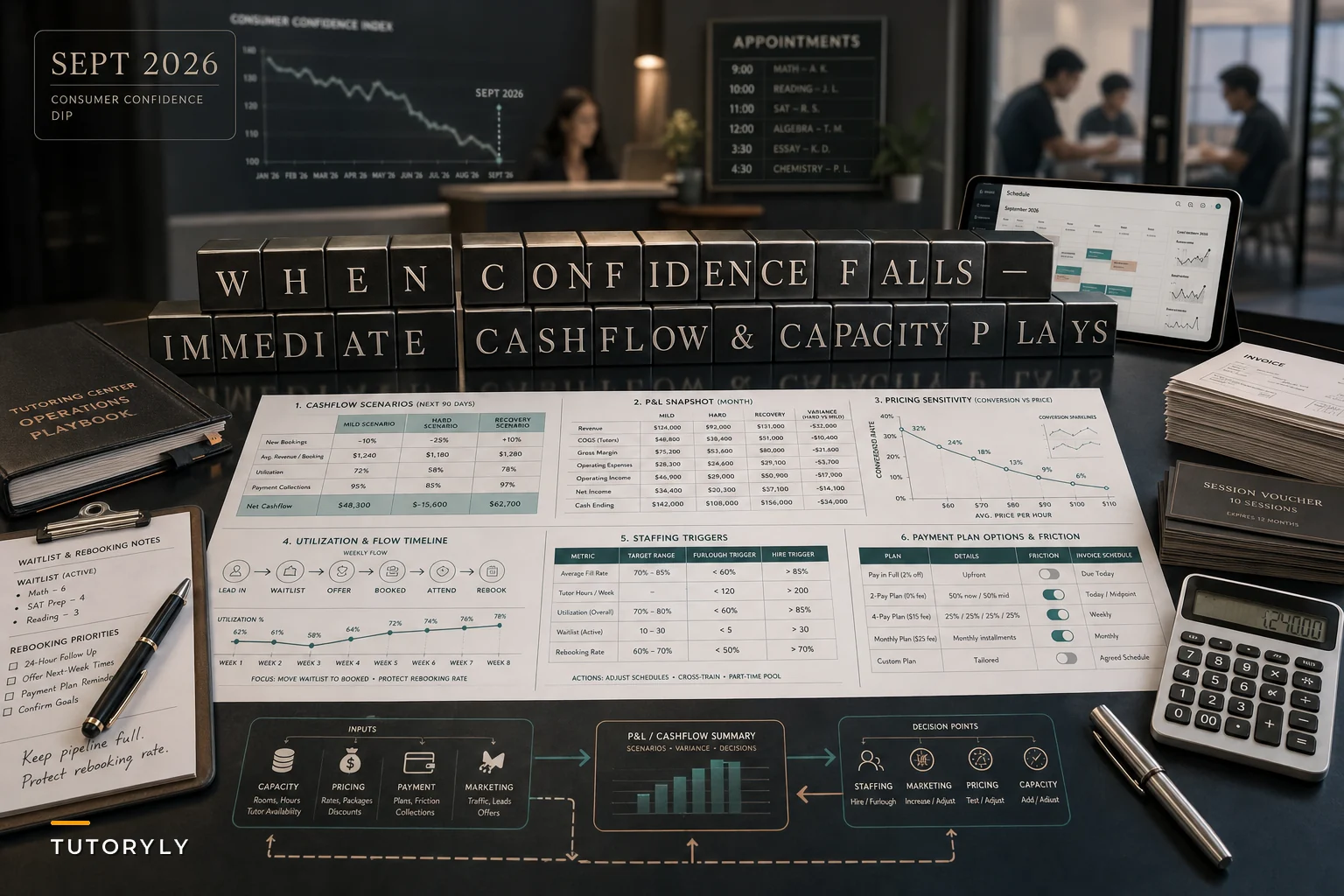

The Conference Board's September reading landed at 81.9 — the weakest number since 2014. Reuters covered the sharp drop in consumer confidence at the end of September, and the timing was brutal for tutoring centers specifically. The first few weeks of the academic year are when families decide whether to commit to a full semester or "wait and see." That reading landed right in the middle of that window. Confidence numbers don't change whether a kid needs help with Algebra II. What they change is how fast a parent signs, how long they sit on the second invoice, and whether they renew for 20 sessions or buy 6 and reassess. The demand doesn't disappear — it just gets slower, choppier, and more price-sensitive. That's a different problem than a recession, and it needs a different response. Most centers react to this exactly wrong. They either panic-discount across the board (which torches margin and trains families to wait for deals) or they do nothing and watch utilization quietly erode over six weeks until the math stops working. Neither is a plan. What follows is.
What breaks first — and it's not demand
When household confidence weakens, the first thing you'll see isn't a wave of cancellations. It's friction creeping into the parts of your operation that were already fragile.
The pattern looks like this. Trial-to-paid conversions slow down — a family that would've committed after one session now takes three to decide. Payment declines tick up, not because people can't pay, but because they're juggling cards and letting things lapse. No-shows rise slightly, especially for the second and third session of a package, because the urgency that drove the initial sign-up fades. Renewal conversations get harder — parents who used to auto-renew now ask "do we still need this?"
None of these individually looks catastrophic. That's the trap. A 4% drop in conversion, a 3-point rise in decline rates, and a couple extra no-shows per tutor per week feels like noise. Stack them across a 90-day quarter and you've got a 10–15% revenue gap that shows up in your bank balance before it shows up in your gut.
The underlying issue is that most tutoring centers run on assumed stability. Pricing is set once and left alone. Payment plans are informal. Utilization is tracked loosely, if at all. That works fine when confidence is high and families commit easily. The moment the environment gets choppy, you need tighter instruments — and most centers are flying with none.
The capacity math nobody wants to look at
Before touching price, look at utilization. This is where the real money leaks, and it's the least emotional lever you have.
Never miss another tutoring session.
Tutoryly helps you schedule, confirm, and manage every tutoring session efficiently.
- Unified session scheduling
- Automated student notifications
- Tutor calendar & availability management
No credit card required
A typical mid-size center running 6 tutors across after-school and weekend blocks has theoretical capacity far above what it actually bills. In practice, you've got dead slots — the 4pm Tuesday hour nobody books, the Saturday morning block that's half full, gaps created when a student drops from Thursdays but you never rebooked the chair. When confidence falls and families trim sessions, these gaps widen fast.
Here's a rough breakdown of where capacity actually goes in a center that thinks it's running efficiently:
| Capacity bucket | Typical % of total slots | What it's actually costing you |
|---|---|---|
| Billed, delivered sessions | 60–68% | Your real revenue |
| Dead slots (never booked) | 12–18% | Pure fixed-cost drag |
| No-shows / late cancels | 6–10% | Paid tutor, no revenue (depending on policy) |
| Soft-credited make-ups | 5–9% | Delivered twice, billed once |
The centers that survive a confidence dip without panic-discounting are the ones that attack the middle two rows before they touch pricing. Pull dead slots from 15% down to 9% by consolidating schedules and shifting families into tighter blocks, and you've recovered more margin than a 10% price cut would ever give you — without changing what parents pay.
Start by identifying the two lowest-fill days and test consolidating them for one month to measure immediate impact on dead-slot rate.
In practice, this usually means consolidating the thinnest days. If Tuesday and Thursday afternoons are each running at 50%, merging demand onto one fuller day and freeing the other — for group sessions, admin, or simply not paying a tutor to sit — changes your cost structure immediately. Families barely notice. Your P&L notices a lot.
Pricing: don't cut, restructure
Across-the-board discounting feels responsive and is almost always wrong. It signals weakness, permanently resets what families think your service costs, and is nearly impossible to walk back once confidence recovers.
What works better during a confidence squeeze is restructuring the offer so the entry point gets easier without the unit price dropping. There's a real difference, and families feel it even if they can't articulate it.
-
Smaller first commitments. Replace the 20-session package push with a clean 6- or 8-session block. Same per-session rate. Lower total dollar ask. The parent who's nervous about a $1,600 commitment will say yes to $520.
-
Payment flexibility over price cuts. Splitting an existing package into bi-weekly charges costs you nothing in margin and removes the single biggest objection during a tight stretch. A family that won't pay $800 up front will often pay $200 every two weeks without blinking.
-
Value-add instead of discount. Bundle a progress review session or a diagnostic retest into the package rather than cutting the price. You're adding perceived value using capacity you may already have sitting in those dead slots.
-
Hold your renewal rate, sweeten the terms. For existing families on the fence, offer a locked rate if they commit by a date — not a lower rate. Scarcity of terms beats cheapness of price.
When straight discounting actually makes sense
There's one narrow case: a short, clearly-labeled, deadline-bound offer targeting a specific under-utilized block. "Weekday 3pm slots, 15% off through October 20" — that's yield management on inventory that was going to waste anyway. The labeling matters. A vague "fall discount" trains everyone to wait. A specific "fill this empty chair" offer doesn't.
When it's a bad idea
If your margins are already thin — sub-30% contribution after tutor pay — discounting is how you go from stressed to insolvent. Centers in that zone need to fix utilization and payment friction first, full stop. Cutting price on a thin margin during a demand dip is just speeding toward the wall.
A real scenario
A two-location center — roughly 140 active students between the sites — noticed trial conversions slipping in the first three weeks of the term. Not a cliff, just softer. Instead of discounting, they did three things over about ten days.
They audited their schedule and found around 16% of slots were dead or soft-credited. They consolidated their weakest afternoon blocks, which let them trim one part-time tutor's hours without reducing delivered sessions. They repackaged the standard 16-session offer into an 8-session starter at the same per-hour rate, and quietly switched new families to bi-weekly billing by default.
Over the following six weeks, trial-to-paid conversion recovered close to where it had been — the smaller commitment did most of that work. Payment declines dropped because bi-weekly amounts were easier to absorb. Consolidating the schedule cut roughly $2,800 a month in tutor cost that was being spent on half-empty blocks. Net effect: revenue held, margin actually improved slightly, and they never ran a single "sale."
The lesson isn't the specific numbers. It's the order of operations: capacity first, payment friction second, offer structure third, price last.
The instrument most centers are missing
Most centers skip this part, and it's the one that separates a calm response from a reactive one. You can't make any of these moves intelligently without a cashflow view that shows you which lever matters most right now.
When confidence is wobbling, you're not managing one future — you're managing three. A mild scenario where conversions dip 5% and recover by November. A harder one where they dip 12% and stay flat through winter. A recovery scenario where this turns out to be a blip. Each of those calls for a different staffing and marketing decision, and you need to see the dollar impact before you commit to anything.
This is exactly why a proper tutoring center cashflow forecast with P&L scenarios and seasonal toggles stops being a nice-to-have during a confidence dip and becomes the thing you run your week on. Toggle a 10% conversion drop and instantly see it pushes your hiring trigger out by six weeks — you make that call cleanly instead of agonizing over it. See that pulling dead-slot cost saves more than a planned discount would, and the decision makes itself.
Here's a simple visual of that scenario workflow.
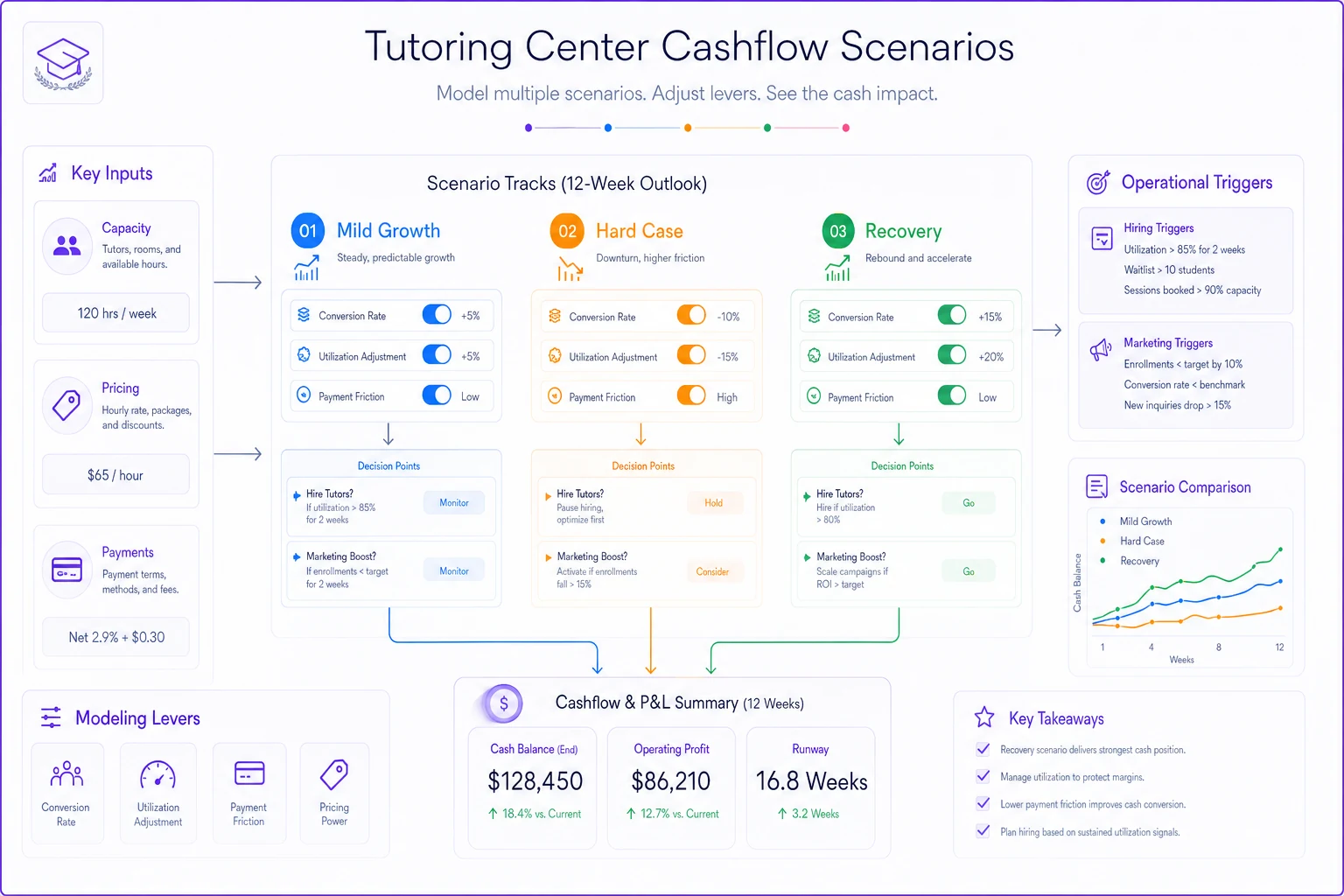
Most of these pricing and capacity moves are reversible and low-risk only if you can see their effect in advance. Without a scenario model, every change feels like a gamble, so owners freeze — and freezing during a demand dip is the single most expensive thing you can do.
A fast checklist for the next 14 days
If confidence weakness is starting to show up in your numbers, work this in order:
-
Pull your real utilization rate — billed-and-delivered slots as a % of total capacity. Find your dead slots and soft-credit rate.
-
Consolidate your two thinnest time blocks; identify any tutor hours you can trim without cutting delivered sessions.
-
Switch new families to split/bi-weekly billing by default to kill the up-front-cost objection.
-
Introduce a smaller starter package at the same per-session rate — lower total ask, not lower unit price.
-
Target one deadline-bound, block-specific offer at your most under-used slot. Label it clearly as a limited fill-the-chair deal.
-
Tighten your renewal conversations
lock rates for early commitments instead of discounting.
-
Run a 3-scenario cashflow view (mild / hard / recovery) and set a clear trigger for when you'd pause hiring or marketing spend.
The deeper point
A confidence drop like the one the Conference Board reported in September doesn't destroy tutoring demand — it stress-tests how tightly your center is run. Centers with loose scheduling, informal payment terms, and set-and-forget pricing feel it immediately because they have no instruments and no slack. Centers that track utilization, manage payment friction deliberately, and model their cashflow before they act barely feel it at all.
The families still need the help. Your job during a wobble isn't to chase them with discounts — it's to lower the friction on the yes, squeeze the waste out of your capacity, and keep enough visibility into your numbers that you're making decisions a week ahead instead of a month behind. Do that, and a weak confidence reading becomes a quarter you quietly outperformed while your competitors panic-discounted their way into a hole.
Ready to streamline your tutoring operations?
Join 500+ tutors and centers using Tutoryly to save time, improve scheduling accuracy, and enhance student experiences.