

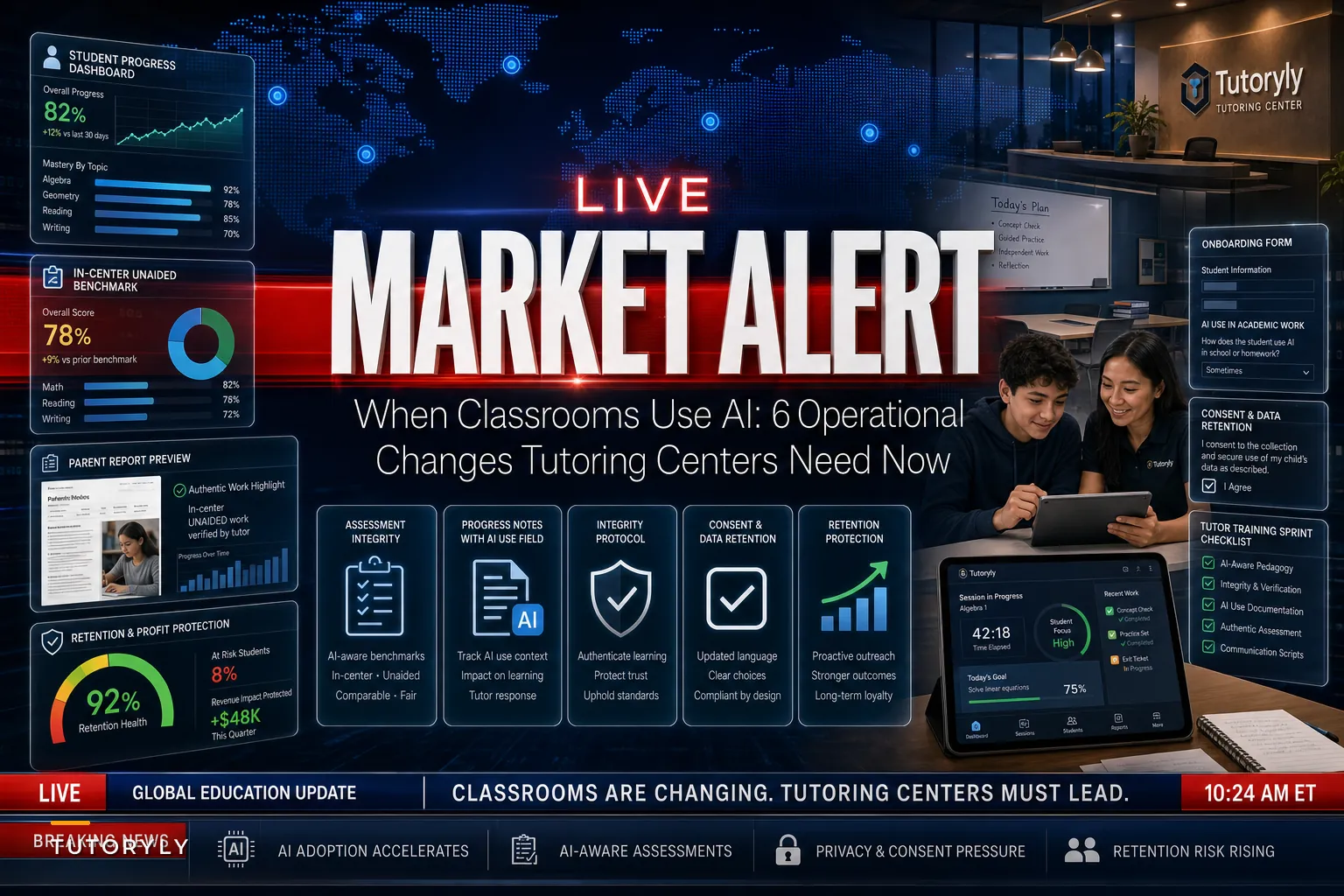

Teachers are redesigning how they grade. A late-October Reuters piece on how teachers are remaking classrooms for the AI age laid out what a lot of tutors already feel on the ground: more in-class writing, more oral defenses of work, more "show me how you got there" assessment, and a growing push to teach AI literacy directly instead of pretending students aren't using these tools.
That's a classroom-side shift. But it lands hard on tutoring centers, because the whole value proposition of tutoring is support that aligns with what the school is actually measuring. When schools change what counts as evidence of learning, your lesson plans, your progress reports, and even your intake assessments quietly go stale.
The centers that get burned here aren't the ones who ignore AI. They're the ones who keep running their pre-AI operation while the schools their students attend have already moved on. A parent whose kid now gets graded on an in-class handwritten essay doesn't want a tutor coaching polished take-home drafts. The mismatch shows up fast, and it shows up as churn.
So here's what actually breaks — and what to change.
The underlying problem isn't AI — it's evidence
The classroom change isn't really "students use AI now." It's that evidence of learning moved locations. It used to live in the finished product — the essay, the problem set, the slide deck. Now teachers assume the finished product might be AI-assisted, so they're relocating the evidence to places AI can't easily fake: in-class work, live explanation, process, revision history.
If your tutoring center still measures success by output quality, you're measuring the exact thing schools stopped trusting. A student can produce a beautiful essay in your session and still bomb the in-class version, because the skill being assessed is now "can you do this unaided, in the room, in 40 minutes."
That reframing drives every operational change below. You're not adding an "AI module." You're shifting your whole operation from product-evidence to process-evidence.
Change 1: Rebuild lesson and assessment templates around visible process
Your lesson templates probably have a slot for "work completed" or "assignment reviewed." That's product thinking. The new version needs a slot for how the student demonstrated the skill without assistance.
Never miss another tutoring session.
Tutoryly helps you schedule, confirm, and manage every tutoring session efficiently.
- Unified session scheduling
- Automated student notifications
- Tutor calendar & availability management
No credit card required
-
Did the student explain their reasoning out loud, unprompted?
-
Could they redo a problem with the numbers changed, cold?
-
What did they do when stuck — did they reason, or reach for a tool?
-
Timed, unaided mini-tasks completed in-session
A concrete example: a 10th-grade English tutor used to spend most of a session polishing a draft essay. The redesigned session spends 15 minutes on an unaided, handwritten paragraph on a surprise prompt, then uses the rest of the time coaching the reasoning gaps that showed up. The deliverable isn't a better essay. It's a student who can generate structure under pressure.
The operational mistake here is treating this as a tutor-by-tutor preference. If half your staff still coach polished drafts and half coach in-session recall, your progress data becomes noise. Template it, and make the process fields mandatory.
Change 2: Add AI-use fields to progress tracking and parent reports
This is the one centers resist most, and it's probably the most important. Your progress-tracking needs an explicit field for AI use — not as a gotcha, but as data.
When a student's school essay grade drops after a strong tutoring quarter, the first question is "what changed?" If you logged that the student was leaning on AI for structure at home and couldn't reproduce it in class, you have an answer and a coaching plan. If you didn't log it, you're guessing in front of a frustrated parent.
A practical field set looks something like:
| Field | What it captures | Why it matters |
|---|---|---|
| AI use observed | None / for checking / for generating | Tells you if the tool is a crutch or a helper |
| Unaided performance | Below / at / above assisted level | The gap that predicts classroom results |
| Integrity flag | Clear / needs conversation | Protects you and the family |
| Skill transfer | Can/can't redo cold | The real retention signal |
For parent reports, you don't need to say "your child used AI." Frame it around transfer: "Maya writes well with support but needs practice producing structure independently, which is what her teacher is now grading." Parents understand that instantly, and it positions you as aligned with the school rather than oblivious to it.
Frame AI observations around skill transfer and next steps in parent notes to keep conversations constructive and solution-focused.
One caution worth flagging: the moment you start recording AI-use observations about minors, you've expanded what sensitive data you're holding. That ties directly into your student-data governance and privacy SOPs — these observational notes need the same consent, retention, and access rules as everything else in a student file, and arguably more care because they touch academic integrity.
Change 3: Revise consent and integrity language before you need it
Two documents need updating, and most centers haven't touched them.
First, parental consent. If you're going to observe and document how a student uses AI, or run any kind of unaided benchmark to detect AI-assisted work, parents should know that's part of your process. Not buried in fine print — stated plainly during onboarding. Centers that handle this well frame it as a feature: "We track independent skill, not just finished work, because that's what schools now assess."
Second, your own integrity protocol. What happens when a tutor strongly suspects a student submitted AI-written work and is asking the tutor to "just fix it"? Right now, most tutors improvise, and they improvise differently. Some refuse, some quietly help, some report to the parent. That inconsistency is a liability.
A simple, written protocol handles most of it:
-
Tutor does not complete or disguise AI-generated work on the student's behalf.
-
Tutor redirects the session toward understanding the underlying skill.
-
If the pattern repeats, it goes into the progress note with an integrity flag.
-
A manager — not the individual tutor — decides whether to raise it with the family.
-
The conversation with parents is about skill-building, never accusation.
Step 4 matters more than it sounds. Individual tutors shouldn't carry the weight of "accusing" a kid. Centralize the judgment call.
Change 4: Update benchmark assessments to measure unaided ability
Your intake and benchmark assessments were probably designed when a take-home diagnostic meant something. It doesn't anymore. A student can score well on a take-home writing sample that AI heavily shaped, and you'll place them two levels too high.
The fix is straightforward but changes your intake flow: at least part of your benchmark must be done in-center, unaided, observed. Short, timed, no devices. You're not trying to catch anyone — you're trying to get a true baseline so your placement and progression actually hold up.
In practice, this usually surfaces when a center realizes mid-semester that a chunk of students were placed off bad data. Their home-done diagnostics looked strong; their in-class performance didn't match. Re-baselining with an in-center unaided task fixes placement and makes your progress numbers trustworthy again.
When this makes sense vs. when it doesn't
Makes sense when: your students are in schools that have shifted to in-class assessment, your packages depend on accurate leveling, or you've seen placement complaints.
Probably overkill when: you run early-elementary foundational tutoring where AI use is a non-issue, or pure test-prep for exams that are already proctored — in those cases your assessment already measures the right thing.
Don't bolt an integrity audit onto a program that doesn't need one. It adds friction and spooks parents for no gain.
Change 5: Train tutors on AI-aware pedagogy, not AI-policing
The worst outcome here is turning your tutors into cheating detectives. That poisons the relationship and misses the point. The skill you actually want is AI-aware teaching — knowing how to use these tools as a learning aid while still building the independent capability schools are grading.
Good tutor training on this covers:
-
How to run a quick unaided check without making it feel like an interrogation
-
How to use AI with a student productively (brainstorming, self-quizzing, getting unstuck) versus letting it do the thinking
-
How to spot the tell that a student can produce but not reproduce — the classic sign of over-reliance
-
How to have the "let's build this so you can do it in class" conversation without shaming anyone
The common mistake is making this a one-time memo. Tutors need to see it modeled and practiced, ideally worked into your existing calibration or observation routine, so everyone interprets "AI-aware" the same way. Otherwise you get drift, and drift is what makes parents feel like the experience depends on which tutor they happened to draw.
Centralized platforms that support session documentation and staff calibration notes help here — not because AI runs the training, but because consistent record-keeping is what surfaces drift before it becomes a retention problem.
Change 6: Package new services carefully — and only if real
There's an obvious temptation to launch "AI literacy sessions" and "integrity audits" as paid add-ons. Some of this is legitimate and genuinely valuable. Some of it is fear-marketing that families will see through quickly.
A realistic scenario: a mid-sized center with around 180 active students across two locations noticed a wave of parent questions after their district tightened in-class assessment. Instead of a flashy new product launch, they did two things — added the unaided in-center component to benchmarks, and offered a short four-session "independent writing" mini-block for families who wanted it. Uptake was modest, maybe 20–25 families in the first term, but the bigger win was retention. Churn conversations that used to end in cancellation now ended in a re-plan, because the center was visibly tracking what the school now cared about. The add-on revenue was fine; the retention effect was the real return.
Who should NOT rush into new AI-branded offerings
-
Centers without a clean progress-tracking system yet — fix the data first
-
Single-tutor operations where you can't deliver consistent process across staff
-
Anyone marketing "AI detection" as a guarantee; detection is unreliable and you'll get caught over-promising
That's the pattern worth copying. Lead with operational alignment. Let the paid offering be a natural extension, not the headline.
A simple sequencing plan
If you're figuring out where to start, order it like this:
-
Add the unaided, in-center element to benchmark assessments. (Fixes bad placement immediately.)
-
Add AI-use and skill-transfer fields to your progress notes.
-
Write the integrity protocol and train tutors on it.
-
Update consent language to reflect the new tracking.
-
Rework parent-report wording around independent skill.
-
Only then, consider a packaged offering — and only if demand is real.
The revenue idea comes last. That's deliberate. Centers that chase the new service line first usually skip the operational groundwork and end up selling something they can't consistently deliver.
Here's a simple workflow to sequence these changes.
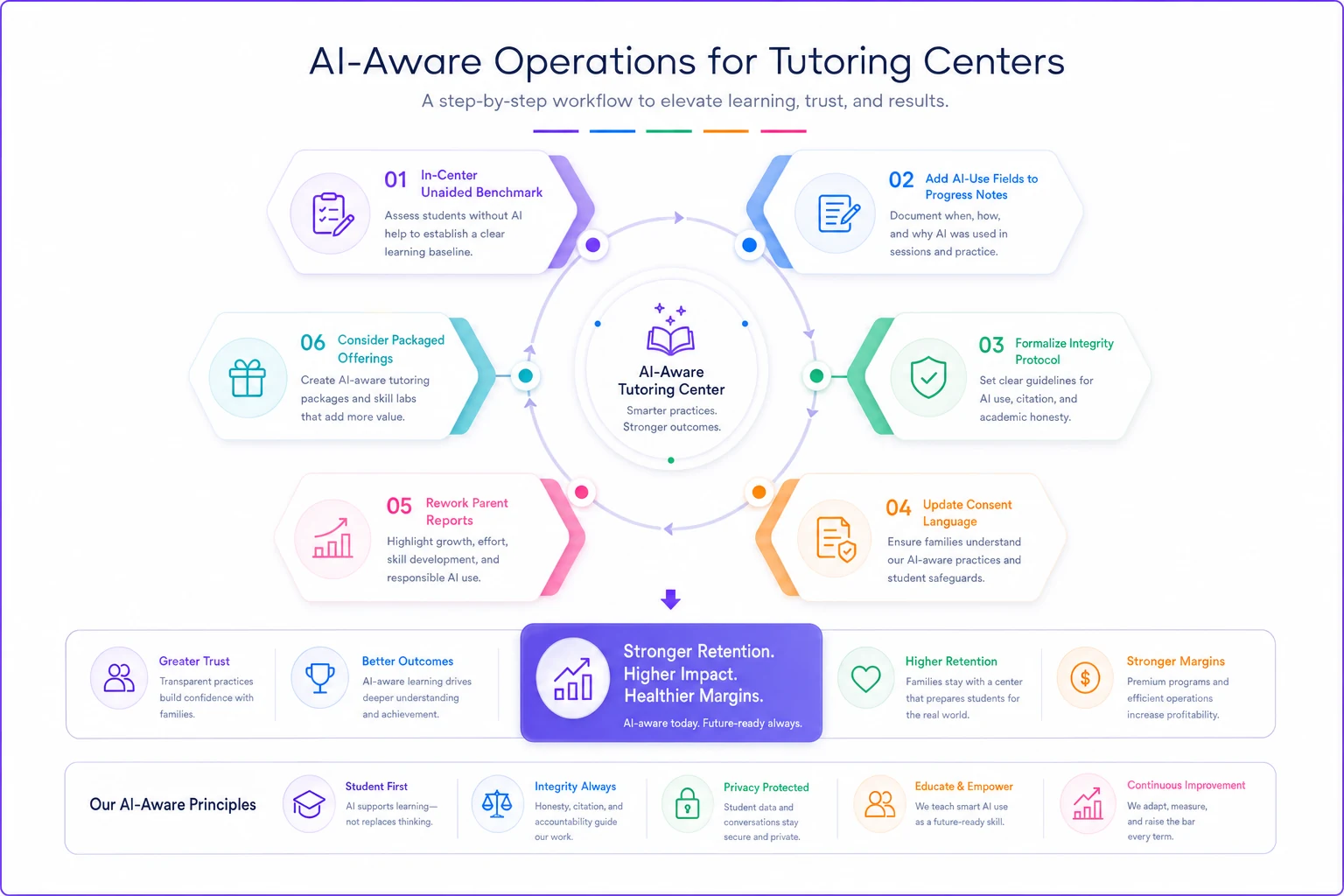
Follow this order to build the foundation before monetizing.
The real takeaway
The classroom shift isn't a threat to tutoring. If anything, it increases the need for it — building genuine unaided skill is harder and more valuable than ever. The actual threat is operational lag: running a center whose templates, assessments, and reports still quietly assume the old world where a finished product proved mastery.
Fix the evidence problem. Measure what students can do in the room, without help. Document it honestly, store it responsibly, and talk to parents about independent skill the way their kids' teachers now do. That's the alignment argument, and right now, it's one of the stronger ones a tutoring center can make.
Fix the evidence problem. Measure what students can do in the room, without help. Document it honestly, store it responsibly, and talk to parents about independent skill the way their kids' teachers now do. That's the alignment argument, and right now, it's one of the stronger ones a tutoring center can make.
Ready to streamline your tutoring operations?
Join 500+ tutors and centers using Tutoryly to save time, improve scheduling accuracy, and enhance student experiences.