

Most tutoring centers already know, informally, who their strong people are. The owner knows Priya is the one you put in front of a panicking AP Calc kid, and that Marcus can handle a nervous third grader learning phonics but shouldn't touch SAT Reading. That knowledge lives in someone's head. And the moment a center grows past roughly 8–10 tutors, or opens a second location, that head-knowledge stops scaling. Matching slows down, mistakes creep in, and parents start noticing the tutor assigned to their kid "wasn't really a math person."
Micro-certifications fix this — but only if you build them as structured, machine-readable records instead of a wall of PDF certificates nobody looks at. This post is about building tutor micro-certification templates specific enough to drive scheduling and matching automatically, not another training binder sitting in a shared drive.
Why most tutoring "certifications" are useless for operations
A center runs some internal training, a tutor completes it, they get marked as "certified." But the record is a single yes/no flag: certified or not certified. That flag can't answer any of the questions your scheduling actually needs:
-
Certified in what, exactly? Algebra I, or all of math?
-
Certified to work with whom? Early elementary? Test-anxious teens? IEP students?
-
When does it expire? Did they recertify after the curriculum changed last fall?
-
What evidence backs it — a quiz score, an observed session, nothing?
A binary "certified" badge is operationally dead. It tells you someone did a thing once. It doesn't tell your matching rules anything useful. The whole point of a micro-certification is that it's micro — narrow, specific, attached to real evidence — so that both a human scheduler and an automated matching rule can actually use it.
The gap usually shows up when a center tries to automate matching for the first time. They want the system to auto-suggest tutors for a new "Geometry, grade 10, exam prep" request and realize their data can't support it because every tutor is tagged "Math — Certified." You can't filter on mush.
The four pieces every micro-cert template needs
A usable micro-cert is really four coordinated templates, not one. Skip any of them and the badge stops being something your operations can rely on.
Never miss another tutoring session.
Tutoryly helps you schedule, confirm, and manage every tutoring session efficiently.
- Unified session scheduling
- Automated student notifications
- Tutor calendar & availability management
No credit card required
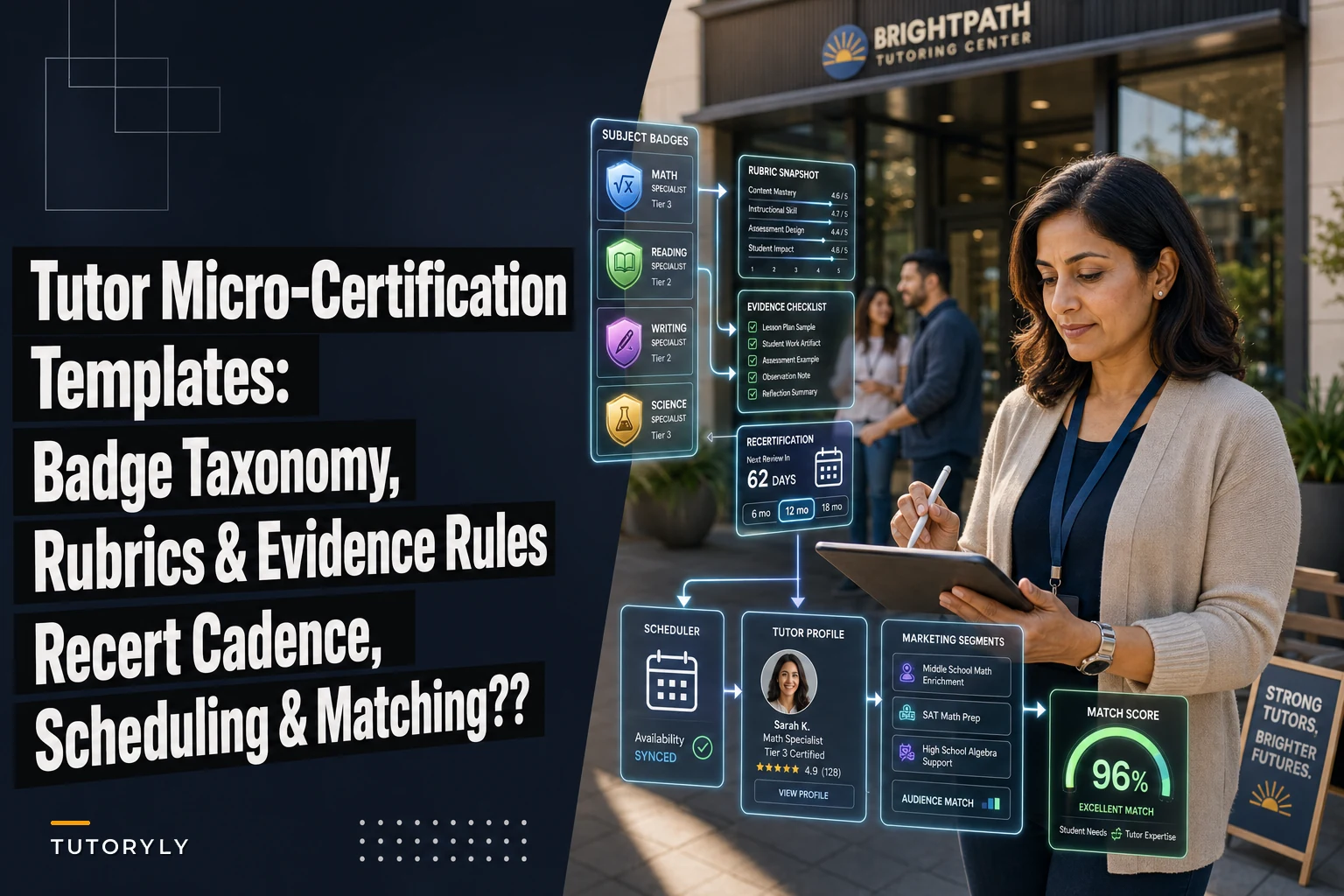
1. Badge taxonomy (the naming system)
This is the foundation, and it's where most centers go wrong — either too broad ("Math") or weirdly granular ("Factoring Quadratics"). You want badges at the level a parent actually requests and a schedule actually books.
-
Subject/level — what's being taught (e.g., Algebra II, Primary Literacy, SAT Math)
-
Learner context — who it's for (e.g., Early Elementary, Exam Prep, Mixed-Ability, IEP-Supported)
-
Delivery — how it's done (e.g., 1
1, Small Group, Online)
A badge is the combination: Algebra II · Exam Prep · 1:1. Specific enough to match on, broad enough that you don't end up with 400 badges.
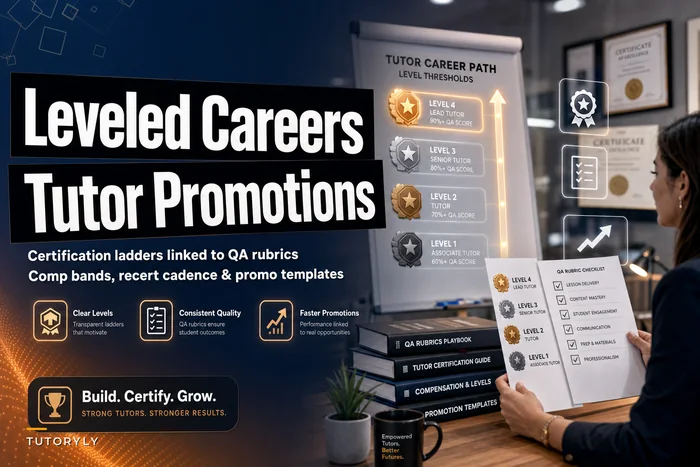
One thing to avoid: don't bake a tutor's level (junior/senior) into subject badges. Keep seniority separate — that belongs in your leveled tutor career path, where it drives pay and promotion, not subject-match logic. Mixing the two means a pay raise accidentally changes who the scheduler thinks can teach fractions.
2. Assessment rubric (how someone earns it)
Each badge needs a rubric with a pass line that isn't vibes-based. The useful format is a small scorecard — 4 to 6 dimensions, each scored, with a minimum threshold.
For an Algebra II · 1:1 badge, a rubric might look like this:
| Dimension | What you're checking | Pass threshold |
|---|---|---|
| Content accuracy | No math errors in a timed problem set | 95%+ |
| Error diagnosis | Can identify why a student made a mistake, not just that they did | Meets |
| Explanation clarity | Observed session — explains a concept two different ways | Meets |
| Pacing | Doesn't rush or stall; adapts to student | Meets |
| Session notes quality | Leaves notes a substitute could pick up | Meets |
The content threshold is high on purpose. A tutor who makes algebra errors can't hold an Algebra II badge, full stop. The softer dimensions use "Meets / Needs work" because they're judgment calls from an observer, and treating them like precise percentages is false precision.
3. Required evidence per badge (what gets stored)
This is the piece almost everyone forgets, and it's the one that makes the whole thing auditable. Each badge should specify exactly what evidence must exist before it's awarded, and that evidence should be attached to the record:
-
Knowledge badges → a scored assessment on file (PDF or score + date)
-
Delivery badges → a dated observed-session form, signed off by whoever observed
-
Context badges (IEP-supported, early elementary) → completion of relevant internal training plus one observed session with that learner type
The reason this matters: when a parent escalates, or when you're onboarding a new lead tutor, "prove it" needs an answer that takes ten seconds, not an afternoon of asking around. Evidence-per-badge turns "I think Marcus is good with little kids" into "Marcus holds Early Literacy, observed 2024-09-12 by Dana, re-observed 2025-02."
4. Recert cadence (when it expires)
Badges rot. Curricula change, standards shift, and a tutor who hasn't touched geometry in a year is rusty. Set an explicit cadence per badge type, not one blanket rule:
-
Core subject badges — recert every 12 months, or immediately when that curriculum version changes
-
Exam-prep badges — recert every 6–12 months (test formats move)
-
Context badges (IEP, early elementary) — recert every 12 months, always via observation, never via quiz
The trigger-on-curriculum-change rule is the one people miss. If you version your curriculum (and you should), a new version should automatically flip affected badges to "recert due." Otherwise your badges quietly describe a course that no longer exists.
Making certifications actually drive scheduling
Once badges are structured data, your matching rules can treat them as hard filters and soft preferences. A realistic matching rule stack looks something like this:
-
Hard filter — eligibility. Tutor must hold the exact required badge, and the badge must not be expired. No badge, not a candidate. This single rule eliminates the most damaging mismatches before a human ever looks.
-
Hard filter — context. If the request is flagged IEP-supported, only tutors with the matching context badge appear.
-
Soft rank — availability + continuity. Among eligible tutors, prefer the one already matched to a sibling or who has an open recurring slot that fits.
-
Soft rank — load balancing. Break ties by who's under their target utilization that week.
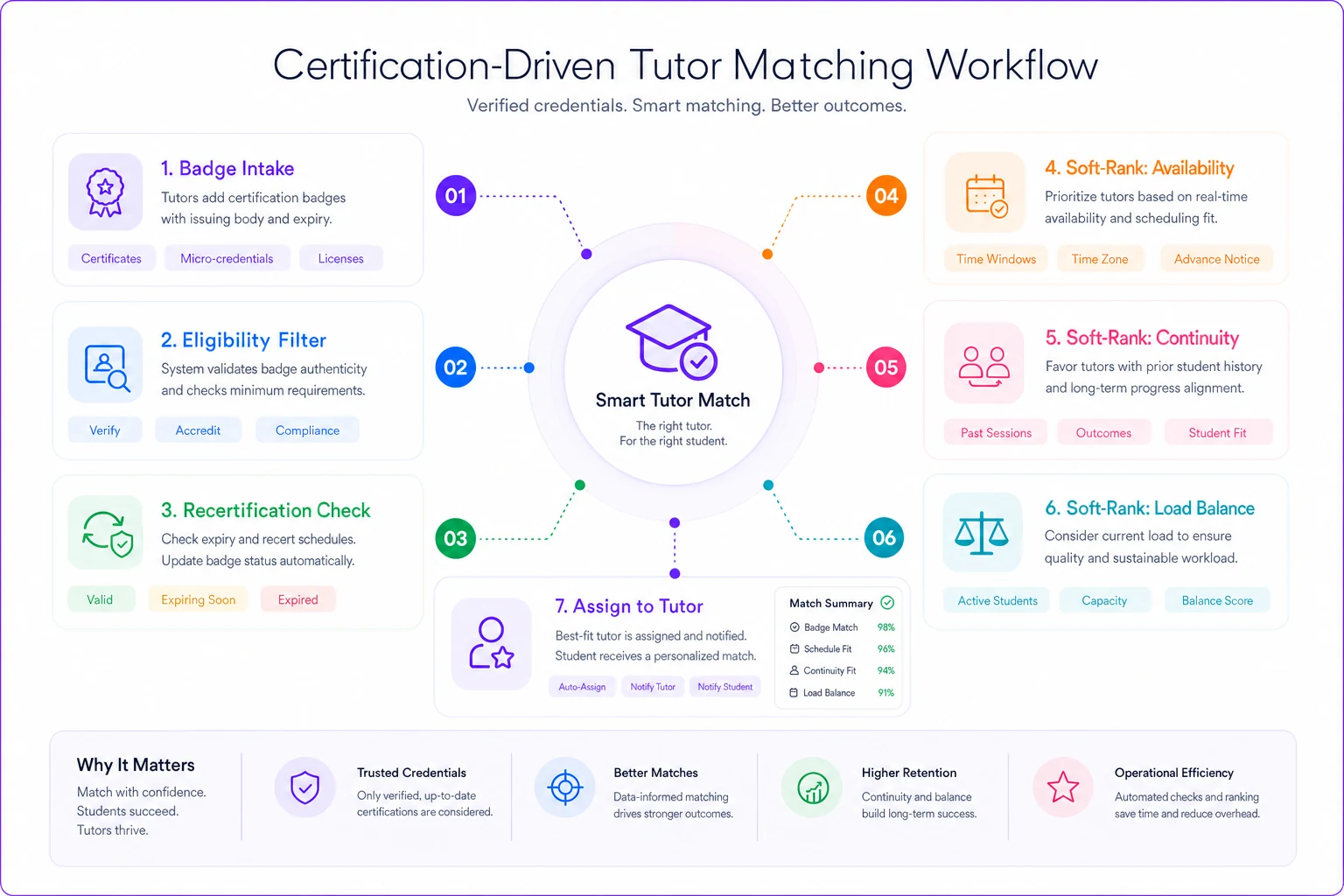
The important shift here: certifications stop being an HR artifact and become the first gate in matching. A tutor whose Exam-Prep badge lapsed last month simply won't surface for exam-prep requests until they recert — the schedule enforces the rule instead of relying on someone remembering it.
This also closes a quiet revenue leak. Centers that match on gut tend to over-assign their two or three "trusted" tutors, burn them out, and leave qualified-but-unbadged tutors with empty calendars. Badging the full roster widens the eligible pool, smooths utilization, and cuts the frantic "who can cover this?" scramble.
When this makes sense (and when it doesn't)
This level of structure is worth building when you're past roughly 8 tutors, running multiple subjects, or coordinating across locations. Below that, a shared spreadsheet is honestly fine and a full badge taxonomy is over-engineering.
It's also a bad idea if your badges would just mirror job titles — then you've added bureaucracy without any matching benefit. And if you can't commit to actually enforcing recert cadence, don't build expiry into your rules. A system that blocks your best tutor because of a stale date nobody maintained will get overridden within a week and ignored entirely after that.
Letting badges do double duty in marketing
Once you have evidence-backed badges, they're the most honest marketing asset you own. Parents are tired of vague "our tutors are experts" claims. A specific, verifiable credential reads completely differently.
Instead of "experienced math tutors," a profile can say: "SAT Math certified · 40+ exam-prep sessions · recertified Aug 2025." That's not a slogan — it's backed by evidence on file. The same taxonomy that filters your schedule can populate tutor profile cards, match-confirmation emails ("Your tutor, Priya, holds Algebra II · Exam Prep certification"), and subject pages on your website.
The only rule: never market a badge you can't produce evidence for. The whole value of the system is that the claim is real, which is exactly why required-evidence-per-badge isn't optional paperwork.
A real scenario
A two-location center with around 14 tutors was matching entirely by owner intuition. The owner personally approved most assignments, which capped how fast they could book new students — roughly a day of lag on new requests because everything routed through her.
They built a badge taxonomy of about 20 badges across subjects, context, and delivery, backed each with rubrics and at least one observed session per delivery badge, then wired eligibility into their matching as a hard filter.
-
New-request-to-assignment time dropped from roughly a day to a few hours, because front-desk staff could assign from the eligible list without waiting for the owner
-
Early-cancellation complaints tied to "wrong tutor" basically stopped — the worst mismatches were filtered out before booking
-
Utilization evened out across the roster; two overworked tutors came down off 90%+ load, and three underused tutors picked up regular hours
Nothing dramatic happened to revenue overnight. But the owner stopped being the bottleneck for every match, which was the real win — that's hours a week back, and a center that can grow without her rubber-stamping every assignment.
How to roll this out without boiling the ocean
You don't build all of this at once. The centers that get it right start narrow and expand:
-
Pick your top 5 highest-volume badges first. The subjects you book most. Don't badge things you rarely offer.
-
Write one rubric per badge, max 6 dimensions. Keep the content threshold strict, soft dimensions pass/fail.
-
Define required evidence and back-fill it for current tutors — most of your strong people can earn their badges from a single observed session.
-
Set recert dates and a curriculum-change trigger before you turn on any enforcement.
-
Turn on the eligibility filter as a hard rule in matching. Leave soft ranking manual at first.
-
Only then expose badges to parent-facing profiles and emails.
Keep each rubric to 4–6 dimensions so evaluations stay practical and fast.
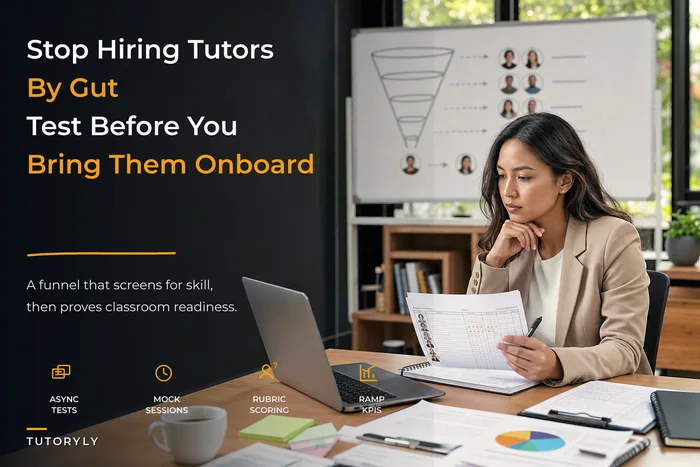
This sequencing matters because badging ties directly into hiring and onboarding. A new hire's ramp should end with specific badges earned, not a vague "fully trained." If you're rebuilding how people come into the center, fold badge targets into your recruitment and onboarding funnel so a mock session doubles as a first observed-evidence record.
The thing most centers get wrong
The failure mode isn't building bad badges — it's building badges that nothing downstream ever reads. A certification that doesn't filter a schedule, doesn't appear on a profile, and doesn't trigger a recert reminder is just a certificate in a drawer.
The value is entirely in the connection: taxonomy feeds matching, matching feeds utilization, evidence feeds marketing, cadence keeps it honest.
Build the four templates, wire the eligibility badge in as a hard gate, and keep the taxonomy small enough that you'd actually maintain it. Everything else — smoother scheduling, fewer mismatch complaints, the owner no longer approving every assignment — follows from that one structural decision: making "who's qualified for what" into data your operations can read, instead of knowledge trapped in one person's head.
Ready to streamline your tutoring operations?
Join 500+ tutors and centers using Tutoryly to save time, improve scheduling accuracy, and enhance student experiences.