


The uncomfortable truth about most tutoring QA programs: the rubric is fine, the observers are well-meaning, and the scores are still garbage. Not because anyone is lazy, but because two people watch the same session and walk away with two completely different impressions of what "good" looked like. One lead scores a tutor a 4 on "checks for understanding." Another scores the same recording a 2. Both are confident. Both wrote thoughtful notes. And now your whole quality system is built on sand.
This is the part of quality assurance nobody wants to run, which is exactly why it's worth running. If you've already built out rubrics and a coaching cadence — and if you haven't, the tutoring quality-assurance loop post covers that foundation — calibration is the step that makes those rubrics actually trustworthy. Without it, you're coaching tutors against noise.
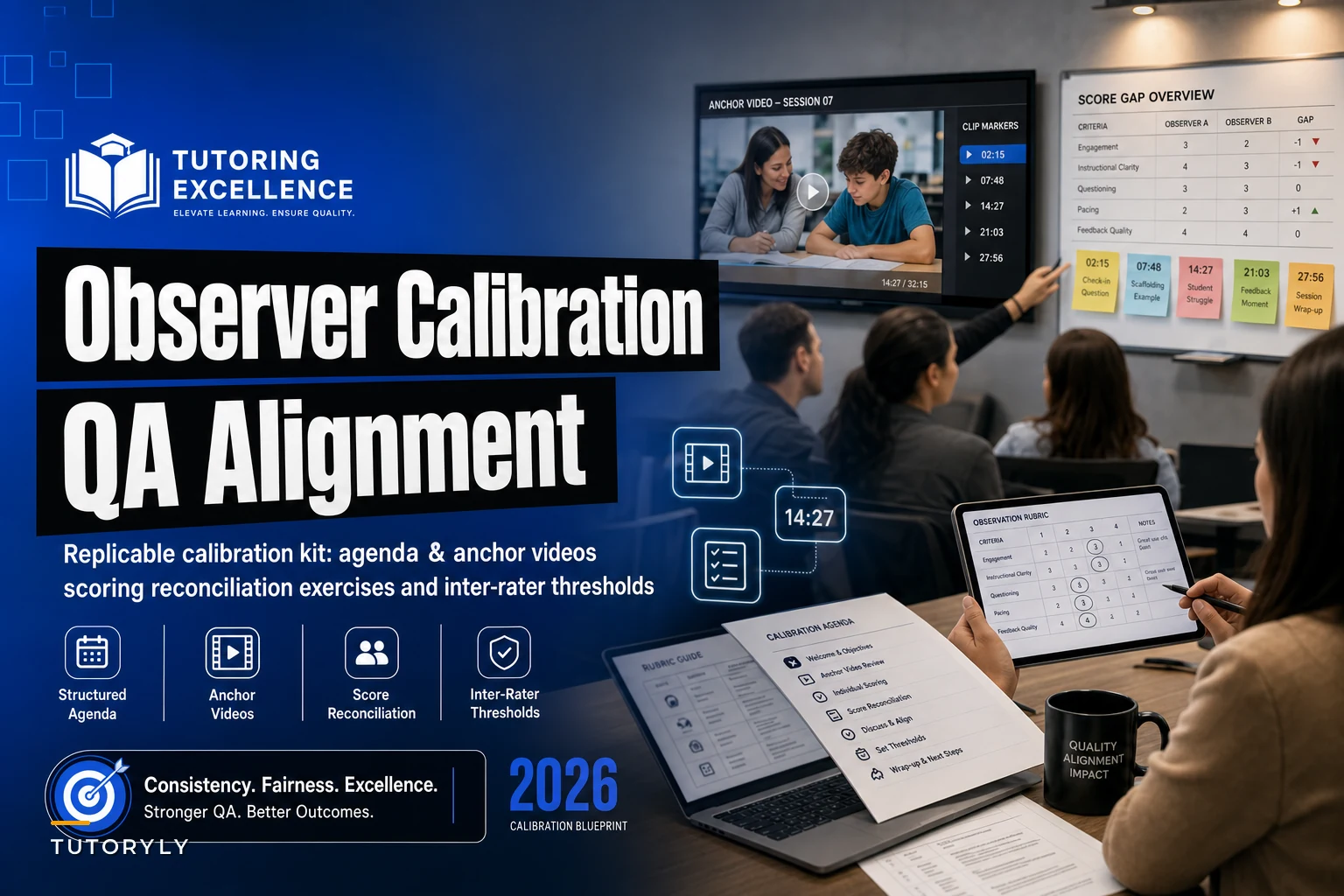
This post is a working blueprint for a session-observation calibration workshop you can run again and again. Agenda, anchor videos, the reconciliation exercise itself, and the inter-rater thresholds that tell you whether your observers are aligned or just pretending to be.
Why observer drift happens (and why it's not a training problem)
Most centers assume score disagreement means observers need "more training on the rubric." So they re-read the rubric aloud, everyone nods, and the drift comes right back the next month.
The real cause is that rubric language is interpretive. A descriptor like "tutor adjusts pace based on student response" sounds objective until you realize one observer counts a single "does that make sense?" as adjusting pace, and another requires the tutor to actually change the activity. Both readings are defensible. The rubric didn't fail — the shared mental model never got built.
-
Halo scoring. A tutor is warm and likeable, so every category drifts up half a point regardless of what the tape shows.
-
Central tendency. Nervous observers park everyone at 3s because a 3 feels safe and un-accusatory.
-
Recency anchoring. The last thing that happened in the session colors the whole score. A strong closing covers for a shaky middle.
-
Personal pedagogy bias. An observer who loves Socratic questioning marks down a tutor who uses direct instruction effectively — not because it was wrong, but because it wasn't their way.
None of these get fixed by reading the rubric again. They get fixed by scoring together, out loud, and arguing about the gaps until the group lands on a shared standard.
What inter-rater reliability actually looks like in a small center
You don't need a research-grade statistics setup. You need a threshold that tells you "our scores are close enough to trust" versus "we're not aligned and shouldn't be making coaching decisions yet."
Never miss another tutoring session.
Tutoryly helps you schedule, confirm, and manage every tutoring session efficiently.
- Unified session scheduling
- Automated student notifications
- Tutor calendar & availability management
No credit card required
The simplest workable standard for a tutoring center: exact-or-adjacent agreement. On a 1–4 scale, two observers are "in agreement" on a category if their scores are identical or one point apart. Scores two or more points apart are discrepancies — those are the ones you hunt down and resolve.
| Metric | Not yet calibrated | Working threshold | Strong alignment |
|---|---|---|---|
| Exact agreement across categories | under 50% | 60–70% | 75%+ |
| Exact-or-adjacent agreement | under 75% | 85–90% | 95%+ |
| Two-point-plus discrepancies | common, multiple per session | rare, 0–1 per session | essentially none |
| Overall session score gap between observers | 0.6+ points | 0.3–0.5 points | under 0.3 points |
Don't obsess over hitting the "strong" column on day one. A center going from 40% exact agreement to around 65% after a single well-run workshop is a real, meaningful win — it means your QA data just became usable. Chase perfection later.
The number that matters most operationally is the two-point-plus discrepancy count. If observers are routinely two points apart on the same category, your scores are functionally random and any coaching built on them will feel arbitrary to tutors. Tutors can smell inconsistent QA from a mile away, and it quietly kills their buy-in.
The workshop agenda (90 minutes, repeatable)
Keep it to 90 minutes.
Longer and people fade; shorter and you don't get through enough reconciliation to actually move the needle. Run it quarterly at minimum, and any time you add a new observer or change the rubric.
-
1. Framing (10 min). State the goal plainly
we are not here to judge tutors today, we're here to judge ourselves as observers. Make clear that disagreement in this room is the point, not a failure. The fastest way to kill honest scoring is to make people feel scored on their scoring.
-
2. Solo anchor scoring (15 min). Everyone watches the same anchor video and scores it independently, in silence, no discussion. No peeking at neighbors. You want uncontaminated scores.
-
3. Reveal and map (10 min). Put every observer's category scores on a board or shared sheet. Don't average yet. You're looking for the spread — where did people cluster, where did they split?
-
4. Reconciliation on discrepancies (30 min). This is the heart of it. Walk only the categories with two-point-plus gaps. Each observer explains what specific moment in the tape drove their score. Rewind to the actual clip. Argue it out until the group lands on a defensible range.
-
5. Rubric annotation (15 min). Capture the decisions. Every time you resolve a disagreement, you've just discovered ambiguous rubric language. Write the clarification down immediately — this is how the rubric gets sharper over time.
-
6. Second anchor + quick check (10 min). Score one more short clip to see if the group tightened up. If agreement jumped, you're done. If not, flag the stubborn category for next session.
If agreement jumped, you're done. If not, flag the stubborn category for next session.
Building your anchor-video library
Anchors are the backbone of this whole thing. An anchor is a pre-scored session recording with a known, group-agreed score for each rubric category. New observers calibrate against anchors; existing observers re-check against them.
You need a small spread, not a huge archive. What actually works:
-
A clear "exemplar" (scores high across the board). Everyone should converge on this easily. It sets the ceiling.
-
A clear "struggling" session. Sets the floor. Useful for checking that observers aren't softening low scores out of sympathy.
-
Two or three "messy middle" sessions. These are the gold. Real sessions where the tutor does some things well and some things poorly in the same category. The messy middle is where observers drift most, so it's where calibration pays off.
-
One "trap" session. A tutor who is charismatic and warm but weak on actual pedagogy. This directly exposes halo scoring. If your observers all rate this one high, you've found your problem.
Get consent squared away before anything hits a shared library — recorded sessions are student data, and your data governance and privacy practices should cover storage, access, and retention of these clips.
Keep anchors short. A 6–8 minute segment showing one clear instructional cycle beats a full 50-minute recording nobody rewatches. And re-anchor at least once a year, because a clip you scored as "exemplary" two years ago might look merely average once your standards rise.
The reconciliation exercise, step by step
This is the exercise that does the real work. Run it exactly like this:
-
1. Collect silent scores. Every observer submits category scores for the anchor with zero discussion first.
-
2. Surface the gaps, not the averages. Identify every category where the max and min observer scores differ by two or more points.
-
3. Go evidence-first. For each gap, each observer states the specific timestamped moment that justified their number. Not "it felt like a 3" — "at 4:12 the tutor asked a closed question and moved on without waiting, so I marked checking-for-understanding down."
-
4. Rewatch the moment. Actually rewind. Half the time, someone misremembered the sequence. The tape settles it.
-
5. Name the rubric ambiguity. When two defensible readings exist, the rubric is the problem. Decide which reading is the standard going forward and write it down.
-
6. Set the anchor score. Lock in the group-agreed score for that category. That becomes the official anchor value.
-
7. Re-score blind next round. On the next anchor, check whether the clarified language actually reduced the gap.
The mistake most centers make here is skipping straight to averaging the scores. Averaging hides the disagreement instead of resolving it. Two observers two points apart who get averaged to a middle score have learned nothing — they'll disagree exactly the same way next month. The disagreement itself is the curriculum.
Here's a simple workflow illustration of the reconciliation exercise.
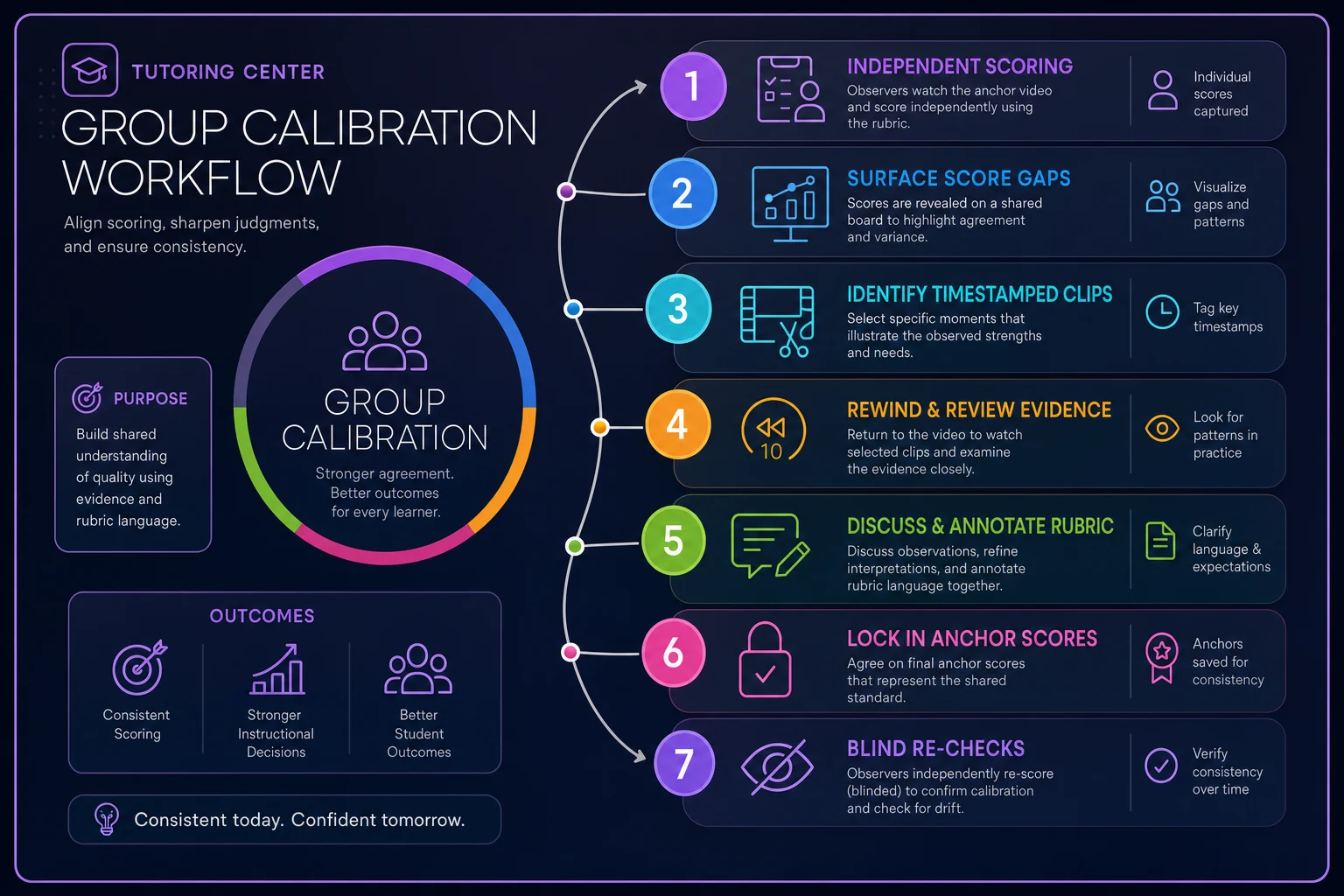
Use this to show the steps during the workshop so everyone sees the process, not just the outcome.
A real scenario
A mid-sized center — six tutors, two site leads doing observations, running weekly QA scoring — had a nagging credibility problem. Tutors complained that scores depended entirely on which lead observed them. One lead was known as "the easy one," the other as "the harsh one," and tutors started angling to be observed by the lenient one.
When they finally sat both leads down with four anchor videos, the numbers were ugly: on a 1–4 scale, exact agreement was around 40%, and they had three or four two-point gaps per session. The "harsh" lead was marking down for weak questioning technique; the "easy" lead barely weighted questioning at all and leaned heavily on rapport. After two 90-minute calibration sessions about three weeks apart, exact agreement climbed to roughly 65%, and the two-point gaps essentially disappeared — maybe one every few sessions. The bigger shift was cultural: the overall session-score gap between the two leads dropped from about 0.7 points to under 0.3. Tutors stopped gaming who observed them, because it stopped mattering. Coaching conversations got easier too, because when a tutor pushed back on a score, the lead could point to a shared standard instead of a personal opinion.
Nothing about the rubric changed in that time. Only the shared understanding of it did.
When this makes sense — and when it doesn't
Run calibration when:
-
You have two or more people doing observations. Single-observer centers have a different problem (consistency over time, not across people) and need a lighter version — self-calibrating against your own past anchors.
-
Tutors have started questioning whether scores are fair.
-
You're about to tie QA scores to anything with stakes — promotions, bonuses, or a leveled tutor career path. The moment scores affect pay or advancement, inter-rater reliability stops being a nice-to-have and becomes a fairness requirement.
-
You've recently changed the rubric or added a new observer.
Skip or postpone when:
-
Your rubric itself is still a mess. Calibrating against a vague rubric just produces well-aligned vagueness. Fix the instrument first.
-
You only have one observer and no plan to add more. Your effort is better spent elsewhere.
-
You're mid-crisis on something more urgent — cashflow, a staffing hole. Calibration is important but it's rarely the fire.
One thing worth flagging: don't run this as a surprise. If your leads think the workshop exists to expose who's "scoring wrong," they'll defend their numbers instead of learning. Frame it as fixing the system, not auditing the people, or you'll get polite compliance and zero actual alignment.
Keeping calibration from decaying
The quiet failure mode isn't running the workshop wrong — it's running it once and never again. Alignment decays. New observers join, the rubric shifts, standards drift upward as your tutors improve. Six months later you're back to random scores and you don't even know it.
-
A fixed cadence. Quarterly is the floor. Put it on the calendar the same way you'd schedule anything else operational.
-
A mandatory anchor pass for new observers. Nobody scores a live session for real until they've calibrated against your anchor set and landed within adjacent agreement.
-
A running discrepancy log. Track which rubric category produces the most two-point gaps over time. That's your next rubric revision, pointing right at itself.
-
Periodic blind re-checks. Drop an anchor into normal rotation occasionally without telling observers it's an anchor. If their score matches the known value, you're still calibrated. If it drifts, you've got early warning before the real scores go bad.
Put one or two anchors into regular rotation as blind checks—they surface drift faster than waiting for the quarterly workshop.
A simple shared scoring system makes all of this far less painful — when observer scores land in one place automatically, the discrepancies surface on their own instead of you hand-collecting sheets and squinting at spreadsheets. But the tooling is secondary. The discipline of scoring together and arguing over the gaps is what actually moves reliability. You can run the first version of this with a conference room, a laptop, and a whiteboard.
The centers that get this right end up with QA scores people actually believe. That's the whole payoff. A score only coaches a tutor if the tutor trusts it means something — and it only means something if it would've come out roughly the same no matter who was watching.
Ready to streamline your tutoring operations?
Join 500+ tutors and centers using Tutoryly to save time, improve scheduling accuracy, and enhance student experiences.