

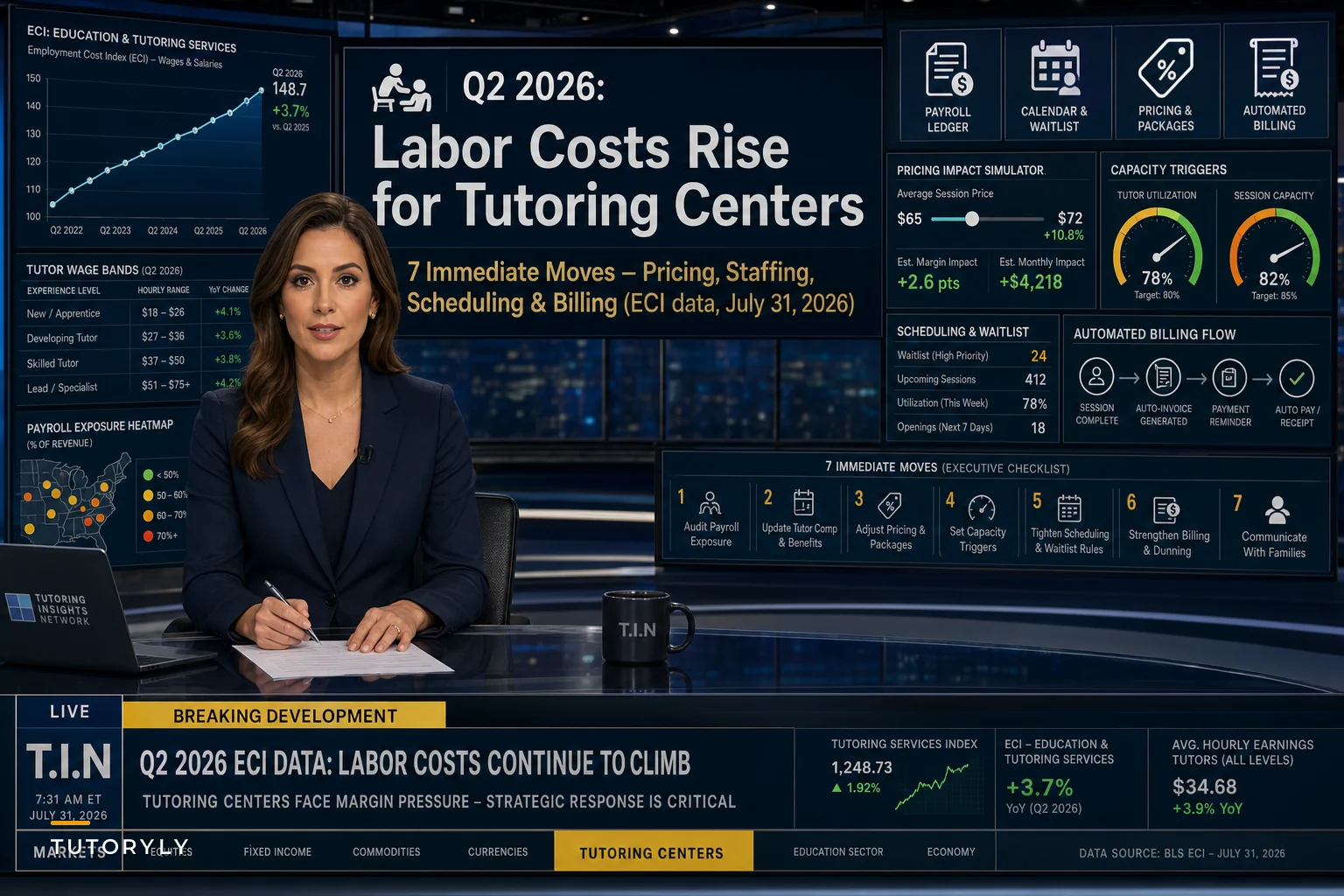

The latest Employment Cost Index numbers dropped yesterday, and if you run a tutoring center, you probably felt that familiar knot in your stomach. Reuters reported that private-sector wages jumped 0.9% in Q2 alone, with total compensation climbing 3.1% year-over-year. For tutoring centers already operating on thin margins while trying to recruit and keep decent tutors, that number stings.
What the headlines don't cover: tutoring labor costs aren't just a wage inflation problem. They're a utilization problem, a scheduling problem, and a retention problem that compounds when you can't keep pace with market rates. Most centers are bleeding money through gaps they don't track—unfilled sessions, mismatched coverage during peak hours, compensation structures that reward hours over outcomes.
The scheduling trap that amplifies wage pressure
The operational squeeze is pretty straightforward. You need to pay tutors more to keep them from leaving for a corporate learning platform or going fully independent. But raising hourly rates without fixing your underlying capacity problems means you're paying premium wages for underutilized time.
Picture a typical Tuesday afternoon. Eight tutors scheduled from 3–7pm. Four fully booked. Two with gaps between 4–5pm. One with a single student at 3pm and nothing after. Another with back-to-back cancellations that came in that morning. You're paying for 32 tutor-hours and delivering maybe 22 hours of actual instruction.
When wages were stable, this kind of inefficiency was annoying but survivable. Now it's a margin problem. A center with 15 tutors averaging $28/hour just absorbed roughly $27,000 in additional annual payroll—before benefits or payroll taxes—and $28/hour might not even be competitive anymore depending on your market.
The reflex move—cut hours, reduce headcount—usually backfires. Coverage gaps during peak hours, families who can't get their preferred slots, and remaining tutors burning out from erratic schedules. What actually works is rethinking capacity and pricing at the same time.
Move #1: Implement surge pricing for high-demand slots
Charging the same rate for every time slot doesn't make sense when your costs and demand vary that much. Tuesday at 4pm is not the same product as Saturday at 9am.
Never miss another tutoring session.
Tutoryly helps you schedule, confirm, and manage every tutoring session efficiently.
- Unified session scheduling
- Automated student notifications
- Tutor calendar & availability management
No credit card required
Pull your utilization data by day and hour for the past three months. The patterns are usually pretty clear:
| Time Slot | Typical Utilization |
|---|---|
| Monday–Thursday 4–7pm | 85–95% |
| Saturday mornings | 70–80% |
| Tuesday mornings | 15–25% |
| Friday evenings | 40–50% |
For slots above 80% utilization, add a 15–20% premium. For slots under 40%, offer a 10–15% discount. Frame it as "preferred timing" versus "flexible scheduling" rates rather than surge pricing—same concept, less friction with families.
Families who genuinely need that Tuesday 5pm slot will pay for it. Others will shift. Both outcomes improve your situation.
Move #2: Create blended compensation tiers
Flat hourly rates regardless of when a tutor works or how full their schedule is made more sense when labor costs were predictable. They don't anymore. You need compensation that rewards the behaviors that actually protect your operation.
Three tiers work well:
Base tier ($X/hour): Standard rate for regular hours with normal prep requirements.
Efficiency tier ($X + 15–20%): For tutors holding 85%+ utilization, regularly taking hard-to-fill slots, or running back-to-back sessions without gaps.
Specialist tier ($X + 25–30%): For multi-subject coverage, working with higher-needs students, or handling emergency substitutions.
You end up paying more for full schedules and flexibility—which is exactly what you need—rather than just tenure or credentials.
Move #3: Redesign packages around commitment, not sessions
Selling sessions or hours creates constant renegotiation and unpredictable cash flow. With rising labor costs, you need steadier revenue and longer commitment windows.
Move from "10-session packages" toward term commitments with built-in flexibility:
Foundational (3-month minimum):
-
Weekly sessions at standard rates
-
24-hour cancellation policy
-
Basic progress tracking
Comprehensive (6-month minimum):
-
Weekly sessions with 10% package discount
-
12-hour cancellation flexibility
-
Monthly progress reports
-
Priority scheduling for make-ups
Intensive (9-month commitment):
-
Bi-weekly or weekly sessions with 15% discount
-
Same-day cancellation allowed (twice per term)
-
Bi-weekly progress updates
-
Guaranteed tutor consistency
-
Sibling discount included
Longer commitments reduce the churn-related overhead of constantly onboarding new students and cut the unpredictability that makes payroll management harder. Converting around 40% of month-to-month families to 6-month packages can improve cash flow predictability by somewhere in the range of $45–60k annually for a mid-sized center. This also connects directly to having a pricing and packaging system that can flex with changing costs while maintaining the margin discipline to stay profitable.
Move #4: Automate the expensive coordination tasks
Administrative burden is a labor cost problem that most centers don't quantify. Tutors are spending 20–30% of paid time on non-instructional work: session notes, parent communication, material prep, handling schedule changes. At higher wage rates, that overhead is no longer a minor nuisance.
The highest-impact targets:
Session documentation—done manually, it runs 5–10 minutes per session. Across 200 weekly sessions, that's 16–33 hours of paid time. Standardized digital forms with required fields that auto-populate student profiles cut that to 2–3 minutes. Tutors check concepts covered, flag anything worth noting, add brief comments, done.
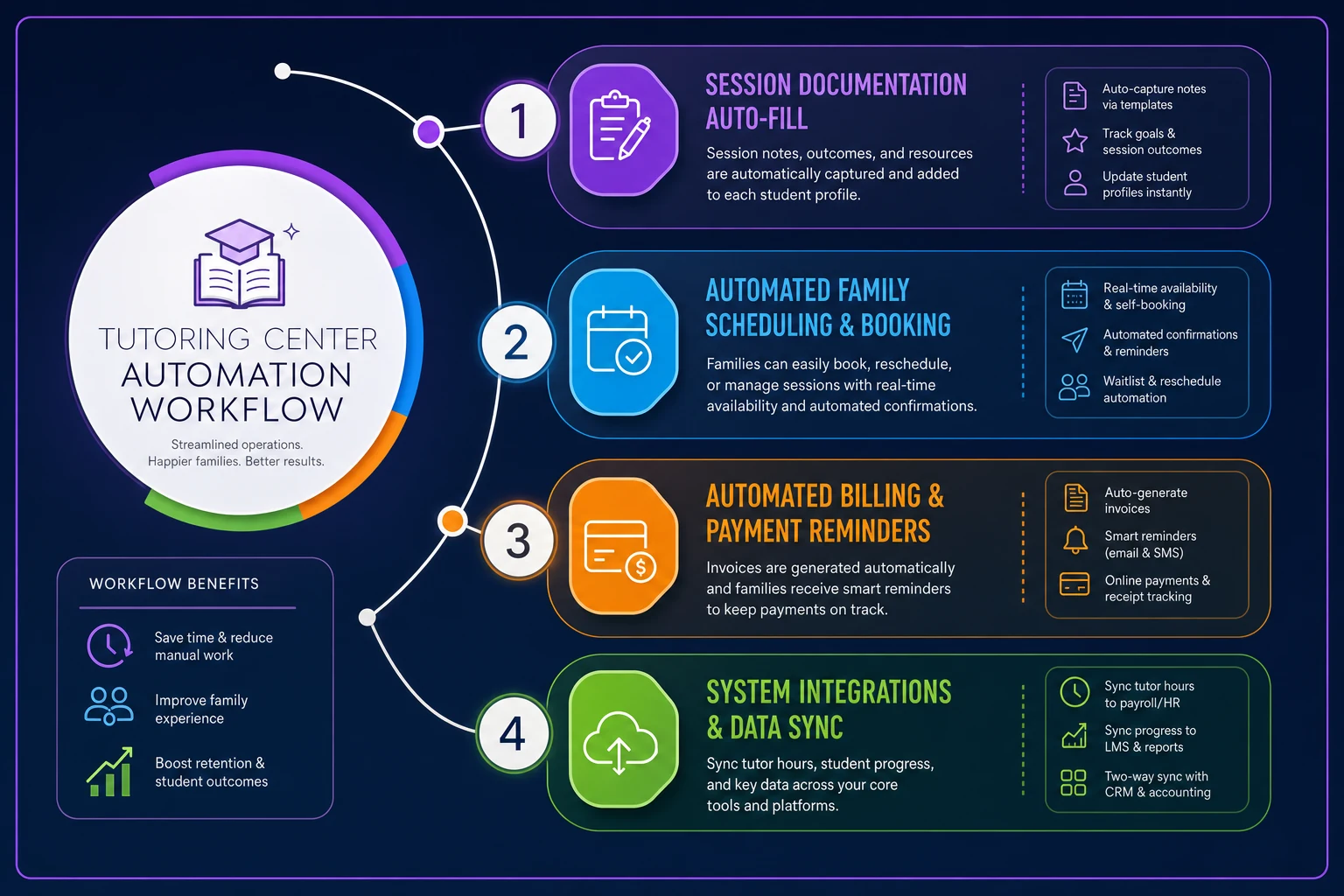
Schedule coordination is another major drain. Tutors checking availability, admins playing phone tag, parents requesting changes. Automated scheduling where families book available slots directly, request changes within policy windows, and receive confirmations without human involvement can cut 10–15 hours of weekly coordination work. One center dropped scheduling-related labor by 15 hours weekly just by eliminating the back-and-forth.
Payment processing and invoicing rounds it out. Automated billing, payment reminders, and failed payment recovery eliminate most of this. The BLS data shows administrative wages rising faster than instructional roles, which makes this an even more urgent target.
Every hour of administrative work you can cut or streamline is budget that can go toward tutor compensation or margin protection. AI-powered operational software built for tutoring businesses handles a lot of this automatically—session notes feeding into student records, scheduling conflicts flagging before they become problems, billing running without anyone chasing it. Not magic, but it adds up fast when wages are climbing.
Move #5: Build utilization-based scheduling rules
Empty slots during peak hours while paying premium wages will compress margins faster than almost anything else. You need actual rules about how schedules get built and adjusted—not just good intentions.
Establish minimum utilization thresholds by day-part:
| Day-Part | Minimum Utilization Target |
|---|---|
| Peak hours (M–Th 3–7pm) | 80% |
| Standard hours (Saturday mornings, early weekday evenings) | 65% |
| Off-peak (mornings, late evenings) | 50% |
When you fall below these thresholds, trigger adjustments in this order:
-
Consolidate tutor schedules — If two tutors each have 60% utilization on Tuesday evenings, restructure so one works the full block at 90%+ while the other shifts days.
-
Incentivize family shifts — "Your tutor has an opening right before your session—add 30 minutes at 20% off" works reasonably well in practice. So does a small discount for moving a session to a less congested slot.
-
Set capacity gates — Don't add new tutor hours to a day-part until existing capacity is above 75%. This prevents the schedule bloat that creeps in when everyone's trying to accommodate one more student without checking the broader picture.
Track utilization weekly and set automated alerts for day-parts that fall below thresholds so you can act before trends compound.
Track it weekly. A center with 20 tutors improving peak-hour utilization from 70% to 85% effectively gains the equivalent of 3–4 tutors worth of capacity without adding a dollar to payroll.
Move #6: Create retention-linked pricing models
Tutor acquisition costs spike in tight labor markets, but so do family acquisition costs. Every family that churns requires finding a replacement—which means maintaining excess capacity—which means higher overhead. Building retention incentives into pricing directly addresses this.
A simple tier structure:
| Tenure | Discount |
|---|---|
| Month 1–3 | Standard rate |
| Month 4–6 | 5% loyalty discount |
| Month 7–12 | 10% loyalty discount |
| Month 13+ | 15% loyalty discount plus priority scheduling |
It seems backwards to lower prices when costs are rising, but the math holds up. A family paying 15% less after a year is more profitable than constantly cycling through three-month families. Acquisition and onboarding costs typically run $200–400 per family. Retention discounts cost considerably less than that while giving you predictable revenue.
And the families who stick around long enough to reach the bigger discounts? They're exactly who you want. They refer others, they're flexible with scheduling, and they rarely cause problems.
Move #7: Restructure group sessions for margin protection
One-on-one tutoring at rising wage rates gets harder to price competitively without losing families. But the typical group model—four to six students thrown together—produces inconsistent outcomes that don't justify even a reduced rate.
Structured micro-groups with specific parameters work better:
Paired sessions (2 students): Same grade, same subject, complementary skill levels. One student slightly ahead provides occasional reinforcement by explaining concepts. Price at 70% of individual rate per student, pay tutor 110% of base. Margin improves roughly 25%.
Focused trios (3 students): Same specific need—SAT math, essay writing, algebra foundations. Tight curriculum that doesn't require much customization per student. Price at 60% of individual rate, pay tutor 120% of base. Margin improves roughly 40%.
Study blocks (4–6 students): Homework support and study skills rather than direct instruction. Tutor circulates. Price at 40% of individual rate, pay tutor 130% of base. Best margin but limited to appropriate use cases.
The critical piece is matching group structure to actual student needs rather than assembling groups to fill schedule gaps. Track progress carefully—if group students aren't advancing at 80%+ the rate of individual students, the model breaks down and families notice.
The integration problem most centers don't address
Fragmented operations compound every problem on this list. Scheduling in one system, payments in another, tutor hours in a spreadsheet, student progress split across paper files and three different apps. That fragmentation makes it nearly impossible to see the connections between utilization, compensation, pricing, and margin in anything close to real-time.
When you can see that Tuesday afternoons are consistently under-utilized while Thursday evenings are overbooked, you can adjust tutor schedules, modify pricing, or shift your enrollment messaging immediately—not months later during a manual review. Operational platforms built for tutoring businesses make this kind of visibility possible, and the centers using them are adjusting faster than the ones still piecing together data from disconnected sources.
Moving beyond reaction mode
Rising labor costs force uncomfortable decisions, but they also reveal how much operational inefficiency most centers have been carrying without fully accounting for it. The centers doing well right now aren't trying to fight wage inflation—they're using it as a reason to fix things that should have been fixed anyway.
Start with utilization. If you can't tell me your utilization rate by day-part for last week, that's the first problem to solve. Everything else—pricing changes, compensation adjustments, package restructuring—depends on actually knowing how you're using existing capacity.
Then tackle scheduling efficiency. Every gap in a tutor's peak-hour schedule is margin burned. Consolidate schedules, build in flexibility incentives, and put rules in place that prevent schedule sprawl from creeping back.
Then align pricing with operational reality. Peak slots should cost more. Long-term families should pay less. Group sessions should serve specific outcomes, not just fill gaps in the schedule.
The Q2 wage data confirms what most operators have already been sensing. The era of stable, predictable labor costs isn't coming back. But rising wages don't have to mean shrinking margins if you're willing to run a tighter operation instead of waiting for conditions to improve on their own.
Ready to streamline your tutoring operations?
Join 500+ tutors and centers using Tutoryly to save time, improve scheduling accuracy, and enhance student experiences.