

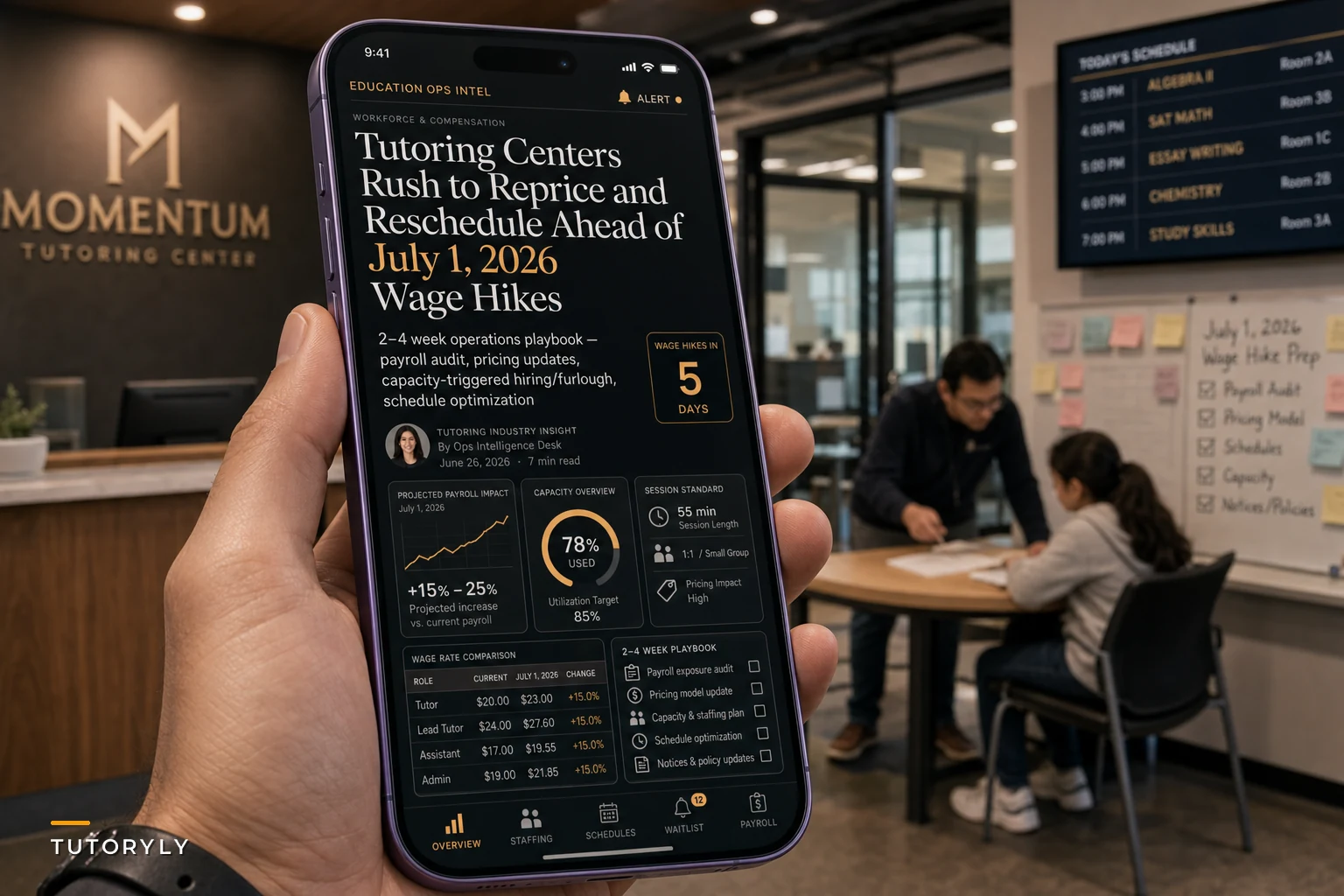

Starting July 1st, minimum wage increases are hitting multiple states and cities at once. If you're running a tutoring center with hourly staff—which is basically all of us—your labor costs could jump anywhere from 8% to 25% depending on where you operate. The Berkeley Labor Center's inventory shows that some cities are pushing minimums past $20/hour, with predictive scheduling and paid sick leave requirements kicking in the same day.
Most tutoring centers are already running on thin margins. When you're paying tutors $18-25/hour and charging clients $45-65, a mandatory wage increase doesn't just squeeze profits—it breaks your pricing model entirely. Factor in front desk staff, assessment coordinators, and part-time admin help, and you're looking at a real hit to the operating budget.
But the wage increase itself isn't even the biggest issue. These changes expose how fragile most tutoring center operations actually are. Manual scheduling, inconsistent pricing tiers, rough capacity planning—these things sort of worked when the numbers were friendlier. When labor costs jump overnight, those inefficiencies become immediate cash flow problems.
The scheduling mess that wage increases create
Most tutoring centers schedule around client demand, not operational efficiency. Sarah works Tuesday and Thursday afternoons because that's when her regulars come in. Mike covers Saturday mornings for SAT prep. Your front desk person splits shifts around peak drop-off and pickup.
That worked fine when you could absorb an extra idle hour here and there. When minimum wage jumps from $15 to $18, those gaps start burning money fast. That 30-minute gap between sessions where your tutor is technically on the clock? Now $9 instead of $7.50. Multiply that across 12 tutors at 20 hours a week, and you're losing an extra $360 weekly just on scheduling inefficiency.
The obvious fix—cutting hours—creates its own problems. Pull back too much and the good tutors leave. They always have options. Pack schedules too tight and quality drops because there's no prep time between sessions. Parents notice when their kid's tutor seems rushed.
What actually works is shifting to block scheduling with built-in efficiency targets. Instead of letting tutors build their hours around personal preference, you create standard blocks that maximize billable time. A typical 4-hour block might look like: three 55-minute sessions with 5-minute transitions, followed by a 25-minute window for notes and parent communication. You're paying for productive time, not idle waiting.
Here's a simple visual of the block scheduling workflow.
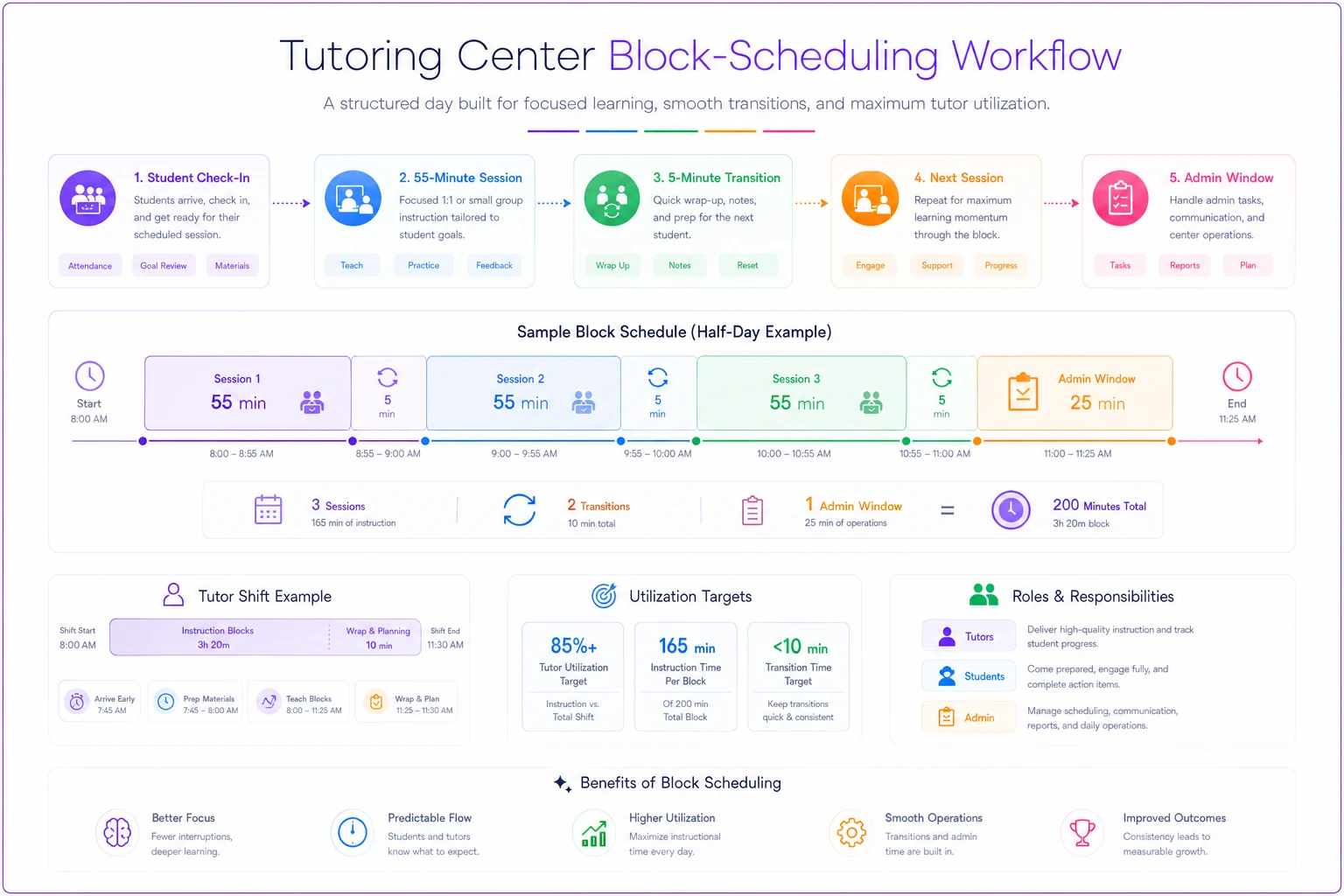
Time transitions strictly—those 5-minute gaps add up fast.
You're paying for productive time, not idle waiting.
Rethinking your pricing tiers when costs spike
The knee-jerk reaction is raising prices across the board. Add $5 per session, send a quick email, hope for the best. That's usually when you lose your price-sensitive families—often the ones who need tutoring most but are barely stretching their budget to afford it.
Never miss another tutoring session.
Tutoryly helps you schedule, confirm, and manage every tutoring session efficiently.
- Unified session scheduling
- Automated student notifications
- Tutor calendar & availability management
No credit card required
A smarter approach is building service tiers that justify different price points. Most centers offer individual tutoring at one rate and maybe a group discount. That structure leaves money on the table and offers clients no real choice.
Here's a tier structure that's worked for several centers:
Premium Individual Sessions ($85-95/hour)
-
Same-day scheduling availability
-
Session recordings provided
-
Weekly progress reports
-
Direct tutor communication channel
Standard Individual Sessions ($65-75/hour)
-
48-hour scheduling notice
-
Monthly progress reports
-
Communication through center coordinator
Semi-Private Sessions ($45-55/hour per student)
-
2-3 students maximum
-
Similar skill levels grouped
-
Shared progress reports
-
Fixed weekly schedule
Academic Coaching Groups ($30-35/hour per student)
-
4-6 students
-
Study skills and homework help
-
Drop-in availability
-
General supervision rather than direct instruction
Worth noting: higher-tier services don't necessarily need more experienced tutors. They need better operational support. Session recordings can be automated with basic screen capture software. Progress reports get systematized with templates. Direct communication channels just need clear boundaries and response time expectations set from the start.
Staffing decisions that actually reduce costs
When labor costs increase, the instinct is to hire fewer, more experienced tutors who can handle more students. This rarely plays out the way you'd expect. Experienced tutors command higher wages, which often offsets the minimum wage impact anyway. They also tend to have less scheduling flexibility because they're juggling multiple jobs or commitments.
A mixed staffing model tends to work better:
Lead Tutors (25% of staff)
-
$28-35/hour
-
Handle complex cases
-
Train newer tutors
-
Create curriculum materials
-
Minimum 20 hours/week
Standard Tutors (50% of staff)
-
$20-25/hour
-
Handle most sessions
-
Follow established curricula
-
15-25 hours/week
Assistant Tutors (25% of staff)
-
Minimum wage + $2-3
-
Support group sessions
-
Handle homework help
-
Conduct assessment prep
-
10-15 hours/week
| Role | Pay | Responsibilities/Notes | Hours/week |
|---|---|---|---|
| Lead Tutors (25% of staff) | $28-35/hour | Handle complex cases; Train newer tutors; Create curriculum materials | Minimum 20 hours/week |
| Standard Tutors (50% of staff) | $20-25/hour | Handle most sessions; Follow established curricula | 15-25 hours/week |
| Assistant Tutors (25% of staff) | Minimum wage + $2-3 | Support group sessions; Handle homework help; Conduct assessment prep | 10-15 hours/week |
Assistant tutors handle the high-volume, lower-complexity work. Standard tutors run your core sessions. Lead tutors take the challenging cases and keep overall quality consistent. You maintain service quality without paying top-tier wages for every single hour of instruction.
The piece most centers miss: clear progression paths between tiers. An assistant tutor should know exactly what skills or certifications they need to move up. That alone reduces turnover, because people can see a future beyond minimum wage rather than a ceiling.
Why your current billing system will break
Manual billing eats up admin time that gets progressively more expensive as wages rise. If your front desk person spends 2 hours a day on billing tasks at the new minimum wage, that's roughly $40 a day in overhead—around $10,000 a year just to process payments.
Moving to automated billing helps, but the bigger fix is restructuring how you charge in the first place:
Package-Based Billing
Sell packages of 4, 8, or 12 sessions instead of charging per session. One invoice per month instead of four. Parents buy a package, sessions get deducted, you invoice again when they're running low.
Automatic Renewals
Recurring monthly packages that auto-renew unless cancelled. No more chasing payments or sending reminders. Cash flow becomes predictable.
Tiered Late Fees
Automatic late fees that escalate: 5% after 7 days, 10% after 14 days. This creates real incentive for prompt payment without anyone having to make an awkward phone call.
Compliance requirements beyond just wages
The Fisher Phillips employment law analysis makes clear that these July 1st changes go beyond minimum wage. Predictive scheduling requirements, expanded sick leave, and new posting obligations are landing in multiple jurisdictions at the same time.
Predictive scheduling in some cities means providing work schedules at least 14 days out. Change a tutor's schedule with less notice and you may owe them predictability pay. That completely breaks the traditional tutoring center habit of accommodating last-minute parent requests.
A few things to have in place before July 1st:
Schedule Locks
Finalize schedules 14 days out. No exceptions outside of documented emergencies. This means training parents to request changes with more lead time—which is a conversation worth having now, not in two weeks.
Float Pool Staff
Keep 2-3 tutors specifically available for last-minute coverage. Yes, you'll pay them even during slow stretches, but it's still cheaper than predictability pay penalties.
Digital Posting Compliance
Required workplace posters need to be accessible digitally for remote workers. If any of your tutors run online sessions from home, you need a system for distributing these notices electronically.
Making the transition without losing staff or clients
The worst move is surprising everyone. Tutors need to understand why scheduling is becoming more rigid. Parents need context for why prices are adjusting. Both need time to adapt.
Get your staff together before the end of next week. Don't just announce the changes—show them the math. Walk through how the wage increase affects the center's economics and explain the block scheduling logic. More importantly, ask for their input. They know which transitions are realistic and which aren't.
For parents, frame the changes around service improvements rather than cost increases. The new tier structure offers choices that match different budgets and needs. The scheduling structure means their child gets a consistent, prepared tutor rather than last-minute substitutes. The billing changes reduce their own admin headache—no more tracking individual session payments or hunting down receipts.
Building operations that survive cost increases
This minimum wage increase won't be the last. Labor costs move in one direction, and the centers that survive build operations that can absorb those shocks. That means creating efficiency in scheduling, billing, and progress tracking—not just reacting to each increase as it hits.
If you've been putting off modernizing your operations, this wage increase makes it urgent rather than optional. Manual processes that were slightly inefficient at $15/hour become genuinely unsustainable at $20/hour. The math changes the stakes.
We built our guide on scaling tutoring businesses with proper staffing triggers and SOPs because we kept seeing centers struggle with exactly these kinds of transitions. The ones with structured capacity planning and stage-based growth handle cost increases far better than those running on informal systems and gut feel.
The next two weeks determine your next two years
These July 1st changes are the catalyst, but the real question is whether you use this pressure to finally build the operational foundation your center needs—or scramble through with temporary patches that leave you exposed to the next disruption.
Start with scheduling blocks. Map out what an efficient week actually looks like for each tutor type. Calculate the utilization rate you need to maintain margins at the new wage levels. Build your price tiers from operational cost, not just what the competitor down the street is charging.
Running a tutoring center at higher wage levels requires different operations than what got you here. The informal, flexible approach that parents appreciated won't survive when every hour of labor costs 20% more. But the structured systems you build now will hold up regardless of what the next round of increases looks like.
Centers that act in the next two weeks will enter July with clear plans, communicated changes, and systems ready for the new reality. Those that wait will spend months playing catch-up, losing staff and clients along the way. The math is unforgiving, but the solution is straightforward: build better operations now, while you still have time to do it right.
Centers that act in the next two weeks will enter July with clear plans, communicated changes, and systems ready for the new reality. Those that wait will spend months playing catch-up, losing staff and clients along the way. The math is unforgiving, but the solution is straightforward: build better operations now, while you still have time to do it right.
Ready to streamline your tutoring operations?
Join 500+ tutors and centers using Tutoryly to save time, improve scheduling accuracy, and enhance student experiences.