


Most tutoring centers already send something to parents. The problem is that something is usually a three-paragraph email a tutor wrote at 9pm, or a monthly PDF nobody opens, or a scribbled note in a folder that rides home in a backpack and never surfaces again. You're doing the work. You're just not getting credit for it — and worse, you might be casually sharing student data in ways that would make a privacy auditor uncomfortable.
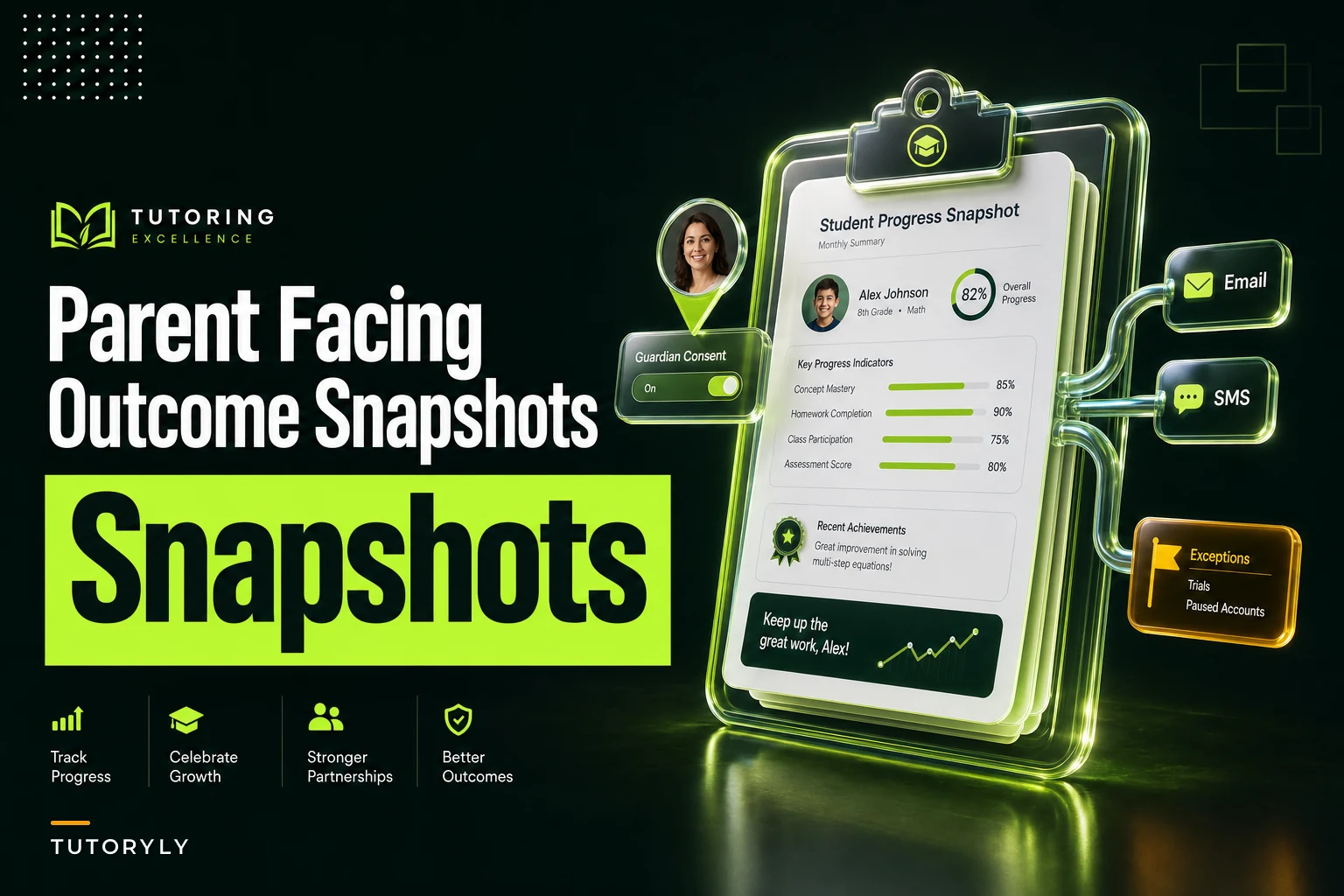
This post is narrow on purpose. It's about one artifact: the one-page outcome snapshot that goes to a parent. Not progress reports (we covered cadence and visuals in parent progress reports that reduce churn). This is the tight, single-page version — plus the consent language that protects you, the distribution rules for who gets what and when, and a couple of simple A/B designs so you can actually tell whether the snapshot is moving renewals and trial conversions.
Why most outcome summaries fail before they're read
Three things usually go wrong at once.
The summary is written for the tutor, not the parent. It's full of "worked on factoring quadratics, reviewed chapter 4, assigned practice set B." A parent reading that has no idea whether their kid is on track. They see jargon and a bill that renews next month.
There's no consistent format, so parents can't scan. One tutor writes four sentences, another writes two pages, a third sends nothing for three weeks. Parents don't compare tutors against each other — they just build a vague sense of "I'm not sure what we're paying for." That vague feeling is what kills renewals.
And then there's the one centers ignore until it bites them: nobody controls what gets shared and with whom. In a family with separated parents, a snapshot meant for one guardian lands in someone else's inbox who wasn't authorized to receive it. A snapshot references another student's name because the tutor copy-pasted from a group session note. These aren't hypotheticals. They're the quiet data problems that pile up when summaries are handcrafted every single time.
The fix isn't "send more updates." It's standardizing one artifact, pinning consent to it, and letting rules handle distribution instead of a tired tutor at the end of a shift.
The one-page snapshot: what actually belongs on it
A good parent-facing snapshot answers four questions a parent is silently asking, in this order:
Never miss another tutoring session.
Tutoryly helps you schedule, confirm, and manage every tutoring session efficiently.
- Unified session scheduling
- Automated student notifications
- Tutor calendar & availability management
No credit card required
-
Is my kid okay?
-
What specifically got better (or didn't)?
-
What are we doing next?
-
What do you need from me?
Everything else is noise. Here's the structure that holds up across subjects and age groups:
The discipline is the constraint. The moment a snapshot grows past one page, tutors start treating it as a report and parents stop reading it. Centers that switch from dense half-page paragraphs to this structure typically cut writing time down to a few minutes — and more importantly, parents start actually replying, which rarely happened before.
| Section | What goes here | Keep it to |
|---|---|---|
| Header | Student first name, reporting period, tutor name, subject | 1 line |
| Snapshot line | One plain-language sentence on overall trajectory | 1 sentence |
| What improved | 1–3 concrete wins, parent-readable | 2–3 bullets |
| Current focus | The skill being worked on right now, in normal English | 1–2 bullets |
| Evidence | One number or artifact (quiz score, reading level, mock test) | 1 data point |
| Next step | What the center is doing next session/month | 1 bullet |
| Parent action | One thing the parent can do, or "nothing needed" | 1 line |
One thing worth sitting with: the "Evidence" row is what separates a snapshot from a feelings update. Parents discount adjectives ("great progress!") but trust a single concrete marker ("moved from a 61% to a 78% on the unit quiz"). You only need one. More than one and you're back to writing a report.
A filled-in example
> Maya — October — Tutor: James — Algebra I > Snapshot: Maya is now keeping pace with her class and gaining confidence on multi-step problems. > What improved: > - Solving two-step equations independently (needed prompts before) > - Showing work clearly enough to catch her own errors > Current focus: word problems — translating sentences into equations > Evidence: unit quiz went from 61% to 78% > Next step: two sessions on word-problem setup, then a short re-check > Parent action: nothing needed — just ask her to explain one homework problem out loud this week
That fits on a third of a page and tells a parent everything they need to feel the renewal is worth it.
Consent language: the part everyone skips
The moment you put a student's name, scores, and progress into a document and send it somewhere, you're distributing education records. Who's allowed to receive them isn't a guess — it should be captured at intake and attached to the account.
You don't need a legal department. You need two things written down once and reused everywhere: who is authorized to receive snapshots, and what the family agrees you can do with the data (store it, send it by email or SMS, reference it in a renewal conversation).
> "I authorize [Center] to share [Student]'s progress summaries with the following people: . I understand these summaries may be delivered by email or text message. I can update or revoke this authorization at any time by contacting [Center]. Progress summaries will not include information about other students."
> "Snapshots are sent only to guardians listed on the active authorization. If guardians are listed separately, each receives their own copy; summaries are never forwarded between guardians by staff."
Keep signed guardian authorization entries attached to the student's account record so the consent check can be automated and audited easily.
That last line matters more than it looks. The most common consent failure isn't a malicious leak — it's a well-meaning tutor forwarding a copy "so Dad stays in the loop" when Dad wasn't on the list. Make the rule explicit so nobody has to make a judgment call at 9pm.
One more: if you ever plan to use snapshot data in anonymized form (for marketing, "our students improved X on average"), say so in the consent. Quietly reusing it later is how trust evaporates fast.
Distribution rules: stop deciding this manually
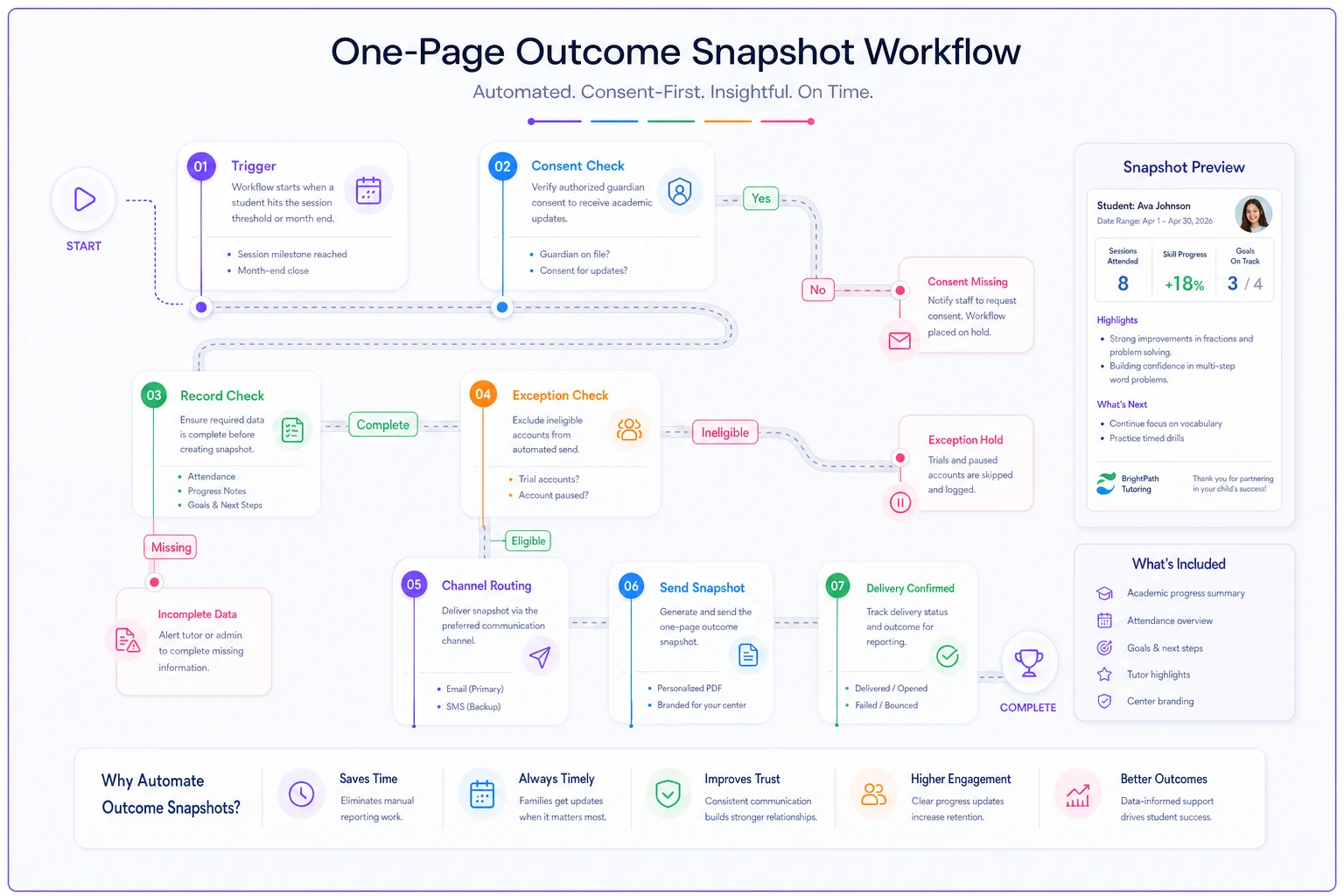
Right now, distribution probably depends on whether a specific tutor remembers to hit send. That's the failure point. Replace "a person remembers" with a short set of rules that fire off events you're already tracking.
-
Trigger every 4th completed session, OR end of calendar month — whichever comes first.
-
Recipient pull authorized guardians from the account, not from the tutor's memory.
-
Channel email by default; SMS a short "new snapshot sent" nudge if the family opted in.
-
Pre-send gate snapshot can't send unless all four required fields are filled (snapshot line, one improvement, evidence, next step). No blank fields go out.
-
Trial students snapshot goes out after session 2, before the trial-to-paid decision point — not after.
-
Pause/hardship accounts suppress automated snapshots so you're not pinging a family whose billing you've already paused.
This is where an AI-powered workflow platform quietly earns its keep. Instead of tutors remembering who gets what, the system fires the snapshot on the trigger, checks the consent list, and blocks sends with missing fields. The tutor's only job is writing four short lines — the routing, the consent check, and the timing happen automatically. You're not adding software to look modern; you're removing the three or four manual decisions where things currently go sideways.
The trial timing detail most centers miss
Sending the snapshot after session 2 but before the renewal conversation is a small sequencing choice with real impact. A parent who has a concrete, readable win in hand walks into that conversation already half-convinced. A parent who's only heard "the trial went well" verbally has nothing to anchor to. Get the artifact in front of them first.
Does any of this actually move renewals? Test it.
Don't take it on faith that a cleaner snapshot renews more families. Most centers have enough volume to run simple comparisons, even without a huge student base.
A/B test 1 — Format. Split families into two groups for a term. Group A gets the current freeform update. Group B gets the one-page structured snapshot. Compare renewal rate and, as a softer signal, parent reply rate. If replies jump in Group B, that's early evidence the snapshot is actually being read.
A/B test 2 — Timing. For trial students only, test snapshot-before-conversation vs. the current flow. Measure trial-to-paid conversion across both. This one often shows a difference faster than the renewal test because the decision window is short.
A few guardrails so you don't fool yourself:
-
Keep groups genuinely comparable — don't stack your strongest students in one group.
-
Run it long enough to clear seasonal noise. One month around a school break tells you nothing.
-
Pick one primary metric per test before you start. Renewal rate or conversion — not a grab bag you reinterpret afterward.
-
Be honest about sample size. If you're comparing 14 families to 16, treat it as a hint, not proof.
A realistic read on the numbers
A mid-size center running the format test across two terms saw structured-snapshot families renew at a modestly higher rate — a few percentage points — and, more tellingly, parent replies roughly tripled off a low base. The renewal lift alone was easy to dismiss given the sample size. The reply-rate jump was the convincing signal: parents were opening and engaging with something they used to ignore entirely. When parents engage before a renewal decision, the renewal tends to take care of itself.
Don't over-index on one number from a small sample. Look at the direction and the engagement signal together.
When this is worth doing — and when it isn't
This makes sense when:
-
You have more than a handful of active families and distribution currently depends on individual tutors remembering.
-
You've had even one awkward moment around who received what.
-
Renewals are a meaningful part of your revenue and you can't clearly point to what parents are actually seeing.
This is probably overkill when:
-
You're a solo tutor with six students you talk to every week anyway. A text works fine.
-
Your parents already get consistent, rich updates through a channel they love. Don't fix what's working.
Who should not start here: centers whose intake doesn't capture guardian authorization at all. Fix that first. Standardizing a clean snapshot on top of a shaky consent foundation just means you'll distribute problems faster and more consistently.
Pulling it together
The whole point of a one-page outcome snapshot is to make the value you're already delivering visible — in a form a parent can read in fifteen seconds, sent to the right people, without a tutor having to make judgment calls at the end of a long day. The template keeps it honest and scannable. The consent language keeps you out of trouble. The distribution rules take the "did someone remember?" risk off the table. And the small A/B tests tell you whether it's actually working instead of leaving you guessing.
Start with the one-page format and the intake consent line. Get those two solid before you automate anything. Once the artifact is consistent and the authorization is captured, the distribution rules and the experiments become the easy part — and that's when you'll finally be able to say, with actual evidence, that the snapshot is pulling its weight on renewals and trials.
Start with the one-page format and the intake consent line. Get those two solid before you automate anything. Once the artifact is consistent and the authorization is captured, the distribution rules and the experiments become the easy part — and that's when you'll finally be able to say, with actual evidence, that the snapshot is pulling its weight on renewals and trials.
Ready to streamline your tutoring operations?
Join 500+ tutors and centers using Tutoryly to save time, improve scheduling accuracy, and enhance student experiences.