

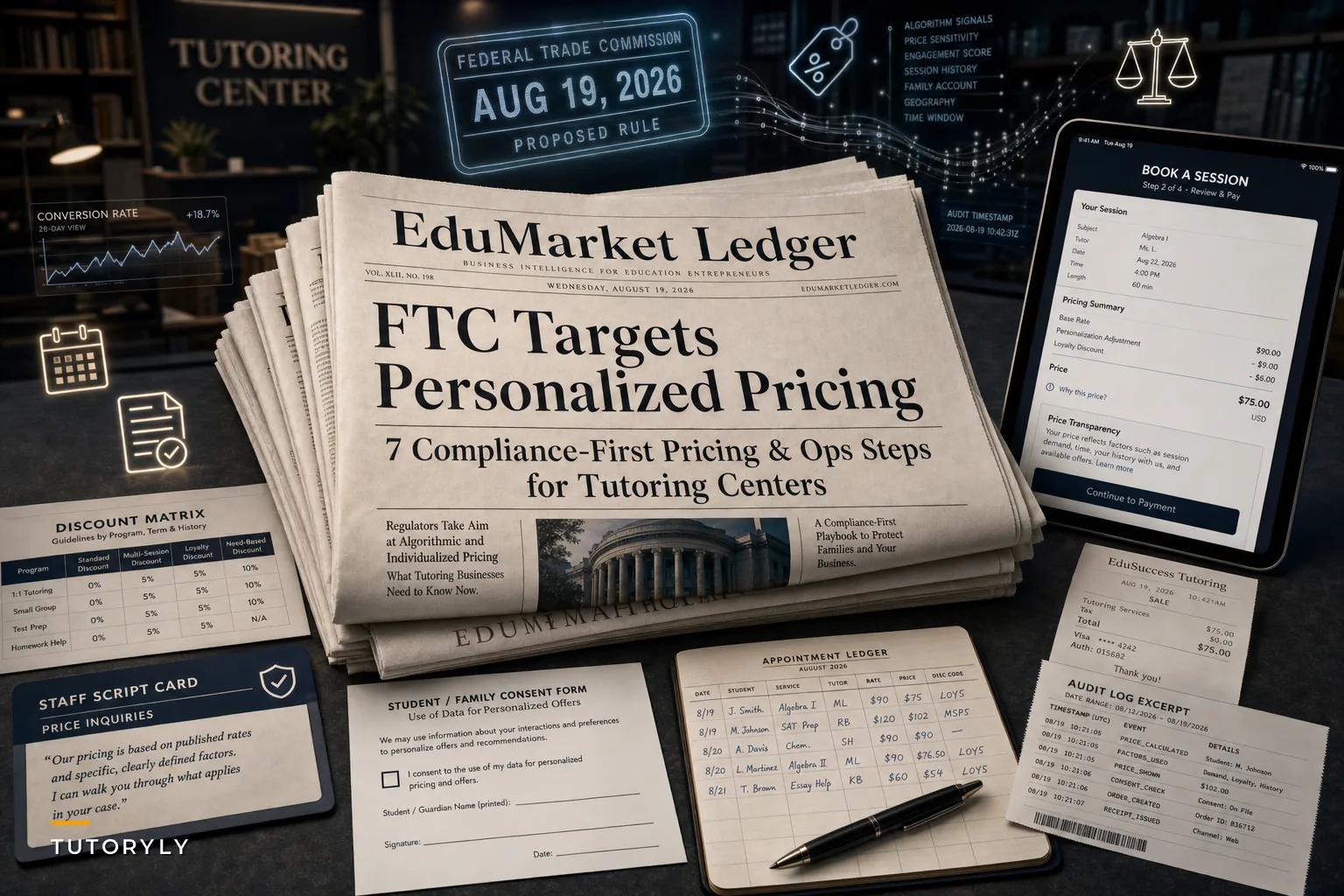

On August 19, 2026, the FTC put out a proposed enforcement policy statement asking for public comment on whether businesses should have to disclose when prices or offers are personalized using customer data or algorithms. Reuters reported that regulators are signaling near-term attention to any company using targeted discounts or dynamic offers, and the FTC's own proposed statement lays out where they think disclosure obligations might land.
Most tutoring center owners read that and think, "That's an Amazon problem, not a me problem." Fair reaction. But if you offer a "returning family" rate, quietly bump your rates during SAT season, or let your CRM auto-suggest a discount when a parent hesitates on the phone — you're doing personalized pricing. You just never called it that.
This isn't a legal explainer. What follows is an operational look at where tutoring centers already do quiet, data-driven pricing, why that exposes you more than you'd expect, and seven concrete steps to tighten things up before disclosure expectations become the norm.
First, be honest about how much personalized pricing you already do
Personalized pricing isn't only the fancy algorithmic stuff. It's any price that changes based on who is asking or what you know about them.
-
Retention saves — a front-desk manager offers a struggling family 15% off "just this term" to stop a cancellation
-
Sibling and family rates that scale with headcount
-
Loyalty pricing where long-term families are grandfathered into old rates
-
Exam-season surcharges during SAT/ACT/finals crunches
-
Lead-source discounts — Google Ads leads get a different intro offer than referral leads
-
"Whatever it takes" negotiation where the owner just names a number based on how badly they want the student
That last one is the sneaky problem. When pricing lives in someone's head and gets adjusted per call, you have zero record of why a family paid what they paid. Fine when nobody's asking questions. It becomes a liability the moment disclosure expectations show up — because you can't disclose a rule you never wrote down.
What tends to happen across a lot of small service businesses is that pricing feels "fair" in the moment but looks arbitrary in aggregate. Two families with identical situations, different prices, no documented reason. That gap is exactly what regulators mean by opaque personalized pricing.
Why tutoring is more exposed than owners assume
Tutoring sits in a category regulators watch closely because the buyer is often emotional and the stakes feel high. A parent whose kid is failing algebra isn't price-shopping the way they shop for tires. That vulnerability is precisely why "we charged them more because they seemed desperate" is a bad look — even if nobody consciously made that call.
Never miss another tutoring session.
Tutoryly helps you schedule, confirm, and manage every tutoring session efficiently.
- Unified session scheduling
- Automated student notifications
- Tutor calendar & availability management
No credit card required
There's also the data angle. If your CRM or booking platform tracks things like household income proxies, zip code, past spend, or urgency signals, and any of that quietly influences the price you quote — you've crossed from "custom quote" into "algorithmic personalization." Most owners don't realize their software is doing this until they actually audit it.
A quick way to test your exposure: could you explain, in one sentence, the rule behind every price a family paid last month? If the honest answer is "it depends who they talked to," you have an inconsistency problem that a disclosure expectation would turn into a compliance problem.
The 7 Steps
Here's a quick workflow showing the sequence of the seven steps.
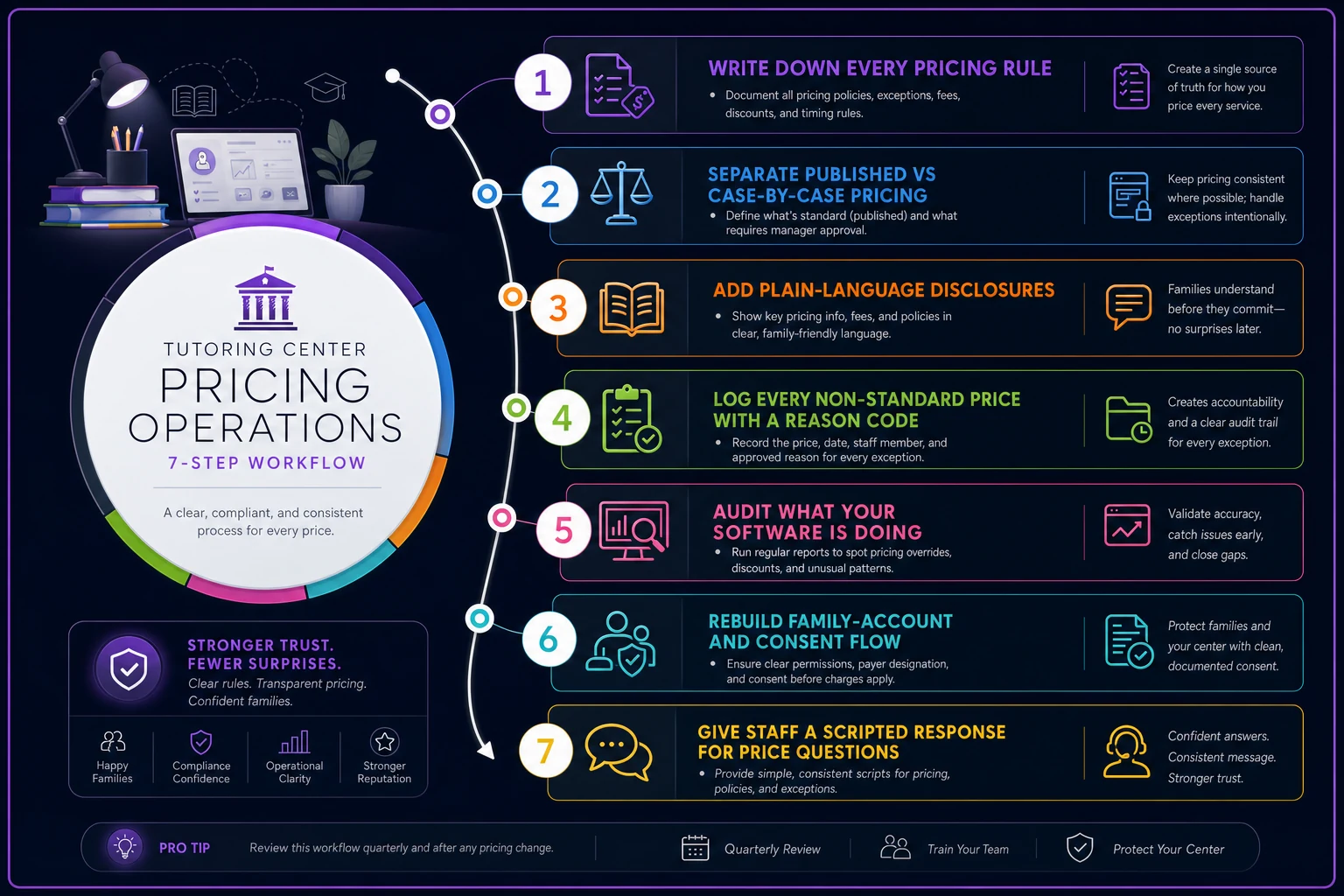
Use this flow as a simple checklist when you implement the steps.
1. Write down every pricing rule you actually use
Not the ones on your website — the real ones. Include the verbal discounts your staff give, the negotiation ceilings, the "I'll knock off $20 if they pay upfront" moves.
Put them in a single pricing rulebook with three columns: the rule, the trigger (who qualifies), and the reason. If a rule can't be written in plain English, it probably shouldn't exist.
A typical first draft looks messy — most centers discover somewhere between eight and twelve informal rules they never formalized. That's normal. The point is converting tribal knowledge into something you can actually govern.
2. Separate "published" pricing from "case-by-case" pricing
There's a real difference between a discount that applies to a defined group (siblings, referrals, multi-session packages) and a discount someone improvises on a call. The first is a policy. The second is a judgment call.
Move as much as you reasonably can into the first bucket. Case-by-case pricing should be the exception, capped, and logged — not the default sales tactic. If your intro-offer discount ranges anywhere from 0% to 40% depending on the salesperson's mood, that spread is your risk.
3. Add plain-language disclosure where personalization exists
You don't need legalese. If sibling pricing exists, say so on the pricing page. If exam-season rates are higher, note it. If a family gets a returning-customer rate, put it on the invoice as a line item, not a mystery discount buried in the total.
The mental model: a family should be able to see that their price was adjusted and why, without having to ask. That single habit covers most of what the FTC proposal is actually concerned about.
4. Log every non-standard price with a reason code
This is the operational backbone of the whole thing. Every time someone charges off-menu, it needs a record: which family, what price, which rule or reason, who approved it.
| Reason Code | When it's used | Requires approval? |
|---|---|---|
| SIB | Sibling/family multi-student rate | No (auto rule) |
| REF | Referral discount | No |
| RETAIN | Cancellation save / retention offer | Yes |
| PROMO | Time-boxed marketing offer | No |
| HARDSHIP | Documented financial hardship | Yes |
| NEG | One-off negotiated rate | Yes |
The "requires approval" column matters. It puts a human check on the discretionary stuff and creates a natural paper trail. If you ever need to show your pricing was consistent and rule-based, this log is your evidence.
5. Audit what your software is doing without telling you
Pull a report of every price charged over the last 90 days and look for spread. Same package, wildly different prices? Dig into why. Sometimes it's legitimate. Sometimes it's a staff member freelancing, or a booking tool applying a dynamic rule you forgot you turned on.
Run the 90-day price-spread report monthly to catch trends early.
This is where a proper operations or billing platform earns its keep — not because it "does compliance," but because it makes the invisible visible. When every price, discount, and reason code lives in one system instead of scattered across spreadsheets and someone's memory, an audit takes an afternoon instead of a week. If you're using a platform that centralizes billing and family accounts, this report should be a few clicks, not a forensic project.
6. Rebuild your family-account and consent flow
Sibling and family pricing is the most common personalized-pricing structure in tutoring, and it's usually the messiest. Consolidated billing, shifting discounts as kids age out, mid-year additions — it gets tangled fast.
Standardize the discount formula, show it explicitly on the account, and make sure the family agreed to those terms at signup rather than discovering them on an invoice. Consistent, disclosed, agreed-to. That's the whole game.
If your packaging structure itself is loose, this is a good moment to fix the foundation — our walkthrough on how to design a tutoring pricing and packaging system covers the margin and LTV math behind clean, defensible tiers, which makes disclosure straightforward because the rules are already deliberate.
7. Give staff a scripted way to handle price questions
Your front desk needs one consistent answer to "why is my price different from my neighbor's?" Right now, most centers have five different answers depending on who picks up the phone.
A simple script: name the rule, point to where it's published, offer any qualifying discount transparently. Something like — "You're on our sibling rate, which is the second-student discount listed on our pricing page. Here's how it breaks down." No improvising, no defensiveness, no made-up justifications.
Consistency here matters more than the exact wording. Pick a script, train to it, and stick with it.
A quick real scenario
A mid-sized center running roughly 130 active students had an intro-offer discount that, on paper, was "20% off the first month." Their audit showed the actual discounts ranged from 10% to 45% across a single quarter, depending entirely on who closed the deal. No reason codes, no approval step, nothing logged.
They didn't do anything dramatic. They capped discretionary discounts at 25%, added a two-code approval system (RETAIN and NEG needed a manager sign-off), and put the sibling and referral rates directly on the pricing page. Within about two months the pricing spread tightened noticeably, and — the part they didn't expect — margin recovered by a few points simply because staff stopped over-discounting to close fast. The discipline that made them compliant also made them more profitable.
When this level of rigor makes sense (and when it's overkill)
Do this now if: you use sibling/family pricing, run seasonal rate changes, give retention discounts, or have more than one person quoting prices. The more hands touch pricing, the faster inconsistency creeps in.
You can go lighter if: you're a solo tutor with a single published rate and no negotiation. One clear price list, honestly displayed, and you're already doing most of what disclosure expects. Don't build a reason-code system for a business that has one price.
Don't overcorrect into: killing every discount out of fear. Personalized pricing isn't the problem — undisclosed, inconsistent, unexplainable pricing is. Sibling discounts are great. Just make them a written rule instead of a wink.
The underlying point
The proposal itself may change shape during the comment period, and exact requirements are still open. But the direction is clear enough to act on: pricing decisions should be consistent, documented, and explainable to the person paying.
That's not really a regulatory burden — it's good operations that most centers were overdue to sort out anyway. Centers that keep pricing in someone's head will feel this as a scramble. Centers that already treat pricing as a set of written rules with a clean audit trail will barely notice. The gap between those two groups isn't legal sophistication — it's whether you decided to write your rules down before someone made you.
The proposal itself may change shape during the comment period, and exact requirements are still open. But the direction is clear enough to act on: pricing decisions should be consistent, documented, and explainable to the person paying.
That's not really a regulatory burden — it's good operations that most centers were overdue to sort out anyway. Centers that keep pricing in someone's head will feel this as a scramble. Centers that already treat pricing as a set of written rules with a clean audit trail will barely notice. The gap between those two groups isn't legal sophistication — it's whether you decided to write your rules down before someone made you.
Ready to streamline your tutoring operations?
Join 500+ tutors and centers using Tutoryly to save time, improve scheduling accuracy, and enhance student experiences.