



Most tutoring center owners pick a scheduling model by accident. You start with whatever your first few families asked for — usually a weekly Tuesday 4pm slot — and that casual arrangement becomes your "model" without anyone ever deciding it should be. Two years later you're trying to forecast revenue, figure out why Thursdays are dead, and explain to a tutor why they got paid for a no-show, and the root cause of half of it traces back to a scheduling structure nobody actually chose.
This piece compares the three models side by side, but not in the abstract. What matters isn't the model's name — it's how each one changes your chair utilization, where it leaks churn, and how predictable your monthly revenue becomes. Those three outcomes are tightly coupled, and each model trades them off differently.
The three models, and what they actually do to your numbers
Before the deep dive, here's the honest comparison. Not marketing-speak — the operational reality of what each one does to the parts of your business you care about.
| Dimension | Fixed recurring slots | On-demand booking | Subscription credit system |
|---|---|---|---|
| Typical utilization | High and stable (75–90%) once filled, but rigid | Volatile (40–70%), peaks and dead zones | Medium-high (65–80%), depends on redemption behavior |
| Main churn driver | Life changes break the weekly commitment | Low switching cost, no habit formed | "Forgot to use credits," then resentment at renewal |
| Forecasting difficulty | Easy — recurring revenue, visible pipeline | Hard — demand-driven, seasonal swings | Medium — predictable billing, unpredictable delivery timing |
| Tutor supply impact | Stable schedules, easy staffing | Hard to staff, feast-or-famine hours | Unpredictable load spikes near expiry dates |
| Cash timing | Steady monthly | Lumpy, follows demand | Front-loaded (you get paid before delivery) |
| Best fit | Long-term academic support, exam prep cohorts | Drop-in help, homework clinics, test cram | Families who want flexibility but need a nudge to show up |
The temptation is to read this table and pick the row with the most "high" and "easy." Don't. The right model depends on your student base and your tutor supply, and most mature centers end up running two of these simultaneously for different products.
Fixed recurring slots: the predictable one that quietly ages out
Fixed slots are the backbone of most centers for a reason. A student books Wednesday 5pm with the same tutor every week, that slot stays theirs until they cancel. Utilization is beautiful once your grid fills — you can hit 85%+ chair occupancy, your tutors know their schedule weeks out, and forecasting gets almost boring in a good way.
Never miss another tutoring session.
Tutoryly helps you schedule, confirm, and manage every tutoring session efficiently.
- Unified session scheduling
- Automated student notifications
- Tutor calendar & availability management
No credit card required
The problem is decay. Fixed slots don't churn suddenly; they erode. A family's kid joins travel soccer in spring, the Wednesday slot dies, and now you've got a hole in your grid that's hard to refill mid-season because everyone else already has their routine. What tends to happen across centers running fixed grids is that utilization looks great in September and quietly bleeds from January onward if nobody's actively managing the empty slots.
Utilization math you should actually track
Slot Fill Rate = Booked recurring slots / Total sellable slots in grid
A sellable slot is any tutor-hour you're willing to staff. If you have 4 tutors × 20 weekly hours = 80 sellable slots and 61 are booked, you're at 76%. Track this weekly, because the trend tells you more than the number. A fill rate sliding from 82% to 74% over six weeks is an early churn signal, not a rounding issue.
Forecasting
Projected monthly revenue = Active recurring slots × avg sessions/month × price per session × (1 - expected mid-month cancel rate)
With a mid-month cancel rate somewhere in the 3–5% range for a healthy center, you can forecast next month within a few percent. That predictability is why lenders and franchise models love fixed slots.
Where it goes wrong
The failure mode is passive slot management. Owners treat a cancelled Wednesday 5pm as a loss instead of as inventory that needs reselling within 48 hours. The slot sits empty for three weeks, the tutor's hours drop, and you've silently lost revenue that never shows up on any report.
When fixed slots make sense: long-term academic support, multi-month exam prep, younger students whose parents want routine. When they're a bad idea: high-school seniors with chaotic schedules, drop-in homework help, anything seasonal where demand spikes around exams and dies afterward.
On-demand booking: flexible, popular with parents, brutal to staff
On-demand lets families book whatever's open, whenever. Parents love it because it fits real life. The catch is that it transfers all the scheduling uncertainty from the family to you — and you're the one who has to staff tutors against demand you can't see coming.
Utilization under on-demand is where the surprises live. You'll get a Thursday-before-finals that's 100% booked and a random Tuesday in October at 30%. Average that out and you might sit at 55% utilization while paying tutors to be present for the slow hours. That gap between present-hours and billed-hours is where the profit quietly disappears.
The metric that exposes the real problem
Fill ratio (block) = Booked hours in block / Staffed hours in block
Break your week into blocks (e.g., Mon–Thu 3–6pm, Mon–Thu 6–8pm, Sat morning). You'll almost always find two or three blocks carrying the whole operation while others run at a loss. A common pattern: the 4–6pm after-school block runs 90%+ while 6–8pm limps at 45%. Once you see it by block, the fix is usually obvious — stop staffing the dead blocks or convert them.
Churn risk nobody talks about
On-demand has a hidden churn driver: no habit forms. A family that only books when they remember is a family that quietly stops remembering. There's no standing commitment pulling them back, so attrition is high and almost invisible — they don't formally cancel, they just fade. Your churn report shows "still active" for weeks on a family that's essentially already gone. Watch days-since-last-booking as your real leading indicator. A family that normally books every 7–10 days hitting 21 days of silence is churning, whether or not they've said so.
Forecasting is the weak point
Next-week forecast = (0.5 × last week) + (0.3 × 2 weeks ago) + (0.2 × same week last year)
It's rough, but it beats guessing, and it lets you flex staffing instead of over-committing.
When on-demand makes sense: homework clinics, drop-in test cram, SAT/ACT crunch seasons, markets where flexibility is the selling point. Who should NOT run pure on-demand: small centers with 2–3 tutors who can't absorb demand swings, and anyone whose cash flow can't survive a slow month.
Subscription credit systems: predictable cash, unpredictable delivery
Credits are the model everyone wants to love. Families buy, say, 8 credits a month, redeem them for sessions, and you get paid upfront whether or not they show. Cash flow is front-loaded and billing is clean. On paper it's the best of both worlds.
In practice, the credit system introduces a problem the other two don't have: the gap between billing and delivery becomes a churn bomb.
Here's how it actually plays out. A family buys 8 credits, uses 5, lets 3 expire. Month after month the unused credits pile up as a quiet grievance. They're paying full price and feeling like they're wasting money. Then renewal comes, they look at the stack of expired credits, and they cancel — not because tutoring failed, but because the model made them feel like they lost money. The center's dashboard shows "healthy revenue" right up until the churn cliff.
The metric that matters most: redemption rate
Credit Redemption Rate = Credits used / Credits issued (per billing cycle)
This is the single most important number in a credit model, and most centers don't track it. A redemption rate below roughly 70% isn't a convenience — it's a churn warning. Low redemption feels like free money in the short run and costs you the renewal. Healthy centers actively push redemption up even though it means delivering more sessions for the same cash, because retention is worth more than the margin on unused credits.
Enforcement and gentle nudging around unused credits is its own discipline, and if you're running this model it's worth building a proper reminder structure — the mechanics of reminder tiers, soft-credit caps, and utilization triggers are covered in depth in subscription attendance enforcement for tutoring.
The tutor-supply landmine
Credit systems create expiry-driven demand spikes. Families who hoarded credits all month suddenly try to burn them in the last week before they expire. You get a flood of booking requests you can't staff, families get turned away, and that rejection right before renewal is deadly. Stagger expiry dates across your base and watch for the end-of-cycle crush.
Forecasting
-
Revenue forecast active subscriptions × plan price (clean, predictable)
-
Delivery/staffing forecast issued credits × expected redemption rate, weighted toward end of cycle
The mistake is forecasting only the revenue and getting blindsided by the delivery load.
When credits make sense: families who want flexibility but need accountability, centers with enough tutor depth to absorb redemption spikes. When it's a bad idea: thin tutor supply (you can't honor the spikes), or a family base that's price-sensitive and will resent unused credits.
Reporting cadence and KPI ownership that ties it together
Whichever model you run, reporting falls apart when nobody owns the number. Here's a clean ownership structure that works for small-to-mid centers.
-
Daily (owner or center manager) Check day-of fill rate and no-shows. One glance. Flag any block under 50%.
-
Weekly (scheduling lead) Slot fill rate trend (fixed), block fill ratios (on-demand), redemption rate (credits). This is the meeting where you reassign empty inventory.
-
Biweekly (owner) Days-since-last-booking report to catch fading families before they're gone.
-
Monthly (owner + finance) Revenue vs forecast variance, utilization by product line, churn reconciliation.
Ownership without a cadence is just intention. The cadence is what forces the number to actually get looked at before it's too late to do anything about it.
Alert thresholds worth setting
-
Fixed-slot fill rate drops below 72% → investigate this week
-
Any on-demand block under 45% for two consecutive weeks → cut or convert staffing
-
Credit redemption below 68% for a cycle → trigger redemption nudges
-
Family days-since-booking exceeds 2× their normal interval → outreach
Dashboard widgets you actually need
-
Utilization trend line (not a single number — the slope is the signal)
-
Redemption rate gauge by cohort/plan
-
Fill ratio heatmap by day/time block
-
At-risk families list (sorted by days-since-last-booking)
-
Revenue-vs-forecast variance bar
Visualize the cadence to align owners and alerts.
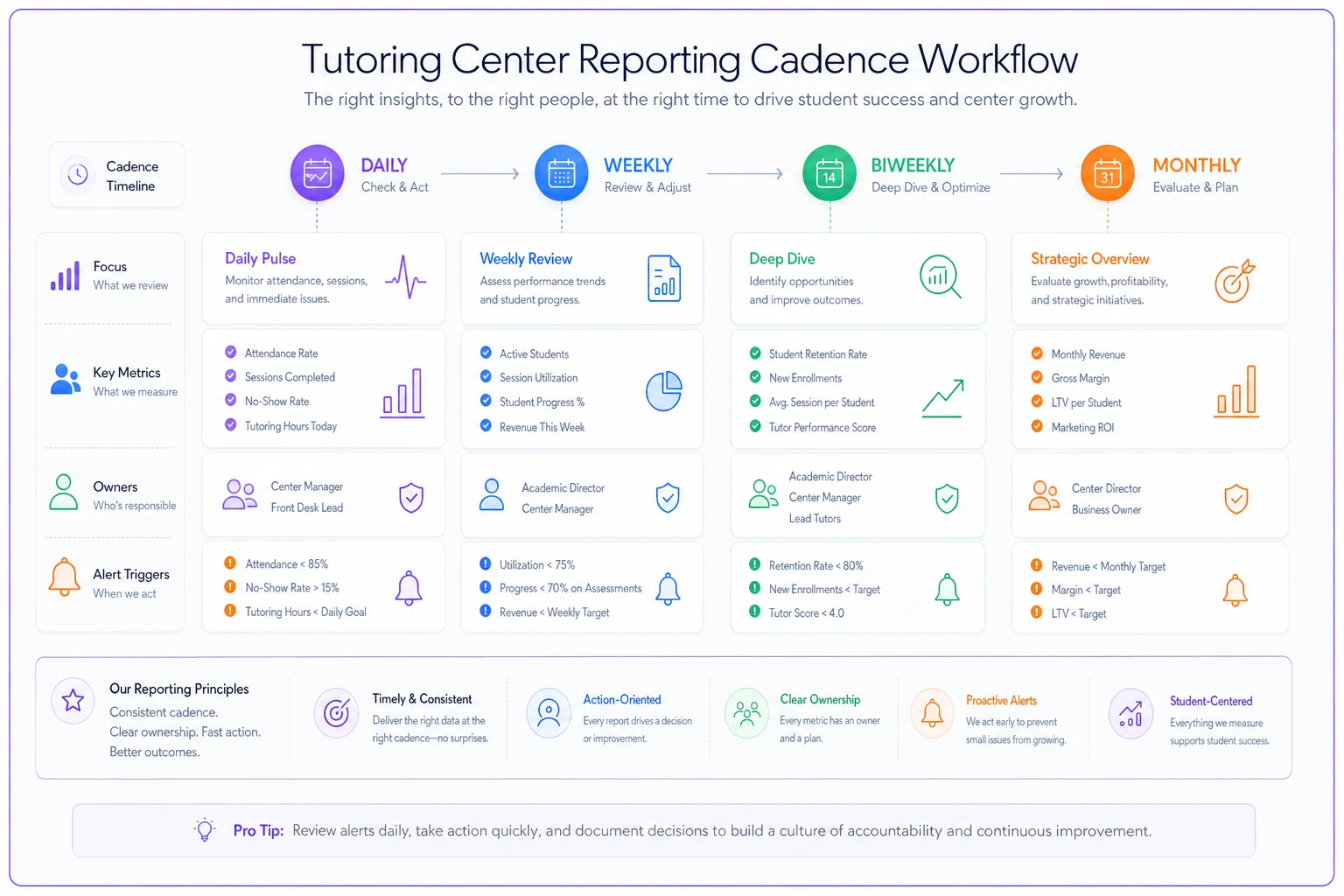
Set a single weekly owner for the slot fill rate so trends aren't missed.
A simple spreadsheet version of the at-risk query is just: filter active families, calculate days since last session, flag anyone past their normal rhythm. In SQL it's a DATEDIFF(NOW(), MAX(session_date)) grouped by student, filtered against each student's rolling booking interval. You don't need a fancy BI stack to run this — you need someone to look at it every two weeks.
A real scenario: the center that switched the wrong product to credits
A mid-sized center — around 140 active students, 6 tutors — moved its entire book to a subscription credit model because the upfront cash looked great. Billing got clean, cash flow improved, and for about four months everything looked fantastic on the revenue dashboard.
Then the renewal cliff hit. Redemption had been running around 62%, which meant a big chunk of families were sitting on expired, unused credits. At renewal, cancellations spiked — roughly a third more than their normal churn — and the reasons were almost all variations of "we weren't using it enough to justify the cost."
The fix wasn't abandoning credits. It was splitting the base. They kept long-term academic students on fixed recurring slots (where the habit and relationship held retention), and moved the credit model to genuinely flexible-need families, with staggered expiry and active redemption reminders. Within a couple of billing cycles, redemption climbed into the high 70s and renewal churn settled back toward their old baseline. Revenue predictability actually improved because each product was now matched to the behavior it fit.
The lesson isn't complicated: the model isn't good or bad on its own. It's good or bad for a specific type of student.
Running a sensitivity check before you commit
Before you switch models, run three quick scenarios on a spreadsheet. Build one row of assumptions — active students, price, utilization/redemption rate, churn — and copy it into pessimistic, expected, and optimistic columns.
Do the pessimistic/expected/optimistic columns so you can see whether edge cases kill your payroll.
-
Pessimistic redemption or fill 10 points below target, churn up 30%
-
Expected your realistic current numbers
-
Optimistic target numbers you'd hit with active management
If the pessimistic column still covers your tutor payroll and fixed costs, the model is survivable. If it doesn't, you're betting your center on everything going right — which is exactly when a credit model's redemption gap or an on-demand slow month will take you out.
Implementation checklist before you change anything
Use this checklist before you switch models.
-
[ ] Pull 3+ months of historical utilization by day/time block
-
[ ] Calculate current churn rate as your baseline to measure against
-
[ ] Segment your student base by behavior (routine vs flexible vs crunch-season)
-
[ ] Map tutor supply flexibility — can you absorb demand spikes, or are you thin?
-
[ ] Pick the metric owner for each cadence (daily/weekly/biweekly/monthly)
-
[ ] Set alert thresholds in whatever system you use (even a spreadsheet with conditional formatting)
-
[ ] Draft reminder templates before launch, not after churn starts
-
[ ] Run the three-scenario sensitivity check
-
[ ] Decide expiry/cancellation rules in writing before families ask
Two reminder templates to adapt
Short (credit nudge): "Hi [Name] — you've got 3 sessions left this month and a few open slots this week. Want me to hold Thursday 4pm for [Student]?"
Long (fixed-slot re-engagement): "Hi [Name], we noticed [Student] missed the last couple of Wednesday sessions. We've kept the 5pm slot open since it's been theirs, but I wanted to check in — is that time still working, or should we look at a different day? Happy to find something that fits your spring schedule."
The short version drives immediate redemption. The long version protects a relationship. Test which tone your families respond to — some read warmth as professional, others read it as filler.
The real takeaway
The scheduling model you run is quietly making three decisions for you every single month: how full your chairs are, how your families drift away, and how blind or clear your revenue forecast is. Most centers never connect their churn problem back to their scheduling structure — they blame tutors, pricing, or the market, when the actual culprit is a model that doesn't match how their families behave. Pick the model that fits your student behavior, not the one with the best cash-flow story. And if you're running more than one product, there's no rule saying you can't mix them — fixed slots for the long-haul academic families, on-demand for the crunch-season crowd, credits for the flexible middle. Just make sure each one has an owner, a metric, and a cadence. The model only works when someone's watching the number it moves.
Ready to streamline your tutoring operations?
Join 500+ tutors and centers using Tutoryly to save time, improve scheduling accuracy, and enhance student experiences.