



The student loan changes that kicked in July 1st are already reshaping how families budget for tutoring. Not in six months. Right now.
Here's what happened: the feds eliminated multiple repayment options (including SAVE), capped undergraduate borrowing at $50,000, and rolled out a new Repayment Assistance Plan that CBS News reports will affect 8 million borrowers immediately. Parent PLUS loans got harder to qualify for. Graduate borrowing got capped at $100,000.
For tutoring centers, the translation is pretty blunt. Parents who were counting on income-driven repayment just watched their monthly payments jump by $200–400. College students lost access to certain loan amounts they were using for living expenses. Families with multiple kids in school are recalculating everything.
This is playing out in real-time. One center in Phoenix had 14 families request payment plan adjustments in the first two weeks of July. Another in suburban Atlanta saw three premium package downgrades before the month ended. Not catastrophic, but the pattern is clear enough to act on.
The operational challenge isn't just about losing customers—it's about adapting fast enough to protect revenue while families figure out their new financial reality.
The payment shock is hitting different segments differently
Middle-income families with college-age kids are getting squeezed hardest. These are typically your $200–300/month tutoring clients—the ones who commit to semester packages for SAT prep or ongoing subject support.
According to the National Consumer Law Center's analysis, borrowers on the now-defunct SAVE plan are seeing payment increases of 2–3x their previous amounts. A parent paying $150/month might now owe $450. That's your tutoring budget gone.
What's less obvious is that families aren't canceling outright. They're negotiating. Asking for holds. Dropping from twice-weekly to once-weekly sessions. Moving siblings from one-on-one to group sessions. The demand is still there—they're just trying to stretch the budget differently.
The operational burden falls on you to handle all those adjustments without breaking your scheduling system or wrecking tutor utilization.
Step 1: Implement immediate payment flexibility (without looking desperate)
Stop requiring full-month prepayment. It helps cash flow in normal times, but right now you'll lose more from cancellations than you'll gain from float.
Never miss another tutoring session.
Tutoryly helps you schedule, confirm, and manage every tutoring session efficiently.
- Unified session scheduling
- Automated student notifications
- Tutor calendar & availability management
No credit card required
-
Traditional monthly prepay (5% discount)
-
Pay-as-you-go weekly (standard rate)
-
Post-pay monthly billing (2% premium)
A center in Denver rolled this out July 8th. Seven families who were planning to cancel stayed on with weekly payment. Revenue dropped around 8% but enrollment held.
The key framing: standard options, not a hardship program. Nobody wants to feel like they're asking for charity.
Step 2: Restructure packages around shorter commitments
Your 20-session semester packages need to become 5-session monthly packages. Families can't commit to $2,000 upfront when they're recalculating loan payments every month.
Real math from a center in North Carolina:
-
Old model
20 sessions @ $75 = $1,500 paid upfront
-
New model
5 sessions @ $80 = $400 monthly
-
Result
Higher per-session rate, lower commitment threshold
They converted 18 of 22 at-risk families to the monthly model. Total revenue per student dropped around 12%, but retention improved because families could adjust month-to-month without feeling trapped.
Build in automatic renewal with easy cancellation. The friction should be in leaving, not in staying.
Step 3: Create a "pause protocol" that preserves the relationship
Families need breathing room without feeling like they're abandoning their kid's education. A formal pause system solves this.
Maximum pause: 6 weeks
-
Weeks 1–2
Full rate hold, guaranteed same tutor and time slot
-
Weeks 3–4
50% rate to hold the slot, tutor on standby
-
Weeks 5–6
$25/week placeholder fee, priority rebooking when they're ready
This isn't charity—it's revenue protection. A family that pauses is far more likely to return than one that cancels outright. The small holding fees also keep them psychologically committed rather than shopping around.
Track pause reasons. "Financial adjustment" is quickly becoming the second-biggest pause reason after summer vacation.
Step 4: Shift capacity planning from growth to flexibility
Your fall planning probably assumed 15–20% growth. That needs to change. Plan for volatile demand with rapid shifts instead.
-
Keep tutor schedules at 70% max, not 85%
-
Maintain 2-week scheduling windows, not monthly
-
Build buffer zones around peak hours for emergency rescheduling
Centers getting crushed right now are running at 95% capacity with zero flexibility. When three families need to shift from Tuesday at 6pm to Thursday at 7pm, you need room to accommodate or you lose them.
One practical tactic: designate a Wednesday 5–7pm flex block where tutors are on-call for makeups, trials, and emergency moves. Pay them 50% base rate for standby time. It costs something, but it's a lot cheaper than losing a family entirely.
Pay tutors a small standby rate for a dedicated flex block to preserve capacity without full scheduling commitments.
It costs something, but it's a lot cheaper than losing a family entirely.
Step 5: Launch "study pod" pricing for budget-conscious families
Group sessions aren't new, but calling them "study pods" with 3–4 students shifts the perception from "discount tutoring" to "collaborative learning." It's a small reframe that matters to parents who don't want to feel like they're downgrading their kid's education.
-
Individual session
$75/hour
-
Study pod (3 students)
$35/hour per student
-
Semi-private (2 students)
$45/hour per student
| Pricing structure that's working |
|---|
| Individual session: $75/hour |
| Study pod (3 students): $35/hour per student |
| Semi-private (2 students): $45/hour per student |
The operational move that makes this easier: let families self-organize the pods. Put up a board—physical or digital—where parents can form groups. You handle scheduling and tutor assignment. They handle recruitment.
A Houston center launched this July 15th and filled 8 pods within two weeks, mostly families who couldn't sustain individual sessions anymore.
Step 6: Introduce credit-based purchasing for irregular schedules
Families can't always predict their schedule when they're under financial stress. Selling credits instead of fixed sessions gives them flexibility without requiring you to hold open-ended spots.
-
10-credit pack
$700 (use within 60 days)
-
5-credit pack
$375 (use within 30 days)
-
Single credits
$80
Each session costs one credit. Unused credits roll forward with a small extension fee ($10 per credit per month).
Two problems solved: families get flexibility, you get upfront payment without the commitment barrier. Breakage—unused credits—runs around 8–12%, which ends up being pure margin.
Step 7: Tighten your retention workflow immediately
Every family is a retention risk right now. Your system needs to activate before they start quietly shopping alternatives.
-
Missed session without 24-hour notice
immediate check-in call
-
Second missed session
offer the pause protocol
-
Request for schedule change
treat it as a soft retention signal
-
Late payment
don't penalize, offer payment options instead
The specific workflow that's helping centers right now: tutors submit an engagement score (1–5) after every session. Any score below 3 triggers a supervisor review. Two consecutive low scores trigger parent outreach before the family ever brings up canceling.
A center in Tampa implemented this in late July. They caught four at-risk families before cancellation and kept three of them with adjustments.
The billing and scheduling infrastructure needs to handle this complexity
Most centers break down here, not because of the strategies themselves, but because their systems can't handle payment flexibility, credits, pauses, and pods running simultaneously.
You're now trying to track:
-
Multiple payment methods per family
-
Credit balances and expiration dates
-
Pause periods and hold fees
-
Pod formations and occasional splits
-
Flexible scheduling with buffer management
-
Retention triggers and follow-up workflows
Spreadsheets break at this complexity. Basic scheduling software wasn't built for this kind of scenario.
This is where properly designed pricing and packaging systems matter more than most center owners realize. The centers handling this transition well aren't just smarter operationally—they have infrastructure that can actually adapt.
Platforms with AI automation handle these workflows by centralizing the data and running the conditional logic automatically. When a family requests a pause, the system calculates hold fees, notifies the tutor, adjusts capacity, and queues follow-up outreach—without someone manually coordinating all of it. When credits near expiration, families get reminders with easy rebooking links before they forget entirely.
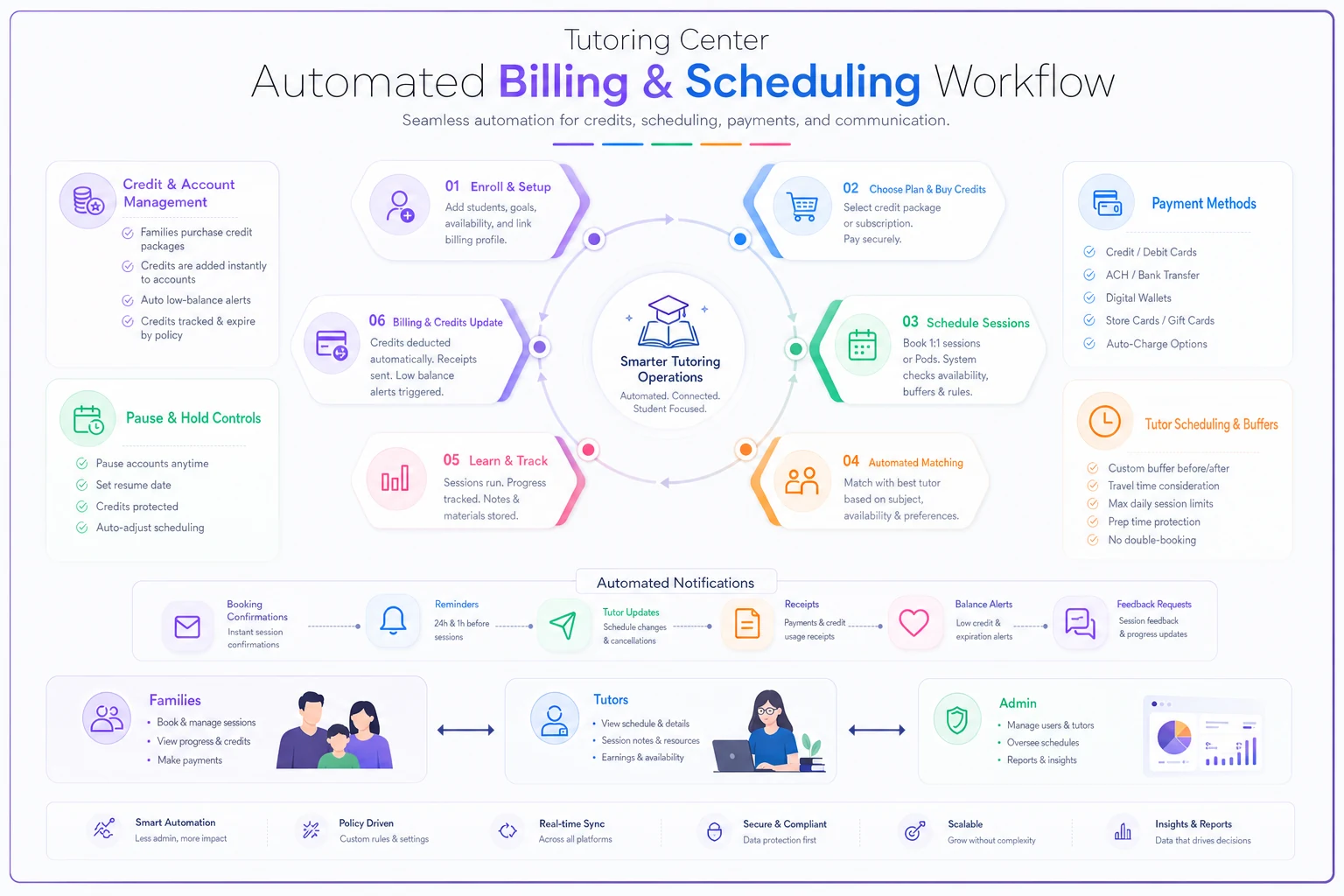
This diagram shows how credits, pauses, pods, and notifications interact across billing, scheduling, and tutor assignments.
The practical difference between manual coordination and automated workflows: roughly 15 hours a week in admin time and meaningfully better retention during volatile stretches like this one.
Revenue protection requires proactive moves, not reactive scrambling
The student loan overhaul isn't a blip—it's a permanent shift in how a lot of families budget for education services. The centers that adapt their operational model now will be in a much better position than those still demanding semester-long commitments and inflexible payment terms six months from now.
-
Email all families announcing "enhanced payment flexibility" (not "financial hardship options")
-
Train staff on pause protocols and retention triggers
-
Set up a study pod formation system
-
Adjust tutor schedules for 70% maximum capacity
-
Add credit-based purchasing as an option
-
Review billing and scheduling systems to confirm they can handle the complexity
Running three business models simultaneously—traditional packages, flexible credits, and group pods—is a real operational burden. There's no way around that.
But centers that made these adjustments in July are holding enrollment flat while more rigid competitors are down 15–20%. Revenue per student might be lower, but retention and referrals are actually holding up because families remember which businesses made things easier during a genuinely stressful period.
The 2026 student loan changes accelerated a shift that was already building. Families want flexibility, transparency, and options. The centers that deliver all three while keeping their operations running efficiently are going to be in a strong position heading into the next few years of growth in tutoring services.
Ready to streamline your tutoring operations?
Join 500+ tutors and centers using Tutoryly to save time, improve scheduling accuracy, and enhance student experiences.